
Atlas vs Covidence (2026): An In-Depth Research Comparison
Atlas is a visual research workspace. Covidence is a systematic-review platform for medical and health research. Compare paper deconstruction and synthesis.
- Byline

Summary
Use Atlas for deep reading and synthesis after screening. Use Covidence for systematic-review workflow management.
The comparison covers cited answers, Knowledge Maps, study exports, forms, and review fit.
Atlas explains how source passages support its answers. Covidence manages screening, extraction, and risk-of-bias workflows.
Atlas keeps each research project focused on its own sources, while Covidence keeps each formal review clean and auditable.
Review teams can run protocol work in Covidence and use Atlas to understand included studies in depth.
Note: We make Atlas. This comparison is written by the team that built it. It is not a neutral third-party review. Where Covidence has the better answer, the article says so. See the rows where Covidence wins and the "When to choose Covidence" section below. The goal is to help you choose between review operations and cited synthesis.
Atlas

Synthesize your included studies in Atlas
Upload included-study PDFs and inspect citations across your review corpus.
Quick verdict
Atlas is a visual research workspace for reading and comparing a set of papers. Covidence is built to run a systematic review. It manages screening, full-text review, data forms, quality checks, and exports.
Atlas makes a Knowledge Map for each paper and a Semantic Map for the whole project. Its cited answers show a claim-source-justification trace: the claim, the source passage, and why that passage supports it. Covidence is strongest for a formal review protocol. Atlas is strongest when you need to compare the included papers and defend the result.
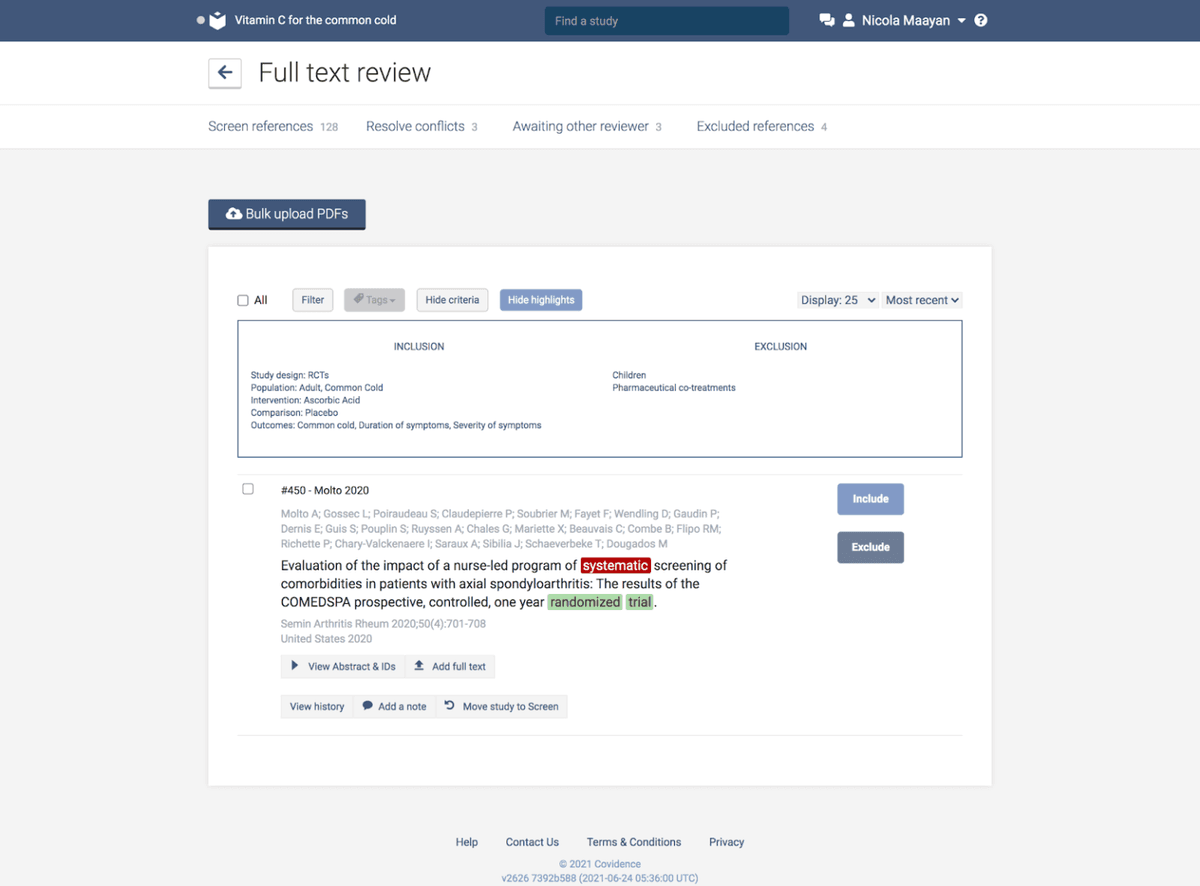
Covidence's official full-text screening guide shows the review surface that Atlas does not replace.
Atlas vs Covidence comparison criteria
Atlas and Covidence live in different categories. Atlas covers close reading, project maps, and cited answers inside a defined research project. Covidence covers screening, forms, quality assessment, and review exports.
The guide to AI systematic-review tools shows where screening platforms sit in the broader stack. The research-synthesis process covers the later reading job Atlas serves.
How we compared the tools
We compared the tools by job. A review team first screens studies. Then it extracts data, checks bias, exports the included papers, reads the papers, and writes the synthesis. A "win" means the product has a real surface for that job. It does not mean the job can be forced into a notes field.
The criteria were citation grounding, Knowledge Maps, screening, extraction forms, risk-of-bias work, included-study migration, and synthesis depth. They match the searcher's real handoff.
Covidence should lead the formal review. Atlas should sit under it when the included PDFs need close reading, maps, and cited answers. Covidence is the better choice when the audit trail itself is the deliverable.
Feature comparison
| Atlas | Covidence |
|---|---|
| Citation grounding: use Atlas when each answer needs claim-source-justification. | Source records: use Covidence when the review file is the source of truth. |
| Knowledge Maps: use Atlas when each included paper needs a visual map. | Screening: use Covidence for full-text screening, votes, and conflicts. |
| Exported form data: use Atlas when CSV data should be cited beside PDFs. | Extraction forms: use Covidence when forms are the main review object. |
| Cited synthesis: use Atlas for close reading and narrative synthesis. | Risk-of-bias workflow: use Covidence when review state must stay structured. |
| ✗ PRISMA flow diagrams and reviewer conflict logs are not Atlas surfaces. | ✓ PRISMA flow diagrams and reviewer conflict logs are supported review-process surfaces. |
Table 1: Atlas and Covidence compared by the main jobs in a formal review handoff.
If your review has reached the included-study stage, test one representative paper first. Run a Knowledge Map, ask a question across the set, and check the cited traces before you move the full review corpus over.
How is Atlas different?
Covidence and Atlas both touch source work. The split is simple. Covidence helps run the review. Atlas helps read and explain the papers after that review has a set of included studies.
Visual maps for papers and projects
Atlas builds 2 visual maps as you read. A Knowledge Map turns 1 paper into claims, evidence, and links. The guide to making a mind map from documents explains that source-to-structure workflow.
A Semantic Map shows the whole project on 1 canvas, where sources, notes, chats, and citations cluster by topic. That is how 200 papers stop being a folder and start being a corpus.
"It's like an ultimate GPT. I can finally see what I've read." Kyle Lao, CEO & Co-founder of MenSC Labs
Covidence does not break each paper into a claim-and-evidence map. It also does not re-map a whole project by topic angle. If you have tried to recover a paper you read three weeks ago, the Knowledge Map is the surface that helps first. Visual maps make a body of papers legible at a glance.
Inspectable claim support
The hard AI research problem is not only that a model may invent text. A tool may also place a citation beside a claim the passage does not support.
Atlas shows each answer as a claim-source-justification trace: the claim, the passage, and why that passage supports it. The AI citation analysis guide provides a rubric for checking that support.
Atlas tracks this with the H/V ratio. It checks whether cited sentences survive a passage-level re-check. Atlas targets H/V < 0.1 on that benchmark, and the verifiable AI research methodology explains the method. Covidence may link to sources, but it is not built around claim-level reasoning. For casual Q&A, that gap may not matter. For a thesis sentence or a brief, it does.
Project-scoped research context
Covidence keeps each review as its own clean container, which protects its audit trail. Atlas also uses project boundaries: sources, notes, chats, maps, summaries, and citations remain inside the project where they were created.
Within that boundary, the same evidence base supports maps, notes, and cited chat without mixing in unrelated work.
The difference is the object model. Covidence tracks review decisions and structured extraction state. Atlas connects research sources to visual maps and cited synthesis inside one project. The guide to organizing research notes shows how that boundary keeps an evidence base focused. Neither tool automatically carries research context into a separate project.
Comparing Atlas and Covidence
The core comparison is a layer split. Covidence is the review operations layer, while Atlas is the reading and synthesis layer.
Covidence should remain the source of truth for reviewer votes, conflicts, exclusion reasons, extraction forms, risk-of-bias state, and PRISMA counts. Atlas becomes useful after the reviewers know which PDFs deserve close reading.
This split also protects the method. A formal systematic review needs stable records that do not shift as a researcher asks new questions. Covidence is built for that stability. A synthesis draft needs passages, claim support, cross-paper questions, and a way to find the argument again later. Atlas is built for that reading loop.
Paper deconstruction with Knowledge Maps
The Knowledge Map is Atlas's per-paper view. It breaks one paper into claims, evidence, and links between them. Node text comes from the paper. It is not a loose summary. You can start with the main claim, then click down to the exact paragraph.
| Atlas | Covidence |
|---|---|
| Multi-level argument structure ✓ | Full-text review with extraction forms |
| Labeled relations (motivates, causes, enables) ✓ | ✗ |
| Faithful-to-source node text ✓ | ✗ |
| Hierarchical breadcrumbs ✓ | ✗ |
| ✗ | PRISMA flow diagram + screening workflow ✓. review-protocol scope only |
Table 2: Knowledge Map coverage compared with Covidence's review-process surfaces.
Good to know: The bottom row belongs to Covidence. Atlas does not ship that surface. A Knowledge Map helps when you need the argument and supporting passages from a paper you read 3 weeks earlier.
Project view with Semantic Maps
The Semantic Map is Atlas's project view. It places sources, notes, chats, and citations on 1 map. Related items cluster by topic. You can switch the topic angle without uploading the files again.
| Atlas | Covidence |
|---|---|
| Spatial embedding of sources + notes + chats ✓ | Review-level dashboards |
| Auto-labeled topic clusters ✓ | ✗ |
| Topic-angle re-projection ✓ | ✗ |
| Project-scoped corpus view ✓ | ✗ |
| ✗ | Team-based screening (two-reviewer agreement) ✓. Covidence owns reviewer votes and conflict checks. |
Table 3: Semantic Map coverage compared with Covidence's team review dashboard.
Good to know: Covidence's strength on that row is real. If your work depends on it, use Covidence. The Semantic Map helps when 200 papers need to act like one corpus instead of one large folder.
Citation-grounded answers
Atlas gives each answer a claim, a source passage, and a short note that explains why the passage supports the claim. You can jump to the source paragraph and check the highlighted text.
| Atlas | Covidence |
|---|---|
| Claim-source-justification triples ✓ | ✗ |
| Reasoning traces (why this passage supports this claim) ✓ | ✗ |
| Jump-to-source with passage highlight ✓ | ✗ |
| H/V ratio < 0.1 benchmark published ✓ | ✗ |
| ✗ | Risk-of-bias assessment templates ✓. Covidence records structured bias judgments for the review file. |
Table 4: Citation-grounding surfaces compared with Covidence's risk-of-bias workflow.
Good to know: Both tools can point to sources. The key question is whether the tool explains why a passage supports a claim. For a thesis sentence or a brief paragraph, that check matters.
Literature-grounded annotations
Atlas marks up each paper when you upload it. Citations inside the paper become objects you can inspect. When a cited source is open, Atlas can pull the useful passage. That lets you see how one paper builds its case from other papers.
| Atlas | Covidence |
|---|---|
| Auto-annotate on ingest ✓ | Per-study extraction forms |
| Multi-citation synthesis (how citations build the argument) ✓ | ✗ |
| Resolve cited sources (open-access) ✓ | ✗ |
| Exact passage / page / paragraph anchors ✓ | ✗ |
| ✗ | Cochrane-aligned extraction templates ✓. Covidence keeps extracted fields consistent across included studies. |
Table 5: Literature annotation surfaces compared with Covidence's extraction templates.
Good to know: These annotations resolve citations inside the paper you are reading. They are not web search. They help show how 1 paper uses the sources it cites.
Project-scoped context
Atlas keeps citations, notes, Knowledge Maps, Semantic Maps, and chats together inside one project. A separate project starts with its own sources and context.
| Atlas | Covidence |
|---|---|
| Project-scoped research context ✓ | Per-review database ✓ |
| Sources + notes + maps + chats share one project ✓ | Review records share one review ✓ |
| Separate projects keep unrelated context isolated ✓ | Separate reviews keep audit trails isolated ✓ |
| Sources must be added to each relevant project | References must be added to each relevant review |
| ✗ | RevMan / GRADEpro export ✓. exports for meta-analysis tools only |
Table 6: Project context compared with Covidence's per-review workflow.
Good to know: Both products use boundaries deliberately. Atlas scopes maps and cited synthesis to a research project. Covidence scopes screening and extraction records to a formal review.
Price comparison
Atlas is a paid product, and there is no free forever plan. The evaluation sample includes 10 sources and 5 lifetime AI chats. After that, Atlas Pro is $20/mo or $204/yr, with Knowledge Map, Semantic Map, cited answers, and project context included.
Covidence's official pricing lists 1 review at $339/year and a 3-review package at $907/year. Organization pricing is quote-based.
| Atlas | Covidence |
|---|---|
| Free: ✗ (evaluation sample only: 10 sources · 5 lifetime AI chats) | Trial: up to 500 records ✓ |
| Pro: $20/mo or $204/yr with unlimited AI chats and unlimited sources | Single: $339/year for one review |
| Knowledge Map, Semantic Map, and claim-source-justification ✓ | Package: $907/year for up to 3 reviews |
Table 7: Atlas and Covidence pricing compared by free access and paid plan scope.
When to choose Atlas or Covidence
- Want paper structure deconstructed multi-level? Go with Atlas. (Knowledge Map)
- Want answers that explain how each citation justifies the claim? Go with Atlas. (claim-source-justification)
- Want maps, notes, and cited chat to share one project context? Go with Atlas.
- Want screening, extraction, and PRISMA flow for medical evidence? Go with Covidence.
- Tied: running a single systematic review where Atlas serves as the deep-reading layer underneath: both work fine. The wedge only opens up once you're building a corpus you'll return to.
Rayyan, Excel, and Systematic Review Toolbox
Covidence is not the only tool in the systematic-review stack. Rayyan is used for screening, while Excel remains a flexible manual option. The Systematic Review Toolbox is a directory for finding review methods and software. Abstrackr is another screening tool.
Zotero, Mendeley, and EndNote
Zotero, Mendeley, and EndNote are reference managers rather than formal review platforms. The Mendeley and Zotero comparison covers that citation-library choice. These surrounding tools help collect and cite studies. Atlas starts after the included PDFs need deep reading and cited synthesis.
RevMan, DistillerSR, and EPPI-Reviewer
RevMan supports structured systematic-review authoring and analysis. DistillerSR is an evidence-management platform for auditable reviews, while EPPI-Reviewer supports systematic reviews, evidence maps, and synthesis. These products compete with Covidence on formal review operations rather than with Atlas's project-scoped reading and citation surfaces.
Recommendations by user type
- PhD researchers: Use both if your field needs formal review records. Keep Covidence for screening and forms. Use Atlas to read the included studies.
- Students writing literature reviews: Use Atlas when the task is a thesis, chapter, or class review. The literature-review writing guide shows where source mapping and cited synthesis support the draft.
- Analysts, PMs, consultants, and journalists: Use Atlas when you need to defend a source-backed claim in a brief or slide. Use Covidence when the deliverable is a formal review audit trail.
- Personal researchers with high stakes: Use Atlas when you need to check each answer against its source. Use Covidence if your real job is review process control.
Covidence is the right system for a formal systematic-review pipeline: screening, exclusion reasons, reviewer agreement, extraction, and PRISMA-style process control. Atlas is the right workspace for deep reading and cited synthesis across the papers themselves.
Keep the review protocol and reviewer workflow in Covidence. Use Atlas when you need to turn the chosen papers into an argument you can inspect and defend.
Migrating from Covidence
Review workflow handoff
Use this handoff after Covidence has completed screening and Atlas is about to support close reading. Freeze the Covidence stage you are handing off, then export the included-study list, RIS file, extraction CSV, and linked PDFs.
Keep the Covidence project as the audit record for screening decisions, conflicts, exclusion reasons, and PRISMA counts. That is the evidence trail a supervisor, co-author, journal, or methods reviewer will expect to inspect.
Next, create an Atlas project for the included PDFs only. Upload the PDFs, let the Knowledge Maps build, and add the extraction CSV as a note if you want the extracted fields to be cited in answers.
The research-paper organizer guide explains how to keep that source set coherent. Ask one narrow synthesis question first and check its claim-source-justification traces before using the answer in prose.
This handoff keeps the boundary clear. Covidence remains the system of record for the formal review. Atlas becomes the reading and synthesis layer for the papers that survived screening.
Covidence owns the protocol trail, while Atlas owns cited close reading after the handoff.
Collaborative reviews need a named handoff owner. The review lead should keep Covidence locked to the method, while the narrative author can own the Atlas project.
If a draft claim depends on an extraction field, cite the pasted CSV note. If it depends on a paper's argument, cite the PDF passage through Atlas. For an exclusion decision, cite Covidence instead.
For solo researchers, the same rule is simpler. Use Covidence when you need a defensible review trail. Use Atlas when the current project's papers need visual maps and cited answers. Do not ask Atlas to recreate reviewer agreement or PRISMA state. Do not ask Covidence to become the project-level map for reading and synthesis.
Exporting Covidence records
Most review groups do not switch from Covidence to Atlas. They add Atlas under the review. Covidence's official guide explains how to export study lists as RIS or CSV, and its extraction documentation covers CSV and Excel exports.
Export the included-study references and retrieve the underlying PDFs through your reference manager or library workflow.
Before moving the complete corpus, compare the exported study count with the PDF folder and confirm that each included record has the expected full text. Keep the original Covidence export beside the Atlas project so later synthesis can be reconciled with the formal review record.
Atlas works from the PDFs. Drop them into a project, and Atlas builds a Knowledge Map for each paper during ingest. If the PDF has a DOI or embedded details, Atlas can pick up the citation data. The RIS row is still useful as a check, but Atlas does not treat a RIS file as the main object.
Some Covidence state should stay in Covidence, including screening tags, reviewer conflicts, form templates, risk-of-bias judgments, and PRISMA counts. Atlas does not model those objects. If you want Atlas to cite form data, export the CSV and paste it into a note inside the Atlas project. Atlas can then treat that note as a source beside the PDFs, while Covidence stays open for structured review fields.
Worked example with 8 papers
Suppose you are writing 1 thesis section from 8 included papers. Upload the 8 PDFs and let each paper finish Knowledge Map processing. You can then open a paper, see its main claim, and click down to the supporting paragraph.
The Semantic Map clusters the 8 papers by topic and lets you switch the topic angle without reading from scratch. Ask where the papers agree and which one offers the strongest counterexample.
Atlas answers with cited claims that each carry a passage and a short reason. You can check the source before drafting.
Covidence is built for a different job. It supports a formal review with 2 reviewers, conflict checks, forms, and a PRISMA output. Atlas supports close reading and prose-ready synthesis. Covidence preserves the formal review record.
When Covidence is the right call
Covidence is the better tool for a formal systematic review or meta-analysis. Choose it for a registered protocol that requires an audit trail and dual screening.
Covidence provides title and abstract screening, full-text screening, conflict checks, audit logs, and PRISMA flow output. It is also better for fixed extraction forms. If every included study needs the same 20 fields, keep that work in Covidence. The same applies to risk-of-bias tables, forest plots, and summary-of-findings work.
Atlas serves the close-reading layer under that review process. Covidence's Cochrane-style review support is the safer choice when a journal or institution expects method conformance. Its documentation shows how the PRISMA flow diagram updates and how reviewers resolve blinded screening conflicts. Atlas does not reproduce those formal-review surfaces.
Where Covidence earns its lead
Covidence's collaboration model is built around independent screening decisions. Its default dual-reviewer mode waits for 2 votes before moving a citation, and a disagreement enters a conflict-resolution queue. That structure protects reviewers from seeing each other's first vote and gives the review lead a specific place to resolve disagreement. Atlas has collaborative research projects, but it does not model blinded votes, exclusion reasons, or screening consensus. Covidence's export surfaces also preserve formal review state through RIS, CSV, Excel, and editable PRISMA records. Atlas can ingest source PDFs and a pasted extraction table for cited analysis, but it cannot recreate the review history behind those exports.
Covidence's interface is purpose-built for repetitive screening. Eligibility criteria, full-text records, reviewer decisions, and conflict state appear in one review surface. That focus matters when hundreds or thousands of citations must move through the same method. Atlas offers the deeper source-reading surface after selection, where Knowledge Maps and cited chat help explain the included studies. For protocol compliance and reviewer accountability, Covidence remains the stronger system of record.
Common objections and edge cases
"I'm in a medical research lab. Won't Atlas break the review method my supervisor expects?" No. The recommended setup is Atlas plus Covidence. Covidence stays as the review platform. Atlas sits underneath as the reading layer. Your supervisor still gets the same review artifacts.
"I tried AI tools before and the citations were wrong. Why is Atlas different?" Atlas is built around a checkable citation surface. Each generated claim carries a passage and a short reason. No AI tool is perfect. The point is that Atlas lets you audit the source quickly.
"My corpus is 500 PDFs. Will the maps hold up?" The Knowledge Map is built per paper. A 500-paper corpus takes longer to ingest than a 50-paper corpus, but ingest runs in the background. You can start with the papers that are ready. Corpus size matters more for the project map and the graph than for one paper's map.
Atlas
Synthesize your included studies in Atlas
Upload included-study PDFs and inspect citations across your review corpus.
Frequently Asked Questions
Atlas is designed around that check. Every answer is rendered as a claim-source-justification triple: the claim, the passage it draws from, and a one-sentence explanation of why the passage supports the claim. You can click into the source paragraph and read the highlighted sentences in context. Covidence may cite at the sentence level or link to sources, but it does not render the reasoning trace that connects the claim to the passage. That trace is the move when you need to defend a thesis sentence, a brief paragraph, or a treatment-plan summary. The verifiable AI research methodology explains how Atlas grounds claims.