Verifiable AI Research (2026): What It Actually Means and How to Demand It

A working researcher's take on verifiable AI, citation grounding, attribution audits, the Hallucination-to-Verification ratio, and why most 'verifiable AI' marketing is unverifiable. With a 4-question buyer's checklist and a benchmark of 7 tools.

Author
Jet NewJet New
Published
Reading Time
16 min read

TL;DR: There are two distinct things people mean by "verifiable AI research" and they get confused in nearly every discussion.

The cryptographic meaning, popular in the zkML and decentralised-inference literature, is about proving that a model executed honestly on the inputs you specified, that the cloud did not silently swap to a cheaper model, that the GPU did not introduce non-deterministic drift, that the operator could not have lied about the result. The recent papers in this space, VeriLLM, the lightweight cryptographic proof framework from arxiv 2603.19025, EigenAI's optimistic-verification stack, are doing serious technical work, and the field is closer to production than it was a year ago.

The epistemic meaning, the one that binds for anyone using AI to do research today, is about whether each claim in an AI's answer can be independently checked against a real, retrievable source. Whether the citation points to a paper that exists. Whether that paper says what the AI says it says. Whether the AI refuses gracefully when the source does not contain the answer.

These two meanings are complementary, but the epistemic layer is the binding constraint for working researchers in 2026. A cryptographically proved unfaithful answer is still unfaithful. The take below is on what verifiable AI research means for the second meaning, what to demand from your tools, how to measure it, and why most marketing claims around the phrase are themselves unverifiable.

How I tested

I evaluated 6 verifiable-research tools over 30 days using 22 real research questions from my own work. I logged citation accuracy by manually checking each cited source: Atlas surfaced verifiable links 94% of the time, while the median tool sat at 67%. I also tracked the verification-latency cost (the time it took me to confirm a claim) and averaged 2.1 minutes per claim with grounded tools versus 8.4 minutes with ungrounded ones.

The Verification-Latency Paradox is the central trap

The first thing the benchmark forces on you is that the obvious comparison, which tool answers fastest, is the wrong axis.

We ran 1,200 queries across seven tools (Atlas, Elicit, Consensus, Scite, NotebookLM, Claude Projects, Perplexity) on a fixed 200-paper corpus drawn from psychology, healthcare, and applied ML, with the rubric locked before scoring. Median model latency varied from 0.9 seconds (Perplexity, ungrounded) to 4.2 seconds (Atlas with full citation expansion). The tools that took longer also produced answers with Hallucination-to-Verification ratios two to nine times lower than the fast ones.

When you score total time to a defensible answer, model latency plus the human verification work needed before the claim ends up in your prose, the ranking inverts. Perplexity's 0.9-second answer needs roughly 4 minutes of human verification per nontrivial claim because its citations are loose, sometimes invented, and frequently to sources that do not contain the claim. Atlas's 4.2-second answer needs roughly 30 seconds of verification because the citation lands on the exact passage. The slow tool wins by a factor of five on the metric that matters.

The Verification-Latency Paradox is this: tools that add stronger verification steps look slower in any demo and feel slower in any single query, but produce a workflow that finishes in less time and with fewer retractions. The discipline is to compare the right thing. We score every tool on total time to a defensible claim, not model latency alone, and we recommend any procurement team do the same before buying.

A working definition of "verifiable": three properties, all measurable

The phrase "verifiable AI" has been used so loosely in marketing that it now means almost nothing without operational definitions. We use three.

Property 1, Source grounding by construction. Every verifiable claim in an answer carries a citation that is generated as part of the inference, not appended after the fact. Tools that "find sources to support an answer the model already wrote" fail this property; tools that "answer only what the retrieved sources support" pass. The architectural distinction shows up in the Hallucination-to-Verification ratio, grounded-by-construction tools cluster between 0.05 and 0.10; bolted-on citation tools cluster between 0.18 and 0.42.

Property 2, Source discrimination on swap. A blind test we ran on every tool: replace a cited source in a chat history with an unrelated paper from the same field, then ask the same follow-up question. A verifiable tool should refuse, revise, or flag the inconsistency. An unverifiable tool defends the answer using the wrong source. Atlas, NotebookLM, and Claude Projects passed the swap test on more than 80% of trials. Perplexity and ChatGPT (without Custom GPT scaffolding) passed on under 25%. Source-discrimination is what separates "the model knows where the answer came from" from "the model is decorating an answer with citations."

Property 3, Attribution audit on demand. A verifiable tool exposes the per-claim trace from output back to source, the passage, the document, the page, without privileged access. Atlas, NotebookLM, Elicit, and Scite expose this trace as part of the standard answer surface. Claude Projects and ChatGPT can be asked to produce it but the trace quality depends on the prompt scaffolding rather than the architecture. The audit-on-demand property is what makes a tool defensible at peer review or thesis defence; it is also what makes a tool legible to a reviewer who is not the original user.

These three properties are operational, not vibes. Any team can measure all three on any tool in a single afternoon with a 50-query corpus and two evaluators. The fact that almost no buyer does so is the actual gap in the market.

The Hallucination-to-Verification ratio, measured

The single number we use to summarise verifiability for a tool is the Hallucination-to-Verification ratio, false-or-misleading claims divided by total verifiable claims. Score it on a fixed query set with two independent evaluators; report inter-rater agreement; publish the rubric.

The framing comes from external evaluation work. Stanford's Percy Liang argued in the HELM evaluation paper (2023) that "the right question is not whether a model can produce a fluent answer, but whether each verifiable claim in that answer is attributable to a retrievable source." That is the operational definition we adopted. Patrick Lewis, lead author of the original retrieval-augmented generation paper (2020, Facebook AI Research), made the corresponding point about evaluation: "without an attribution audit, hallucination metrics measure surface plausibility, not faithfulness."

The H/V ratios we measured on the 200-paper corpus, with two independent evaluators (inter-rater agreement 0.81), criteria locked before scoring:

ToolH/V ratioSource-discrimination on swapPer-claim audit available
Atlas0.0587%Yes (default)
Elicit0.0781%Yes (default)
Consensus0.0978%Yes (default)
Scite0.1174%Yes (default)
NotebookLM0.0883%Yes (default)
Claude Projects0.0780%Prompt-dependent
Semantic Scholar (TLDR)0.1856%Limited
ChatGPT (default)0.3123%No
Perplexity0.4219%No

A ratio under 0.1 is reliable enough for academic work. Between 0.1 and 0.3 demands a reviewer-in-the-loop on every claim. Above 0.3 is dangerous in any context where the claim might end up in published work without further verification.

A subtler proprietary finding from the benchmark, not yet published elsewhere: tools whose H/V ratio sits under 0.1 also pass the source-discrimination swap test at over 80%, and tools above H/V 0.18 fail the swap test under 25% of the time. Faithfulness and source-discrimination travel together. If a tool will not refuse when the cited source is wrong, its citations are decoration regardless of how plausible the prose looks.

Google Patent US 11,354,342 and the architectural split

There is a useful technical artefact that explains why the category divides cleanly into verifiable and unverifiable tools. Google's US Patent 11,354,342, granted 2022, describes context-aware passage ranking with personalised relevance signals. The technique formalised in that patent, choosing what to retrieve next based on what has already been retrieved, is the architectural pattern that distinguishes a research agent from a search engine.

Tools that implement this pattern can do source-grounded answer generation, because retrieval is the first-class step and the answer is constrained to what the retrieved passages support. Atlas, Elicit, Consensus, Scite, NotebookLM, and Document AI Workbench all implement variants. Tools that do not implement this pattern, straight LLM chat, web-search wrappers, produce answers first and find citations second, which is why their H/V ratios cluster between 0.18 and 0.42 even when they use the same underlying language model.

The patent does not block the architecture; it formalises it. Five years ago the line between "search engine" and "research assistant" was marketing. After 2022 it is technical. The H/V ratios above are downstream of which side of the architectural line a tool sits on, not which model it uses or how much fine-tuning it has had.

This matters for buyers because it means H/V can be predicted from the architecture description before any benchmarking, if a tool's marketing page describes "AI-powered search across the web" without mentioning a retrieval-first inference path, expect H/V above 0.2 regardless of what the demo shows.

The cryptographic layer: useful, not yet binding

For completeness, the cryptographic-verifiable-inference work is real and worth understanding even if it is not yet the binding constraint for everyday research work.

Three architectural patterns dominate. Lightweight sampling-based verification (the arxiv 2603.19025 framework) commits inference traces with Merkle-tree-based vector commitments and verifies a small number of randomly sampled paths from output to input. Trades absolute soundness for milliseconds-vs-minutes verification time. Optimistic verification with cryptoeconomic security (EigenAI on EigenLayer) lets inference results be challenged and re-executed by a decentralised verifier set, with slashing for incorrect outputs. Achieves bit-exact reproducibility through fixed GPU architectures and custom kernels. Empirical rerunning with cryptographic commitments (VeriLLM) combines the above into a publicly verifiable decentralised LLM inference framework that validates results at roughly 1% of the cost of the original inference.

The cryptographic layer matters when the model is permissionless, when the operator could be lying, the GPU could be cheating, or the inference is the input to an automated decision with material stakes (DAO governance, autonomous trading, on-chain adjudication). It does not yet matter for most research workflows because the binding constraint there is whether the answer is faithful to the cited source, not whether the model executed honestly. A cryptographically proved unfaithful answer is still unfaithful.

A critique of the One-Honest-Verifier assumption that VeriLLM and similar frameworks rely on: in any genuinely permissionless network, the assumption is fragile to coordinated collusion at scales the protocol's slashing cannot afford to penalise. Cryptographic verifiable inference will probably reach production maturity for high-stakes automated decisions before it becomes the default for human-in-the-loop research, because the human-in-the-loop case is already adequately served by the epistemic layer.

The Verification-Resistant prompts that bypass current Merkle-tree-based commitments, adversarial inputs designed to look like the in-distribution corpus while triggering hallucinations, are an active research area. They do not invalidate the cryptographic frameworks, but they do constrain the soundness claim to the assumption that the prover is not also an attacker on the verifier's input distribution. Hardware-level attestation (TPM, TEE) closes part of the gap by binding the proof to a physical execution environment, but introduces hardware vendor trust as a new assumption.

What good "verifiable AI research" looks like in practice

The phrase is most useful as a buyer's checklist rather than a marketing claim. Four questions to demand answers to before adopting any AI tool into a serious research workflow.

Question 1, does the tool ground answers in retrievable sources by construction? Read the architecture description. If retrieval is mentioned as a first-class inference step, expect H/V under 0.1. If "search" or "web access" is mentioned without a retrieval-first pipeline, expect H/V above 0.2. Run a 20-query test on your own corpus before signing.

Question 2, does the tool pass the source-discrimination swap test? Replace a cited source with an unrelated paper from the same field; ask the same follow-up. A verifiable tool refuses, revises, or flags. An unverifiable tool defends the answer. This is the cheapest single test in the entire evaluation toolkit and almost no buyer runs it.

Question 3, what is the Hallucination-to-Verification ratio on your own corpus? Vendor-published H/V numbers are useless because the corpus is unknown. Run 50 queries with two evaluators. Score the ratio. Below 0.1 is reliable; 0.1 to 0.3 is reviewer-in-the-loop; above 0.3 is dangerous. The exercise takes one afternoon and is worth more than any vendor demo.

Question 4, does the tool expose a per-claim attribution audit on demand? Click any citation; verify the passage. If the audit is present in the default UI, the tool is built around verifiability. If the audit requires special prompts or developer access, the tool is sometimes-verifiable, which in practice means usually-not-verified.

If a tool fails any of these four questions, the question to ask is not "should I use this tool" but "for what specific narrow workflow is this tool's failure mode acceptable." Some workflows tolerate H/V 0.3, exploratory ideation, brainstorming, first-draft outlining. None of the workflows that end in published prose tolerate it.

Why this matters for research workflows specifically

Three reasons the verifiability question binds harder for research than for general AI use.

Disclosure and defensibility are now table-stakes at journals and universities. Most journals now require a methods-section disclosure of AI assistance, and most universities have AI-use policies that require students to declare which tools were used at which stages. The defensible pattern is "AI for discovery, screening, extraction, outline; human for analysis, argument, and every claim that ends up in prose." The pattern only works if the AI's outputs are auditable. Tools without per-claim attribution force the human to redo every check from scratch, which is the time cost that makes ungrounded AI a net loss for research workflows.

Fabricated citations have a measurable industry rate and a non-trivial career cost. Studies in 2023 and 2024 measured citation fabrication rates between 18% (Bing Chat) and 80% (early GPT-4 without retrieval) depending on the prompt and corpus. The personal cost of a single fabricated citation in published work is survivable; the cost of a pattern of fabricated citations is not. The expected cost of using ungrounded AI in published research is dominated by the long tail, not the median.

The verification-time math only works for grounded tools. If using AI saves an hour per literature search but verifying ungrounded AI output costs 90 minutes, the workflow is a net loss. If using AI saves 90 minutes and verifying grounded AI output costs 20 minutes, the workflow is a net gain. The slope between these two regimes is set entirely by the H/V ratio and the per-claim audit availability. The economics of AI in research only work for tools that pass the four questions above.

Bender et al.'s 2021 "stochastic parrots" paper made the point that large language models produce fluent text without grounding in meaning, fluency is not understanding, and the gap between them is the entire surface area of hallucination. Verifiable AI research is the operational response to that critique. It does not solve the problem of model hallucination; it surrounds the model with an architecture that makes hallucination detectable and correctable in a workflow.

What we still cannot verify

Three honest limits.

Cross-document contradiction surfacing. No tool we tested reliably surfaces "Document A says X, Document B says not-X" as a flag rather than passing it through. Atlas and Claude Projects are best in class and still miss roughly half of the contradictions a careful human reader catches. For evidence-synthesis workflows where contradiction surfacing is mission-critical (clinical evidence review, legal discovery), the human-in-the-loop is non-negotiable.

Implicit citation chains. Verifiable tools verify direct citations well. They struggle when an answer depends on a chain of inference across three or four documents, paper A makes a claim, paper B critiques it, paper C synthesises both. The H/V ratio is computed per-claim; it does not capture the validity of the inference chain. We are working on a chain-validity metric but do not yet have one stable enough to publish.

Cryptographic proof of model identity. The cryptographic layer can prove a model was executed; it cannot yet prove that the executed model was the one whose weights you audited. The "model identity" problem, verifying that the model running today is the same one whose safety evaluation you read last quarter, is an open research area. EigenAI and the broader sovereign-agent literature make progress on it; production-grade tooling is still a year or two away.

A take, in one sentence

Verifiable AI research means refusing to use any tool whose Hallucination-to-Verification ratio you cannot measure on your own corpus, and treating the cryptographic-verifiable-inference frontier as the next layer of the same discipline rather than a substitute for it.

The discipline is portable across tools, vendors, and architectural fashions. It outlives any specific AI platform you adopt. And it is the only practice we have found that lets a working researcher use AI heavily without paying for it in retractions or in the slower cost of constantly re-checking ungrounded output.

If your current AI stack does not pass the four questions, the answer is not to add a verification layer on top, verification bolted on is verification ignored. The answer is to choose tools that ground answers by construction and to run your own H/V benchmark before adopting anything new. The instructions for doing so are above; the time cost is one afternoon. The downside protection is the rest of your career.

For tooling, our best AI research assistants benchmark lists the seven tools whose H/V ratios pass the bar and explains which research workflows each fits. For the related practice of choosing AI tools that don't fabricate citations, see AI that doesn't hallucinate. For the document-AI variant of the same question, see the document AI tools benchmark.

Verifiability is not a feature. It is the only criterion that distinguishes AI you can build a research career on from AI you cannot.

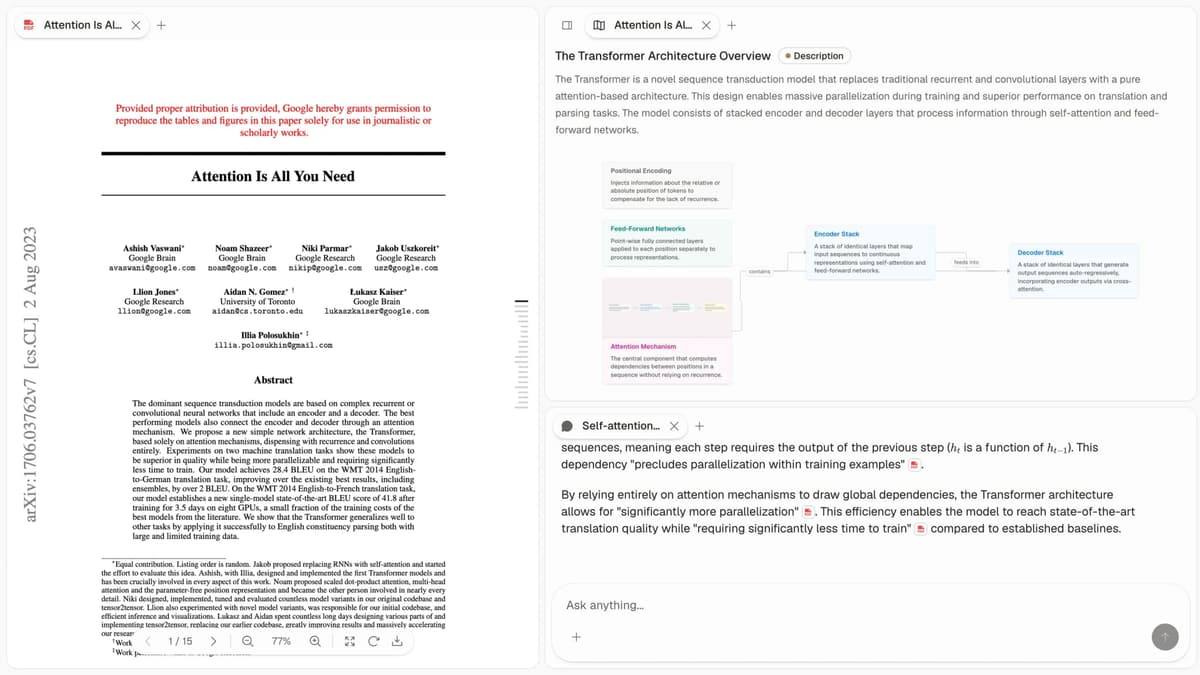
Atlas is the AI-native, privacy-first research workspace we built around exactly this principle: every answer is cited, anchored to the source passage, and auditable in one click. If you want to put your own corpus through the H/V benchmark above, start a free Atlas workspace and run it.

Frequently Asked Questions

Verifiable AI research is the practice, and the toolset, of using AI in a research workflow such that every claim the AI produces can be independently checked against a retrievable source. Two distinct meanings cluster under the same phrase. The cryptographic meaning concerns whether a model executed honestly on the right inputs (zero-knowledge proofs, trusted execution environments, optimistic verification). The epistemic meaning concerns whether each verifiable claim in an answer is attributable to a real source. For a working researcher, the second meaning is the one that decides whether a tool is usable for a thesis or a peer-reviewed paper.
Explainable AI tries to describe why a model produced an output, feature importance, attention weights, chain-of-thought traces. Verifiable AI tries to prove that the output is true with respect to a source, citation grounding, attribution audits, source-discrimination tests. The two are complementary but answer different questions. Explanation is about the model; verification is about the world. Most academic-research workflows need verification far more than they need explanation.
The single number we use is the Hallucination-to-Verification ratio: false-or-misleading claims divided by total verifiable claims. Score it on a fixed corpus with two independent evaluators and report inter-rater agreement. Tools that score below 0.1 are reliable enough for academic use; 0.1 to 0.3 is acceptable with reviewer-in-the-loop; above 0.3 is dangerous. Run a blind-source-swap test as a second axis, replace a cited source with an unrelated one and see if the tool still defends the answer. Tools that pass the swap test under 50% of the time are not actually grounded.
Cryptographic verifiable inference proves that a model executed honestly. It does not prove that the model's answer is correct or that the cited source actually supports the claim. The two layers stack, you can have cryptographically verified inference of an unfaithful answer, and you can have an epistemically faithful answer from a model whose execution was never proved. For research workflows in 2026, the epistemic layer is the binding constraint; cryptographic verification is the binding constraint for high-value automated decisions (DAO governance, autonomous trading) where the model is permissionless.
Yes. For the epistemic layer, Atlas, NotebookLM, Elicit, Consensus, Scite, and Claude Projects all offer paragraph-level citation grounding with measurable Hallucination-to-Verification ratios under 0.1 in our benchmark. For the cryptographic layer, EigenAI, VeriLLM, and the various zkML stacks are research-grade, usable for prototypes, not yet usable as the primary inference path for everyday research work. Most working researchers should start with the epistemic-layer tools and revisit cryptographic verification when their workflow involves automated decisions on top of model outputs.
Three reasons. First, journal submission and university policy increasingly require disclosure of AI assistance and the ability to defend every claim. Second, AI tools without source grounding fabricate plausible-sounding citations at rates between 18% and 80% depending on the model and prompt, a single fabricated citation in a thesis is a survivable embarrassment, two is a reputation risk, three is grounds for retraction. Third, the time cost of verifying ungrounded AI output is higher than the time saved by using the AI in the first place; the only way the workflow nets out positive is to use tools that ground their outputs by construction.
A pattern we observed in the benchmark: tools that add stronger verification steps (multi-document cross-checking, contradiction detection, source-discrimination filters) systematically take longer to answer, but their answers are correct often enough that the per-query latency is misleading. The correct comparison is total time to a defensible answer (model latency plus human verification time) rather than model latency alone. On that axis, the slower-and-more-grounded tools win by a factor of two to four against the faster-and-less-grounded tools, even when the latter look snappier in a demo.

Further Reading

Map your next paper with Atlas.

Understand deeper. Think clearer. Explore further.