
Research & Synthesis18 min read

7 AI Research Tools That Don't Hallucinate (2026)

Compare 7 AI research tools that don't hallucinate. Source-grounded answers with verified citations from Atlas, Elicit, Consensus, Scite, and more.

By Jet New

If you have ever asked ChatGPT for a citation and received a convincing-sounding paper that does not exist, you understand the hallucination problem. According to a 2024 study published in Nature, large language models fabricate citations in roughly 36% of generated references when asked to provide academic sources. AI models generate plausible text, not verified facts. They invent author names, fabricate journal titles, and present fiction as research.

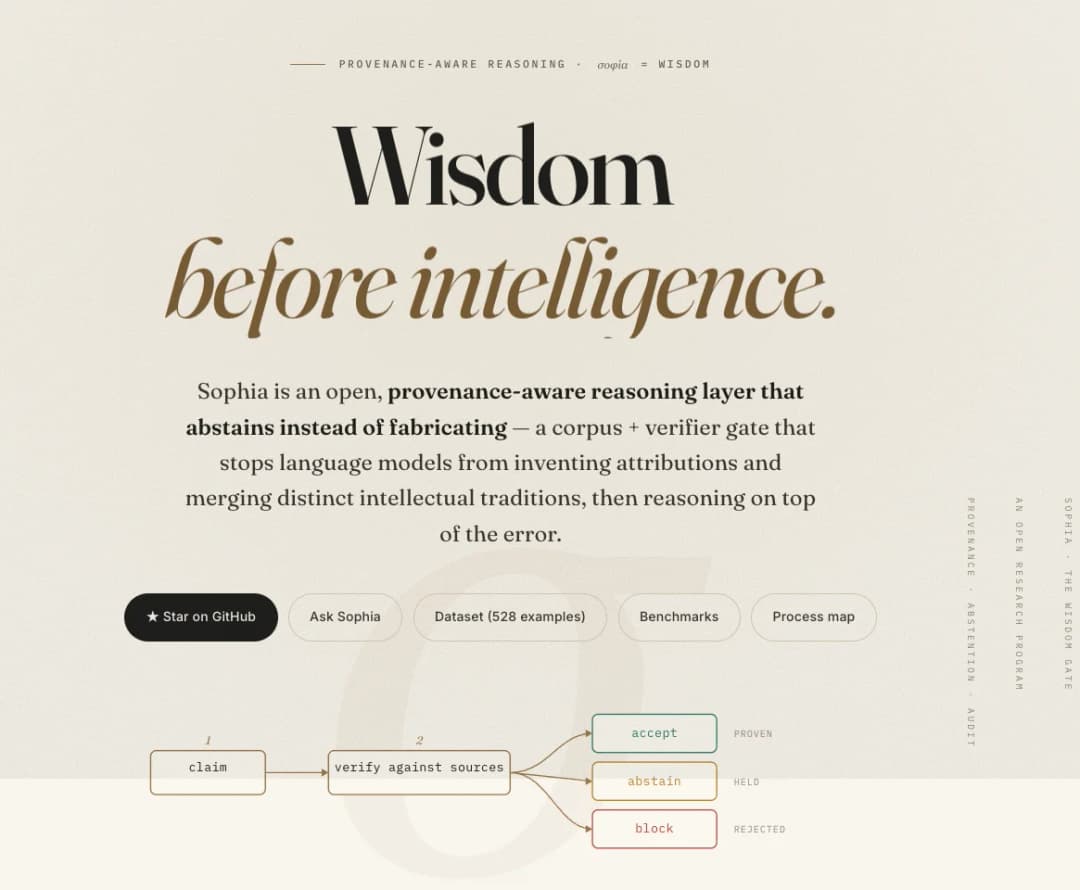
For anyone doing serious work, an AI research tool that does not hallucinate is not a nice-to-have. It is a requirement. Every fabricated citation that slips into a draft is a credibility risk you carry forward, one that can undermine months of careful research. The good news: a growing category of source-grounded tools solves this problem by anchoring every response to real, verifiable documents.

This guide compares seven AI research tools designed to minimize or eliminate hallucinations, so you can find the one that fits your research workflow.

Why AI Hallucinations Happen (And Why They Matter)

Standard large language models like ChatGPT generate responses by predicting the most likely next word based on patterns in their training data. They do not look up facts, verify claims, or check whether a citation exists. They produce text that sounds correct.

This creates specific problems for researchers:

  • Fabricated citations: ChatGPT regularly invents paper titles, authors, and journal names that look real but are made up
  • Confident misinformation: AI can present incorrect claims with the same confident tone as accurate ones, making errors hard to spot
  • Outdated data: Training data cutoffs mean models may cite superseded findings or miss recent research
  • Context distortion: Even when referencing real papers, AI can misrepresent what a study found

The consequences range from embarrassment (citing a paper that does not exist) to serious academic integrity issues (building arguments on fabricated evidence). A 2024 survey by Nature found that a majority of researchers who used general-purpose AI tools had encountered at least one fabricated reference. Separately, a 2024 Pew Research Center survey found that only 29% of U.S. adults have a great deal or fair amount of trust in AI-generated information, underscoring how little confidence the public places in unverified AI output. The problem is not rare.

What to Look For in Hallucination-Free AI Tools

No AI tool can guarantee zero hallucinations. But the best tools reduce the risk by orders of magnitude through specific architectural choices. According to Stanford's 2024 AI Index Report, retrieval-augmented generation (RAG) systems reduce factual error rates by up to 50% compared to standalone large language models when answering knowledge-intensive questions. Here is what to evaluate.

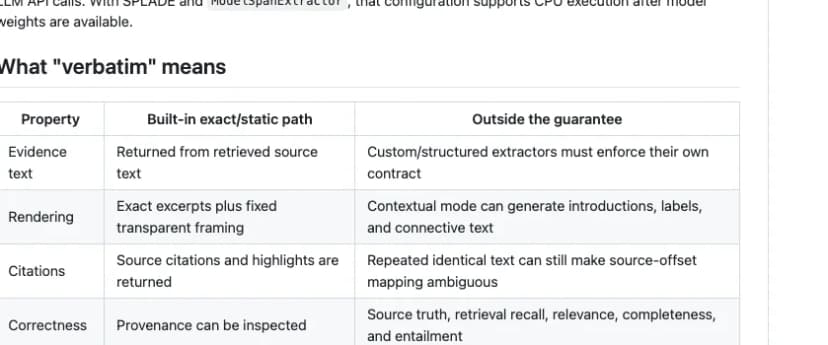
Source grounding. The most important factor. Does the tool answer from specific, identifiable documents rather than from general training data? Tools that use retrieval-augmented generation (RAG) pull relevant passages from real sources before generating a response. This grounds the output in actual text rather than statistical patterns.

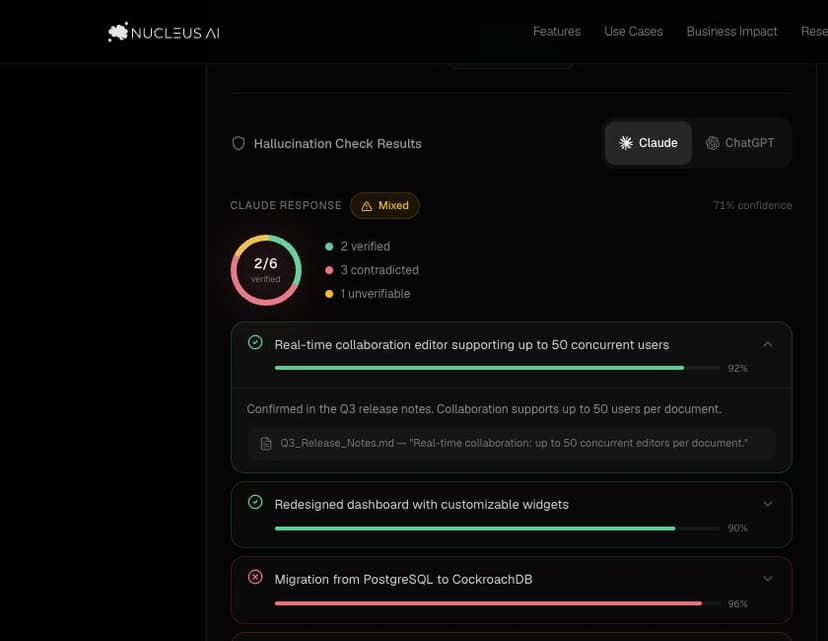
Citation verification. Does the tool check whether the references it provides exist? Some tools cross-reference against academic databases. Others cite only from sources you upload, eliminating the possibility of fabricated references. For a detailed comparison of tools that handle citation management alongside verification, see our guide to the best citation tools for research.

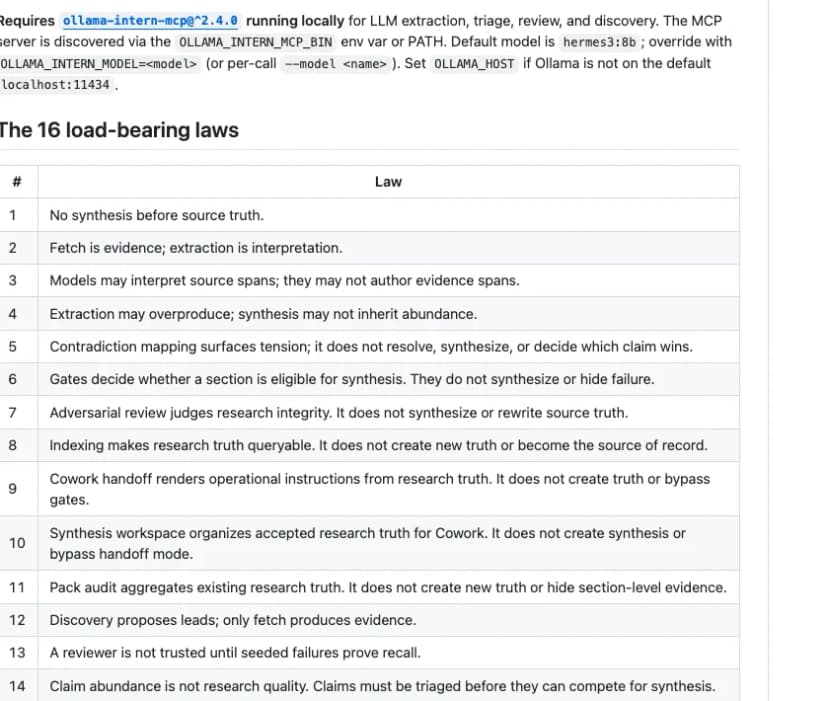
Transparency and traceability. Can you trace any claim back to its source? The best tools show you the exact passage a response draws from, not just a paper title or URL. This lets you verify whether the AI interpreted the source correctly.

Scope limitation. Tools that restrict their answers to a defined corpus (your uploaded documents, a curated database of peer-reviewed papers) are less likely to hallucinate than tools that draw from the open web. The tradeoff is breadth for accuracy.

Confidence indicators. Some tools flag when they are less certain about an answer or when the available sources do not fully address your question. This honesty is more useful than false confidence.

Source type. Consider what kind of sources the tool draws from. Peer-reviewed papers are the gold standard for academic work. Web sources can be useful for general research but vary in reliability. Your own uploaded documents give you full control over source quality.

Top 7 AI Research Tools That Don't Hallucinate

1. Atlas: Best for Source-Grounded Research Synthesis

Best for: Researchers who need AI answers grounded in their own curated sources

Atlas takes a different approach to the hallucination problem. Instead of searching the web or a public database, Atlas works with the sources you upload. PDFs, articles, web pages, and notes become the knowledge base that the AI draws from. Every answer cites specific passages from your documents. Trusted by students and researchers at top universities, Atlas is a knowledge workspace where the AI can only reference what you have provided.

How it prevents hallucinations:

  • AI responses are grounded only in your uploaded sources
  • Every claim includes inline citations linking to specific passages in your documents
  • The AI cannot fabricate references because it can only cite what you have provided
  • Mind maps visualize connections between real sources, not AI-generated associations

Key features:

  • Upload PDFs, save websites, and build a personal research library
  • Ask questions across all your sources and get cited answers
  • Mind map generation that shows how concepts connect across your documents
  • AI autocomplete for notes, grounded in your existing knowledge base
  • Cross-source synthesis with full attribution

Grounding method: Source-anchored AI. Atlas uses your uploaded documents as the sole knowledge base for AI responses. This means the AI cannot invent sources or cite papers that do not exist in your library. As one researcher described it: "Atlas has been a real time-saver for me. I just needed a tool to help me wade through the sea of articles I come across daily." (Walter Tay, Founder, BookSlice)

Pricing: Free tier available, Pro from $12/month

Limitations: Because Atlas grounds answers in your uploaded documents, the quality of its responses depends on the quality and completeness of your source library. If you have not uploaded a relevant paper, the AI will not reference it. For initial paper discovery, pair Atlas with a platform like Semantic Scholar.

2. Scite: Best for Citation Verification

Best for: Researchers who need to understand how papers cite each other and whether findings have been supported or challenged

Scite has built a database of over 1.5 billion citation statements, each classified as supporting, contrasting, or mentioning. This tells you not just that Paper A cites Paper B, but whether Paper A confirms or contradicts Paper B's findings.

How it prevents hallucinations:

  • All data comes from a database of real citation statements extracted from published papers
  • Smart Citations are verified against actual paper text
  • The AI assistant answers based on citation data, not general knowledge
  • You can trace any claim to the specific citation statement in the original paper

Key features:

  • Smart Citations: see whether a citation supports, contrasts, or merely mentions a finding
  • 1.5B+ citation statements indexed from published literature
  • AI assistant that answers questions grounded in citation data
  • Reference check tool that analyzes the citations in your manuscript
  • Browser extension for checking citations while reading

Grounding method: Citation database. Scite's responses draw from its indexed database of real citation relationships between published papers.

Pricing: Free trial, from $12/month for individuals, student discounts available

Limitations: Scite is specialized in citation analysis. It does not help you upload and analyze your own documents or synthesize findings across papers. It works best as a verification layer alongside other research tools.

3. Elicit: Best for Paper-Verified Literature Review

Best for: Academics conducting literature reviews who need answers grounded in actual papers

Elicit searches a database of 125M+ academic papers and provides answers extracted directly from those papers. Its extraction feature pulls specific data points (methods, outcomes, sample sizes) from each paper, giving you verifiable data rather than AI-generated summaries. See our Elicit alternatives comparison for more options.

How it prevents hallucinations:

  • Searches a database of real academic papers, not the open web
  • Extracted data points link directly to the source paper
  • Structured tables show which paper each data point comes from
  • Research questions return papers, not AI-generated answers

Key features:

  • Semantic search across 125M+ academic papers
  • Structured data extraction with source attribution
  • Bulk analysis with custom columns (methodology, sample size, findings)
  • Export with full citation data
  • Systematic review workflow support

Grounding method: Paper-verified extraction. Elicit pulls data directly from academic papers and attributes each data point to its source.

Pricing: Free tier (5,000 credits/month), Plus from $12/month

Limitations: Elicit is focused on academic papers. It does not work with your own uploaded documents, web content, or non-academic sources. It is also better at extraction than synthesis. You get structured data from individual papers but limited help connecting findings across them.

4. Consensus: Best for Peer-Reviewed Evidence Synthesis

Best for: Researchers who need evidence-based answers from peer-reviewed literature only

Consensus takes the strictest approach to source quality: it searches only peer-reviewed academic papers and never draws from web content. Ask a question, and it shows you what the published research says, including a Consensus Meter that indicates whether studies agree or disagree.

How it prevents hallucinations:

  • Only searches and cites peer-reviewed papers
  • Consensus Meter shows actual research agreement, not AI-generated opinions
  • Every answer links to the specific studies it draws from
  • No web content mixed in with academic sources

Key features:

  • Ask research questions in plain language
  • Consensus Meter showing yes/no/mixed agreement across studies
  • Filter by study type (randomized controlled trials, meta-analyses, etc.)
  • Direct links to studies on publisher sites
  • Copilot feature for deeper analysis of specific topics

Grounding method: Peer-reviewed only. Consensus restricts its knowledge base to published, peer-reviewed academic papers.

Pricing: Free tier available, Premium from $8.99/month

Limitations: Consensus works best for questions with empirical answers. It is less useful for theoretical questions, exploratory research, or topics where the question itself needs refining. The Consensus Meter can also be misleading for questions where study quality varies widely.

Best for: Researchers who want free, AI-powered paper discovery grounded in a verified academic database

Semantic Scholar, from the Allen Institute for AI, provides AI features built on top of a verified database of 200M+ academic papers. Its TLDR summaries are derived from the actual paper text, and its citation context shows real citation relationships.

How it prevents hallucinations:

  • TLDR summaries are generated from actual paper abstracts and content
  • Citation context is extracted from real papers, not generated
  • All results are published academic papers with verified metadata
  • No generative answers from general knowledge

Key features:

  • TLDR: one-sentence AI summaries derived from paper text
  • Citation context showing how papers reference each other
  • Research alerts for new papers in your area
  • Influence scores and citation metrics
  • Free with open API

Grounding method: Database-derived. All AI features draw from the indexed content of real academic papers.

Pricing: Free

Limitations: Semantic Scholar is a discovery and browsing platform, not a research workspace. You cannot upload your own documents, take notes, or synthesize findings within the platform. The TLDR summaries are helpful for screening but no substitute for reading the actual papers.

6. Perplexity: Best for Web-Cited General Research

Best for: Professionals and students who need quick answers with traceable web sources

Perplexity functions as an AI search engine that cites every claim. It searches the web in real time and provides numbered inline citations so you can verify where each piece of information comes from.

How it reduces hallucinations:

  • Real-time web search grounds responses in current sources
  • Numbered inline citations [1], [2], [3] link to specific web pages
  • You can click through to verify any claim
  • Focus modes allow you to restrict searches to academic sources

Key features:

  • Natural language search with inline citations
  • Pro Search for multi-step research with deeper analysis
  • Focus modes (Academic, YouTube, Reddit, Writing)
  • Collections for organizing research threads
  • Source quality indicators

Grounding method: Web-cited. Perplexity searches the web and cites the pages it finds, though it still generates text that can sometimes misrepresent sources.

Pricing: Free tier available, Pro $20/month

Limitations: Perplexity's citations come from the open web, which means source quality varies. It can cite blog posts with the same formatting as peer-reviewed papers. It also sometimes misrepresents what a cited source says, a subtler form of hallucination that requires careful verification. For academic work, Consensus or Elicit provide more reliable sourcing.

7. ResearchRabbit: Best for Citation Network Discovery

Best for: Researchers exploring a new field who want to discover papers through verified citation networks

ResearchRabbit avoids the hallucination problem by taking a different approach entirely. Instead of generating answers, it maps citation networks. Add a few seed papers, and it shows you papers that cite your seeds, papers your seeds cite, and related work, all based on real citation data.

How it prevents hallucinations:

  • Does not generate text or make claims
  • All connections are based on verified citation relationships
  • Paper recommendations come from citation network analysis, not AI generation
  • No fabricated references because it only shows papers that exist in academic databases

Key features:

  • Visual citation network mapping from seed papers
  • "Similar Work" and "All References" exploration
  • Author network visualization
  • Zotero integration for easy library management
  • Free
  • Research timeline showing field evolution

Grounding method: Citation network. ResearchRabbit uses verified citation relationships between papers rather than generating claims.

Pricing: Free

Limitations: ResearchRabbit does not answer questions or synthesize findings. It is a discovery tool that shows you related papers through citation connections. You still need to read the papers and draw your own conclusions. It also requires seed papers to start, so you need some initial foothold in the literature.

Comparison Table

PlatformGrounding MethodSource TypeHallucination RiskFree TierBest Use Case
AtlasSource-anchored AIYour documents + papersVery LowYesResearch synthesis
SciteCitation database1.5B+ citation statementsVery LowLimitedCitation verification
ElicitPaper-verifiedAcademic papers (125M+)LowYes (5,000 credits/mo)Literature review
ConsensusPeer-reviewed onlyPeer-reviewed journalsVery LowYesEvidence-based answers
Semantic ScholarDatabase-derivedAcademic papers (200M+)LowYes (fully free)Paper discovery
PerplexityWeb-citedWeb + academicMediumYesGeneral research
ResearchRabbitCitation networkAcademic papersVery Low (no generation)Yes (fully free)Network discovery

How to Choose the Right Tool

The right AI research tool depends on your sources, your use case, and how much verification you are willing to do. If you have already spent time collecting and reading papers, the question becomes: are you getting full value from those sources, or are insights slipping through the gaps between your reading notes and your memory?

If you work with your own documents: Atlas is the strongest choice. It grounds every answer in your uploaded sources, so the AI can only cite what you have provided. This gives you maximum control over source quality. And because the context compounds as you add more sources, your knowledge workspace becomes more useful over time rather than more cluttered.

If you need citation verification: Scite shows you how papers cite each other, including whether subsequent research supports or contradicts a finding. This is valuable for checking whether a paper's claims hold up.

If you are doing a structured literature review: Elicit's semantic search and structured extraction give you verifiable data from academic papers, organized in a way that makes systematic comparison straightforward.

If you want only peer-reviewed evidence: Consensus restricts itself to published academic research, making it the safest choice for questions that need evidence-based answers.

If you need free paper discovery: Semantic Scholar covers 200M+ papers with no usage limits. Its AI features are derived from real paper content, not generated from general knowledge.

If you need quick web-sourced answers: Perplexity provides citations but requires more careful verification since it draws from the open web.

If you want to explore citation networks: ResearchRabbit maps real citation relationships without generating any text, making hallucination impossible.

For most researchers, the best approach is combining a grounded synthesis tool (like Atlas) with a discovery tool (like Semantic Scholar or Elicit). This covers both the finding and the sense-making phases of research. For broader comparisons, see our guides on AI tools with references you can verify, AI that cites sources, and the best AI research assistants.

FAQs

Why do AI tools hallucinate citations?

Standard large language models generate text by predicting the most likely next words, not by looking up facts. When asked for a citation, the model generates a plausible-sounding author name, paper title, and journal, because that is the pattern it has learned. It is not searching a database or verifying that the reference exists. This is why the fabricated citations often look convincing: they follow the correct format and use realistic-sounding names and titles. Source-grounded tools solve this by retrieving real documents before generating a response, so the AI cites actual text rather than invented references.

Can any AI tool guarantee zero hallucinations?

No. Even source-grounded tools can occasionally misinterpret a passage, take a quote out of context, or miss the nuance of a complex argument. The goal is not zero hallucinations but a large reduction in hallucination risk combined with the ability to verify every claim. Tools like Atlas and Scite make verification easy by linking directly to the source passage. The practical standard is: can you trace and check every claim the AI makes? If yes, the occasional error is catchable. If no, you are building on a foundation you cannot inspect.

What is retrieval-augmented generation (RAG) and why does it matter?

RAG is the architecture that makes source-grounded AI possible. Instead of relying solely on what it learned during training, a RAG system first retrieves relevant passages from a specific document collection, then generates its response based on those retrieved passages. This means the AI's response is anchored in real text, not patterns from training data. Atlas, Elicit, and Consensus all use forms of RAG. The key benefit for researchers is that you can trace any claim back to the specific document and passage it came from.

How do I verify AI-generated references?

Follow these steps for any AI-provided reference: First, check that the paper exists by searching for the title in Google Scholar or Semantic Scholar. Second, confirm the authors and publication details match. Third, read the relevant section of the actual paper to verify that it says what the AI claims. Fourth, check the publication date to ensure the information is current. Source-grounded tools like Atlas make this easier because they link directly to the passage in your uploaded document, but you should still verify that the AI's interpretation matches your own reading.

Are source-grounded AI tools accurate enough for academic publishing?

Source-grounded tools are accurate enough to accelerate your research, but they are not a substitute for your own careful reading and analysis. Use them to find relevant information quickly, identify connections across sources, and generate starting points for your writing. Then verify the key claims against the original sources and apply your own analytical judgment. Most academic integrity guidelines treat AI as a research aid, similar to a database search or a citation manager. The important thing is that your analysis, interpretation, and argument are your own. For more on AI for literature review workflows, see our dedicated guide.

What is the difference between AI hallucination and AI confabulation?

In practice, the terms are used interchangeably in the AI field. Both refer to AI generating false information with apparent confidence. Some researchers prefer "confabulation" because it describes the process more accurately: the AI is not lying on purpose but filling in gaps in its knowledge with plausible-sounding content, similar to how memory confabulation works in psychology. For practical purposes, the distinction does not matter much. What matters is whether the tool gives you a way to verify its claims against real sources.

Conclusion

The hallucination problem is real, but it is solvable. The key is choosing tools that ground their responses in verifiable sources rather than relying on general training data.

For different research needs:

  • Source-grounded synthesis: Atlas anchors every answer to your uploaded documents
  • Citation verification: Scite shows whether research supports or contradicts specific claims
  • Structured literature review: Elicit extracts verifiable data from academic papers
  • Evidence-based answers: Consensus searches only peer-reviewed research
  • Free discovery: Semantic Scholar provides AI features built on a verified paper database

The common thread is traceability. The best AI research tools do not just give you answers. They show you where those answers come from. Without that traceability, you are trusting the AI's confidence rather than its evidence.

Ready to try AI research you can trust? Try Atlas free to upload your sources and get cited answers grounded in your actual documents, not fabricated references. Loved by thousands globally, it is the knowledge workspace where every claim has a source you can check.

Frequently Asked Questions

Standard large language models generate text by predicting the most likely next words, not by looking up facts. When asked for a citation, the model generates a plausible-sounding author name, paper title, and journal because that is the pattern it has learned. Source-grounded tools solve this by retrieving real documents before generating a response, so the AI cites actual text rather than invented references.
No. Even source-grounded tools can occasionally misinterpret a passage or take a quote out of context. The goal is not zero hallucinations but a large reduction in risk combined with the ability to verify every claim. Tools like Atlas and Scite make verification easy by linking directly to the source passage.
RAG is the architecture that makes source-grounded AI possible. Instead of relying solely on training data, a RAG system first retrieves relevant passages from a specific document collection, then generates its response based on those passages. This anchors the AI response in real text. Atlas, Elicit, and Consensus all use forms of RAG.
Check that the paper exists by searching for the title in Google Scholar or Semantic Scholar. Confirm the authors and publication details match. Read the relevant section to verify it says what the AI claims. Check the publication date. Source-grounded tools like Atlas make this easier because they link directly to the passage in your uploaded document.

Continue Exploring

Ready to build your knowledge system?

Atlas helps you capture, connect, and retrieve knowledge with AI. Turn information overload into a personal advantage.

Try Atlas Free

More from the journal