
ChatGPT Alternatives (2026): 10 Best AI Tools Compared
Best ChatGPT alternatives: 10 AI tools compared for research, writing, coding and search, with free vs paid options including Atlas, Claude and NotebookLM.
- Byline

Summary
The best ChatGPT alternative depends on the task, with Atlas, Claude, Gemini, Perplexity, NotebookLM, Copilot, Mistral, Llama, DeepSeek, and Grok covering different workflows.
The updated guide compares free tiers, research, coding, long-document reasoning, live web search, local models, privacy, and paid plans.
Consider Atlas for paper reading with citation explanations and annotations, NotebookLM for study notebooks, and Perplexity for web research.
The right replacement depends on whether you need citations, local privacy, coding support, image tools, or general assistant coverage.
By Jet New, Atlas editor. We make Atlas, one of the products in this guide.
Choose a ChatGPT alternative for the task you need to complete: reading papers, editing code, searching the web, working in office apps or running a model locally. The right choice depends on the features you will use and the limits you can accept.
This guide compares 10 alternatives across writing, research, coding, search and daily chat. Each entry covers its intended use, limitations and price.
Consider Atlas when paper reading needs citation explanations, passage selection and PDF annotations. NotebookLM suits a notebook of study sources and audio overviews. Keep a general assistant for writing or coding, and consider local models when you need control over where inference runs.
For narrower matchups, see NotebookLM vs Claude Projects, Gemini alternatives, NotebookLM alternatives, and our guide to Perplexity alternatives.
 Atlas
AtlasAsk a cited question across your own sources
Upload your documents, ask a focused question, and inspect every cited passage.
Why Look for ChatGPT Alternatives in 2026?
For a research-focused shortlist, see our AI research assistants guide.
Users usually move off ChatGPT for five practical reasons.
Cost is the first one. ChatGPT Plus is $20/month per user, with higher Pro and business tiers for heavier use. Free alternatives such as Gemini, Copilot, Claude's free tier, and NotebookLM now handle many everyday tasks well.
Privacy is the second. Some users want clearer data rules, EU hosting, or local files. That pushes them toward Claude, local Llama models, or Mistral.
Workflow fit can justify adding another tool. GitHub Copilot brings assistance into an IDE, while Perplexity centers the experience on web research. For paper reading, compare the actions available beside the document before switching.
Our Chat With a Paper comparison records ten capabilities across ChatGPT, NotebookLM, Anara, Jenni and Atlas. ChatGPT and Atlas both support opening PDF sections from citations, image understanding and reading the PDF alongside chat. Atlas also meets the comparison's criteria for citation explanations, paragraph hover-to-chat, integrated concept maps, direct figure and table selection, and persistent PDF annotations. The matrix describes these reading features without scoring answer accuracy.
Reliability is the operational reason. ChatGPT outages are common enough that teams with critical workflows keep a backup model on a different vendor.
Response style is another reason. Try the same task in the assistants on your shortlist and compare whether the answer follows your instructions, makes its assumptions clear and is usable for your work.
What to look for
Start with the task you want an assistant to handle. That might be cited research, long-file review, live web search, IDE coding, private local use or daily chat. Compare the features that affect how you complete that task.
Use six checks before paying. Can it cite sources you can open? Can it upload your files? Does it support the workflow you need, such as research review or code editing? Is the context window large enough? Is the free tier useful? Does its privacy model fit your data?
Comparison table
The table groups the alternatives by features and intended use. It is an editorial comparison: check the source, file support and plan behind a cell before choosing a tool for your work.
| Tool | Best For | Citations | Document Upload | Research Workflow | Context Window | Free Tier | Privacy Fit | Paid From |
|---|---|---|---|---|---|---|---|---|
| Atlas | Source-grounded synthesis | Yes | Yes | Strong | Multi-doc | Yes | Strong | $20/mo |
| Claude | Writing, reasoning | Partial | Yes | Strong for long files | 200K tokens | Yes | Medium | $20/mo |
| Gemini | Free generalist | Partial | Yes | Strong in Google apps | Up to 2M tokens | Yes | Medium | $19.99/mo |
| Perplexity | Live web search | Yes | Limited | Strong for web research | Web-scale | Yes | Medium | $20/mo |
| NotebookLM | Your PDFs | Yes | Yes | Strong inside one notebook | 500K words/notebook | Yes | Medium | $19.99/mo Plus |
| Copilot | Microsoft 365 | Partial | Yes | Strong in Office | GPT-4-class | Yes | Strong for tenants | $30/user/mo M365 |
| Mistral | EU-hosted chat | Limited | Partial | General chat | 128K tokens | Yes | Strong for EU hosting | $14.99/mo |
| Llama 3.3 | Local / open | No | Setup needed | Build your own | 128K tokens | Yes | Strong if local | Inference cost |
| DeepSeek | Coding, math | Limited | Partial | Strong for code | 128K tokens | Yes | Check region | Low-cost API |
| Grok | X integration | Limited | Limited | Strong for X context | 128K tokens | Limited | Tied to X | $8/mo X Premium |
Table 1: ChatGPT alternatives compared by citation support, file handling, research fit, context, free tier, privacy fit and entry price.
Use the table first. Choose Atlas when the job needs file upload, a private research set, and answers that link back to source passages.
10 best ChatGPT alternatives
1. Atlas: Best for Grounded Knowledge Work
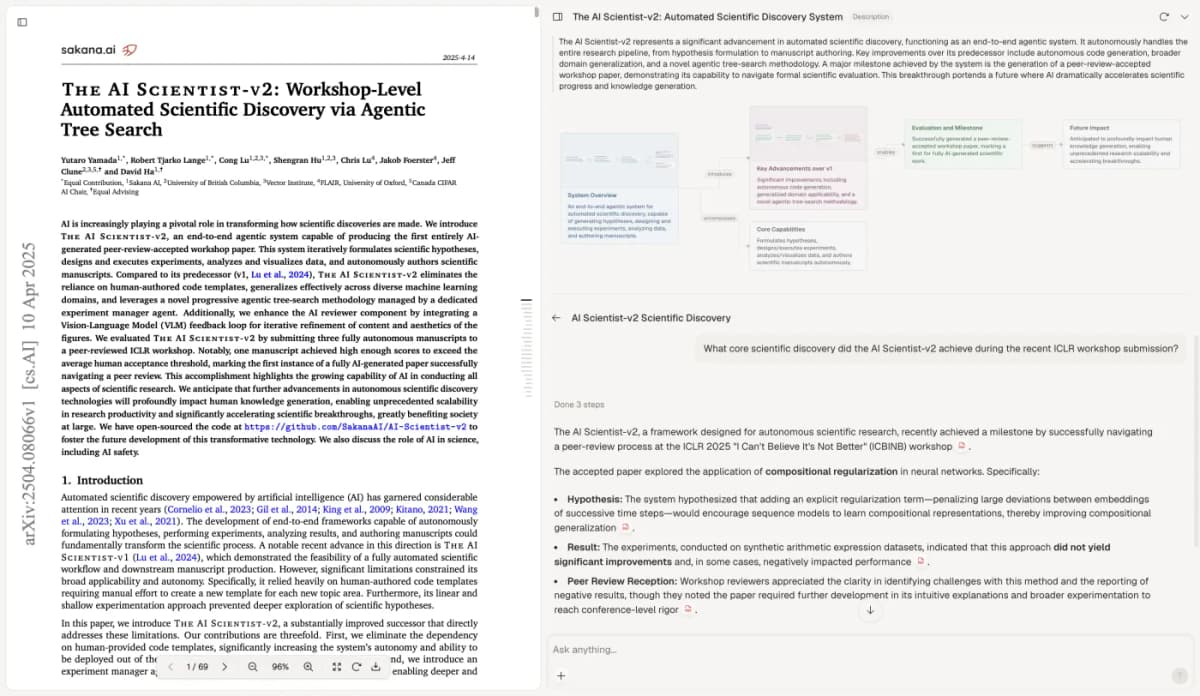
Atlas is the alternative for users who want AI answers grounded in their own documents. Upload PDFs, articles, notes, and lecture files. Atlas maps the sources, then answers with citations to the exact passages it used.
It fits researchers, students, writers, and analysts who work across many documents. The proof point is the answer flow. Upload a paper, ask what claim supports a finding, open the citation, and check the source passage. The map also shows links across files that a plain chat thread can hide. The limitation is scope. Atlas is not a broad chatbot. It does not try to match ChatGPT for code or brainstorming without sources. Atlas Pro is $20/month.
2. Claude: Best for Reasoning and Writing
Anthropic's Claude (Sonnet 4 and Opus 4 series) is the most-recommended ChatGPT alternative for writing, analysis, and complex reasoning. The 200K-token context window handles full books and long codebases.
Claude is best for writers, lawyers, analysts, and developers who care most about response quality. Its writing is strong, its safety posture is clear, and Projects gives teams saved context. The tradeoff is that Claude has no native image generation and fewer plugins than ChatGPT. Pricing includes a free tier, Pro at $20/month, and Team seats from $25/user/month.
For more, see NotebookLM vs Claude Projects.
3. Google Gemini: Best Free Generalist
Google Gemini offers free and paid access with integrations across Drive, Docs, and Gmail.
Gemini is the easiest free pick for Google users. The free tier is capable, Gemini 2.5 Pro reaches a 2M-token context window, and Workspace links help inside Drive, Docs, and Gmail. The main drawback is writing polish. Claude still feels more controlled, and Google's interface changes often enough to slow teams down. Gemini is free, with Google AI Pro at $19.99/month.
4. Perplexity: Best for Live Web Research
Perplexity is the ChatGPT alternative built around web search. Every answer cites the live web sources. Pro Search uses agentic web crawling for deeper queries.
Use Perplexity when the question depends on current web proof. That includes news, product research, market checks, or sourced answers. Its citations are precise, and Pro Search handles multi-step web queries better than a normal chat. It is weaker when the task does not need web data. The free tier is useful, while Pro is $20/month.
5. NotebookLM: Best for Your Documents
Google's NotebookLM is free, accepts up to 50 sources per notebook, and answers with citations to your own files. The audio overview feature is unique and good.
NotebookLM is strongest for students and researchers with PDFs, slides, or lecture notes. It is free, cites your sources, and its audio overviews are useful for review. The constraint is notebook scope. It does not synthesize across notebooks, and it remains tied to Google. NotebookLM is free with a Google account. NotebookLM Plus is part of Google AI Pro.
6. Microsoft Copilot: Best for Microsoft 365
Microsoft Copilot uses GPT-4-class models and is free with a Microsoft account. The Microsoft 365 integration (Word, Excel, PowerPoint, Outlook) is deep and useful.
Copilot is the obvious pick for Windows and Microsoft 365 users. The free tier is useful, Office links are deep, and image generation via DALL-E 3 is available. The weak point is product sprawl. Bing Chat, Copilot, and Microsoft 365 Copilot still feel split across surfaces. Personal use can start free, while Microsoft 365 Copilot is $30/user/month for business use.
7. Mistral Le Chat: Best European Alternative
Mistral's Le Chat runs the Mistral Large and Pixtral models. EU hosting gives it an edge for users with EU data rules.
Mistral Le Chat is best for EU users, privacy-minded teams, and developers who want a European AI provider. It has a strong free tier, open-weight smaller models, and EU hosting. The ecosystem is smaller than OpenAI's or Anthropic's, and the mobile app is less mature. Pricing starts free, with Pro at $14.99/month.
8. Llama 3.3: Best Open-Weight Model
Meta's Llama 3.3 70B is the best open-weight model in the wild. Run it locally via Ollama or LM Studio, or use it through Groq, Together, or Hugging Face.
Llama 3.3 fits privacy-sensitive users, developers building custom apps, and anyone who wants local AI. It is free to download, local inference gives full privacy, and the ecosystem is massive. The tradeoff is setup complexity. It also trails frontier models on the hardest reasoning tasks. The model weights are free, while inference cost varies by host.
9. DeepSeek: Best Low-Cost Coding Option
DeepSeek's V3 and R1 models punch well above their cost class on coding and math benchmarks.
DeepSeek is useful for code, math, and low-cost API work. It is strong on code and math, and some models have open weights. The concerns are hosting region, data rules, and a less polished UI. It offers a free chat tier and low-cost API access.
10. Grok: Best for X Integration
xAI's Grok links directly to X and shows live social context. The Grok 3 series is competitive on general tasks.
Grok is for heavy X / Twitter users and anyone who wants live social signal inside the assistant. Its edge is X data and less filtered output. That can be useful or messy, based on the query. The limit is that it is bundled with X Premium and has fewer add-ons than ChatGPT, Claude, or Gemini. Pricing starts at $8/month with X Premium, with X Premium+ at $16/month for Grok 3.
Which alternative should you choose?
If you need to inspect a paper while discussing it, consider Atlas for cited answers, passage selection and annotations. Open the supporting passage before reusing a claim. For long-form writing, compare Claude and ChatGPT using the same draft and instructions.
If price is the constraint, Gemini, Copilot, NotebookLM, and Atlas all cover common tasks without requiring ChatGPT Plus. For live web research, use Perplexity. For your own PDFs, use NotebookLM if the corpus fits one notebook, or Atlas when you need cross-document synthesis.
For privacy or local use, run Llama 3.3 via Ollama or choose Mistral. For coding, use GitHub Copilot in the IDE, Claude in chat, or DeepSeek for cost-sensitive workloads. For Microsoft 365, use Copilot.
For research papers, citation availability is only the first check. Decide whether you also need to select a paragraph or figure for discussion, inspect why a citation supports an answer, or retain annotations on the PDF.
Cite-Fit-Fallback and pricing
Use this table after you have narrowed the job. Price matters less than fit, but it helps separate a free backup from a paid daily tool.
| Tool | Best Paid Fit | Public Starting Price | Privacy Note |
|---|---|---|---|
| ChatGPT | Broad daily assistant | Plus from $20/mo | Review the data controls for your account |
| Claude | Writing and long files | Pro from $20/mo | Strong cloud controls, still vendor-hosted |
| Gemini | Google apps | Google AI Pro from $19.99/mo | Best if your work already lives in Google |
| Atlas | Private cited research | $20/mo | Best when your own files are the source of truth |
| Mistral | EU-hosted chat | $14.99/mo | Useful when EU hosting is a buying factor |
| Llama 3.3 | Local model use | Free weights, hosting varies | Strongest privacy if you run it on your own machine |
Table 2: Paid-plan starting points and privacy tradeoffs for the main ChatGPT alternatives in this guide.
My switching screen is Cite, Fit, Fallback. First, ask whether the tool can cite the source you need. Second, check whether it fits the daily workflow, such as Docs, IDE, PDFs, or web search. Third, keep a fallback from a different vendor so an outage or model change does not stop the work.
Other ChatGPT Alternatives Worth Knowing
These are narrower than the top 10. Each can still fit a specific job.
- Poe by Quora is useful when you want many models in one interface instead of one main assistant.
- Chatsonic by Writesonic is a better fit for marketing teams that want chat tied to content publishing and SEO work.
- Character.AI focuses on roleplay and character chat.
- You.com is closest to Perplexity: an AI search assistant with paid plans for heavier use.
- HuggingChat is worth trying when you want an open-source-feeling chat surface without setting up a local model.
For image and video generation, do not pick a ChatGPT replacement only by text quality. Midjourney, DALL-E, Runway, Sora, Flux, and Gemini's media tools are a separate buying decision. Choose that category when the deliverable is an image or clip. For cited text answers, use the research tools above.
Alternatives by use case
Free ChatGPT alternatives
The "free ChatGPT alternative" question now has several strong answers in 2026:
- Gemini, best free generalist
- Microsoft Copilot, free GPT-4-class
- NotebookLM, free for your PDFs
- Atlas ($20/mo Pro) with source-cited synthesis
- Claude, free tier with strong writing quality
- Perplexity, free tier for cited web search
- DeepSeek, free chat
- Mistral Le Chat, free generalist with EU hosting
Pick based on what you do most. Most knowledge workers need two free tools. Use one for general chat and one for cited research. Pay only for the workflow you use every week.
ChatGPT alternatives for coding
For coding, compare the interface as well as the model. See ChatGPT alternatives for coding for options including GitHub Copilot in an IDE, Claude for design and review, and DeepSeek for API-based work.
ChatGPT alternatives by AI type
The category has split into AI variants in 2026. Each one fits a different workflow:
- Reasoning AI: OpenAI o3, Anthropic Claude with extended thinking, Google Gemini 2.5 Pro for slow problem-solving on math, code, and analysis.
- Research AI: Perplexity Pro, Atlas for cited answers across your sources, and NotebookLM for cited answers inside one notebook. Each ties answers to sources you can check.
- Coding AI: GitHub Copilot, Cursor, Claude in IDE. See ChatGPT alternatives for coding.
- Multimodal AI: Gemini for vision and audio, Claude for vision and PDFs, GPT-4o for fluent voice.
- Image and video AI: Midjourney, DALL-E inside ChatGPT, Sora, Runway, Flux. Separate category from text chat.
- Privacy-first AI: Atlas for a private source corpus, Llama 3.3 via Ollama for local use, and Apple Intelligence for on-device work.
Most knowledge workers run 2-3 of these in parallel rather than one chatbot.
Student and Reddit picks
The most discussed picks on r/ChatGPT and r/ArtificialIntelligence in 2026:
- Claude for essay writing and long-form reasoning.
- Perplexity for citations and homework research.
- NotebookLM for textbook and lecture-notes Q&A. The free tier is generous.
- DeepSeek for free coding assistance.
- Gemini for the free Google account integration.
- Atlas for connecting class notes, readings, and projects with cited answers and mind maps.
Students should start with free tools and upgrade only when a clear workflow demands it. For a paper-writing workflow, NotebookLM free plus Atlas Pro cover most needs without paying for ChatGPT Plus.
The Practical Conclusion
In 2026, "the best ChatGPT alternative" is usually a small stack. Most heavy users keep 2-3 tools. Use Claude or Gemini for chat. Use Atlas for research, Copilot for code, or Perplexity for search. Keep NotebookLM, Gemini, or local Llama as a free fallback.
The lock-in to one chatbot is gone. The premium is on knowing which tool fits which task.
AtlasAsk a cited question across your own sources
Upload your documents, ask a focused question, and inspect every cited passage.
Frequently Asked Questions
For general chat: Google Gemini and Microsoft Copilot both offer strong free tiers. For research: NotebookLM (free, source-grounded) and Atlas (free tier with mind map). For coding: DeepSeek and Claude (free tier). For web research, consider Perplexity's free tier. Check the current limits and try your intended task before paying for an upgrade.