
Gemini Alternatives (2026): 8 Best AI Assistants Compared
Best Google Gemini alternatives in 2026. Atlas, ChatGPT, Claude, Perplexity, NotebookLM, Microsoft Copilot, Mistral, and Llama for chat, research, and writing.
- Byline

Summary
In 2026, no single Gemini replacement wins every job across writing, cited search, document chat, and private local work.
Choose Atlas for cited answers from your files, Claude for polished prose, and Perplexity for a visible web source trail.
NotebookLM is the best free source-chat pick, while Copilot fits Microsoft 365 teams and Mistral fits EU-hosted chat.
Gemini still wins when Google Workspace integration or a 2M-token context window matters more than source tracing.
Google Gemini in 2026 is one of the strongest free AI assistants available. The free tier is generous. Gemini 2.5 Pro has a 2M-token context window, and the Google Workspace tie-in is deep. But it is not best at every job. Claude is stronger for prose. Atlas is stronger when you need answers tied to your own sources. Perplexity is stronger for cited web search. ChatGPT has the broader app and tool ecosystem.
This guide ranks 8 alternatives based on which job each one wins.

 Atlas
AtlasCheck Gemini answers against your own sources
Upload a document, ask the same question, and inspect the cited passage.
Why Look for Gemini Alternatives?
For our 200-paper benchmark of seven AI research assistants, see our AI research assistants guide.
Most searches for Gemini alternatives come from one of three needs.
First, another tool may win the task. Claude is a better writing partner for many users. Atlas is better when the answer must cite uploaded sources. Perplexity is built around live web citations. ChatGPT has plugins and image generation.
Second, some teams want less Google lock-in. A non-Google assistant can keep AI work separate from Gmail, Docs, Drive, and Ads data.
Third, Gemini has changed names and surfaces often: Bard, Gemini, Gemini Advanced, then Gemini 2.5. That churn can make repeat workflows harder to teach.
What to Compare in Gemini Alternatives
Use the tool's main job as the filter. Compare each alternative on the requirements that affect your work:
- Citations: whether an answer links back to your files or current web sources.
- File handling: the number and size of documents the tool can analyze together.
- Writing quality: whether edits preserve your meaning and style.
- Workspace fit: whether the tool works inside Google Workspace, Microsoft 365, or neither suite.
- Price: whether the free plan covers the workload or requires a paid upgrade.
- Privacy: whether you need a no-training business plan, regional hosting, or a model that runs locally.
Research Workflow Scorecard
Read the scores as practical job-fit signals. They are not lab results. A high score means the tool handles that job well. A low score on a job you do not need should not rule out the tool.
| Tool | Best fit | Citation quality | Document handling | Research workflow | Google Workspace fit | Free tier | Privacy posture |
|---|---|---|---|---|---|---|---|
| Atlas | Source-grounded research | 5/5 | 5/5 | 5/5 | 2/5 | Trial/free access | Strong source control |
| ChatGPT | General chat and tools | 3/5 | 4/5 | 3/5 | 2/5 | Strong | Account-tier dependent |
| Claude | Writing and reasoning | 3/5 | 4/5 | 3/5 | 1/5 | Strong | Strong no-training defaults |
| Perplexity | Live web search | 5/5 | 2/5 | 3/5 | 1/5 | Strong | Enterprise needed for strict data rules |
| NotebookLM | Free source chat | 4/5 | 4/5 | 3/5 | 5/5 | Excellent | Google account dependent |
| Microsoft Copilot | Microsoft 365 work | 3/5 | 3/5 | 2/5 | 1/5 | Good | Strongest in M365 tenant |
| Mistral Le Chat | EU-hosted chat | 2/5 | 3/5 | 2/5 | 1/5 | Good | Strong EU fit |
| Llama 3.3 | Local or open-weight use | 1/5 | 2/5 | 1/5 | 1/5 | Self-hosted | Full control if local |
Table 1: Gemini alternatives scored on citations, file handling, research fit, Google Workspace fit, free tier, and privacy.
If Gemini leaves you checking uncited answers by hand, compare tools built to answer with traceable references. Atlas can answer questions across uploaded papers, reports, and notes while linking each claim to a supporting passage.
The 8 Best Gemini Alternatives
1. Atlas: Best for Grounded Research
Atlas fits people who need answers grounded in their own documents. Upload sources and Atlas builds a navigable mind map. Its chat answers cite specific passages, so you can move from a claim back to the PDF or note that supports it.
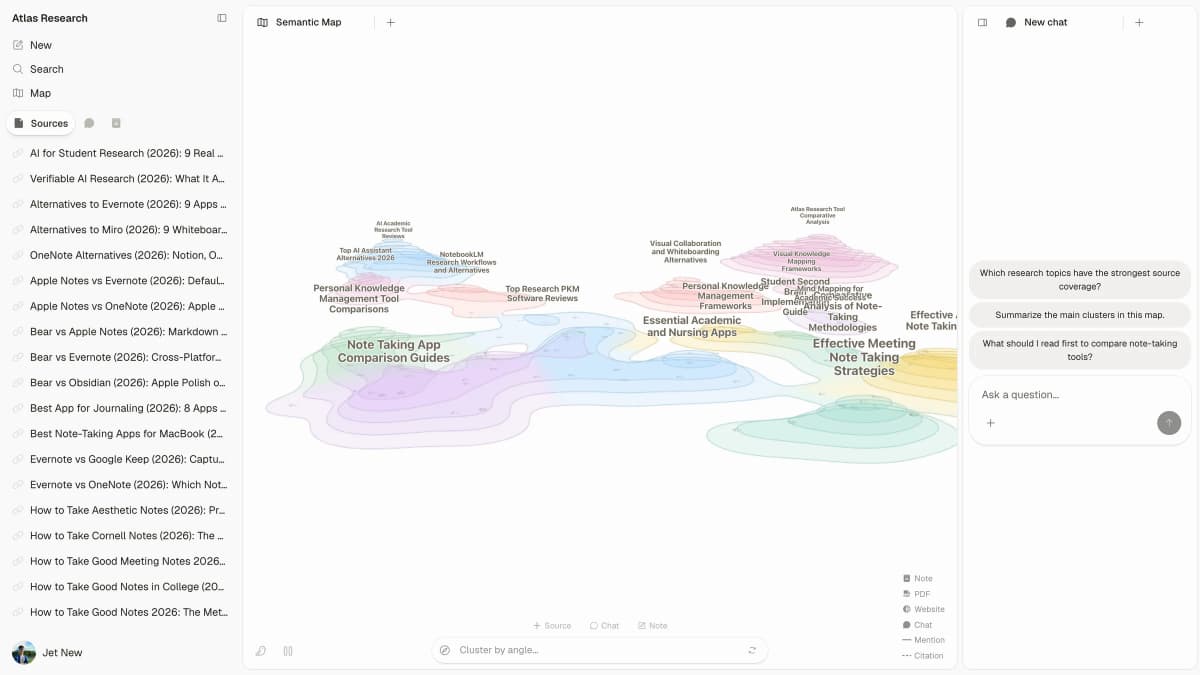
Researchers, students, and analysts get the most value when they synthesize many PDFs, notes, or reports. Atlas Pro is $20/month.
2. ChatGPT: Best General-Purpose Alternative
ChatGPT is Gemini's closest all-purpose rival. It has custom GPTs, a mature tool ecosystem, Code Interpreter, and DALL-E image generation. Its free tier covers most casual chat needs.
Choose ChatGPT when you want one assistant for chat, plugins, image generation, light coding, and broad app support. Pricing starts with a free tier. Plus is $20/month, and Team is $25-30/user/month.
For more, see ChatGPT alternatives.
3. Claude: Best for Writing
Claude is often the better pick for careful writing, critique, and reasoning-heavy drafts. Its 200K-token context is enough for most single files and many report-length projects.
Writers, analysts, and operators who care most about the final response quality should test Claude before defaulting to Gemini. Claude has a free tier, and Pro is $20/month.
For a source workflow comparison, see NotebookLM vs Claude Projects. For more PDF chat tools, see NotebookLM alternatives.
4. Perplexity: Best for Web Search
Perplexity is purpose-built for cited web search. Every answer points to live sources. Pro Search uses an agent for multi-step queries.
Use Perplexity when your Gemini use is mostly current-events research, quick market scans, or source-backed web answers. It has a free tier, and Pro is $20/month.
5. NotebookLM: Best Free Source Chat
NotebookLM is also a Google product, but it is distinct from Gemini chat. It ingests up to 50 sources per notebook and grounds answers in your uploads.
Students and researchers with a small PDF library should try NotebookLM first because the core product is free with a Google account.
6. Microsoft Copilot: Best for Microsoft 365
Microsoft Copilot uses GPT-4-class models and is free with a Microsoft account. Its Word, Excel, Outlook, and Teams tie-ins mirror Gemini's Google Workspace role.
Copilot makes the most sense when your team already lives in Outlook, Word, Excel, Teams, and SharePoint. The consumer version is free. Microsoft 365 Copilot is $30/user/month.
7. Mistral Le Chat: Best EU Option
Mistral is Europe's frontier model lab. Le Chat runs on EU infrastructure with strong privacy practices.
EU users and privacy-focused teams should include Mistral in the shortlist. It has a free tier, and Pro is $14.99/month.
8. Llama 3.3: Best Local Option
Llama 3.3 70B is an open-weight model. Run it locally through Ollama or LM Studio, or use a hosted provider such as Groq, Together AI, or Hugging Face when local setup is not the goal.
Choose Llama when local control matters more than a polished hosted app. The model is free to download, while inference cost depends on the machine or host.
Plan and Context Comparison
Use this table for plan and context-window checks after you have narrowed the list by job. Gemini still wins when one huge context window matters more than source tracing or workflow fit.
| Tool | Free Tier | Paid From | Context Window |
|---|---|---|---|
| Atlas | Yes | $20/mo | Multi-doc |
| ChatGPT | Yes | $20/mo | 128K tokens |
| Claude | Yes | $20/mo | 200K tokens |
| Perplexity | Yes | $20/mo | Web-scale |
| NotebookLM | Yes (full) | $19.99/mo | 500K words/notebook |
| Microsoft Copilot | Yes | $30/user/mo (M365) | GPT-4 class |
| Mistral | Yes | $14.99/mo | 128K tokens |
| Llama 3.3 | Yes (self-host) | Inference cost | 128K tokens |
Table 2: Free plans, paid plans, and context window size for each Gemini alternative.
Choose by Work and Organization
The best Gemini replacement changes with the source of the work: personal documents, public web research, a company productivity suite, or local infrastructure.
Gemini Alternative by Use Case
For source-grounded research, start with Atlas. For writing, start with Claude. For live web search, start with Perplexity. For your own PDFs on a free plan, start with NotebookLM, then move to Atlas when you need a larger research workspace.
Microsoft 365 users should test Copilot first. EU users should test Mistral. Privacy-sensitive developers should run Llama 3.3 through Ollama. ChatGPT is the broadest pick for plugins, GPTs, image generation, and mixed tasks.
Enterprise and Specialist Alternatives
Some search results include tools that are not direct Gemini chat replacements. They matter when the buyer is a company, a developer team, or a go-to-market team.
Amazon Q Business belongs on an enterprise shortlist when your data already sits in AWS and the task is internal knowledge search. Glean is stronger when the real need is workplace search across SaaS apps. GitHub Copilot is the better Gemini substitute for code inside an IDE. Jasper and Copy.ai serve marketing teams that need brand controls, campaign workflows, and approvals.
That split is important. A researcher comparing Gemini to Atlas or NotebookLM is choosing a source workflow. A CIO comparing Gemini to Amazon Q Business or Glean is choosing a governed search layer. A marketing team comparing Gemini to Jasper is choosing a campaign system, not just a model.
Cost, Privacy, and Context Limits
Subscription prices alone do not show whether a replacement fits. Compare the annual cost with the provider's data rules and the amount of source material the tool can analyze at once.
Annual Cost by Use Pattern
Headline subscription prices hide the real cost of an AI assistant. Here's the actual annual bill for three common use patterns:
| Tool | Solo "chat" user | Solo "research" user (heavy doc upload) | Team of 5 |
|---|---|---|---|
| Gemini Advanced (Google AI Pro) | $239.88 | $239.88 | $1,200 (Workspace add-on) |
| Atlas Pro | $240 | $240 | $1,200 |
| ChatGPT Plus / Team | $240 | $240 | $1,500 ($25/user) |
| Claude Pro / Team | $240 | $240 | $1,500 ($25/user) |
| Perplexity Pro | $240 | $240 | $2,400 ($40/user Enterprise) |
| NotebookLM | $0 (free) or $239.88 (Pro) | $239.88 | $0 (Workspace bundled) |
| Microsoft Copilot Pro | $239.88 | $239.88 | $1,800 ($30/user M365 Copilot) |
| Mistral Le Chat Pro | $179.88 | $179.88 | $899.40 |
| Llama 3.3 self-hosted | ~$50 (cloud GPU) | $300+ (heavy use) | $600-1,200 (shared infra) |
Table 3: Real annual cost for a solo chat user, a solo research user with heavy uploads, and a team of five.
The cheapest paid frontier-model option in 2026 is Mistral Le Chat at $14.99/month. The cheapest solo stack is Gemini's free tier plus free NotebookLM for documents, which costs $0/year. The lowest-cost private stack is local Llama 3.3 on a small VPS or a one-time GPU box.
For teams, the hidden cost is SSO. Gemini for Workspace, ChatGPT Team, Claude Team, and Mistral Pro often push SAML SSO into an enterprise tier. That can double the per-seat cost. Microsoft Copilot is the exception if you already pay for Microsoft 365.
API pricing tells a different story for power users. As of 2026, OpenAI's GPT-5 mini and Anthropic's Claude Haiku 4.5 sit around $0.20-$1 per million input tokens. Google's Gemini 2.5 Flash is cheaper at roughly $0.075 per million input tokens. That makes Gemini hard to replace for high-volume API use, even when another app has a better UX.
Privacy and Data Residency
How each provider treats your prompts and uploads varies more than the marketing copy suggests:
- Gemini consumer accounts may be reviewed by humans and used to improve the product unless Activity is paused. Gemini for Workspace and Google AI Pro use stricter defaults.
- ChatGPT Free and Plus accounts are opt-out for training. Team, Enterprise, and API accounts are no-training by default.
- Claude does not train on consumer or API data by default. Enterprise adds SOC 2 Type II and HIPAA options.
- Atlas stores notes in user-controlled storage. It uses on-device AI for embeddings and summaries when possible.
- Perplexity Free and Pro data may be used for product improvement. Enterprise is the safer plan for strict data rules.
- NotebookLM says uploaded sources are not used for training.
- Microsoft Copilot does not train on Microsoft 365 data, per the M365 Copilot data protection statement.
- Mistral Le Chat is EU-hosted and GDPR-aligned. Pro and Enterprise data are not used for training.
- Self-hosted Llama gives the most control because prompts and outputs stay on your own machine or server.
For healthcare, finance, or EU public-sector work, shortlist Microsoft 365 Copilot, Claude Enterprise, Mistral Enterprise, or self-hosted Llama. Avoid consumer Gemini, ChatGPT Free/Plus, and Perplexity Free/Pro for sensitive content unless legal and security teams approve the contract.
Context Window in Practice
Gemini 2.5 Pro's 2M-token context is the headline feature, but most users rarely need it. Two million tokens is roughly 1.5 million words. That is about 5,000 pages, or 30 long novels. A few real tasks do benefit:
- A medium codebase can fit in 2M tokens with room for instructions.
- A full day of meeting transcripts can fit in Claude's 200K window or any 1M+ model.
- A 100K-word book fits in any current frontier model.
- A pile of 50-100 academic papers may need 1M+ tokens if you insist on loading everything at once.
For typical chat or single-document research, Claude's 200K window is enough. Gemini's 2M context helps with full codebases or large paper sets. Outside those cases, a larger window often adds delay and cost without better answers.
Atlas uses retrieval instead of trying to fit a whole library into one prompt. It indexes uploaded sources and retrieves the most relevant passages for each question. That approach trades raw context size for lower cost and a source trail when the library is larger than 2M tokens or every answer needs a citation.
Final Take
Gemini remains the strongest choice when you need its Google Workspace integration or unusually large context window. Keep it for those jobs instead of switching simply because another model scores better on a single benchmark.
Choose Claude for writing, Atlas for cited research across your files, Perplexity for live web search, and Copilot for Microsoft 365. Use two tools only when your work genuinely spans two of those jobs; otherwise, one focused alternative is cheaper and easier to manage.
AtlasCheck Gemini answers against your own sources
Upload a document, ask the same question, and inspect the cited passage.
Frequently Asked Questions
Three reasons. Quality on specific tasks, Claude beats Gemini on writing and nuanced reasoning, Atlas beats Gemini on source-grounded research synthesis, Perplexity beats Gemini on cited web search. Privacy, users diversifying away from Google. UI churn, Gemini has been rebranded multiple times (Bard, Gemini, Gemini Advanced) and the interface keeps changing.