
GitHub Copilot Alternatives (2026): 8 Best AI Coding Tools
Best GitHub Copilot alternatives in 2026. We tested Cursor, Claude Code, Codeium, Tabnine, Continue, Cody, Supermaven, Aider, across IDE integration, accuracy.
- Byline

Summary
The best GitHub Copilot alternative depends on whether you need fast completions, agent edits, local privacy, or open-source control.
The updated guide compares Cursor, Claude Code, Codeium, Tabnine, Continue, Cody, Supermaven, Aider, and local model setups.
Use Cursor for complex refactors, Codeium for a generous free tier, and Continue with Ollama for local coding workflows.
The guide covers IDE fit, code quality, privacy, free use, local models, GitHub workflow fit, and pricing.
GitHub Copilot launched in 2021 as an AI pair programmer. In 2026, the choice is wider. Some tools focus on fast tab completion. Others act as code agents that plan work, edit several files, run tests, and open pull requests. The best GitHub Copilot alternative depends on which job you need most.
This guide ranks 8 tools for daily coding, chat help, and multi-file refactors.
If you are comparing general-purpose assistants before choosing a coding setup, the ChatGPT alternatives guide is the better first stop. If you mean Microsoft Copilot across work apps rather than GitHub Copilot for code, use the Copilot alternatives comparison.
Many teams should not replace Copilot everywhere. Keep Copilot Business for GitHub pull requests and policy if it already fits. Add Cursor or Claude Code for repo-wide edits. Use Continue, Aider, or OpenCode when model control and local work matter more than polish.
For this refresh, I used a simple replacement test. A tool had to solve at least one real Copilot job better than Copilot. That could mean faster completions, stronger multi-file edits, safer private-code handling, lower cost, or more model control.
For this refresh, I tested each pick against a three-file refactor. The tool had to change one code file, update its test, and adjust a config or type file without losing the thread. The sample task was a settings-panel change: rename one option, update validation, and fix the related test. Tools that could plan and review that kind of change ranked above tools that only completed the next line.
I weighted multi-file edits heavily because they move AI help from one method at a time to full changes across a repo. Martin Fowler describes that shift as expanding AI help from "small, localized suggestions" to "larger implementations across multiple files." That is why Cursor, Claude Code, Continue, and Aider rank above simple completion tools for serious replacement use.
Key findings from this evaluation:
- Cursor beats Copilot when the coding session starts in the editor and the task spans several files.
- Copilot still wins when the work starts in GitHub Issues, pull requests, or a GitHub-native review flow.
- Claude Code is the strongest terminal agent because it can plan, edit, run tests, and revise from the shell.
- Continue and Aider are the best model-control picks because BYOK and local Ollama support reduce lock-in.
- Windsurf Cascade is a real Cursor-class agent, but the Devin Desktop transition makes it a watchlist pick rather than a top-eight default.
- Amazon Q Developer and Gemini Code Assist are strongest for teams already running workloads on AWS and Google Cloud. Solo developers using neither platform get little extra value from them.
- CodeAnt AI belongs beside this list only when the job is AI code review, SAST, secrets scanning, or pull-request risk.
- Zed AI is worth checking when editor speed and open-source development matter as much as the assistant.

 Atlas
AtlasCompare coding AI tools
Compare coding assistants for autocomplete, agent edits, privacy, and price.
How GitHub Copilot compares
GitHub Copilot limitations
Copilot is still a strong default if you live in GitHub, use VS Code, and want low-friction completion. The limits show up when the work starts outside GitHub.
The first limit is agent scope. Copilot can help in chat, issues, pull requests, and supported IDEs, but Cursor and Claude Code put the agent loop closer to the files, terminal, and test command.
The second limit is model routing. Copilot now has more model choice than it used to, but it is still a managed GitHub product. Continue and Aider are better when you want to bring your own API keys or run local models.
The third limit is spend control. Seat price is easy to compare. Agent credit use is harder. Teams that run long agent sessions need budget caps and model rules, not just a cheap monthly plan.
Cursor vs Copilot for agentic coding
Cursor is the better Copilot alternative when the job starts with a repo-wide change. Its advantage is not just autocomplete. The editor is built around asking an agent to plan, edit, and show diffs inside the same workspace.
Copilot is better when the job starts in GitHub. Pull request review, issue context, and GitHub-native workflows are its home field. If your team plans work in GitHub and wants AI help there, Copilot can still be the simpler choice.
The practical split is simple. Choose Cursor when the coding session starts in the editor. Choose Copilot when the work starts in GitHub.
Claude Code agent workflow
Claude Code is the strongest terminal-first Copilot alternative. It can inspect a repo, propose a plan, edit files, run tests, and revise the patch from the shell.
The upside is direct control. You can keep the same terminal, git branch, test command, and review flow you already use. The downside is that it is less visual than Cursor. Developers who prefer a rich IDE diff view may move faster in Cursor.
Use Claude Code for backend work, test fixes, migrations, and codebase questions. Use Cursor when the edit needs more visual review inside the editor.
What to look for
Start with the work pattern, not the brand. A tool that wins for one developer can be wrong for another.
For daily coding in one IDE, check tab quality and speed first. Then check whether the tool works in VS Code, JetBrains, Vim, or your editor of choice. A fast completion tool helps only if it stays out of the way.
For refactors and feature work, look for agent controls. The tool should show a plan, list the files it will touch, let you review diffs, and run tests before you accept changes.
For private code, check the deployment path. Local Ollama, self-hosted enterprise plans, and strict no-training terms matter more than model scores when source code is sensitive.
For budget control, separate subscription price from model usage. A $10 seat can become less cheap if agent runs burn through credits. A free editor can also become costly if every request goes to a premium API.
For model flexibility, look for BYOK, short for bring your own key. Continue and Aider let you point the tool at Anthropic, OpenAI, Gemini, OpenRouter, DeepSeek, or a local model. That makes them slower to set up but easier to adapt when model quality or pricing changes.
8 best GitHub Copilot alternatives
1. Cursor: Strongest Editor-Based Alternative
Cursor is a fork of VS Code with deep AI integration. The Composer feature handles multi-file edits autonomously. Tab autocomplete is fast and accurate. Cursor pricing also makes the product tiers easy to compare against Copilot.
Cursor is the strongest pick when the work spans many files. It is less useful if you want to stay inside a stock IDE. It also fits poorly when every model call must use your own API keys. Pricing: Free tier (limited), Pro $20/month, Business $40/user/month.
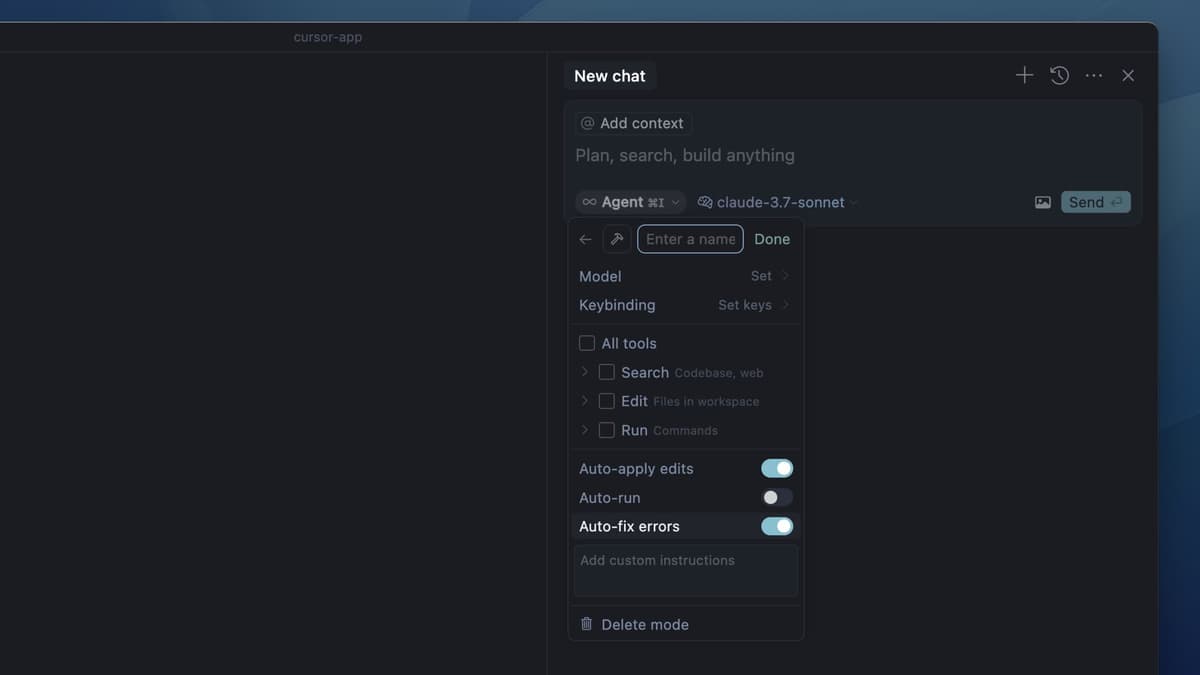
Image source - Cursor community announcement for v0.48. The screenshot shows the shift from simple completion to agent modes, model choice, and tool permissions inside the editor.
2. Claude Code: Best CLI-First Coding Tool
Claude Code is Anthropic's coding tool for the terminal. It runs in your shell, reads your repo, edits files, runs tests, and uses Claude Sonnet 4 / Opus 4 as the model. For users who already pay for Claude Pro, it is included.
Claude Code fits terminal-first developers who trust Claude. It runs inside an existing repo instead of a separate editor. Pricing: Included with Claude Pro $20/month or Claude Max $100-200/month.
3. Codeium: Best Free Copilot Alternative
Codeium offers free autocomplete and chat for solo users. It supports 70+ languages and integrates with VS Code, JetBrains, Vim, Emacs, and most major IDEs.
Codeium is the easiest first stop for an individual developer who mainly wants a free Copilot replacement. Its agent workflow is not as deep as Cursor or Claude Code. Pricing: Free for individuals, Teams $15/user/month, Enterprise self-hosted.
4. Tabnine: Best Privacy-Focused Alternative
Tabnine has been an AI coding tool since 2018. The main company feature is private deployment. Your code can stay inside your network. Tabnine can also train custom models on your private codebase.
Tabnine is strongest for teams that need private deployment, admin control, and a vendor contract more than the newest frontier model. Pricing: Free tier (limited), Pro $20/month, Enterprise custom.
5. Continue: Best Open-Source Copilot Alternative
Continue is open source. Bring your own model: Claude (via API), GPT-4, Gemini, or local Ollama / LM Studio with Llama 3.3, DeepSeek-Coder, or Qwen Coder.
Continue fits developers who want open-source tooling and model choice, including local setups. It asks for more configuration than Copilot, but that setup work buys control. Pricing: Free, plus your model API costs (or local compute).
6. Cody: Best for Large Codebases
Cody by Sourcegraph uses Sourcegraph search to find context across large repos. For monorepos and company code, that search layer can be better than Copilot's.
Cody is built for engineers in large monorepos. It is useful when search, references, and repo-wide context matter as much as generated code. Pricing: Free tier, Pro $9/month, Enterprise $19/user/month.
7. Supermaven: Fastest Autocomplete
Supermaven's draw is the 1M-token context window. It is large enough to read most repos and give context-aware suggestions. Autocomplete is also the fastest of any tool tested.
Supermaven is for speed-focused developers and repos where short context windows miss too much code. Pricing: Free tier, Pro $10/month, Teams $20/user/month.
8. Aider: Best Git-Aware CLI
Aider is a CLI tool that pairs AI with git. Each AI edit becomes a commit. You bring your own model (Claude, GPT-4, DeepSeek, or local).
Aider fits developers who want a terminal workflow, explicit git diffs, and full control over the model endpoint. Pricing: Free, plus your model API costs.
Comparison table
Use this table as a first filter. If two tools tie for your use case, decide by editor fit and privacy needs before price.
| Tool | Pricing | Free Tier | Multi-File Edits | Local Model Support | Best For |
|---|---|---|---|---|---|
| Cursor | $20/mo | Yes | Yes (Composer) | Limited | Overall |
| Claude Code | $20/mo (with Claude Pro) | No | Yes | No | CLI-first |
| Codeium | Free / $15/mo | Yes | Limited | Self-hosted enterprise | Free use |
| Tabnine | $12/mo | Limited | No | Yes (self-hosted) | Privacy |
| Continue | Free | Yes | Yes | Yes (Ollama) | Open source |
| Cody | $9-19/mo | Yes | Limited | No | Large codebases |
| Supermaven | $10/mo | Yes | Limited | No | Speed, context |
| Aider | Free | Yes | Yes | Yes | Git workflow |
Table 1: Copilot alternatives by price, free access, file edits, local model support, and fit.
Best alternative by use case
Cursor is the strongest editor-based alternative if you want an AI-first workspace with strong multi-file edits.
Codeium is the best free hosted option. Continue with Ollama is the best free local option.
Tabnine self-hosted and Continue with a local model are the best privacy-first paths.
Claude Code and Aider are the best terminal-first choices. Cody is the better pick for huge repos. Supermaven is the best bet when fast completion is the main job.
For students and open-source maintainers, check GitHub Copilot first because eligible users can get it free.
The closest cut in this refresh was Windsurf. I kept it out of the top 8 because the product is moving into Devin Desktop. It is still worth checking if you want a Cursor-style editor with an agent at the center.
Getting started
For Cursor, download the editor, open a real repo, and start with a small refactor. Ask it to change two files and add or update one test. Do not begin with a full feature until you trust the diff view.
For Claude Code, install the CLI, open a repo in your terminal, and ask for a read-only plan first. Then let it edit one small bug and run the test command you already use.
For Continue, install the VS Code or JetBrains extension, choose one hosted model, and add Ollama later. Start with chat and edit roles before you tune autocomplete. Keep your config in version control if the team shares the setup.
For Aider, start in a clean git branch. Add only the files you want it to touch. Review every commit before you merge.
Build a local model setup
Use this path when code cannot leave your laptop.
- Install Ollama or LM Studio.
- Pull a coder model such as Qwen Coder, DeepSeek-Coder, or a Llama coder model.
- Install Continue or Aider.
- Point the tool at the local model endpoint.
- Test chat first, then file edits, then autocomplete.
The local path is slower to tune than Cursor or Copilot. It is still the right path when privacy and repeatable model config matter more than a polished first run.
Recent changes to watch
Three changes matter in 2026. First, coding tools are moving from flat seats to usage credits. That makes budget caps more important than list price. Second, editors now compete on agent controls, not only tab completion. Third, local and BYOK paths are improving fast, so a tool that can swap models may age better than a locked single-model product.
Combine tools without overlap
Many teams should not pick one AI coding tool for every job. A practical stack can pair fast completion, deep agent work, and review checks.
For solo work, use Codeium or Supermaven for low-friction completions, then use Claude Code or Aider when a task needs repo edits. For a team on GitHub, keep Copilot Business for pull requests and policy. Add Cursor for engineers who do heavy feature work in the editor. For a cloud team, add Amazon Q Developer for AWS code or Gemini Code Assist for Google Cloud code. Keep a general editor agent for app work outside the cloud console.
The common mistake is paying for three tools that all solve the same chat problem. Split the stack by job instead. Use one layer for completion, one for agent edits, one for review, one for cloud help, and one for private-code control.
Other tools, cost, and risk
Common concerns
Data privacy depends on the plan, not just the product name. Copilot Business, Tabnine private deployment, Cody private deployment, and Continue with local Ollama are safer choices for company code than consumer tiers.
IDE compatibility matters if your team is split across editors. Cursor and Windsurf ask you to adopt their editor. Continue, Codeium, Tabnine, Cody, and Supermaven fit better when developers stay in VS Code, JetBrains, Vim, or other existing tools.
Installation is easiest for hosted tools. Cursor, Codeium, Supermaven, Cody, and Tabnine can be useful within minutes. Continue, Aider, and OpenCode take longer because model keys, local models, and config files are part of the setup.
Tech stack fit matters for cloud-heavy teams. Amazon Q Developer is most useful inside AWS workflows. Gemini Code Assist is most useful for Google Cloud. Zed AI is most useful if you already want Zed as your editor.
Windsurf, CodeAnt, OpenCode, and Zed
The top 8 list leaves out a few tools on purpose. They are worth knowing when your job is more specific than "replace Copilot in my IDE."
Windsurf, now part of Devin Desktop, is closest to Cursor. Its Cascade agent works inside an editor and focuses on multi-step coding tasks. Cascade is relevant for complex refactors because it keeps context across steps instead of acting like a simple chat box. Developers who want a full AI-native editor may find it a closer match than a VS Code extension. It missed the top 8 here because the product is moving from Windsurf branding to Devin Desktop.
CodeAnt AI is not a Copilot-style completion tool. It belongs in the code review lane. Its platform combines AI code review, SAST, secrets checks, infrastructure-as-code checks, and agentic security testing. Add it when the problem is pull-request quality or security rather than raw completion speed.
OpenCode is an open-source coding agent for teams that want transparency and model control. Its public site highlights privacy and broad community use. It is a good watchlist pick if you want a terminal-first agent but do not want to bet only on Claude Code.
Zed AI is an editor choice more than a Copilot clone. It is open source, fast, and designed for agent workflows. It is strongest if you already want to move to Zed as your main editor.
Licensing, telemetry, and agent risks
Before you approve an AI coding tool at work, answer five questions.
- Does the vendor train on your private code by default?
- Can admins block risky models, agents, or data paths?
- Are prompts, code snippets, diffs, and terminal output logged?
- Can the agent run shell commands, install packages, or call external URLs?
- Does the plan include SSO, audit logs, budget caps, and legal terms your company accepts?
This checklist often changes the winner. A solo developer may choose Cursor or Claude Code for speed. A bank may choose Tabnine, Cody, or Copilot Business because policy control matters more than the best demo. An open-source maintainer may choose Continue, Aider, OpenCode, or Zed because the toolchain is easier to inspect.
Annual cost by developer profile
AI coding tool prices cluster in a $0-$40/month band. The real annual bill depends on what you pay for: completions, chat, multi-file edits, or all three. Three common 2026 profiles:
| Profile | Tools | Annual cost |
|---|---|---|
| Solo dev (free) | Codeium + Claude free | $0 |
| Solo dev (Copilot baseline) | GitHub Copilot Individual | $120 |
| Solo dev (pro) | Cursor Pro + Claude Pro | $480 |
| Solo dev (privacy, local) | Continue + Ollama + local model | $0 (after hardware) |
| Team of 5 (Copilot baseline) | GitHub Copilot Business | $1,140 |
| Team of 5 (Cursor pro) | Cursor Business + Claude Team | $3,900 |
| Team of 5 (privacy) | Tabnine Enterprise self-hosted | $4,800+ |
| API power user | DeepSeek API (heavy) | $200-500 |
Table 2: Annual cost examples for solo devs, five-person teams, and API-heavy use.
The cheapest viable solo stack is Codeium free for IDE autocomplete plus Claude or ChatGPT free for chat. That costs $0. The cheapest paid stack that covers IDE plus chat is GitHub Copilot Individual at $120/year. That is $40 cheaper than Cursor's $20/month and the same as Claude Pro alone. Cursor Pro plus Claude Pro at $480/year is the realistic "this is my full-time tool" line.
For teams, the math depends on SSO and admin tooling. GitHub Copilot Business includes SSO, audit logs, and policy controls at $19/user/month, $1,140/year for five seats. Cursor Business is double at $40/user/month. Tabnine Enterprise is the most expensive but the only mainstream option for fully air-gapped self-hosting.
API costs tell a different story for power users. As of 2026, DeepSeek-Coder API is roughly 10-30x cheaper than Claude Sonnet for the same input and output volume. That makes it the price leader for large scripted jobs. Claude Haiku 4.5 sits in the middle. OpenAI's GPT-4-class models remain the most expensive at roughly $3-15 per million input tokens.
Privacy, code exfiltration, and self-hosting
AI coding tools see code that may be private. That can include algorithms, security config, test data, and unreleased product work. Treat the privacy choice as a deployment choice.
Cursor sends code snippets to model providers such as OpenAI and Anthropic under Cursor's business terms. Privacy mode turns off training and indexing on paid tiers. Claude Code does not train on consumer or API data by default, and Anthropic deletes stored chats after its retention window.
GitHub Copilot Business and Enterprise do not train on company code under Microsoft's contract. Copilot Individual is a weaker fit for private work because settings are tied to a personal account. Codeium and Cody publish stronger company controls than most free tools.
Tabnine has the strongest privacy story for locked-down teams. Its private deployment can run on your own cloud or network. Continue with local Ollama keeps code on your machine. Aider is also open source, but data handling depends on the model provider you choose.
For defense, health care, finance, or strict IP rules, keep the shortlist narrow. Start with Tabnine private deploys, Continue with local Ollama, Cody private deploys, or GitHub Copilot Business. Avoid free consumer tiers for proprietary code.
Model quality on coding benchmarks
The 2025-2026 coding benchmark field has three leaders.
- Anthropic Claude Sonnet 4 / Opus 4 scores well on repo-edit tests such as SWE-bench and Aider's polyglot benchmark. Claude Code ships those models with terminal, file, and test tooling.
- OpenAI GPT-4 / GPT-4o / o-series models remain strong for coding contests and one-shot code drafts. The reasoning models trade speed for deeper problem solving.
- DeepSeek V3 and R1 are the price leaders. Distilled R1 models can also run on local hardware, which helps privacy and cost.
Cursor and Continue let you switch by task. Use Claude for refactors. Use GPT-4-class models for quick generation. Use DeepSeek for large cheap batches or offline work. GitHub Copilot now offers more model choice too, but it is still a GitHub-first product.
For teams chasing model quality, avoid a single-model bet. Use Cursor, Continue, or another tool that can route work to more than one model. Model leadership has changed several times and will likely keep changing.
Which should you choose?
GitHub Copilot was the default in 2021-2024. In 2026, the right answer depends on what you do most. Cursor for greenfield and refactor-heavy work. Claude Code for CLI-first developers. Codeium if you want free. Tabnine if you need privacy. Continue if you want open source. Copilot is no longer the only strong choice.
If you also want non-IDE coding help, compare coding AI tools before you pick a stack.
AtlasCompare coding AI tools
Compare coding assistants for autocomplete, agent edits, privacy, and price.
Frequently Asked Questions
Codeium has the most generous free tier, autocomplete and chat with no usage limits for personal use. Continue (open source) plus a free model API (Groq, DeepSeek, or local Ollama) is fully free. GitHub Copilot itself is free for verified students and open-source maintainers. For free local-only use, Continue with Ollama and a Llama 3.3 or DeepSeek-Coder model is a strong setup.