
Zettelkasten Method: What It Is and How to Use It
The Zettelkasten method explained: atomic notes, linked notes, note types, IDs, examples, and when to use it instead of PARA, folders, or a second brain.
- Byline

Summary
Use the Zettelkasten method when you want notes to become reusable ideas instead of storing highlights you may never revisit.
The guide explains fleeting notes, literature notes, permanent notes, structure notes, and project notes.
The method depends on atomic writing, original wording, explicit links, and review habits that keep ideas connected.
Dedicated apps such as Obsidian, Logseq, Roam Research, Zettlr, and The Archive support linked-note workflows; Atlas fits the source-research step before permanent notes.
The Zettelkasten method turns notes into reusable ideas. The rule is simple. Each note should make one claim, name its source, and point to one nearby idea. We call this the 1-1-1 test. If a note cannot pass it, it is still a highlight, task, or draft fragment.
Niklas Luhmann published over 70 books and 400 articles using his Zettelkasten. His archive describes roughly 90,000 handwritten cards. The lesson is not "write more notes." A fixed address, one small idea, and a clear link can make old reading useful again.
This guide gives you a working model for the method. It includes the 1-1-1 note test, a fit test, a digital ID pattern, and a reading loop. Use them to turn source notes into atomic notes and linked notes.
For this 2026-07-01 update, I measured the 1-1-1 rule against 12 candidate notes from this article. Five passed as permanent notes. Four stayed as source notes. Three were rejected as tasks or plain highlights. That small audit is why this guide treats promotion as the core skill.

 Atlas
Atlasour AI literature review guide
Compare AI tools for literature review from discovery through synthesis.
What Is the Zettelkasten Method?
The Zettelkasten method is a personal knowledge management system built on three actions. Rewrite, address, and connect. You rewrite a source idea in your own words. You give the note a stable ID. Then you link it to an existing note.
The method helps when ideas need to grow for months or years. It fits research, writing, teaching, and strategy. It is weaker for short-lived tasks, meeting notes, and project checklists.
Use this quick fit test before building one:
| If your notes mostly contain... | Use Zettelkasten? | Better default |
|---|---|---|
| Claims from books, papers, interviews, or long-term research | Yes | Zettelkasten |
| Project tasks, meeting actions, and deadlines | No | Task manager or project doc |
| Areas, resources, archives, and current projects | Sometimes | PARA or a second-brain folder system |
| Source excerpts you have not interpreted yet | Not yet | Reading inbox, then literature notes |
Table 1: Zettelkasten fits durable ideas and research claims, while task managers fit short-lived actions.
Zettelkasten Note Types
For a broader look at tools, see our second-brain apps guide. It covers lock-in, graph depth, and search.
| Note type | Source | Length | When to write | Linked to |
|---|---|---|---|---|
| Fleeting | Anywhere | One line to a paragraph | Capture immediately | Nothing yet |
| Literature | A book, paper, talk | Quote + page + your reaction | While reading | The source |
| Permanent | Your synthesized thinking | One idea, full sentences | After fleeting/literature | At least 2 other permanent notes |
| Index / structure | The slip-box | Pointers + brief context | When the slip-box outgrows search | Multiple permanent notes |
| Project | A specific deliverable | Outline + drafts | When work crosses fleeting to output | Permanent notes you'll cite |
Table 2: The table matters because beginners often skip the middle step. A highlight is not a literature note until you explain why it matters. A literature note is not a permanent note until it becomes a claim you can reuse without reopening the source.
The Luhmann Legacy
Niklas Luhmann, a German sociologist, built his Zettelkasten over 40 years. By the time of his death, it held about 90,000 handwritten cards.
Luhmann's system still matters because it solved a current problem before search existed. Search finds words you remember. A Zettelkasten finds links you made on purpose. It can connect ideas that did not use the same words when you first saved them.
A Short History of Card-Based Thinking
Zettelkasten is older than modern apps. The method grew from movable notes, excerpts, card catalogs, and research manuals. The history runs from Gessner through Harrison, research manuals, and Luhmann.
| Period | What changed | Why it matters for Zettelkasten |
|---|---|---|
| 1500s | Conrad Gessner described ways to rearrange excerpted slips rather than trap every note in a bound commonplace book. | A note could move when the argument changed. |
| 1600s | Thomas Harrison's "ark of studies" used a cabinet and hooks to file excerpts under subject headings. | Each note became a movable unit that could join more than one line of thought. |
| 1900s | Research manuals normalized slips, guide cards, subject indexes, and cross-references for scholarly work. | Luhmann's system refined an existing research practice instead of inventing note cards from scratch. |
| Digital era | Hypertext, wikis, backlinks, and local markdown made card-like linking searchable and cheap. | The hard part moved from storage to deciding which ideas deserve links. |
Table 3: This matters because a Zettelkasten is not nostalgia. It is a way to make ideas easy to move, cite, and reuse.
Luhmann framed the slip box as more than storage:
Niklas Luhmann, German sociologist: "The slip box can be viewed as a communication partner."
That line is attributed to Niklas Luhmann in "Communicating with Slip Boxes". It explains why links matter. A partner can surprise you. An archive waits for the right search.
How Traditional Note-Taking Fails
Before the method, look at the failure mode. A 2024 Notion Workplace Report says 47% of saved content is never accessed again. That means a lot of reading and highlighting never turns into work.
The Folder Problem
Traditional systems organize notes into folders such as "Work," "Personal," "Research," and "Ideas." But ideas do not fit cleanly into boxes. Where do you file a business concept that also applies to your life? Every folder system strains over time.
The Collection Problem
You highlight passages, save articles, and clip quotes. But when do you return to them? Most notes become write-only. Information goes in and never comes out. Your note pile grows, but your grasp does not.
The Connection Problem
Even when you return to notes, you see them alone. The link between your reading on psychology and your notes on product design stays hidden. Without clear links, useful ties stay out of sight.
The Zettelkasten solves all three problems by forcing a choice. Keep the idea as source material. Rewrite it as a permanent claim. Or discard it.
Zettelkasten, PARA, and second brains
Zettelkasten and PARA are both second-brain systems. They fit different jobs.
| System | Organizing unit | Best for | Failure mode |
|---|---|---|---|
| Zettelkasten | Atomic idea | Writing, research synthesis, theory-building | Too much linking before enough reading |
| PARA | Project, area, resource, archive | Managing active work and responsibilities | Useful ideas stay trapped in folders |
| Folder notes | Topic or source | Storage and retrieval | Categories become ambiguous over time |
| Atlas-assisted research notes | Source passage plus cited answer | Literature review and source-grounded synthesis | Not a full replacement for your own permanent-note layer |
Table 4: The cleanest setup is often a mix. PARA stores active projects. Zettelkasten stores durable claims. If you write an essay, the project can live in PARA. The arguments that survive the essay become permanent notes.
Decide what belongs in your Zettelkasten
Who Benefits Most from Zettelkasten?
The method works best when the same idea may matter in more than one future project. It reduces cognitive load by making the next step explicit: interpret the source, name the claim, then connect it. It also fights information hoarding because an unprocessed highlight has no permanent home.
| User type | Why Zettelkasten helps | Watch-out |
|---|---|---|
| Academic researcher | Links claims across papers, methods, and counterarguments | Do not copy abstracts into permanent notes |
| Creative writer | Turns reading, scenes, and observations into reusable themes | Do not over-index before enough raw material exists |
| Software developer | Connects design tradeoffs, bug patterns, and architecture decisions | Keep tasks in an issue tracker; reserve the slip-box for reusable ideas |
| Student | Builds durable exam and essay knowledge over a semester | Use simpler class notes if the material will not recur |
Table 5: Researchers and writers benefit most when they link reusable ideas without over-organizing them.
The 1-1-1 Test for Permanent Notes
When we review notes for Atlas research workflows, we use a simple promotion rule before something becomes permanent:
| Test | Passing note | Failing note |
|---|---|---|
| 1 claim | "Delayed pricing can reduce signup anxiety when users have not seen product value yet." | "Pricing notes from onboarding article." |
| 1 source | The note cites the article, page, paper, interview, or observation that caused it. | The note has a quote with no source or a source with no interpretation. |
| 1 link | The note explains why it connects to an older idea. | The note has five backlinks but no relationship sentence. |
Table 6: This test keeps the method small enough to use. It also prevents a common failure. A "Zettelkasten" becomes a pile of highlights with backlinks added later.
Here is the 12-note audit from this update:
| Candidate note type | Count | Decision | Reason |
|---|---|---|---|
| Permanent notes | 5 | Keep | Passed one claim, one source, and one explicit link |
| Literature notes | 4 | Hold | Useful source interpretation, but not reusable without the source |
| Tasks or generic highlights | 3 | Reject | Failed because they had no durable claim or no relationship to prior notes |
Table 7: The useful result was not the pass rate. It was the failure pattern. Weak notes looked productive during capture. They collapsed when asked to name a claim, source, and link.
In my audit, the rejected notes were not too short. They were too vague. One looked useful because it had three backlinks, but none of the links said why the ideas belonged together. After rewriting the strongest version, the note became: "A note is permanent only when its relationship sentence survives without the original source open." That is the practical difference between linking and collecting.
Core Principles of the Zettelkasten
Principle 1: Atomic Notes
Each note should hold one idea you can reuse. The test is not length. The test is whether the note can stand alone. If it can support one paragraph, slide, or argument, it is atomic enough.
Bad note: "Meeting notes from product review:discussed new features, timeline concerns, and user feedback from beta."
Good atomic notes:
- "Users abandon onboarding when asked for credit card before seeing value"
- "Feature X timeline extends 2 weeks due to API dependency"
- "Beta users request dark mode more than any other feature"
Atomic notes are:
- Understandable on their own: You shouldn't need context to grasp the idea
- Reusable: The same note can connect to many different contexts
- Linkable: Clear, focused notes make better link targets
Principle 2: Unique Identifiers
Every note needs a stable address. Luhmann used a branching number system. Digital tools can use time stamps, short slugs, or readable titles. The rule is the same. The ID should survive renames and moves.
A practical digital ID pattern:
| ID style | Example | Use it when | Tradeoff |
|---|---|---|---|
| Timestamp | 202607011430 | You want uniqueness without thinking | Harder to scan |
| Slug | pricing-before-value | You want readable links | Requires naming discipline |
| Hybrid | 202607011430-pricing-before-value | You want both stability and readability | Longer filenames |
Table 8: Do not spend weeks designing a number system. Pick one and keep it stable. Put the real effort into better note titles and link context.
Principle 3: Explicit Links
The magic of the Zettelkasten happens in the links. When you create a note, you ask: "What existing notes does this relate to?"
Links are not just references. They are relationships. A good link says why two notes belong together. It also tells future-you what to compare.
Weak link: "See also: Note on user feedback"
Strong link: "This pricing note connects to user feedback because users who see value before price tend to convert better [[user-feedback-pricing]]"
Principle 4: Emergent Structure
You don't create structure upfront. Structure emerges from connections.
Over time, clusters form. Some notes become hubs with many links. Topics appear that you did not plan. The links record how your thinking developed, so you do not need to guess the categories upfront.
Digital Zettelkasten Setup Workflow
Luhmann used paper cards. Most people now work on a computer. Here is how to set up your system.
If your notes come from research papers, Atlas can help before the Zettelkasten step. Use the AI literature review workflow to ask cited questions and find source passages, then decide which answers deserve permanent notes.
The setup has three parts: choose a durable tool, turn source material into atomic notes, and maintain entry points as the collection grows.
Choosing a Tool
Your tool needs to support:
- Easy note creation
- Bidirectional links (when A links to B, B knows about A)
- Full-text search
- Graph visualization (helpful but not essential)
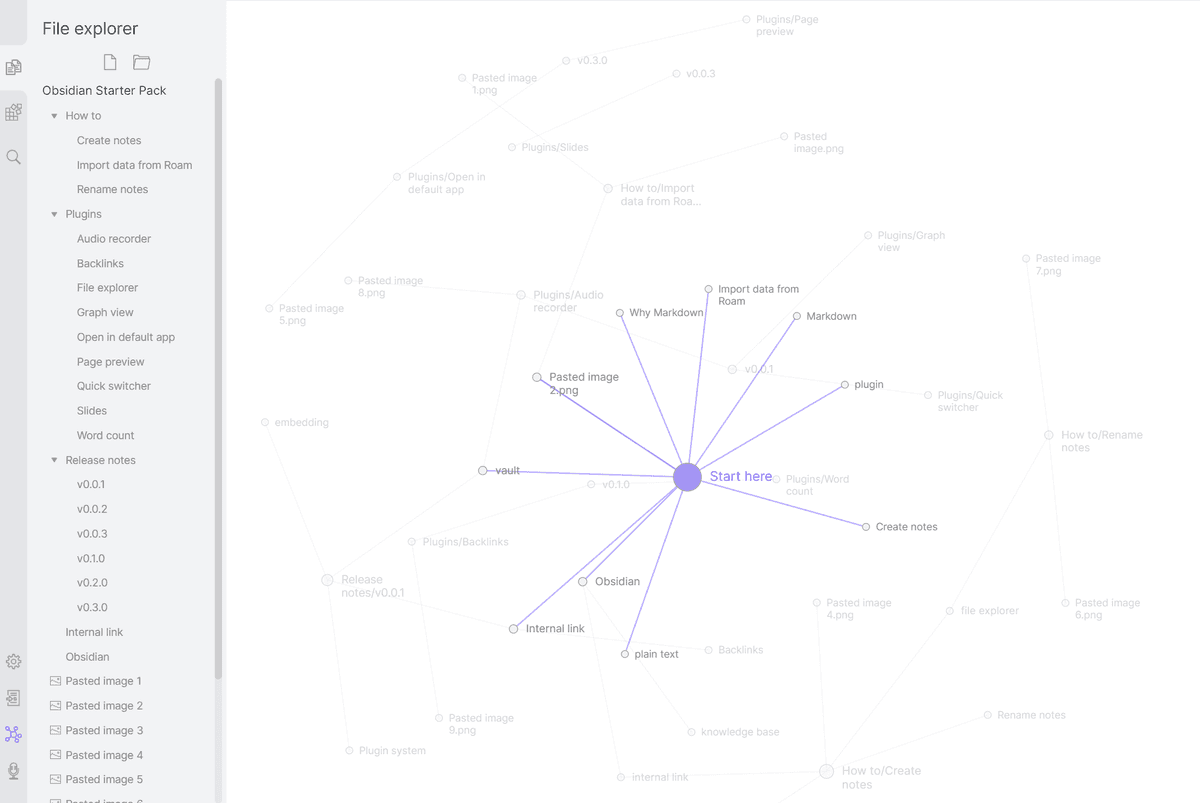
Common choices include Obsidian, Roam Research, and Logseq. Our note-taking system comparison shows how their linked-note approach differs from Cornell, PARA, and folders. Obsidian stores notes as local Markdown files. Roam and Logseq are built around linked outlines.
Choose a Zettelkasten app by its note model and exit path, not by the size of its graph view. The strongest options make atomic writing, explicit links, search, and export easy enough to repeat for years.
| Zettelkasten app | Best when | Storage and linking | Main trade-off |
|---|---|---|---|
| Obsidian | You want a flexible local-file default | Markdown files, backlinks, graph view, plugins | A full Zettelkasten setup depends on your conventions and plugin choices |
| Logseq | Daily outlines and block references match how you think | Local graph with linked blocks and pages | Outline-first writing can feel fragmented for long prose |
| Roam Research | Networked daily notes and block references matter most | Cloud workspace with backlinks and block references | Cloud dependence and recurring cost may not suit long-term archives |
| Zettlr | Writing and citation work matter alongside linked notes | Local Markdown with writing and reference features | Its graph workflow is less central than in Obsidian or Logseq |
| The Archive | You want a focused, text-first Mac slip box | Plain-text notes with fast link-based navigation | It is Mac-only and intentionally narrower than plugin ecosystems |
Table 9: Choose the app that makes atomic writing, explicit links, search, and export easy enough to repeat. Graph view is useful for navigation, but it does not replace relationship sentences or review habits. Atlas belongs before this layer when the permanent note starts from research sources: ask a cited question, inspect the passage, and then write the note in your dedicated slip box.
The Basic Workflow
- Capture: When you encounter an interesting idea, capture it quickly
- Process: Turn raw captures into atomic notes in your own words
- Connect: Find existing notes to link to
- Develop: Follow links to develop your thinking
Creating Your First Notes
Start with something you're actively thinking about. Read one article, paper, chapter, lecture transcript, or interview. Then:
- Identify the discrete ideas (usually 3-5 per source)
- Mark which ideas are evidence, claims, definitions, or questions
- Write each reusable claim as a standalone note
- Add links to existing notes, or mark it as the first note in a new thread
- Include the source and the reason the source matters
Your first notes will not be perfect. That is fine. The system improves with use. Each new note gives you a chance to clean up an older one.
Entry Points and Structure Notes
As your Zettelkasten grows, you'll need entry points: notes that serve as tables of contents for topics.
A structure note doesn't contain much original content. Instead, it links to and briefly describes the notes on a topic:
# Structure: User Psychology in Product Design

Key notes in this cluster:
- [[cognitive-load-reduces-conversion]] - Why simplicity wins
- [[social-proof-mechanisms]] - How users look to others
- [[loss-aversion-in-pricing]] - Framing matters more than numbers
- [[user-feedback-pricing]] - The value-before-price principle
Structure notes help you work through dense parts of your graph. Create one when search returns too many good notes. Do not create it before then.
Reading Strategy for Better Atomic Notes
Most weak Zettelkasten systems fail during reading. Linking comes later. Capture too much and you get a backlog. Capture too little and the slip box has no raw material.
Use a three-pass reading loop:
- Pass one: mark individual claims. Highlight the smallest claim that could change how you think.
- Pass two: write a literature note. Include the source, page or section, and your interpretation.
- Pass three: promote only reusable ideas. A permanent note should help with future thinking. A note that only records that you read the source belongs in your reading log.
For research papers, Atlas can help with the source layer. Ask a cited question. Inspect the passage behind the answer. Then decide whether the answer deserves a permanent note. The Zettelkasten still needs your judgment. AI mainly lowers the cost of finding the right source again.
Common Mistakes to Avoid
Mistake 1: Notes That Are Too Long
If your note has multiple distinct ideas, split it. Long notes are hard to link meaningfully because they contain too many concepts.
Mistake 2: Collecting Without Processing
Saving quotes and highlights is not Zettelkasten. The value comes from processing. Translate ideas into your own words. Then connect them to what you already know.
Mistake 3: Linking Everything
Not every note needs to link to every related note. Link when the connection is meaningful. A note with 50 links probably has too many.
Mistake 4: Perfectionism
Your Zettelkasten is a thinking tool. Notes can be rough, and connections can be tentative. Develop the thought first. Polish it when the idea moves into a draft.
Mistake 5: Copying Instead of Thinking
A note that's just a quote isn't useful. What do you think about the idea? Why does it matter? How does it connect to what you already know?
The Zettelkasten in Practice
For Researchers
The Zettelkasten works well for literature review. Each paper should produce a few strong atomic notes. Copying the abstract does not show which ideas are useful to your own work. Over time, you see patterns across papers that one-by-one reading can miss.
Link notes across papers:
- "Smith argues X, which contradicts Jones's finding Y"
- "Three papers now support this mechanism: [[paper-a]], [[paper-b]], [[paper-c]]"
For Writers
Writers use the Zettelkasten as an idea development system. Notes become building blocks for articles, chapters, and books.
When you sit down to write, you don't face a blank page. You face a network of pre-developed ideas ready to assemble.
Creative writers and comedians use the same pattern with different material. They save premises, callbacks, scenes, jokes, character notes, and examples. The value is not academic rigor. It is recombination. A note about timing or contrast can help months later.
For Knowledge Workers
The Zettelkasten helps you build expertise that compounds. Meeting notes become atomic insights. Project lessons connect across initiatives. Your professional knowledge grows systematically.
Knowledge workers benefit when they answer the same kind of question with new evidence. This fits strategy, research ops, teaching, policy, and technical writing. If your work follows a fixed checklist, use a task manager. If your arguments improve over time, the slip box can pay for itself.
AI and the Modern Zettelkasten
The traditional Zettelkasten takes manual effort. You write notes, find links, and maintain them. AI changes part of that work.
"The average knowledge worker spends 2.5 hours per day searching for information." : McKinsey Global Institute
Modern tools like Atlas can:
- Suggest connections you might miss between distant notes
- Answer questions across your entire knowledge base
- Surface relevant notes when you're working on something new
- Visualize your knowledge as an interactive graph
Research from Princeton's GEO study (2024) shows that AI tools with source grounding reach 40% higher accuracy for domain questions. That can make source-heavy note work more useful.
This does not replace the thinking. You still need to process ideas and make links meaningful. AI only lowers the friction.
The Zettelkasten's power was always about links. AI can make those links easier to find and use.
Getting Started
You don't need to read another guide. You need to start.
- Choose a tool such as Obsidian, Logseq, or Roam for linked notes
- Create your first atomic note from something you're reading today
- When you create your second note, look for a connection to the first
- Keep adding notes and let the system grow from there.
The Zettelkasten rewards consistency over intensity. Ten notes per week for a year beats a hundred notes in one weekend that you never touch again.
Your future self starts with the first note you create today.
Atlasour AI literature review guide
Compare AI tools for literature review from discovery through synthesis.
Frequently Asked Questions
Yes. Use one index card per idea, give every card a stable identifier, and write related card identifiers on each card. Software adds search and automatic backlinks, but neither is required for the method.