
7 Best Zotero Alternatives for Research in 2026
Compare seven alternatives to Zotero for PDF reading, citations, writing apps, syncing, and AI—and find the best reference manager or Paperpile alternative.
- Byline

Summary
In 2026, choose another tool when Zotero feels too rough for PDF reading, Google Docs, Word, or AI paper Q&A.
The guide covers seven tools: Mendeley, Paperpile, EndNote, ReadCube Papers, Citavi, Atlas, and Zotero itself.
Use Mendeley for PDFs, Paperpile for Google Docs, EndNote for Word, and Atlas for cited paper Q&A.
Zotero is still the free baseline. Paid tools mainly win on polish, sync, AI, or deeper project structure.
Atlas is built for research synthesis. Each answer links back to the source PDF, so you can check the passage before you use it.
Atlas also turns sets of papers into mind maps as your library grows. That helps a literature review build on prior reading instead of starting over each week.
Zotero is the free default for academic citations. Paid tools may fit better when you need a different PDF reader, tighter support for your writing app, or AI-assisted synthesis. This guide compares six alternatives plus Zotero across those jobs, along with syncing and price.
The central distinction is what each product manages. Mendeley, Paperpile, EndNote, ReadCube Papers, Citavi, and Zotero organize references and create citations. Atlas complements a reference manager when you need to compare findings across a selected set of papers and inspect the source passage behind an answer.
 Atlas
AtlasSee where AI research tools fit
See eight research tools compared across discovery, checking, and synthesis.
How we compared the alternatives
We compared the products using their official documentation for five decisions: how they store and annotate PDFs, which writing apps they support for inserting citations, how they sync and share libraries, whether they can answer questions across papers, and what their current plans include.
Prices and plan limits can change, so verify them on the linked product pages before subscribing. For a broader comparison of research assistants, see our AI research assistants guide.
7 Best Zotero Alternatives
The seven tools below solve different problems around a reference library. Some improve reading or citation entry, while others add project structure, AI assistance, or a free and open-source baseline.
1. Mendeley
Mendeley has the cleanest PDF reader in this set after the 2024 Reference Manager rebuild. It includes 2GB of free cloud sync. It also has strong group libraries for shared literature reviews and tight Scopus plus Elsevier journal support.
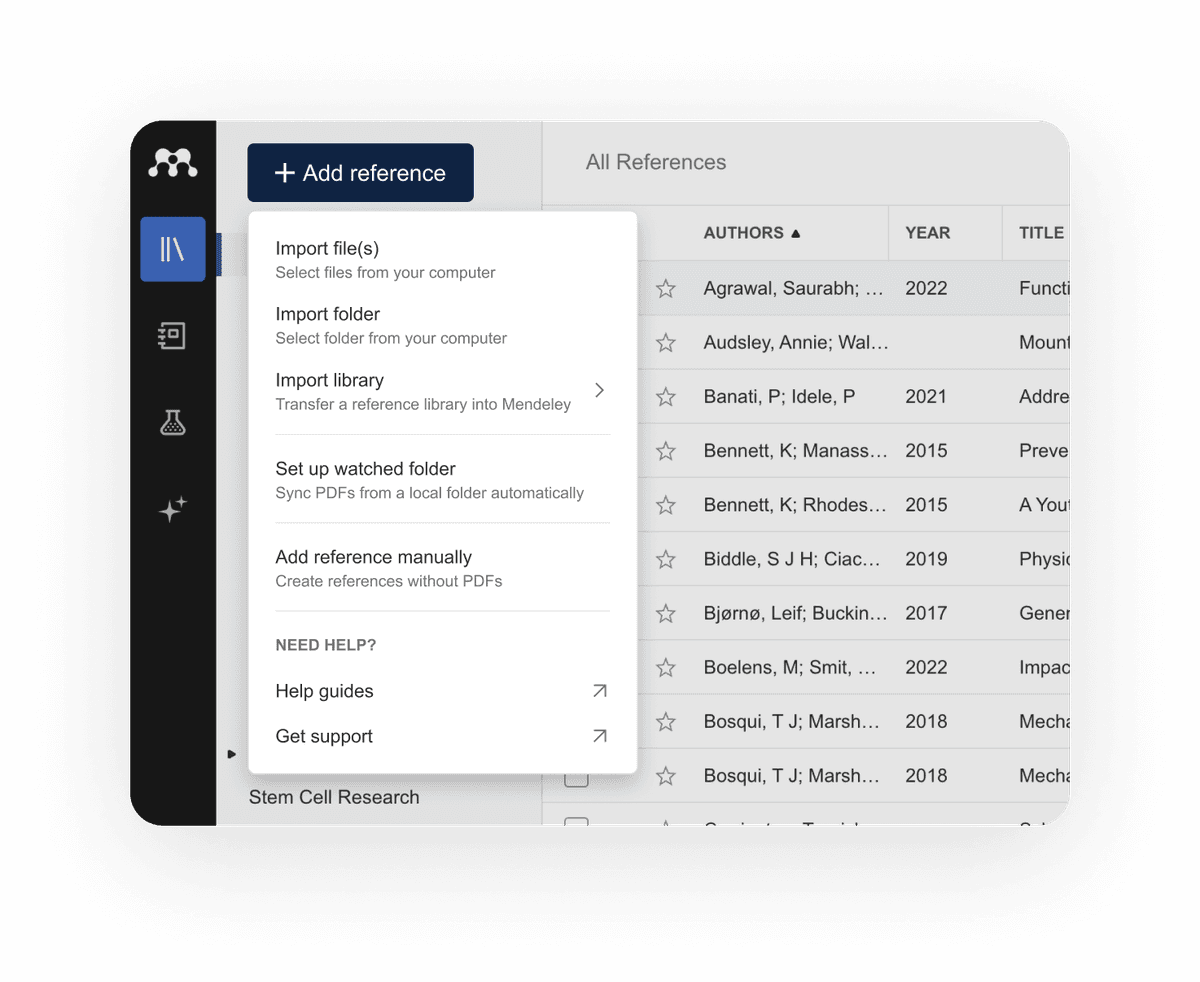
This official Mendeley screenshot shows the import menu. It helps if most of your papers start as local PDF files. Source is the Mendeley features page.
The tradeoff is Elsevier ownership. The 2022 sync shutdown hurt long-time users, and the open-source community is weaker than Zotero's. It also has fewer citation styles than EndNote. Mendeley fits solo users and small teams that want a clean PDF reader for free. It is strongest in Elsevier-heavy fields. Our Evernote alternatives roundup covers note apps that pair with it. Mendeley is free, with paid storage tiers via Elsevier per the May 2026 pricing page.
2. Paperpile
Paperpile is the Google Docs pick. Its cite-while-you-write flow inside Docs is the best here. The app feels clean in the browser. The Chrome add-on saves papers from JSTOR, arXiv, and PubMed with little friction.
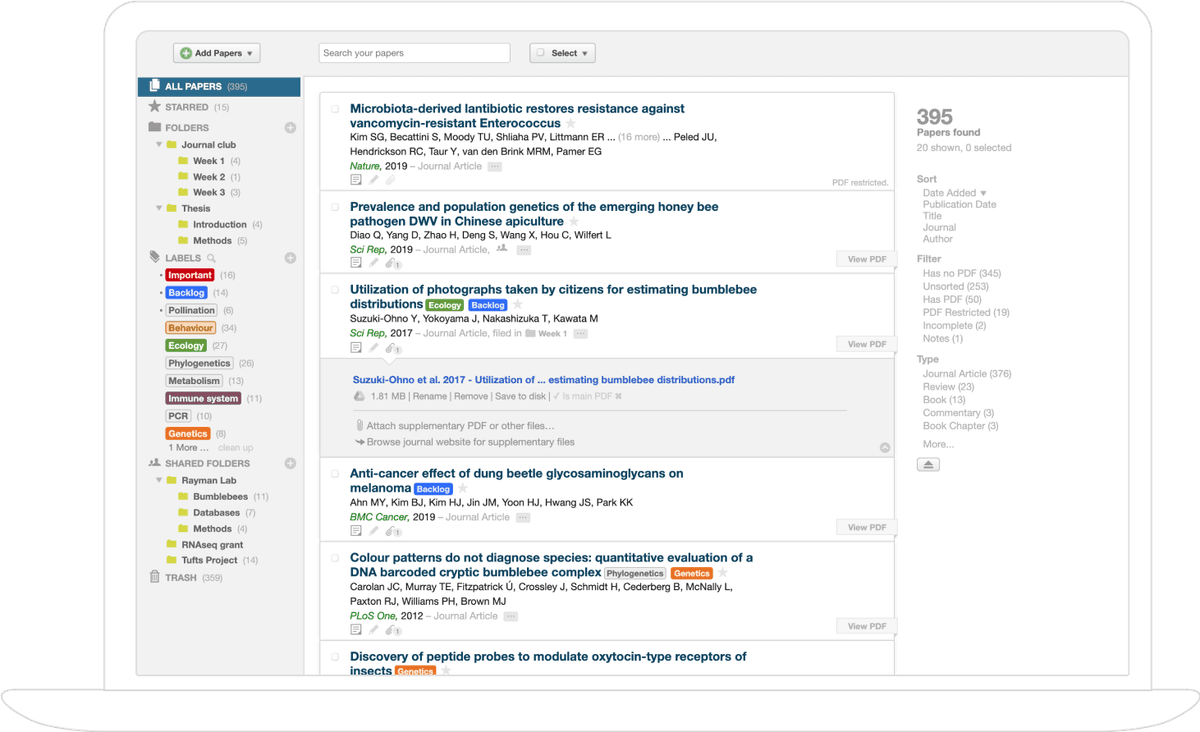
This official Paperpile screenshot shows the browser-first library view behind its Google Docs workflow. Source is the Paperpile homepage.
The weakness is lock-in. The desktop app only recently moved into beta, the product is paid-only, and the workflow assumes Google Docs. Paperpile fits researchers who write in Docs. Pricing is $2.99/month for individuals and $9.99/month for teams.
3. EndNote
EndNote remains the campus standard. Its Microsoft Word "Cite While You Write" support is the strongest in this set. It also offers 7,000+ citation styles and solid PDF tools.
Outside institutional licenses, the $249.95 one-time price is steep. The UI is older than Mendeley or Paperpile, and sync improvements lag cloud-native competitors. EndNote is best for researchers at institutions with site licenses, where it is often free for the user. Institutional pricing varies.
4. ReadCube Papers
ReadCube Papers is the AI discovery pick. It can suggest papers from your own library. The PDF reader is clean. Notes are easy to add, and SmartCite works in Word and Google Docs.
The user base is smaller than Mendeley or Zotero, and the product is subscription-only at $5/month. It fits researchers who want AI-suggested next papers and clean reading without committing to the Zotero ecosystem.
5. Citavi
Citavi combines citations, tasks, and notes in one project. That style is common in German academic work. It has strong Word support and works well for theses and books.
The downside is platform fit and complexity. Citavi is Windows-first, with macOS support through the less mature Citavi Web, and the learning curve is steep. It fits long-form research projects where tasks and references belong in one tool, especially in German academia. Pricing is $119/year.
6. Atlas
Atlas is for cited AI Q&A across PDFs, notes, and web research. Each answer points to the source passage, and the free tier covers light solo use.
It is not a traditional citation manager and does not yet offer Word "Cite While You Write." The best setup pairs Atlas with Zotero or Mendeley for bibliography work. It fits researchers who want AI answers they can check. For the wider category, see our smart notes app guide. Atlas has a free tier and a $20/month Pro plan for higher AI limits.
7. Zotero (For Comparison)
Zotero remains free, open source, and principled. It includes 300MB of free cloud storage and unlimited local storage. It also has the largest plugin community, with tools such as Better BibTeX, ZotFile, and Mdnotes.
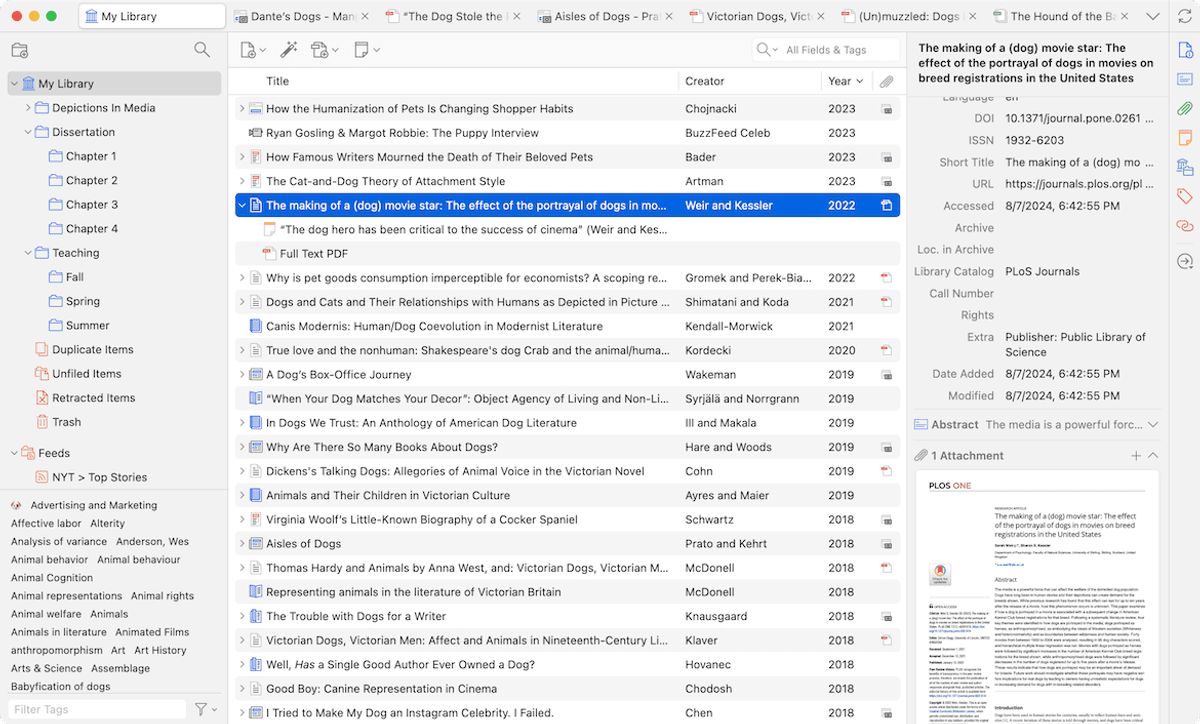
Zotero's official desktop screenshot shows folders, tags, paper details, and a PDF preview. That is why it is still the open-source baseline. Source is Zotero.org.
The desktop UI is dated, mobile lags, and there is no native AI. Zotero is still the right baseline for open labs and users who do not want vendor lock-in. The app is free, with paid cloud storage above 300MB per Zotero documentation in May 2026.
Comparison Table
Start with the writing-app column because citation insertion is the hardest workflow to replace. Then compare price and AI support: Zotero, Mendeley, Paperpile, EndNote, and Citavi manage bibliographies, while Atlas adds cited Q&A but still needs a reference manager for final formatting.
| Tool | Price | Best For | AI | Word/Docs |
|---|---|---|---|---|
| Mendeley | Free / paid storage | PDF reading, Elsevier | Limited | Word add-in |
| Paperpile | $2.99/mo | Google Docs writers | Beta | Docs native |
| EndNote | $249.95 once | Institutional | None | Industry-best |
| ReadCube | $5/mo | AI citation recs | Yes | SmartCite |
| Citavi | $119/yr | Tasks + refs | None | Word strong |
| Atlas | Free / $20/mo Pro | Cited AI Q&A | Yes (cited) | Pair with above |
| Zotero | Free | FOSS baseline | None | Word/Docs add-on |
Table 1: Cost, fit, AI, and Word or Docs support for each tool.
When to Choose Each Tool
Choose Zotero when free, open-source reference management is the priority, or Mendeley when you want a more polished free PDF reader. Choose Paperpile for Google Docs and EndNote when your institution provides a license for Microsoft Word workflows.
Choose ReadCube for AI-assisted paper discovery, Citavi when a long research project needs tasks beside references, and Atlas for cited Q&A across a paper library. Atlas complements Zotero or Mendeley rather than replacing their bibliography tools.
Common Mistakes
Avoid switching tools mid-PhD unless the current tool blocks your work. The migration cost is high because citation styles break and annotations sometimes do not transfer. Pick a tool early and stick with it.
Do not ignore cloud-storage limits. Zotero's 300MB free tier fills fast for PhD students, so budget the $20-60/year storage upgrade or use Mendeley's free 2GB tier.
Do not skip AI grounding. Generic ChatGPT can invent citations with confidence. Atlas, ReadCube, and Paperpile ground AI in your actual library, which matters for research use. Our smart notes app guide covers the grounding criteria in more depth. For the broader option set, see ChatGPT alternatives.
Next Step: When AI Helps Most
AI helps most when you ask a question across many papers. A useful answer should cite the exact paper and passage. Atlas fits this job and pairs well with Zotero or Mendeley for bibliography work.
For a wider view of the category, see where AI research tools fit before changing your citation manager.
Cost, Privacy, and AI Reliability
A reference manager may hold years of academic work. Compare the full cost of keeping it through a degree, whether you can retain control of private or embargoed material, and how reliably its AI features point back to the correct paper.
Five-Year Cost for Graduate Students
Reference managers stay with you for 4-7 years through a degree. A five-year view gives the true cost. For a typical PhD student who builds a 1,500-paper library:
| Tool | Year 1 cost | Five-year cost | Storage included |
|---|---|---|---|
| Zotero (free + 6GB cloud upgrade) | $20 | $100 | 6GB cloud |
| Zotero (free, local only) | $0 | $0 | Local unlimited |
| Mendeley (free) | $0 | $0 | 2GB cloud |
| Paperpile Individual | $35.88 | $179.40 | Google Drive |
| EndNote | $249.95 | $249.95 (one-time) | Local + EndNote Online |
| ReadCube Papers | $60 | $300 | 100GB cloud |
| Citavi | $119 | $595 | Cloud + local |
| Atlas Pro | $240 | $1,200 | Cloud (per Atlas plan) |
Table 2: Five-year cost estimate for a graduate student comparing free tiers, storage upgrades, and paid plans.
The cheapest viable five-year stack is Mendeley free plus a Google Docs or Word add-in, at $0 total. The cheapest paid setup for the full PhD writing loop is Zotero with a paid cloud upgrade at roughly $20-60/year. EndNote's $249.95 one-time price can beat subscription tools over five years, but only if your institution does not provide a free site license. Most R1 universities in the US, UK, Canada, and Australia include EndNote in their library bundle.
The hidden cost is migration. Switching tools mid-PhD usually costs 8-20 hours. Expect to re-download PDFs, repair broken citation links in drafts, fix collections, and retag papers. Pick a tool in year one and only switch if it blocks your work.
For collaborative projects, the per-seat math changes. Paperpile Teams at $9.99/user/month costs about $600/year for a five-person lab. Mendeley Group plans add $4-8/user/month above the free tier. Zotero group libraries are free up to the 300MB cloud-storage cap, then per-user storage upgrades apply.
Privacy, Data Residency, and Long-Term Reliability
Reference libraries can hold private work. That includes draft papers, peer notes, advisor comments, and embargoed data. Here is the short read in 2026:
- Zotero. Open source and run by a nonprofit. It can sync through WebDAV. It is the safest long-term bet because the file format is open and the data is yours.
- Mendeley. Owned by Elsevier since 2013. The older Mendeley Desktop sync shutdown in 2022 is a real trust mark against it, even though the current app is stable.
- Paperpile. Claims SOC 2 Type II. Storage rides on Google Drive, so Google Workspace rules matter.
- EndNote. Owned by Clarivate. It is local-first by default. EndNote Online is US-hosted.
- ReadCube. Owned by Digital Science. It claims SOC 2 Type II and GDPR fit.
- Citavi. Owned by Lumivero. It is EU-hosted by default because of its German roots.
- Atlas. Stores notes in user-controlled storage and runs on-device AI for embeddings and summaries when possible.
For long-term safety, Zotero and EndNote are the best bets. Zotero wins on open files and nonprofit control. EndNote wins on its 30-year track record and local-first format. Mendeley loses trust because Elsevier has shut down old data paths before.
AI Q&A Quality and Hallucination Behavior
The 2024-2026 wave of AI features in citation tools falls into three groups:
- AI paper suggestions. ReadCube and Paperpile can suggest related papers from your saved set. This is useful for discovery. Risk is low because you check each paper before citing it.
- AI paper summaries. Most paid tools now make short summaries of new PDFs. Quality varies. Expect some wrong methods, dates, or sample sizes. Always reread the abstract.
- AI Q&A across papers. Atlas, ReadCube, and Paperpile let you ask "what do my papers say about X?" and return answers tied to the papers. These answers can still misinterpret a method or attach a claim to the wrong passage. For graded or published work, open the cited source and check every claim.
The practical rule is simple. Use AI for discovery and summaries. Check every citation before it appears in a paper. Never copy an AI-written quote into your own work until you check the source.
Final Take
Zotero remains the open-source baseline. Mendeley is the polished free option. Paperpile fits Google Docs writers. EndNote fits campus Word users. ReadCube and Atlas cover AI use cases. Citavi owns the tasks-plus-references niche. Choose the tool that fits your writing app and your need for grounded AI.
AtlasSee where AI research tools fit
See eight research tools compared across discovery, checking, and synthesis.
Frequently Asked Questions
Six. Mendeley (free, Elsevier-owned) for PDF reading and Reference Manager 2024 redesign. Paperpile ($2.99/month) for Google Docs integration, the slickest cloud-native option. EndNote ($249.95 one-time) for institutional-grade citation management with Microsoft Word integration. ReadCube Papers ($5/month) for AI-recommended citations and clean PDF reading. Citavi ($119/year) for German-academic-favorite knowledge organization with task management. Atlas ($20/month Pro) for AI-cited Q&A across your reference library. Pick by workflow: cloud-native (Paperpile), institutional (EndNote), all-in-one (Citavi), AI-grounded (Atlas).