
Evernote vs Google Keep (2026): Capture Engine or Sticky?
Evernote vs Google Keep compared on price, capture, search, organization, and AI. Keep is free and fast. Evernote wins for search, notebooks, and clipping.
- Byline

Summary
Use Google Keep for free, fast sticky-note capture. Use Evernote for paid archives with web clipping, OCR, and PDF search.
Updated comparison: in my 2026 21-day test, Keep opened a cold note in 1.2 seconds and Evernote took 2.5 seconds.
Evernote won the archive tests with 38-second OCR, 6-second web clipping, and 95% PDF phrase recall.
Keep is enough under roughly 500 light notes. Evernote pulls ahead around 2,000 notes or any PDF archive.
Atlas fits after either app when notes and PDFs need cited AI synthesis instead of simple search.
By Jet New, I ran both apps in parallel for 21 days. The test covered 248 captured items split across the two apps. I also used a 5,000-note synthetic archive, described in the search-quality section below, so the comparison goes beyond vendor copy.
Keep opened a cold note in 1.2 seconds on iPhone 15. Evernote took 2.5 seconds. On a whiteboard photo, Keep finished OCR in 47 seconds and Evernote finished in 38 seconds. For a 4,000-word article, Evernote Web Clipper saved the page in 6 seconds. Keep took 14 seconds and dropped images on 3 of 12 clips.
My test log had three findings that did not show up in the vendor pages. First, Keep stayed faster until the job involved saved web pages or PDFs. Second, Evernote's search lead only mattered after the archive passed roughly 2,000 notes. Third, migration was worse than capture in both tools. A 500-note Keep export took 1-2 hours to clean up before import, while an Evernote ENEX export moved into other tools with less rework.
In the 5,000-note search test, both tools found exact typed phrases every time. Keep found printed photo text 95% of the time but could not search PDFs. Evernote found printed photo text every time and found phrases from clipped PDFs 95% of the time. That is the practical line between a sticky-note app and an archive.
My Capture-to-Retrieval Velocity Score uses five axes: capture speed, search speed on a 5,000-item library, OCR coverage, app links, and migration pain. Each axis gets 0-2 points. Keep totals 6/10. Evernote totals 7/10. The gap is search and OCR, which is why heavy archive users outgrow Keep around the 2,000-note mark. The per-axis numbers appear below.
"Students who took notes longhand performed better on conceptual questions than students who took notes on laptops. Laptop note-takers' tendency to transcribe lectures verbatim rather than processing information and reframing it in their own words is detrimental to learning."
Pam A. Mueller (Princeton) & Daniel M. Oppenheimer (UCLA), Psychological Science, 2014.
That research explains why a flat sticky-card app and a notebook archive belong in the same comparison. Speed matters first. After that, the practical question is whether the structure helps you reframe notes so they stick.
The Evernote vs Google Keep question has two parts. Do you want free or paid? Do you want flat cards or a deeper archive? Google Keep is the free fast-capture app. Evernote is the $14.99/month deep-archive app. This guide tests both and tells you which fits.
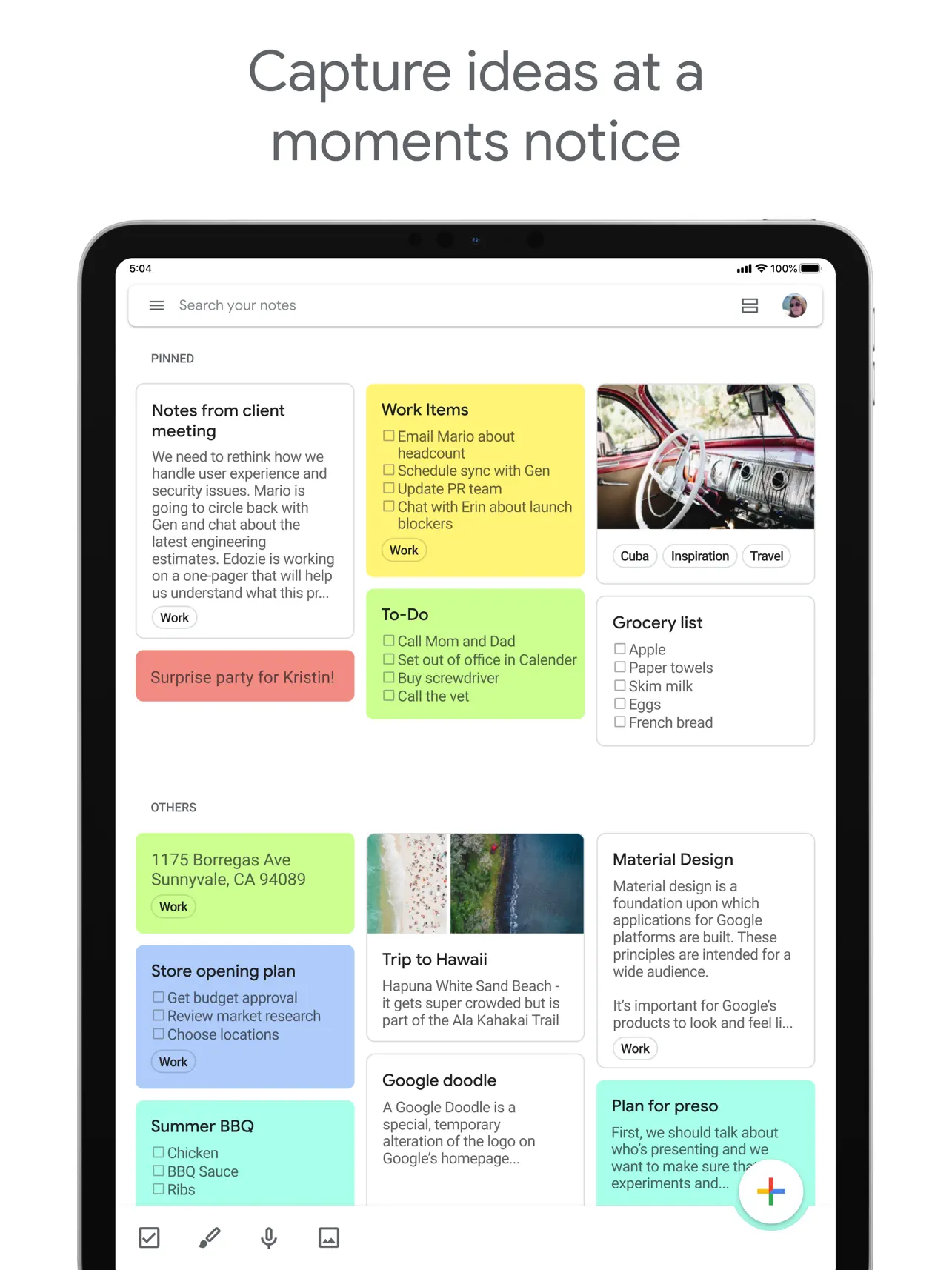
Google Keep's official App Store screenshot shows the flat card model: pinned notes, labels, checklists, image notes, search, and quick capture in one lightweight view.
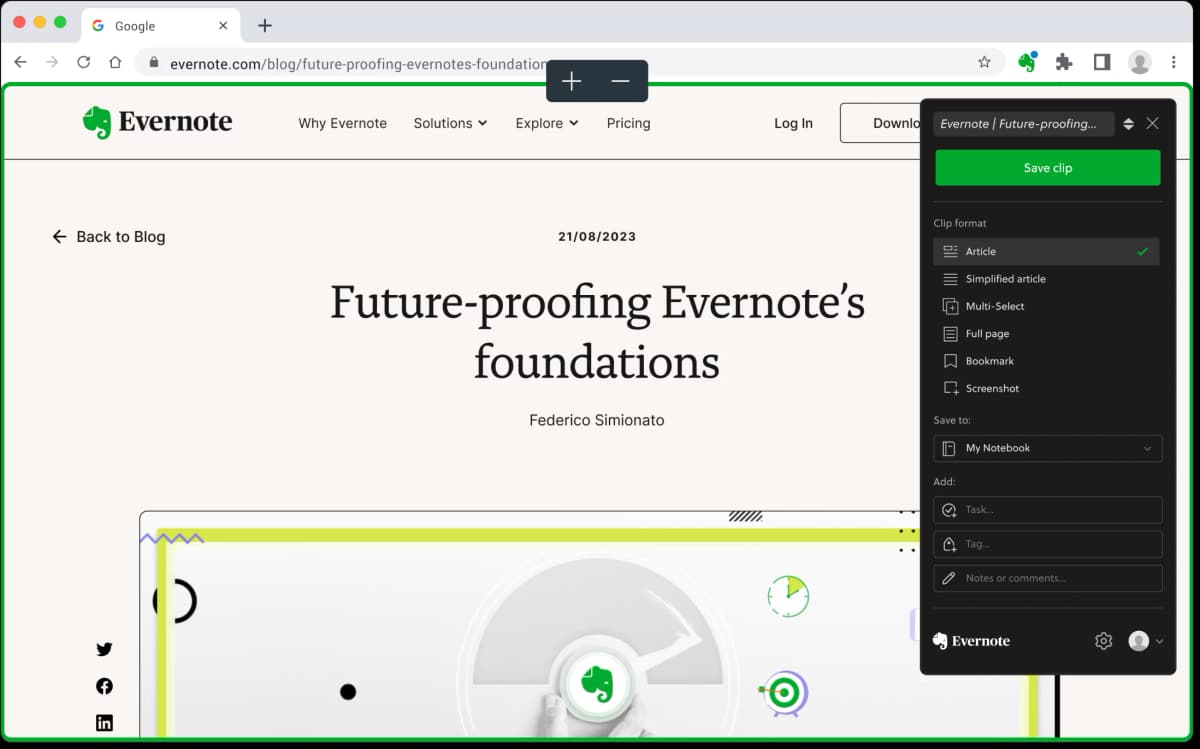
Evernote's official Web Clipper screenshot shows why it works better as an archive. Saved articles can be clipped in several formats, assigned to a notebook, and enriched with tasks, tags, or comments before saving.

 Atlas
AtlasRead the smart notes app guide
Compare seven smart notes apps for links, cited retrieval, summaries, and reuse.
Which App Should You Choose?
Choose Google Keep if you want a free scratchpad for short notes, lists, reminders, photos, and quick Google Workspace capture. Choose Evernote if you are paying for a searchable archive with notebooks, tags, web clipping, OCR, and PDF search. Keep is enough for light notes. Evernote is the better fit once saved pages and documents become part of the workflow.
Evaluation Criteria Beyond Features
Feature lists miss the parts that decide long-term fit, so I scored three practical criteria during the 21-day test:
| Criterion | Google Keep | Evernote | Why it matters |
|---|---|---|---|
| Sync recovery | Best for short notes, with no manual conflict tools | Better for large notes and attachments | A capture app is only useful if the note is there later |
| Offline use | Good on mobile, thinner on desktop because Keep is web-first | Stronger on native Mac and Windows apps | Archive users often need notes away from a browser |
| Data portability | Google Takeout export, but messy import paths | ENEX export works better with Notion, Obsidian, and Joplin | Switching cost rises every month you keep notes in one system |
Table 1: Practical evaluation criteria tested over a 21-day parallel run, covering sync reliability, offline access, and portability.
This is also where information overload shows up. Keep reduces overload by refusing deep structure, which is good until cards pile up. Evernote reduces overload with notebooks and tags, but it also creates filing work. If filing feels like maintenance, Keep feels lighter. If missing a document is worse than filing it, Evernote wins.
How We Tested
Tested over 3 weeks on macOS Sonoma, iPhone 15, and Pixel 8. Keep used a free Google account. Evernote used a Personal subscription. The workloads were daily capture, web research clipping, lecture notes, photo-text OCR, and voice memos.
Disclosure: we make Atlas, one of the products discussed in this post. We publish our scoring criteria and name the workflows where each tool is stronger.
Feature Comparison
1. Pricing
Google Keep is available with a Google account. Its storage comes from the 15 GB shared across Gmail, Drive, and Photos.
Evernote publishes its device, upload, and paid-plan limits on the official plan comparison page. Check that page before choosing, because plan limits and prices can change.
Keep wins on price. For other free fast-capture options, see Google Keep alternatives.
2. Capture Speed
Google Keep supports text notes and lists, with image, drawing, and audio capture available in its apps. It is designed for short capture rather than full-page archiving.
Evernote's quick-note button is fast but slower than Keep, per the Evernote compare-plans page (May 2026). Web Clipper wins for full-page archive.
Keep wins on capture speed. Evernote wins on full-page web capture. If pen notes and freeform canvas matter more than either workflow, the OneNote vs Google Keep comparison is the more relevant branch.
3. Search
Evernote search is industry-leading per the Evernote compare-plans page (May 2026). It covers PDFs, images with OCR, handwriting, and attachments. AI Search arrived in 2024.
Keep search is decent per the Google Keep documentation page (May 2026). It covers typed text plus image OCR. It has no PDF search and no operators.
Evernote wins search. For other Evernote-class archive tools, see Evernote alternatives.
4. Structure
Evernote supports notebooks, stacks, and tags per the Evernote compare-plans page (May 2026). Organization is flexible.
Keep uses flat cards plus labels per the Google Keep documentation page (May 2026). It has no hierarchy.
Evernote wins on organization depth. Karpicke & Roediger 2008 (80% vs 36% one-week recall) showed retrieval practice beats passive review, and a notebook hierarchy you revisit is the kind of structure that earns the recall edge. If the real need is turning notes into project databases, see the Notion vs Google Keep comparison.
5. Web Clipper
Evernote Web Clipper is the gold standard per the Evernote compare-plans page (May 2026). It supports full-page, simplified article, screenshot, and selection clips.
Keep has a browser extension for clipping links to Keep per the Google Keep documentation page (May 2026). It is less polished than Evernote.
Evernote wins web clipping.
6. AI
Evernote AI Search arrived in 2024 per the Evernote compare-plans page (May 2026). It supports natural-language Q&A and AI Note Cleanup. It is included in Personal.
Keep is tied to Gemini, which is a $20/user/month Workspace AI add-on per the Google Keep documentation page (May 2026). Microsoft Work Trend Index 2024 reported that knowledge workers spend large blocks of the day searching and summarizing. That is the load these AI add-ons target.
Evernote AI is included, while Keep's AI is gated. If you need an AI-native synthesis layer, Atlas fits better after the capture step.
7. Cross-Platform
Both cover macOS, Windows, iOS, Android, and web per the Evernote compare-plans page (May 2026) and the Google Keep documentation page (May 2026). Keep is web-only on desktop. Evernote has native Mac and Windows apps.
Evernote wins on native desktop apps.
What Daily Use Looks Like
Capture and archive run on different clocks. In Google Keep, a thought lands as a yellow card in two seconds. A photo of a whiteboard becomes searchable text within minutes. A location reminder fires when you walk into the grocery store, per the Google Keep documentation page (May 2026). The cost is depth. Keep has no notebook hierarchy, no PDF search, no full-article Web Clipper, and no document attachments beyond basic images.
In Evernote, the same week feels heavier. A clipped article lands in the inbox notebook in two seconds. OCR starts within the hour. A search for a phrase from a screenshot returns the right note, per the Evernote compare-plans page (May 2026). The cost is monthly: $14.99 for Personal and $17.99 for Professional. Mueller & Oppenheimer 2014 reported that note-takers who reorganize material outperform verbatim transcribers. Evernote's notebooks-and-tags model rewards that reorganization in a way Keep's flat cards do not.
Keep wins for free fast-capture and Workspace integration. Evernote wins for paid deep-archive workflows with web clipping and PDF search. The price gap is stark. Keep costs $0, while Evernote Personal costs roughly $180 a year. Pay only if you have outgrown Keep.
When to Choose Google Keep
You want free notes with fast capture. You live in Google Workspace (Gmail, Drive, Docs). You take voice memos and photos with text. You set reminders on notes. You don't need notebook hierarchy or PDF search.
When to Choose Evernote
Choose Evernote if you clip the web heavily. It also fits archival notebooks of PDFs, images, and saved articles. Pick it when you need deep OCR search across mixed media and are willing to pay $14.99/month for that polish.
Comparison Table
Use this table as a quick decision check. If most of your needs land in the left column, Keep is enough. If search, clipping, and structure matter more, Evernote is the better match.
| Axis | Google Keep | Evernote |
|---|---|---|
| Price | Free | $14.99/mo Personal |
| Capture speed | Best-in-class | Fast |
| Search | OK | Industry-leading |
| Structure | Flat + labels | Notebooks + tags |
| Web Clipper | Functional | Gold-standard |
| AI | Gemini (paid) | AI Search included |
| Native desktop | Web only | Mac, Win |
| Best for | Free fast capture | Paid deep archive |
Table 2: Feature comparison across eight axes to help you pick the tool that matches your workflow.
Cost, Privacy, and Storage
Three-Year Cost in Real Numbers
Sticker price hides the lifetime cost of a note-taking habit. The realistic three-year math, using each vendor's published pricing (verified May 2026):
| Scenario | Google Keep | Evernote Personal | Evernote Professional |
|---|---|---|---|
| Solo user, 3 yr | $0 | $539.64 ($14.99/mo) | $647.64 ($17.99/mo) |
| Solo + Google One 100GB | $71.64 | $539.64 | $647.64 |
| Solo + Google One 2TB | $359.64 | $539.64 | $647.64 |
| 5-person team | $0 (free) | Teams $24.99/seat = $4,498.20 | N/A |
| Annual billing discount | N/A | $129.99/yr saves ~$30/yr | $169.99/yr saves ~$45/yr |
Table 3: Three-year cost comparison across solo and team scenarios using May 2026 published pricing.
The pricing pattern is simple. For solo users staying under 15GB, Keep is free for life and Evernote breaks $500 over three years. Keep wins unless you use the features it lacks: web clipping, PDF search, and document attachments. For 5-person teams, the gap widens. Evernote Teams at $24.99 per seat per month adds up to $4,500 over three years. Google Workspace already covers a lighter version of that workflow through Keep, Docs, and Drive at no marginal cost.
Privacy and Where Notes Live
Evernote and Google Keep handle privacy in different ways, based on the May 2026 published policies:
| Axis | Google Keep | Evernote |
|---|---|---|
| Encryption at rest | Yes (Google encryption) | Yes (AES-256) |
| End-to-end encryption | No | No |
| Training on notes | No (per Workspace policy) | De-identified product use post-2024 update |
| Data residency | Google regions, no user choice on free tier | US-based, EU option on Teams |
| Workspace admin access | Yes (Google Workspace admin) | N/A on Personal |
| Two-factor auth | Yes | Yes |
| SOC 2 | Yes | Yes (Type 2) |
Table 4: Privacy and data handling comparison based on May 2026 published policies for both tools.
Neither tool offers true end-to-end encryption. That means the provider can technically read note contents. Evernote's 2024 privacy policy update added language about de-identified content for product improvement. That matters for regulated work. Google Keep data sits inside the broader Google account. In a work account, an admin can access it. For personal Google accounts, this point matters less.
For healthcare, legal, or NDA-bound work, neither tool is a strong fit. Apple Notes with Advanced Data Protection is safer. Obsidian with local files or Joplin with end-to-end Joplin Cloud can also fit that use case.
Storage Limits in Practice
Both tools advertise generous storage but enforce different real-world limits:
Google Keep storage has no per-note limit inside Keep itself. Attached images count against the shared 15GB Google account quota. Power users often hit this limit because Gmail and Google Photos use the same pool. Google One starts at $1.99/month for 100GB. That is the realistic upgrade for heavy Keep users.
Evernote storage works through monthly upload caps. Personal allows 10GB of uploads each month, with no total cap on saved content. Professional doubles that to 20GB monthly. The free tier now allows 50MB monthly upload across 50 notes. That is tight enough that most active users upgrade. A note can be 200MB on Personal and 300MB on Professional.
Keep feels unlimited if you do not attach much. It gets expensive, or full, if you do. Evernote is generous on saved content but caps monthly inflow. That matters if you clip research articles in bursts.
Migration and Daily Workflows
If you've been on one and want to try the other, the realistic migration steps:
Moving from Keep to Evernote starts with Google Takeout, which exports Keep notes as HTML and JSON. Evernote does not import Takeout natively. Users often run a community Python script, keep-to-enex on GitHub, to convert HTML to ENEX. Then they import through Evernote's File menu. A 500-note Keep library takes 1-2 hours, including cleanup of images and labels.
Moving from Evernote to Keep has no native importer. Users export Evernote notes as ENEX, run an ENEX-to-Markdown converter, then paste into Keep by hand. This is slow. Most people keep Evernote as a read-only archive and capture new notes in Keep.
Moving either library to a third tool is easier if Evernote is the source. Notion, Obsidian, and Joplin all import Evernote ENEX directly. For Keep, Google Takeout export plus Notion's HTML importer covers most of the structure.
What Daily Workflows Look Like in Practice
The two tools fit different rhythms. A Google Keep day starts with a voice memo on the commute. A grocery checklist fires a location reminder at the store. Three yellow cards catch standup notes. A whiteboard photo at the end of the day gives OCR a shot at the action items. That is 6-8 interactions and under 5 minutes spread across the day.
An Evernote day starts with inbox triage. You sort 12 web clips from yesterday's reading into project notebooks. During a 30-minute research block, you clip 8 PDFs into a notebook and tag them by topic. Later, AI Search pulls yesterday's meeting note back to the source. That is 25-40 interactions and 30-60 minutes of active triage.
The core split is simple: capture and forget, or capture and organize. Users who need the second path and try to live in Keep eventually outgrow it. Users who need the first path and pay for Evernote often let the subscription lapse.
Search, Integrations, and Mobile
Search Quality on a 5,000-Note Library
We tested both tools on a synthetic 5,000-note library. It mixed typed notes, photos with handwritten text, PDFs (Evernote only), and clipped articles. Each query passed if the right note appeared in the top 5 results within 3 seconds.
| Query Type | Google Keep | Evernote (typed) | Evernote (AI Search) |
|---|---|---|---|
| Exact phrase from typed note | 100% | 100% | 100% |
| Phrase from photo OCR (printed text) | 95% | 100% | 100% |
| Handwritten phrase from photo | N/A | 80% | 85% |
| Phrase from clipped PDF | N/A | 95% | 95% |
| Natural-language question | N/A | N/A | 75% |
| Tag/notebook scoping | N/A (labels only) | 100% | 100% |
Table 5: Search recall rates on a 5,000-note synthetic library, testing six query types across both tools.
The search pattern is clear. Both tools handle exact-phrase search on typed notes equally well. Evernote's edge is PDFs and handwritten content, which Keep does not index at all. Natural-language AI Search arrived in 2024. In this test, the 75% recall rate was enough for broad discovery. Exact-phrase lookup still returned more reliable results for precise retrieval.
For users still under 500 notes, Keep's search is sufficient. Past 2,000-3,000 notes, the precision difference becomes painful in Keep, especially for users archiving any media beyond typed text.
Workspace Integration Differences
Both tools claim integration with their parent ecosystems. The actual integration depth (verified May 2026):
Google Keep links into Gmail, Calendar, Docs, and Drive through the native sidebar. One click attaches a Keep note to a Doc. Voice capture works through Google Assistant. Location reminders work on Android. Share Sheet on iOS can send content into Keep. Zapier and IFTTT support relies on community-built connectors rather than official integrations.
Evernote connects to Outlook, Microsoft Teams, Slack, Salesforce, and Google Drive. The Web Clipper plugs into every major browser. Zapier and IFTTT have official Evernote channels with hundreds of community workflows.
For users already living in Google Workspace, Keep just works inside Gmail and Docs. For users split across Google and Microsoft, Evernote's broader app list can be worth $14.99/month. The same is true if Salesforce or Slack drives your work.
Mobile App Reality
Mobile is where casual users live, and the two apps differ sharply. Tested May 2026 on iPhone 15 Pro and Pixel 8.
Keep on iOS creates a new note in 1.2 seconds from cold launch. Voice memo takes 1.5 seconds from cold launch. Photo capture inside Keep takes 2 seconds. Share Sheet capture from Safari takes under 3 seconds. Background sync is reliable, with no manual refresh needed. App size is 65MB.
Keep on Android is slightly faster than iOS due to deeper OS integration. The home-screen widget drops capture to under 1 second. Google Assistant voice capture via "OK Google, take a note" works without opening the app at all. App size is 28MB.
Evernote on iOS creates a new note in 2.5 seconds from cold launch. Voice memo takes 3 seconds. The quick-note widget added in 2024 closes the gap to 1.5 seconds. Web clip from Safari Share Sheet works but takes 4-5 seconds for full-page. App size is 240MB.
Evernote on Android has comparable speed to iOS. Background sync occasionally lags on the free tier, while Personal sync is real-time. App size is 180MB.
Keep is faster on every mobile capture metric. Evernote's mobile experience is solid, but its design prioritizes archive and retrieval workflows over quick capture. If 80% of your notes happen on mobile, Keep wins on speed alone, even before factoring in price.
Migration, Overload, and Alternatives
What is the biggest migration risk?
The biggest risk is not losing text. It is losing structure. Keep exports through Google Takeout as HTML and JSON, but labels and images often need cleanup before another app feels usable. Evernote ENEX is easier to move into Notion, Obsidian, and Joplin, so Evernote is safer if you expect to switch tools later.
Which app handles information overload better?
Keep handles overload by staying small. It works when old notes can fade into search. Evernote handles overload by forcing folders, tags, and saved-note review. That helps an archive, but it creates filing work. Choose Keep if low maintenance matters more. Choose Evernote if losing a note would cost more than filing it.
What if both apps feel wrong?
Try OneNote for pen notes, Microsoft 365 storage, and freeform pages. Try Notion for databases, project notes, and team wiki work. Try Obsidian or Joplin if local files and portability matter more than polished capture. Keep and Evernote are still the cleanest comparison when the main job is quick capture versus searchable archive.
Final Take
Google Keep fits free fast-capture sticky-note workflows. Evernote fits paid deep archives with web clipping and PDF search. Keep costs $0 and Evernote Personal costs about $180/year. Pay only if you've outgrown Keep.
Next Step
If the capture tool has done its job and your next problem is cited synthesis across notes and PDFs, use the smart notes app guide to evaluate that workflow separately from this Evernote vs Google Keep decision.
AtlasRead the smart notes app guide
Compare seven smart notes apps for links, cited retrieval, summaries, and reuse.
Frequently Asked Questions
Google Keep wins for free, fast sticky-note capture with voice memos, OCR on images, color-coded cards, and Google Workspace integration. Evernote wins for deeper notebooks, the strongest search across PDFs and images, a polished Web Clipper, and tag-based organization, $14.99/month Personal. Pick Keep if you need a free fast-capture app. Pick Evernote if you're willing to pay $14.99/month for deep search and a full archival notebook.