
5 Literature Review Mistakes to Avoid and How to Fix Them
The 5 most common literature review mistakes and how to fix them. Read smarter, synthesize faster, and organize source notes into a source-backed argument.
- Byline

Summary
Avoid treating a literature review like a reading diary, because the review needs to become an argument about the field.
The 3C audit checks each paragraph for a claim, a source chain, and a consequence for the research gap.
Define the review type, read in passes, group evidence by theme, and map source links as you go.
Atlas helps with cross-paper synthesis, but Zotero should remain the source of truth for citations and bibliography export.
A literature review fails when it becomes a reading diary. The job is not to prove that you opened many PDFs. The job is to show what the field knows, where studies disagree, and what gap your work can address.
The fastest fix is to treat the review as a research system from day one. Define the type of review you are writing. Read in passes. Capture each useful claim beside the theme it supports. Then update the synthesis while the source is still fresh.
By Jet New, Atlas researcher.

 Atlas
AtlasConnect literature review themes with citations
Ask across your paper set and trace themes back to supporting passages.
The 3C Review Audit Method
I use a quick 3C audit when reviewing a weak draft: claim, chain, consequence. In June 2026, I applied it to this article before editing and found five failure modes: unclear scope, isolated notes, weak citation trails, late synthesis, and tool sprawl. Each body paragraph should make one claim, place it in a source chain, and explain the consequence for the research gap. A paragraph that only says "Smith found X" or "Jones argues Y" is still a source note. Review writing must connect that result to other work and to the writer's argument.
The 3C audit tests each paragraph. A draft can cite 60 papers and still fail if every paragraph only sums up one source. A strong search strategy also cannot save a draft with no visible source chain. The consequence check asks what changes after the reader accepts the evidence.
| 3C audit question | What a passing paragraph shows | Common failure |
|---|---|---|
| Claim | The writer's point comes before the citation | The paragraph starts with a source name |
| Chain | The source is linked to earlier or later work | The paper appears alone |
| Consequence | The paragraph explains why the evidence changes the gap | The paragraph ends after a summary |
Table 1: A strong review paragraph makes a claim, connects studies, and explains why the comparison matters.
Who This Mistake Guide Is For
This guide is for students and researchers with a stack of papers and no clear argument yet. It fits thesis chapters, review articles, and early proposals. A standalone review has its own opening, body, and ending. A thesis chapter uses the review to frame the study and justify the question.
The advice is not a full systematic review plan. A systematic review needs a formal search plan, screening records, and clear methods. A normal thesis review can still borrow that rigor without pretending to follow the PRISMA reporting framework.
If disconnected notes are already slowing the review, use this research-paper synthesis workflow to ask cited questions across your paper set in Atlas. Keep Zotero for citation management and bibliography export.
Common Literature Review Mistakes and Fixes
Use this table as a triage tool. If your draft has more than one symptom, fix the highest row first. Later fixes depend on clear scope and a real argument.
| Mistake | Symptom | Fix |
|---|---|---|
| Annotated-bibliography style | One paragraph per paper, no synthesis | Group papers under a theme or argument |
| Source dumping | Long quote blocks without analysis | Replace each quote with your one-sentence interpretation |
| No critical voice | Every paper sounds equally strong | Flag limits, conflicts, and weak methods |
| Missing the gap | The review ends without a research question | Conclude with what is not known and why it matters |
| Recency bias | Only papers from the last five years | Trace at least one core thread back to the original work |
| Citation chaining without reading | You cite papers you have only seen cited elsewhere | Read the abstract, methods, and key result before citing |
Table 2: Most literature-review failures improve when notes, synthesis, structure, and source checks become explicit.
Mistake 1: Reading Without a System
The first trap is reading every paper from abstract to conclusion. That feels thorough, but it is slow. It also treats a minor method detail like it matters as much as the finding that will guide your argument.
Use a two-pass read instead.
- First pass: Read the abstract, research question, conclusion, and figures. Decide whether the paper belongs in your review.
- Second pass: Read the methods and results only if the paper passed the first screen.
- Capture: Before closing the PDF, write one note in your own words: what this paper changes for your argument.
That last note matters most. A summary says what the paper said. A useful review note says what the paper does for your question.
Mistake 2: Taking Disconnected Notes
Many weak reviews have good notes trapped in separate files. Each paper has a summary, but the summaries do not speak to each other. When writing starts, the author has to rebuild every link from memory.
A literature review must synthesize its sources. In plain terms, synthesis means putting studies in conversation. One paper supports a theme. Another challenges it. A third explains why the results differ.
Use theme-first notes:
Paper-first notes
- Paper A summary
- Paper B summary
- Paper C summary
Theme-first notes
- Theme: intervention effects
- Paper A found a short-term gain
- Paper B found no long-term gain
- Paper C explains the difference through sample size
- Theme: method quality
- Papers A and C used matched controls
- Paper B used a weaker design
- Gap: no study tests the method in a low-resource setting
When you read a new paper, ask a simple question: "Which theme does this change?" Add the claim there. Do not create another isolated note unless the paper opens a new theme.
Mistake 3: Losing Citation Relationships
Academic work is a conversation. Papers respond to, extend, and challenge earlier work. If you lose that chain, your review loses its story.
A citation map does not need to be fancy. Track four things as you read:
- Which studies are cited again and again
- Which papers introduce the theory or method
- Which newer papers challenge an older claim
- Which papers share data, population, or method limits
This helps you avoid a common error. Do not cite a claim just because five recent papers mention it. Read the original source first. The map also helps you spot the difference between real agreement and papers repeating the same weak claim.
Mistake 4: Delaying Synthesis
Many researchers plan to read first and synthesize later. That plan feels logical. It also creates a pile of notes that is hard to use.
Start the synthesis document with the first paper. After each reading session, spend ten minutes updating it:
- Add new evidence to a theme
- Mark a conflict between papers
- Write one gap or open question
- Move a paper from "maybe useful" to "central" or "background"
This changes how you read. If a theme is already saturated, you can stop collecting more of the same evidence. If a gap appears, you can search for papers that test it. For more technique, see our guide on how to synthesize research papers.
Limitations of AI and Traditional Literature Reviews
Traditional narrative reviews are flexible. That is useful for thesis chapters and theory sections, but it also creates risk. Without clear criteria, the review can drift toward favorite authors, recent papers, or sources that are easy to find.
"A literature review is an evaluation of existing research works on a specific academic topic," write Uchendu Eugene Chigbu, Sulaiman Olusegun Atiku, and Cherley C. Du Plessis.
It covers search, reading, analysis, writing, citing, and references. That is broader than "read papers and write notes." It also explains why strong reviews record how sources were found and why they were kept.
AI can help with search, extraction, and questions across papers. It cannot replace careful reading. You still need to check methods. You also need to judge study quality and verify AI claims against the source.
Mistake 5: Choose Better Tool Alternatives
Tool sprawl creates hidden work. Your PDFs live in one app. Notes live in another. Drafts live somewhere else. Every search takes longer, and useful links disappear.
A good literature review stack has three jobs:
- Citations: Zotero or Mendeley stores paper details and exports bibliographies.
- Source reading: Your PDF reader keeps highlights tied to pages.
- Synthesis: A workspace connects themes, questions, and cited answers across the paper set.
For most researchers, Zotero should stay in the stack. It is the safer choice for citations and bibliography export. Atlas fits the synthesis layer. Upload a paper set, ask questions across it, and inspect cited passages before using the answer.
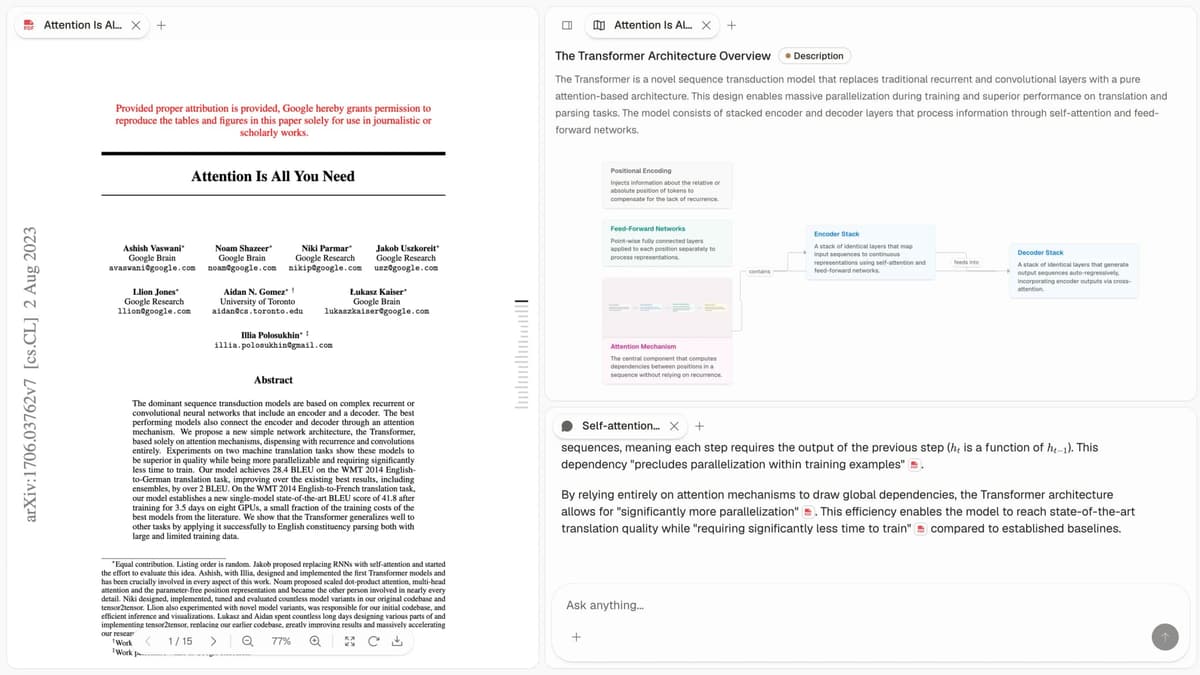
The screenshot shows one uploaded paper, a map of its Transformer architecture, and an answer with citation badges. For a review, repeat the source check across the selected papers before comparing themes.
Here is the concrete workflow:
- Upload 10 to 20 papers for one review theme.
- Ask: "Which papers support, challenge, or complicate my claim about this theme?"
- Open the cited passages behind the answer.
- Add each verified claim to the right theme in your synthesis document.
- Keep Zotero as the bibliography source of truth.
This fixes three mistakes at once. It reduces isolated notes, starts synthesis before the final writing week, and keeps claims tied to sources. Atlas augments the review process. It does not replace critical reading or source checks.
If your notes are scattered, use the research-paper synthesis workflow to ask cited questions across your paper set in Atlas. Use it beside Zotero rather than instead of Zotero.
A Better Literature Review Workflow
Here is the workflow in one pass.
Phase 1: Initial Survey
- Gather candidate papers through database searches.
- Screen abstracts and conclusions.
- Build an early theme list.
- Mark papers for deep reading.
Phase 2: Deep Reading
- Read the most useful parts in separate passes.
- Capture one argument-level note after each paper.
- Add claims to themes.
- Track source links and citation chains.
Phase 3: Synthesis Refinement
- Review each theme for support, conflict, and gaps.
- Search only where the outline is thin.
- Cut papers that do not change the argument.
- Turn the theme notes into section claims.
Phase 4: Writing
- Use the synthesis as the outline.
- Lead each paragraph with your claim.
- Build the structure from your claims, then use sources as evidence.
- End by naming the gap your work addresses.
Start with a Better Review System
Choose this process if you want a literature review that is easy to audit. A reader should be able to see why each source is there, how studies relate, and where the research gap comes from.
Before you add another paper, check the system. Do you know the type of review you are writing? Are your notes grouped by theme? Can you trace key claims back to the original source? Are you synthesizing as you read?
Fix those habits before adding more papers. The writing gets easier because the thinking is already organized.
For a complete walkthrough, see our guide on how to write a literature review with AI.
AtlasConnect literature review themes with citations
Ask across your paper set and trace themes back to supporting passages.
Frequently Asked Questions
The five most common mistakes are: reading papers linearly without a system, taking notes without connecting themes, failing to track citation relationships, waiting until the end to synthesize, and using fragmented tools that don't support your workflow.