
How to Take Notes in Nursing School (2026): A Working System
How to take notes in nursing school 2026: the best methods (Cornell, concept maps, SOAP notes, drug cards), the apps to use, and a weekly review plan.
- Byline

Summary
Use nursing school notes to connect lectures, concept maps, drug cards, lab values, and weekly review.
The updated guide covers Cornell notes, concept maps, pharmacology cards, iPad lecture notes, Anki, NCLEX organization, and AI safeguards.
Use Cornell for lectures, concept maps for systems thinking, drug cards for pharmacology, and spaced repetition for memorization-heavy content.
Nursing notes work when they filter volume, organize by body system, and stay verifiable against trusted clinical sources.
Nursing school destroys most note-taking systems. The volume is high, the pace is fast, and the exams demand precise recall under pressure. This guide gives you the working system: what to capture, what to skip, which formats to use, and how to review each week.
The system I saw work best is Capture, Convert, Confirm. Capture only high-yield cues during class. Convert those cues into Cornell questions, maps, or drug cards within 24 hours. Confirm the risky facts against the book, slide deck, instructor notes, or approved clinical source before they enter long-term review.
For broader methodology, see how to take Cornell notes and how to take good notes.
 Atlas
AtlasUse Atlas only for source-backed research notes
Read nine student AI workflows for research, citations, and source checks.
Quick Answer
Use Cornell notes for lectures, concept maps for body systems, and drug cards for pharmacology. During class, capture only repeated rules, patient-safety warnings, lab changes, and examples that change what a nurse should do.
Within 24 hours, turn those notes into questions or diagrams and verify clinical facts against your textbook, slides, instructor, or an approved clinical source. Review the material again each week with practice questions instead of rereading every page.
Build Your Nursing Note System
Compare nursing note-taking methods
For research papers and guideline work, use Atlas only for source-backed research notes. That guide shows how to use papers without treating AI as a clinical source.
| Method | Best content | Effort | Recall benefit |
|---|---|---|---|
| Charting | Compare/contrast (drug classes, disease states) | High | Highest for comparisons |
| Concept map | Pathophysiology, body systems | Medium | High, visual recall |
| Cornell | Lecture content with cue questions | Medium | High |
| ADPIE-structured | Care planning (Assess, Diagnose, Plan, Implement, Evaluate) | Medium | Highest for clinicals |
| Mnemonic + flashcards | Lab values, normal ranges, drug names | Low | High with spaced review |
Table 1: Charting and concept maps fit clinical comparisons; Cornell and split-page notes fit lectures and review.
Prepare handouts and slides
Do 15 minutes of setup before class. This is not deep study. It is a way to spot what matters before the room gets loud.
- Download the slide deck or handout.
- Skim headings and bold terms.
- Mark blank tables, care-plan boxes, and drug lists.
- Write 3 questions you expect the lecture to answer.
- Leave space beside each slide for professor cues.
Use instructor handouts as the spine, then expand the points your instructor stresses. If a handout lists five causes of chest pain, wait for class to tell you which ones your instructor stresses. If the slide has a long drug list, mark the class, the safety issue, and the lab to watch. Do not copy the whole list.
Capture the right lecture details
Your first job is not to copy the slide deck. Your first job is to catch cues. Star what the instructor repeats, writes on the board, says will be on the exam, or ties to patient safety.
Use a 3-column capture page during lecture:
| Cue | What to write | What to skip |
|---|---|---|
| Professor repeats it | The rule, warning, or pattern in your own words | The full slide sentence |
| Professor gives a patient example | Age, symptom, lab, risk, and the priority action | Extra story details |
| Professor says "watch for" | Red flags, side effects, contraindications, and lab changes | Generic definitions you can read later |
| Slide has a long list | Top 3 exam-prone items and why they matter | Copying every bullet |
Table 2: This keeps notes brief enough to review. It also trains the same cue-to-action habit tested by the NCSBN Clinical Judgment Measurement Model: recognize cues, analyze cues, prioritize, act, and evaluate.
In plain terms, write down what changes care. If a fact would change who you see first, what you report, what you teach, or what you hold, keep it. If it only restates the slide title, skip it.
Account for nursing-school demands
Three things make nursing-school note-taking harder than typical undergraduate work.
Volume: A typical med-surg semester covers 10+ body systems with 30-50 conditions per system. Each one has labs, meds, risks, and care steps. Standard linear notes do not scale.
Risk: Drug and disease notes carry a real cost of error. A wrong drug-class fact in clinical can hurt a patient.
Exam style: NCLEX-style questions demand judgment beyond plain recall. "Which patient should the nurse see first?" asks you to link labs, symptoms, risk, and care.
Good nursing notes solve all three.
Three Note Formats for Nursing School
1. Cornell notes for lectures
The standard Cornell layout, three sections on each page:
- Right column (large): key ideas during lecture.
- Left column (narrow): cue questions added within 24 hours after lecture.
- Bottom row: 2-3 sentence summary.
Use Cornell for traditional lecture content (foundations, ethics, pharmacology basics). The cue-question column is what separates Cornell from generic notes, it forces you to test yourself rather than reread.
For full Cornell mechanics, see how to take Cornell notes.
2. Concept maps for systems content
A concept map is a visual diagram with nodes. For nursing, the nodes are conditions, labs, care steps, and drugs. The lines explain the relationship: causes, treats, worsens, or conflicts with.
Concept maps train the NCLEX priority skill. A low potassium result changes a digoxin decision. That changes rhythm risk. That can change fall risk.
Build a concept map for each body system. Center the system organ, surround with conditions, branch out to labs, drugs, and nursing interventions. Use color coding by category.
Tools: draw.io and Excalidraw work for free diagrams. Notability and GoodNotes work well for hand-drawn maps on iPad. Atlas is only a light fit here. Use it for cited research notes. Base clinical decisions on verified clinical guidance.
3. Drug cards for pharmacology
A drug card is a compact reference for one medication with fixed fields:
- Class (e.g., beta blocker)
- Mechanism (e.g., blocks beta-1 receptors, reducing HR and contractility)
- Indications
- Contraindications
- Adverse effects (highlight severe ones)
- Nursing implications (assessments, teaching points)
- Onset, peak, duration
Build cards for the top 200 NCLEX-relevant drugs. Some students prefer paper index cards, others use Anki for digital spaced repetition.
Adapt Notes for Clinical Work
Practice with SOAP notes
Class notes and clinical notes are not the same thing. Class notes help you learn. Clinical notes help a care team understand what happened.
Use SOAP practice notes once you start clinical rotations. NCBI Bookshelf defines SOAP as Subjective, Objective, Assessment, and Plan, a common structure for health care documentation.
| SOAP field | Nursing-school note version |
|---|---|
| Subjective | What the patient reports: pain, nausea, dizziness, fear, or history |
| Objective | What you can measure or observe: vitals, labs, wounds, output, gait |
| Assessment | What pattern you think the cues point toward |
| Plan | What the nurse should monitor, teach, report, or do next |
Table 3: Do not use SOAP notes as a replacement for your program's charting rules. Use them as practice for clear thinking. They force you to separate patient statements from measured facts, which is also useful for NCLEX case questions.
Separate class and clinical notes
Class notes help you learn patterns, while clinical rotation notes track a real patient day. Keep them separate.
| Setting | Main job | What to capture |
|---|---|---|
| Lecture | Learn the pattern | Cues, rules, lab shifts, drug warnings, exam hints |
| Lab | Practice the skill | Steps, safety checks, sterile breaks, common errors |
| Clinical rotation | Track the patient | Vitals, symptoms, orders, care given, what changed |
| Post-clinical | Learn from the case | What you missed, what you reported, what you would do sooner |
Table 4: For clinicals, write less and verify more. Do not put protected patient details in a personal app. Use your school-approved charting system and your instructor's rules. In your private study notes, keep only de-identified learning points, such as "low output plus rising creatinine needs fast follow-up."
One useful end-of-shift prompt is simple. What changed, what did I do, and what would I watch next time?
Best Nursing School Apps
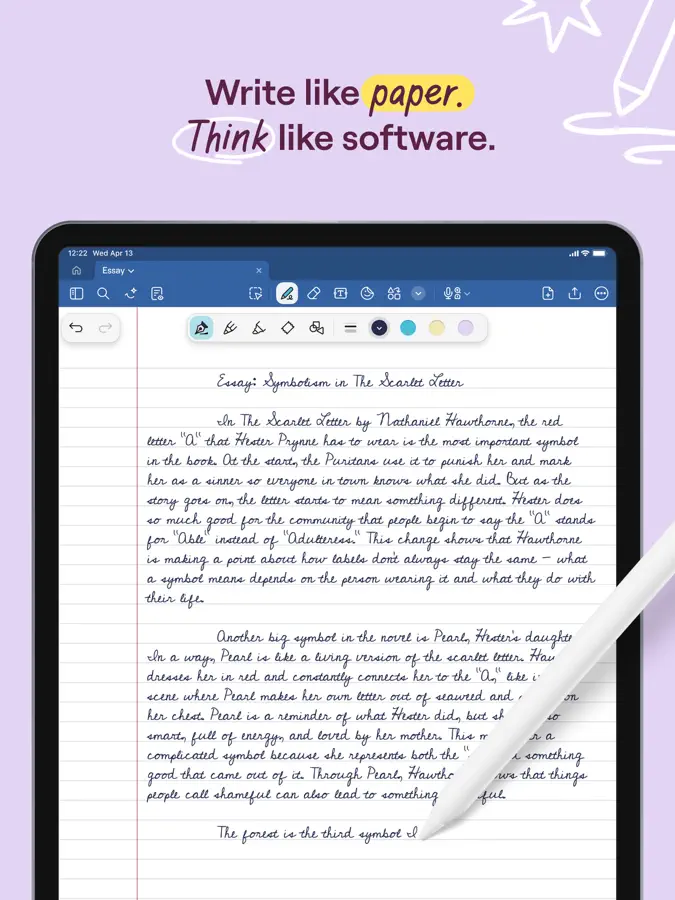
Notability: best for audio-synced lecture notes
Pricing: Starter free, Lite, Plus ~$20/year, Pro ~$99/year.
Why nurses pick it: Notability links recordings to written notes, so tapping a note can return to the corresponding audio. That helps when a fast lecture moves past a detail before you finish writing it down.
GoodNotes: best for iPad PDF annotation
Pricing: Free tier (3 notebooks), Essential ~$11.99/year or $35.99 one-time, Pro ~$35.99/year, AI Pass ~$9.99/month.
Why nurses pick it: import the lecture slide deck as a PDF, annotate directly during class, organize by semester. AI Pass adds handwriting-aware summarization. Custom templates (notebook paper, Cornell, study planner) save setup time.
Anki: best for memorization-heavy review
Pricing: Free desktop and Android, AnkiMobile $24.99 one-time for iOS.
Why nurses pick it: Anki schedules cards for repeated review, and retrieval-practice research supports testing memory instead of only rereading. Build your own cards so each answer matches your approved course material.
Atlas: useful only for research-backed notes
Pricing: $20/month Pro.
Atlas is an AI-native knowledge workspace. It is not the main tool for nursing lecture notes, drug cards, or NCLEX drills. Use it only when the assignment involves research papers, evidence-based practice sources, or clinical guidelines. For that workflow, see the student's guide to AI research.
- Cited summaries of long readings with links back to the original source pages.
- Mind maps from source notes when you need to explain a paper or guideline.
- Linked context so a research paper, rubric, and draft notes stay together.
Disclosure: Atlas is the product behind this blog. Always verify clinical facts against your textbook, ATI, your instructor, or approved clinical sources. Never rely on AI alone for drug doses, disease facts, or patient care.
Handwritten, typed, or iPad notes?
Use the format that fits the task.
| Format | Best use | Weakness |
|---|---|---|
| Handwritten paper | Slow, high-focus recall work | Hard to search or reorganize |
| Typed notes | Fast outlines and study guides | Easy to drift into word-for-word copying |
| iPad notes | Slide PDFs, diagrams, lab sheets, and mixed ink/text | Requires app setup and battery discipline |
Table 5: Mueller and Oppenheimer's 2014 study found that laptop note takers often wrote more but learned less on conceptual questions. The practical nursing-school rule is simple: type for speed, write by hand for meaning, and use iPad ink when the lecture runs through slides or diagrams.
Other useful tools
- Notion ($0 Personal, $10/mo Plus): databases with properties and filtered views for organizing drugs, conditions, and clinical experiences.
- Obsidian (free): local Markdown files with backlinks for system-organized note hubs.
- NotebookLM (free): summarize textbook chapters or YouTube lecture videos. For the broader option set, see NotebookLM alternatives.
The 3-Pass Review System
This is the discipline that separates students who pass NCLEX cleanly from students who struggle.
Pass 1: during lecture
Capture brief notes on the slide PDF or in Cornell format. Do not polish. Mark exam cues, safety warnings, lab changes, and patient examples.
Average lecture: 45 minutes lecture + 15 minutes capture overhead.
Pass 2: within 24 hours
Rewrite key ideas in clean Cornell format. Build one small concept map for the system covered. Add cue questions in the left column. Move 5-10 facts into Anki.
This is the load-bearing step. Review within 24 hours keeps weak lecture notes from turning into a pile of unread pages.
Time: 30-45 minutes per lecture.
Pass 3: weekly review
Set aside 60-90 minutes every Sunday. Cover the right column on Cornell notes and answer the cue questions. Redraw concept maps from memory. Then do 20-30 NCLEX-style practice questions for the systems covered that week.
Use a daily review checklist
Use this short check at the end of each study day. It keeps the system light enough to use when you are tired.
- Pick the hardest class from today.
- Write 5 cue questions from that class.
- Mark 3 facts that affect patient safety.
- Add 3 lab or drug facts to Anki.
- Redraw 1 small map from memory.
- Say the map out loud in simple words.
- Check 1 fact against the book or slide deck.
- Put loose notes into the right body-system folder.
- Write down 1 thing to ask in class or lab.
- Stop when the list is done.
This is not a second study block. It is a reset. The goal is to keep notes clean before they pile up. Ten calm minutes each day beats a 3-hour rescue session on Sunday night.
Keep the check small and use a timer; you do not need a new app. If you miss a day, do not rebuild the whole plan. Open the last class deck, pick one hard idea, and make one clear cue question. Then stop. The habit works because it is easy to start.
Use plain words when you can. Write "low K can hurt heart rhythm" before you write a long term you do not yet own. Add the formal word after you know the idea. Plain first, exact second.
Organize Notes for Exam Review
Organize by body system
Nursing classes often follow the syllabus week by week. NCLEX is organized by body system and client need. Organize your notes around that NCLEX structure.
Build top-level folders (or pages, or vaults) for:
- Cardiovascular
- Respiratory
- Renal and urinary
- Neurologic
- Endocrine
- Gastrointestinal
- Integumentary
- Musculoskeletal
- Hematologic and immune
- Reproductive
Within each system, sub-fold:
- Conditions
- Labs and diagnostics
- Nursing interventions and procedures
- Pharmacology
- Concept map (1 master per system)
This cleanup takes about 2-3 hours per semester. It pays back during NCLEX prep.
Build a pharmacology list
NCLEX repeats the same high-yield drug groups often. Build those drug cards first. Common categories:
- Heart and blood pressure: beta blockers, ACE inhibitors, ARBs, calcium channel blockers, digoxin, diuretics, anticoagulants.
- Breathing: bronchodilators, steroids, and leukotriene modifiers.
- Endocrine: insulin types, oral hypoglycemics, levothyroxine.
- Pain and sedation: opioids, NSAIDs, acetaminophen, benzodiazepines.
- Antibiotics: penicillins, cephalosporins, fluoroquinolones, vancomycin.
- Psychiatric: SSRIs, SNRIs, antipsychotics, mood stabilizers.
Spend 15-20% of study time on drug cards. Drugs and lab values show up across many systems.
Memorize core lab values
Memorize the standard adult ranges cold. You will use them in every exam.
- Sodium: 135-145 mEq/L
- Potassium: 3.5-5.0 mEq/L
- Calcium: 9.0-10.5 mg/dL
- Magnesium: 1.5-2.5 mEq/L
- BUN: 10-20 mg/dL
- Creatinine: 0.6-1.2 mg/dL (women slightly lower)
- Glucose (fasting): 70-100 mg/dL
- Hgb: 12-16 g/dL (women), 14-18 (men)
- Hct: 37-47% (women), 42-52% (men)
- Platelets: 150,000-400,000
- WBC: 5,000-10,000
- INR therapeutic on warfarin: 2.0-3.0
Build an Anki deck or a single laminated card. Drill until automatic.
A 1-week implementation plan
- Day 1: Pick your tools. Use Notability or GoodNotes for iPad notes, a Cornell template, Anki for review, and Notion or a folder system for body-system notes.
- Day 2: Set up the 10 body-system folders.
- Day 3: Take Pass 1 notes in your next 2 lectures using the new system.
- Day 4: Run Pass 2 review within 24 hours. Build 1 concept map.
- Day 5: Build 10 drug cards in Anki. Start a daily review habit.
- Day 6: Run Pass 3 weekly review on a system you covered this week.
- Day 7: Adjust the system to your reality. Drop what does not fit, double down on what does.
After 1 week, the system works. After 1 month, it can handle a full course load. After 1 semester, it can carry you into NCLEX prep.
Common traps
- Copying every word: Slows you down without improving recall.
- No weekly review: Notes accumulate without compounding.
- Skipping concept maps for systems content: You will pass quizzes but fail prioritization questions.
- Trusting AI on clinical facts: Always verify against your textbook.
- Tool-hopping mid-semester: Pick one tool stack on day 1, commit for the semester.
- Ignoring lab values until NCLEX prep: They are the highest-use content, learn them in foundations.
Final Recommendation
In 2026, how to take notes in nursing school is less about a magic method and more about a system you can repeat. Use Cornell for lectures, concept maps for systems, drug cards for pharmacology, and Anki for recall. Use iPad notes when slides and diagrams matter. Organize by body system to mirror NCLEX. Run the 3-pass review every week. AI tools can help with research papers, but always verify clinical facts against your textbook or instructor. Consistent weekly review matters more for NCLEX readiness than decorative pages.
AtlasUse Atlas only for source-backed research notes
Read nine student AI workflows for research, citations, and source checks.
Frequently Asked Questions
Cornell notes paired with concept maps work best for most nursing students. Cornell handles lecture content with cue questions on the left for self-testing, key ideas on the right, and a summary at the bottom. Concept maps handle systems-thinking content (cardiovascular, renal) where relationships between conditions, labs, and interventions matter more than linear facts. For pharmacology, dedicated drug cards with class, mechanism, side effects, and nursing implications outperform paragraph notes. Use spaced repetition (Anki) for memorization-heavy material.