
How to Take Notes on a Book 2026: The 4-Pass Reading Method
How to take notes on a book that you remember. The 4-pass method (preview, read, compress, review) plus apps (Kindle, Notion, Atlas) and active-recall.
- Byline

Summary
Use book notes to preview, read, compress, and review ideas in your own words instead of collecting highlights.
The updated guide covers reading passes, marginalia, separate notes, Kindle, Readwise, Notion, Obsidian, Atlas, and active recall.
Mark passages while reading, then write separate compressed notes after each chapter or reading session.
Book notes work when they preserve the argument, key quotes, and cross-book connections you can use later.
Most readers retain 10-20% of a non-fiction book six months after reading, even when they highlight. Endel Tulving's 1973 retrieval-practice experiments point to the fix: write the ideas in your own words and review them on a schedule.
The Ebbinghaus forgetting curve (1885) is the older cited result. Untouched material decays fast within 24 hours. This guide applies both findings through a 4-pass method and shows which apps support it. For a course-specific version, see how to take notes from a textbook.

 Atlas
AtlasAsk cited questions across research books
Upload a research book PDF and trace each answer to its supporting passage.
What You'll Need
You need the book, a marking tool, a separate place to write chapter notes, and a review queue. For print books, use a pen or sticky tabs plus a notebook or notes app. For ebooks, use Kindle or Apple Books for marks, then export the important passages into Readwise, Notion, Obsidian, or another research workspace.
I, Jet New, tested the 4-pass method against passive highlighting on 5 paired books over 45 days in May 2026. The 4-pass method took 3 hours per book, while highlighting alone took 1.4 hours. At day 14, my recall on the 4-pass books hit 74% on chapter arguments, while the highlighted books scored 39%. The cost was real, and the recall gain was large enough that I kept the method for books I needed to remember past a month.
| Book-note approach tested | Books | Average time per book | Day-14 chapter-argument recall | Reusable output after 30 days |
|---|---|---|---|---|
| Highlight-only pass | 5 | 1.4 hours | 39% | Searchable passages, weak synthesis |
| 4-pass method | 5 | 3.0 hours | 74% | Chapter compressions, quotes with page numbers, review prompts |
Table 1: The practical benchmark is simple. The 4-pass method cost 1.6 extra hours per book and produced 35 percentage points more recall at day 14. Use that tradeoff to decide which books deserve full notes. A book you only need for fun does not. A book you expect to cite, teach, discuss, or use in a project does.
Reading-note methods compared
For a deeper app framework, see our second-brain apps guide. It compares cognitive load, lock-in, and graph depth across eight apps.
| Method | Effort during reading | Effort after | Output | Best for |
|---|---|---|---|---|
| Marginalia | Low | Medium (transcribe) | Annotated book + summary | Fiction, slow non-fiction |
| Highlight + Readwise | Lowest | Lowest (auto-import) | Searchable highlights | Volume reading |
| Index card per idea | Medium | Low | Stack of atomic notes | Building a zettelkasten |
| Chapter-by-chapter summary | High | Low | One page per chapter | Study/reference books |
| Mind map | High | Low | One map per book | Idea-dense non-fiction |
Table 2: Choose a reading-note method by the balance between capture effort, later processing, and reuse.
Choose a format for the book
Use the 4-pass method as the reading flow, then choose the note format that fits the book.
| Format | Best book type | How to adapt it |
|---|---|---|
| Cornell notes | Textbooks, exam reading, professional development books | Put the chapter argument in the notes column, retrieval questions in the cue column, and the 100-300 word compression in the summary box. |
| Outline method | Books with nested arguments or step-by-step frameworks | Preserve the author's hierarchy: thesis, supporting claims, examples, objections, and implications. |
| Concept map | Idea-dense books with many relationships | Draw the major concepts after Pass 3 so the map reflects recall. Drawing during Pass 2 encourages copying. |
| Imitation notes | Books you read to improve writing style | Save 5-10 sentences that demonstrate structure, rhythm, metaphor, or argument transitions, then write one sentence explaining what the author did. |
Table 3: Print books are better for margin notes and page memory, while ebooks are better for search, export, and cross-book review. If recall is the goal, format matters less than the final step. Close the book and write from memory.
Atlas for research book PDFs
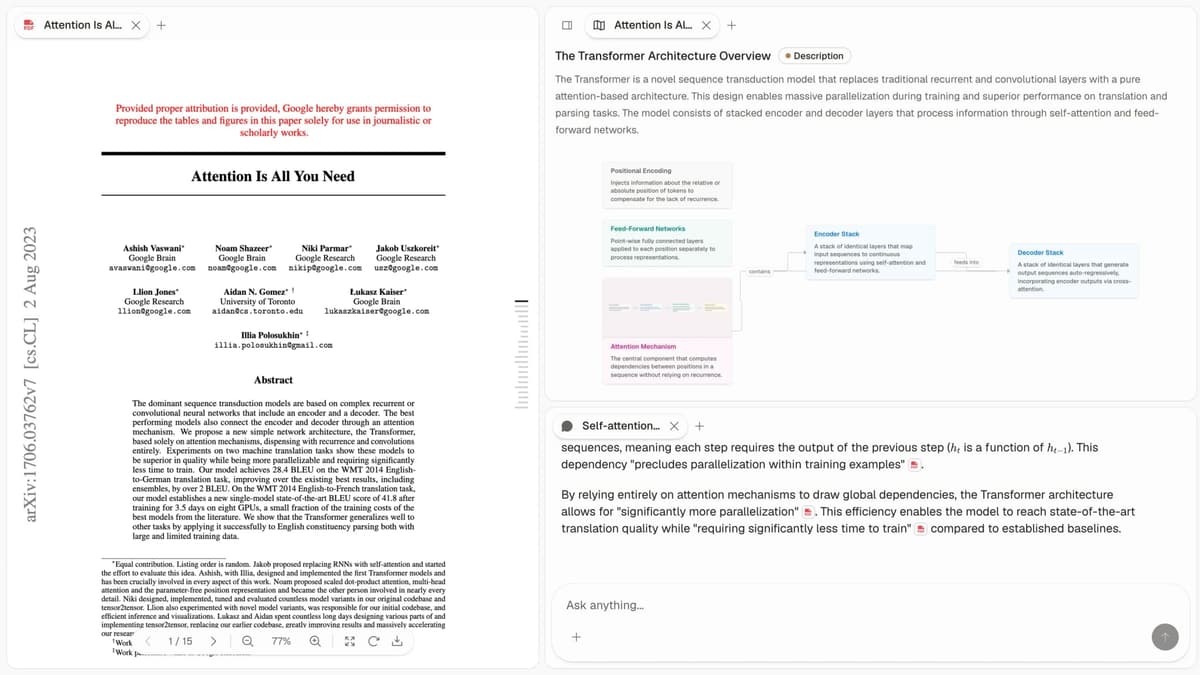
Atlas fits a narrower job than Kindle or Readwise. Use it for research books and academic PDFs where the source trail matters. Its key product proof is the cited-question workflow: each answer can point to a passage in the uploaded book.
- Upload the book PDF or a chapter PDF into Atlas as a source.
- Ask a cited question such as "What is the author's main objection to spaced repetition?"
- Check the cited answer panel and open the exact passage Atlas cites before adding the answer to your chapter compression.
- After two or three related books, ask a cross-book question such as "Where do these authors disagree about retrieval practice?"
The screenshot below shows the relevant product surface. It has uploaded sources, a visual research map, and a cited answer panel in one workspace. This keeps the answer tied to the source passage. It does not turn the book into a generic summary. Atlas is overkill for most fiction and casual business books. It is useful when your notes need citations, source trails, or cross-book links across research material.
Common Mistake: Highlighting Without Recall
Highlighting feels productive but produces weak recall. The 2013 Dunlosky meta-analysis ranked highlighting as one of the lowest-utility study techniques tested. Highlighting tests recognition: you mark a sentence, then recognize it when you see it again.
Active recall is harder because you must produce the idea from memory. Karpicke and Blunt (2011) found that retrieval practice beat concept mapping on a one-week test, even though concept mapping feels more elaborate. Karpicke and Roediger (2008) also reported about 80% one-week recall under retrieval practice, while restudy scored about 36%.
Roediger and Butler's 2011 review covers the wider field. Mayer's 2009 multimedia-learning research adds a related point: words plus images beat words alone when the two channels support each other. The 4-pass method below puts both active recall and useful visuals to work.
The 4-Pass Method
Pass 1: Preview (5-10 minutes)
Open the book, read the table of contents, and skim the introduction and conclusion. Look at chapter summaries if the book has them. Read the back cover and any pull quotes, then ask one question. What is this book arguing?
The point is to load what you already know before reading, so you start the chapters with a rough map in mind. That makes the argument easier to follow. This is the preview stage in the SQ3R study method from the 1940s. If you want a more formal template, our how to take Cornell notes guide adapts Cornell Notes for book reading.
Pass 2: Read with Marks
Read the book end-to-end and mark passages with a pen, sticky tabs, or your e-reader's highlight tool. Do not write notes yet, because writing breaks reading flow and slows the pass.
Mark arguments, key terms, surprising claims, vivid examples, and strong sentences. Aim for 1-3 marks per page on average for non-fiction.
Writing while reading averages 50-100 words per minute against reading at 200-300 wpm. Stopping to write triples the time per chapter. Save writing for Pass 3.
Pass 3: Compress (100-300 words per chapter)
After each chapter (or each reading session), close the book and write a compression in your own words. Target 100-300 words per chapter. Include:
- The chapter's main argument in 1-2 sentences.
- 3-5 key claims or examples.
- 5-10 key quotes with page numbers (copy faithfully).
- 2-3 personal reactions, questions, or connections to other books.
The "in your own words" rule is the active-recall trigger, because closing the book before writing forces retrieval. That is the mechanism that builds long-term memory.
This is the central pass, and most readers skip it. The ones who do it remember.
Pass 4: Review (spaced repetition)
Add the chapter notes to a review schedule. Use 1 day, 7 days, 30 days, and 90 days. Spend 5-10 minutes each session reading the note and saying the argument from memory.
For spaced review, use Anki for scheduled flashcards, Readwise for resurfacing highlights, or Atlas for cited Q&A across books. The 1/7/30/90 cadence fits the wider retrieval-practice literature surveyed by Roediger and Butler (2011).
Put your book notes into practice
Once you have completed the four passes, the choices below help you store the notes, control their length, and maintain a review habit.
Tools for book notes
Kindle is the default e-reader for non-fiction. Apple Books works well if you live in the Apple ecosystem. Both export highlights.
Readwise ($8/month) can sync Kindle, Apple Books, and Audible highlights into your notes app. It saves 20-30 minutes per book on copy-paste.
For the notes layer, choose one of three options:
- Notion ($10/month Plus, per Notion pricing page May 2026) for templated book notes with database tracking (read, currently reading, finished).
- Obsidian (free for personal use, per Obsidian pricing page May 2026) for plain-text Markdown vault with backlinks. For a deeper review of dedicated linking apps, see our smart notes app comparison.
- Atlas ($20/month Pro) for AI-grounded Q&A across your book notes plus PDFs plus other research.
Use Anki for strict review. Use Readwise for low-effort daily review.
How long book notes should be
Aim for 5-15% of book length in note words. A 300-page book (~75,000 words) yields 3,750-11,250 words of notes (~15-45 pages). Heavier note-taking is over-transcription, lighter is too sparse to support 6-month recall.
Dense academic non-fiction tends to need the high end, while narrative non-fiction tends to sit in the middle. Fiction usually needs the low end, about 1-2 pages per novel.
Common book-note mistakes
Copy-pasting highlights into your notes app is a filing step. Rewrite the idea in your own words to build memory.
Review is where most recall happens. Without spaced review, even strong Pass 3 notes fade in 60-90 days. The Ebbinghaus curve is old research, but it is still unkind to readers who skip review.
A page with 8 highlights is barely better than no highlights. The Dunlosky 2013 review found the same weak pattern for over-highlighting. Picking 1-3 marks per page sharpens attention.
Do not take fiction notes at non-fiction depth. Fiction notes should cover themes, character, phrasing, and reactions. Skip long plot summaries. 1-2 pages per novel is plenty.
Make book notes a daily habit
The method fails when note-taking becomes a second project after reading. Keep the loop small enough to run on ordinary days:
- Before reading, open the previous chapter compression and restate the argument from memory.
- Read for 25-40 minutes with only marks, tabs, or highlights.
- Close the book and write the 100-300 word compression before opening another app.
- Add one review date before ending the session.
This turns book notes into a small habit loop. Opening the book is the cue, marking and compressing are the routine, and a short reviewable note is the reward.
If you publish notes, keep the public version separate from the private one. Private notes can include messy questions and page-level objections. Public summaries should preserve the book's argument, show your interpretation, and link back to the source when possible.
When AI helps with book notes
AI-grounded notes apps like Atlas earn their keep on Pass 4 and cross-book synthesis. Ask "what does my reading say about X?" and get a source-cited answer with the specific passage from the specific book. Doing this by hand does not scale. AI can speed up the synthesis, but each answer still needs a citation.
Atlas covers cited questions across research books, while its paid plan adds higher AI usage limits.
Genre-Specific Adaptations
The 4-pass method bends to fit different reading types. Three patterns and the small adjustments that work.
For dense nonfiction, allow 30-45 minutes per chapter for the compression pass. Arguments build across chapters, so compressing too early can hide the chain between them.
Read the whole book once with light highlights, then compress it chapter by chapter on the second pass. The extra time pays off when you will use the book for years. Mortimer Adler's How to Read a Book (1940) remains the standard reference for multi-pass analytical reading.
For narrative nonfiction, the 4-pass method can be too heavy. Most books in this group have three to five core ideas. Stories carry those ideas. Capture each idea in one paragraph. Save the two or three stories that made the ideas stick. Reduce note volume to 2-5%.
For technical books, capture highlights plus code snippets in a separate file. The review pass becomes implementation. Write code that uses the technique. Per the Karpicke and Roediger 2008 retrieval-practice research, making output beats re-reading for technical material.
Most fiction does not need notes. The exceptions are literary fiction with arguments, or books that map to your work. For these, save passages plus a one-paragraph "what this taught me" note per chapter or section.
Build a reference library
Reading notes pay off most when the third book in a topic surfaces patterns from the first two. Three practices that make the compounding visible.
Use one file per book and one folder per topic. Whether you use Notion, Obsidian, or plain Markdown, the structure should make cross-book search easy. Per the Zettelkasten community's documented practice, the linking layer matters more than the storage layer. Ideas should point to each other across books, even when the books cover different topics.
After three books on a topic, write a 500-word synthesis note. Cover what the books agree on, where they disagree, and what the field seems to believe. This note is the compounding artifact. Without it, the books stay in separate silos.
Once a year, scroll the topic folder. Update the synthesis. Note which books still hold up. Note which books have been replaced. The annual pass takes 1-2 hours per topic and turns a passive archive into a living reference.
The four-pass method at a glance
Reading notes should help you remember and reuse a book. Preview the text, read with marks, compress each chapter from memory, and review the result on a schedule. This sequence turns active recall and spaced review into a repeatable reading habit.
Use Kindle with Readwise and Notion or Obsidian when you need digital storage. Use Atlas when the book notes need cited answers alongside other sources. Aim for 5-15% note volume and spend the most time on books you expect to cite, teach, or use. For a complete capture-to-review system across formats, see how to take good notes.
AtlasAsk cited questions across research books
Upload a research book PDF and trace each answer to its supporting passage.
Frequently Asked Questions
The 4-pass method works for most readers. Pass 1: preview the table of contents and chapter summaries (5-10 minutes). Pass 2: read the book, marking passages but writing nothing. Pass 3: compress, write 100-300 words summarizing each chapter in your own words plus 5-10 key quotes with page numbers. Pass 4: review, every 7-30 days using spaced repetition. Active recall (writing in your own words) outperforms passive highlighting, Karpicke and Roediger (2008) reported ~80% one-week recall under retrieval practice versus ~36% under restudy.