

The SQ3R reading strategy means Survey, Question, Read, Recite, and Review. It turns a selected text into questions you can try to answer yourself, then check against what you read.
Start with one manageable part of an academic chapter or research text. Keep your first answer separate from the answer you check later. That makes a gap visible and gives you a clear reason to return to the source.
The note below uses an actual textbook section and a hypothetical recall error. We wrote the questions and example answers to teach the process. They do not report a learner's performance or a new study.

Check your reading answers against sources
Keep your own recall separate from answers checked against the text.
What the SQ3R reading strategy means
Survey gives you a view of the text's structure. Question turns that view into things you want to understand. Read means working through the text for meaning. Recite is your own account of what you learned. Review returns to the questions and gaps over time. Stanford's SQ3R guide presents the five steps and advises adapting them to your purpose.
This guide uses closed-text recall for the recite step. Put the passage, notes, and answer aids away before trying your answer. The Toronto Mississauga guide explicitly asks readers to explain ideas without looking back.
You can speak or write. Choose a form that lets you show what you can recall yourself.
The routine gives you a way to organize reading and follow up on gaps. It does not promise a fixed reading speed, grade, or level of understanding. A smooth answer can still contain a mistake. Your next task is to compare it with the source, correct it, and try again later.
Survey and question the selected text
Choose a text tied to your course or research question, and state what you need from it. You might want to explain a term, follow a claim, or understand how two ideas relate. Keep that purpose next to the title and section location in your note. The text supplies evidence for the answers you check later.
Survey headings, figures, and scope
Look over the title, headings, figures, captions, summary, and any practice questions. Notice which ideas have their own sections and which are parts of a larger topic. Minnesota's guide treats this overview as a way to see how the details fit together. Surveying gives you a route through the text, rather than a substitute for reading it.
For a research article, adapt the survey to its question, methods, results, and limits. A figure caption may point to a finding that needs the surrounding text to make sense. Mark unfamiliar terms and places where the author narrows a claim. The AI reading-assistants guide also keeps source reading and checking central when answer tools are available.
Write questions you can answer
Turn a heading into a question, then refine it. Ask what the term means, why a claim follows, how two ideas differ, or what an example shows. One focused question is often more helpful than a request to explain the whole chapter. Keep room to change it if reading reveals that your first question missed the main point.
Write the questions before you collect answers. Grace Fleming's SQ3R explanation uses chapter features to form questions and adds prompts while reading. We use that practical question-making step here. Its learning-style advice and fixed review timing are not requirements for this note.
Check the source's suitability if you found it outside your assigned reading. Who wrote it, what does it cover, and does it support your question? The CRAAP test can help record those checks. A suitable source can still contain a hard passage or a simplified claim, so keep your questions open while you read.
Read and recite before checking answers
Read one coherent section at a time and try to follow its reasoning. Answering the prepared questions matters, but also notice ideas that your questions did not cover. Stanford's guidance stresses reading for meaning. Add a new question when it helps you understand the passage's role in the larger text.
Read the passage and its qualifiers
Record where the passage is, using a heading, page number, or other locator you can find again.
Read the example and the sentence that explains it. If the author says a claim holds under certain conditions, include those conditions in the note. A phrase lifted from its setting may be too broad to answer your question accurately.
When a term stays unclear, write down the specific gap. Is the definition missing, or can you not see how it applies to the example? That distinction shapes your next reading step.
A second source can help, but name what it adds. Bringing sources together with their roles clear keeps an outside explanation from being mistaken for the assigned author's words.
Attempt recall with answer aids hidden
At the end of the section, close the text and hide the source notes and generated answers. Keep only the question visible.
Write or say the answer in your own words, including the connection or example the question asks for. If you cannot recall a part, mark it as a gap. Do not fill it from an answer aid while calling the attempt unaided.
Minnesota's recite instructions ask readers for an own-word account without looking at the pages. In this note, the first attempt stays as written.
Reopen the source afterward and add the checked version beside it. Copying over the first attempt would hide what you need to work on next.
Worked question-passage-recall SQ3R reading note
Our selected text is section 1.1 of OpenStax Biology 2e. We focus on its scientific-method headings and ask how a hypothesis differs from a prediction. The five rows show the process around that question, with an invented first attempt clearly marked.
| SQ3R step | Question or task | Source location | Note to retain |
|---|---|---|---|
| Survey | Where is the needed explanation? | The Scientific Method and its subheadings. | Read the explanation and test sections together. |
| Question | How do hypothesis and prediction differ? | Proposing a Hypothesis. | Keep this question visible before collecting an answer. |
| Read | What does each term do? | Proposing a Hypothesis. | Hypothesis offers a testable explanation. Prediction states an expected result. |
| Recite | Explain the difference with the text closed. | Source hidden for this step. | Hypothetical first attempt: a hypothesis is the result I expect. |
| Review | What needs correction and another attempt? | Reopen Proposing a Hypothesis. | Correct the swapped roles, then try the distinction again later. |
Table 1: We wrote the tasks and note fields as a teaching aid. The named source supplies the concept check. We invented the recall error to show how correction works. No student response was measured, and no new test, study, or experiment was conducted for this guide.
Correct the answer without erasing it
The hypothetical attempt gives the expected result to the hypothesis.
The source check distinguishes the suggested explanation from the prediction drawn from it. Keep both versions so the correction has a visible target. The next prompt can ask the learner to explain each role and say how they connect.
The note does not need a long copied passage. It needs a location, the part that answers the question, and a plain-language correction.
Use exact quotes only when their wording matters, and check them against the text. If the passage does not settle your question, keep the gap open and seek clarification from the course or another named source.
Turn the gap into a review question
Write a prompt that tests the missing connection, rather than asking whether the answer looks familiar.
For this example, ask for an explanation and an expected result in a new, simple case. The learner should make the attempt before looking at the saved answer. A changed example can show where the idea still needs work, though it is no formal measure of comprehension.
The Toronto review guidance returns to questions over time and uses source reading to fill gaps. Choose a later review point that fits the course and task.
Record the new attempt and what still needs attention. The question remains useful even if the first response was incomplete.
Check the reading note in Atlas
Add the selected text to an Atlas project and check that the needed section is present. Attempt recall before opening an answer tool. Then start a fresh chat, mention the text, and ask about the specific question and your attempted answer. Use Project only where appropriate. Earlier chat messages can remain context, which is why a fresh chat helps keep this check focused.
Ask for the passage that supports or corrects the answer, a short explanation, and any unresolved gap. For this example, name the Proposing a Hypothesis heading. Ask to keep your attempt distinct from the checked answer. A generated explanation can help locate a reading issue, but it cannot tell you what you recalled independently.
Open the citation and read the surrounding source to check the terms and any conditions the answer may have dropped. Some sources offer exact navigation, while others require you to find the heading or passage yourself. If the cited passage is missing or does not answer the question, keep the claim unresolved and ask for the named section again.
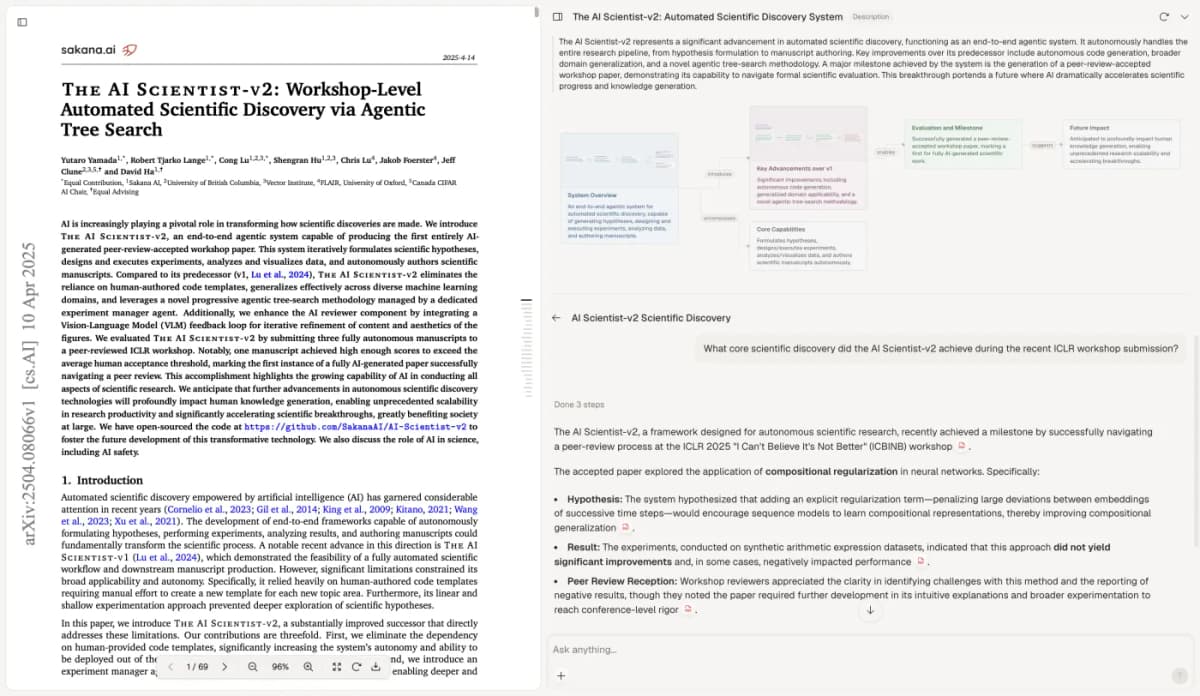
Atlas citation inspection with Yutaro Yamada et al.'s (2025) The AI Scientist-v2: Workshop-Level Automated Scientific Discovery via Agentic Tree Search, CC BY 4.0. This is not the OpenStax example, an observed SQ3R session, or independent recall evidence. The existing screenshot is reused unchanged, retaining original framing and compression. The license covers the embedded paper.
Choose New → Note, enter the question, first attempt, checked source location, correction, and next review prompt. Wait for Saved before closing. Keeping research notes organized makes it easier to return to the question. Hide the checked answer again when you make the next recall attempt.
Review what you can explain
Return to the question after a break and try your own answer again. Compare it with the saved source check only after the attempt.
Look for a missing relation, a swapped term, or a limit you left out. Then return to the relevant passage instead of rereading the whole text without a clear goal.
Use the idea in a course problem, an explanation to a peer, or another task that matches the reading purpose. Keep the course's rules for AI use in view. If the task calls for expert research appraisal, statistical work, or another specialist check, this reading routine does not perform that work.
- Can you answer the question with the text and answer aids hidden?
- Can you explain the reason or connection, rather than repeat a phrase?
- Can you find the passage that supports the checked version?
- Have you kept the first attempt and later correction distinct?
- Do you know which gap to review or ask about next?
An incomplete answer is useful information for choosing the next step.
A generated answer that sounds clear is also something to inspect. Keep the learner's work, source support, and open questions visible as you continue reading.
Check your reading answers against sources
Keep your own recall separate from answers checked against the text.