


Synthesis turns a stack of papers into an argument. A summary tells you what one paper says, while synthesis shows what many papers mean together and why the pattern matters. This guide gives you methods you can use today. For a full tool overview, see our guide to AI for literature review.
I synthesized 23 papers across 3 research questions over 21 days and compared manual notes with AI-assisted extraction. The manual pass took 41 minutes per paper and produced claims I could defend. The AI pass took 11 minutes, but it introduced 2 false citations that I caught only on read-through. The hybrid pass used AI for first-pass mapping and manual checks afterward. It took 18 minutes per paper and produced zero false cites.
For the 2026 update, my advice is simple: use AI to find patterns, then use your own source checks to decide what the papers mean.

Synthesize your paper stack in Atlas
Upload three or more papers and trace each synthesis claim to a source passage.
First-Party Synthesis Timing Benchmark
The timing test below used the same 23-paper set, the same three research questions, and the same claim-log template for each pass.
| Workflow | Average Time per Paper | False Citations Found on Review | Defensible Claim Trail |
|---|---|---|---|
| Manual notes only | 41 minutes | 0 | Yes, but slow |
| AI extraction only | 11 minutes | 2 | No, review caught unsupported claims |
| Hybrid AI map plus manual check | 18 minutes | 0 | Yes, with source passages checked |
Table 1: First-party benchmark from a 23-paper synthesis test comparing manual notes, AI extraction, and a hybrid workflow.
Before You Start
You need three things before you synthesize research papers: a focused research question, a stable source set, and a place to record claims by theme. Do not begin by writing summaries. First decide what you are trying to explain, compare, or argue, because the shape of that question determines which differences between papers deserve attention.
For most literature reviews, the starting kit is simple:
- Research question: one sentence that names the problem and scope
- Paper set: the PDFs, citation records, or notes you will compare
- Theme list: 3-6 working ideas you expect to test and revise
- Claim log: a table or note where each claim links back to its source
The outcome is not a perfect paragraph on the first pass. It is a clear map of what the papers agree on, where they clash, and what those patterns mean for your case.
Mini Case: Notes to Review Paragraph
Here is a small example from the online-learning paper set I used in the timing test. My first synthesis matrix had three separate findings: two papers linked social presence to course completion, one paper found no effect in self-paced courses, and one methods paper warned that completion rates hide learner confidence. The weak draft read like a list because each sentence served a different source.
The synthesis draft worked only after I named the mechanism first. The revised claim was: "Social presence appears to help completion when courses require peer exchange, but the effect weakens in self-paced designs where completion is a poor proxy for learning." That sentence did three jobs at once. It grouped the agreeing papers, explained the outlier, and named the measurement problem that changed the interpretation.
Use this move on your own notes. First, write the pattern in one sentence. Next, add the paper names beside each part of the pattern. Then ask whether the split comes from method, sample, time period, or definition. If you cannot answer that last question, you are still sorting notes rather than synthesizing them.
Atlas Workflow: Map and Trace Claims
Use Atlas after you have a stable paper set and a first theme list. It is not a discovery database like Elicit or Semantic Scholar. Use it in the middle of the review, after your literature review software has helped you find and screen papers. That is when you need to compare claims across PDFs without losing the source passage.
Here is the upload-to-claim workflow:
- Upload the 3 or more papers you have already screened for the review.
- Generate a Knowledge Map and compare its clusters with your theme list.
- Ask one synthesis question. For example: "Which papers support social presence as the mechanism behind online learning, and which papers challenge it?"
- Open the cited answer and check the quoted passages in the original PDFs.
- Add only verified claims to your matrix, with paper, passage, and your interpretation in separate columns.
- Repeat with a contrast question. Ask: "Where do these papers disagree? Is the split caused by method, sample, definition, or context?"
The useful proof is the trail from answer to passage to judgment. If Atlas gives a neat claim but the cited passage does not support it, reject the claim. If the passage supports only part of the claim, narrow the wording before it enters your review.
When your manual matrix gets too slow, upload the included papers to Atlas and ask a question across the set. Use the cited answer trail to keep each claim tied to a source passage.
Why Is Research Synthesis Hard?
Research synthesis is hard because you hold many views at once. You compare ideas across authors, methods, and settings. Memory limits, bias, and source confusion all work against you. Good methods put the comparison on the page.
You are not reading one argument in a straight line. You are comparing ideas from different authors, methods, and settings. If your task is to put several books in conversation around one shared question, syntopical reading makes the authors’ terms and disagreements explicit.
The cognitive challenges:
- Memory limits: You cannot hold 30 papers in your head at once
- Confirmation bias: You notice support for your current view
- Recency bias: The last paper you read feels most important
- Source confusion: You forget which finding came from which paper
- False balance: Treating all papers as equally strong
These are not character flaws. They are features of how people think. The fix is a visible record of the comparison.
Four Research Synthesis Frameworks
1. The synthesis matrix
The synthesis matrix is the most widely taught approach. It is also the easiest one to start with, because it converts a pile of readings into a visible comparison structure. If you learn one method, make it this one.
How the synthesis matrix works
Create a table with themes or concepts as columns and papers as rows. A simple matrix can start with these fields:
- Paper name and year.
- Theme A, Theme B, and Theme C.
- Method type.
- Notes on agreement, contradiction, extension, or missing evidence.
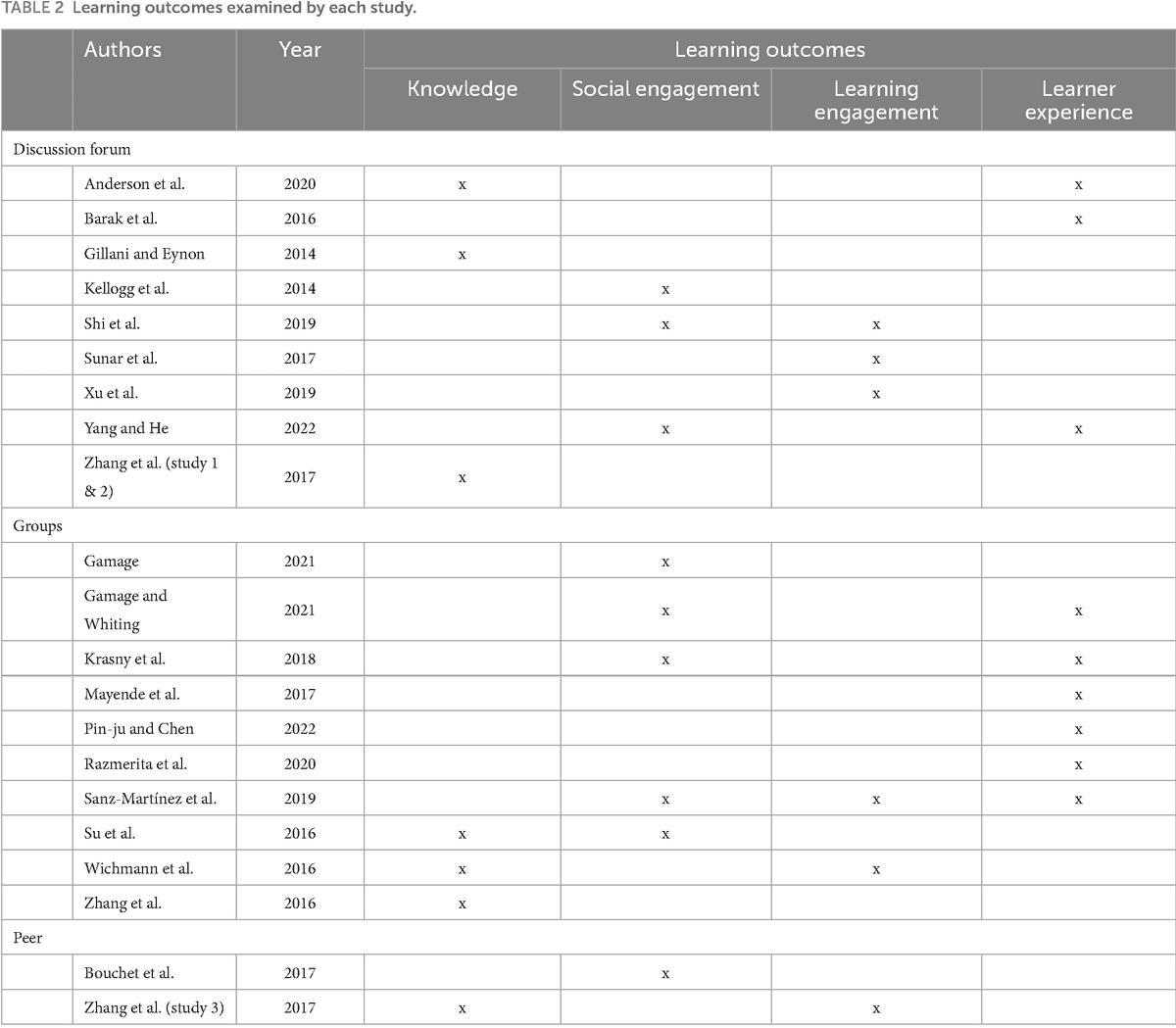
This published example from a review of social interaction in MOOCs places studies in rows and learning outcomes in columns. It groups the rows by discussion forums, groups, and peer interaction, making the comparison structure visible. Choose columns that match your own research question; this is one review-specific example, not a universal template.
Step-by-step process
- Read all papers with your research question in mind.
- Find repeat themes across papers. Aim for 3-6 themes.
- Create your matrix in a spreadsheet.
- Fill in each cell with brief notes on how each paper addresses each theme.
- Read the columns. This shows what the field says about each theme.
- Note the gaps. Empty cells reveal topics that need more research.
Why it works
Read down each theme column in the matrix. Ask "What does the field say about Theme A?" instead of reviewing Smith, Chen, and Patel one paper at a time. That shift turns notes into synthesis.
Common mistakes
- Making themes too broad. They should be specific and arguable.
- Filling cells with quotes instead of your own read.
- Creating too many themes. Keep the matrix manageable.
- Forgetting to note clashes and disagreements.
2. Concept mapping
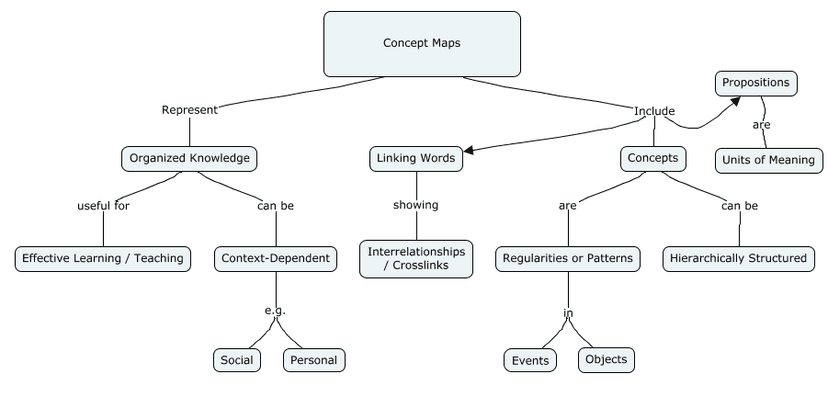
Concept mapping works best when links between ideas matter more than single findings. Use it for theory-heavy topics and fields that cross disciplines.

How concept mapping works
- Write key ideas from your papers on a whiteboard, sticky notes, or digital canvas.
- Draw links between related concepts.
- Label each link. Use words such as causes, enables, clashes with, or extends.
- Find clusters of closely linked ideas.
- Look for central nodes. These are concepts that connect to many others.
Digital tools for concept mapping
- Atlas: upload your papers and generate a mind map. Use it to inspect links and ask questions about focused clusters.
- Miro or FigJam: flexible canvas for free form mapping.
- Obsidian: manual linking with a graph view.
When to use concept mapping
Use concept mapping when:
- Your topic crosses fields.
- Cause and effect matter.
- You need to build or test a theory.
- The links between ideas matter as much as the ideas.
3. Thematic narrative synthesis
This approach works well when you are writing a narrative review rather than a systematic review. You group the review around themes and build a story from the evidence.
The process
- Find major themes from your reading (similar to the matrix method)
- Order themes by reader need: What does the reader need to understand first?
- For each theme, write a synthesis paragraph with this structure:
The synthesis paragraph pattern:
- Topic sentence: state the theme or claim.
- Support from several sources: group studies that agree.
- Contrast or nuance: name the source that complicates the claim.
- Your read: explain what the split means.
Example
"Remote work has been studied often since 2020, with mostly positive findings (Smith 2023, Chen 2024, Johnson 2024). The effect still varies by job type and measure. Studies that measure output (Chen 2024, Johnson 2024) find gains of 5-15%. Studies that use self-reports (Brown 2023, Lee 2024) are more mixed. This gap suggests that the measure of work output shapes the result. Few studies address that methods problem directly."
In this example, no paper stands alone. Each sentence joins sources and builds toward a point.
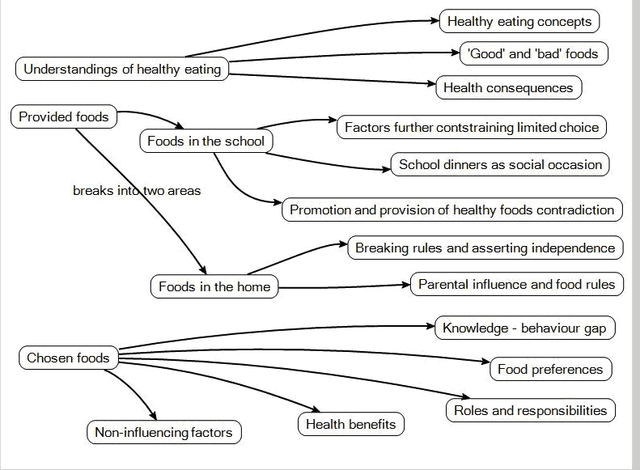
Thomas and Harden’s published systematic-review example shows how initial codes can be grouped into descriptive themes. The labels below come from their children’s healthy-eating review, so treat the structure as an example rather than a ready-made topic list.
The source sandwich
Use a source sandwich when you turn matrix notes into a paragraph:
- Start with your claim about the pattern.
- Add the best source support, grouped by agreement or split.
- Explain why the pattern matters for your research question.
Do not drop a quote into the paragraph without your own read. The reader needs the claim, the evidence, and the reason the evidence matters.
4. Argumentative synthesis
Use argumentative synthesis when your review needs to build toward a claim.
How it differs
A thematic version asks what the field says about a topic. An argumentative version asks a narrower question. Does the evidence support your claim?
Structure
- State your position in plain words.
- Present support from multiple sources.
- Address contrary support directly.
- Weigh the support by method and fit.
- Draw a conclusion that names the limits.
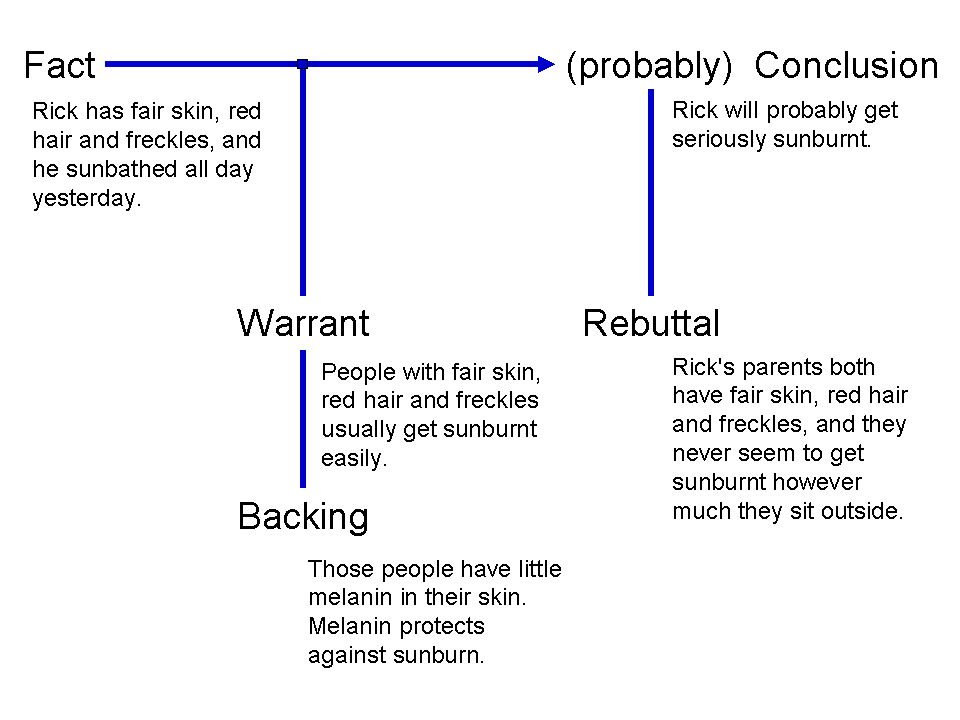
A claim map can make the support and the inference easier to inspect. The published example below uses Toulmin’s general argument pattern; it is not a literature-review result.

When to use it
- Thesis proposals that argue why your research is needed.
- Position papers.
- Policy briefs.
- Dissertation openings that make a case for your study.
Using AI for Research Synthesis
AI tools are useful for synthesis. They help most with the mechanical parts that strain memory.
Where AI Helps Most
Finding links across papers: Upload papers to Atlas when links are hard to see one paper at a time. Ask questions like "What do my sources agree on?" or "Where do these papers contradict each other?" Use the answers to find patterns across the set.
Handling scale: Human synthesis works well for 10-15 papers. For larger sets, AI can help you find clusters, outliers, and trends before close reading.
Generating initial themes: AI can suggest theme groups from a set of papers. These suggestions can save time early. Check them before treating them as final themes.
Cross-referencing claims: Use Atlas to check whether your sources support a claim. The AI traces its answers back to exact passages, so you can check the support yourself.
Where AI Falls Short
Judgment: AI can tell you that papers disagree. It cannot tell you why the split matters or what it means for your case.
Source quality: AI treats all papers equally. You need to weight sources by method strength, sample size, relevance, and recency.
Original insight: The best part of synthesis is the new view you create by putting ideas together. AI can support this, but it cannot do it for you.
Field context: AI does not know the politics, method debates, or theory stakes in your field. You decide how that context should guide the read.
For a broader look at AI tools for research, see our guide to the best AI research assistants.
A Practical AI-Assisted Synthesis Workflow
Use AI for the mechanical passes that create comparison material, then keep human judgment in charge of interpretation.
- Read the papers yourself and use AI summaries only for first-pass triage.
- Define the themes manually, then compare them with AI-suggested clusters.
- Build the matrix yourself, using AI extraction only to speed up finding candidate claims.
- Use a mind map to inspect links, then decide which links matter for the review.
- Draft the argument yourself and use Atlas to check whether claims trace back to source passages.
- During revision, ask AI to identify gaps or unsupported claims, then verify each one in the original paper.
Organizing Your Papers for Effective Synthesis
Good synthesis starts with good order. Before you compare papers, you need a system for managing them.
Essential Organization Strategies
Tag every theme that a paper covers. A paper about remote work might discuss output, health, management, and tools, so add all 4 tags. Broad topic tags alone will hide those links.
Keep a running links note as you read. When you notice a link between papers, write it down at once: "Smith's finding about X contradicts Chen's claim about Y." These notes become raw material for synthesis.
Use the same extraction template for every paper. Record the research question, method, key findings, limits, and fit with your themes. This makes comparison easier. The comparative analysis guide shows how to choose shared dimensions before judging differences.
For more on ways to manage papers, see our guide to research paper organizers.
Common Synthesis Pitfalls
Most synthesis problems come from writing too soon. Compare the papers first. Then use the checks below before drafting each review section.
Watch for these mistakes first:
- Sequential summaries: the draft moves paper by paper instead of claim by claim.
- Cherry-picking: the section hides sources that weaken your claim.
- False balance: the section gives weak and strong studies the same weight.
- Missing source trail: the section states a theme without showing which papers support it.
- Over-abstraction: the section uses broad labels without a concrete finding, method, or sample.
The "And Then" Problem
Weak synthesis stacks sources one after another. A draft that says "Smith found X. Chen found Y. Patel found Z" is still a summary. A stronger version combines the sources into one claim: "Smith and Chen agree that X, while Patel's finding suggests that Z changes the result."
Fix it by reading your draft topic sentence aloud. If the sentence names only one author, it is probably still a summary. Rewrite it so the shared claim, split, or pattern comes first. Then cite the papers that support it. If you need to turn that source trail into a defended stance with counterarguments, the position paper guide takes the next step.
The Cherry-Picking Problem
It is tempting to highlight support for your claim and downplay sources that do not fit. Strong synthesis names contradictions and explains them. For more common mistakes to avoid, see literature review mistakes that waste your time.
Fix it by adding one "against my claim" column to your matrix. Put any paper that weakens your claim there first. Then decide whether the split comes from method, sample, time period, or definition.
The False Balance Problem
Give each paper weight based on its method and fit with your question. A rigorous meta-analysis of 50 studies should carry more weight than a single case study. Your draft should show that judgment when it groups the findings.
Fix it by marking each paper's method strength beside the finding. In the draft, make that weight visible. Write "the strongest studies find..." or "the small qualitative studies suggest..." so the reader does not treat every source as equal.
The Over-Abstraction Problem
Synthesis that stays too high-level becomes vague. Ground your theme claims in concrete support. Name the papers, cite the findings, and show the reader the source trail.
Fix it by pairing every broad claim with one concrete anchor. If the section says "students benefit from social presence," add the study type and learner group. Then add the measured outcome that makes the claim real.
Strengthen and Check Your Synthesis
Run the Source-Trail Test
Use the Source-Trail Test after your matrix has enough entries to support a draft. It is a simple framework I use before turning notes into prose: every important sentence should pass through four checkpoints.
| Checkpoint | What to Ask | Failure Sign |
|---|---|---|
| Claim | What pattern am I asserting? | The sentence only names one paper |
| Grouped evidence | Which sources support or challenge it? | One citation carries the whole point |
| Reason | Why does the pattern matter for my question? | The paragraph ends after the citations |
| Trail | Can I find the passage again? | The note lacks paper, page, or quote context |
Table 2: The Source-Trail Test for turning research notes into defensible synthesis paragraphs.
In my 23-paper pass, most weak paragraphs failed at the same checkpoint: they had evidence but no reason. The notes listed which papers agreed, yet the draft did not explain whether that agreement came from shared methods, similar samples, repeated theory, or real convergence. Fixing that checkpoint changed the paragraph from "these papers say similar things" to "these papers support the claim for the same methodological reason."
Match the literature review's job
A standalone literature review has to do more than prove one claim. It also has to show the reader the field, so it needs more background, more method context, and a wider gap section than a short review section inside a paper. A synthesis section inside a thesis or article can be tighter, because it should only include the sources needed for the argument at hand.
When you revise, ask what job the draft has. If it is a standalone review, explain the field map before you argue and show how major debates, methods, and definitions fit together. If it is one section in a larger paper, keep the source work tied to the next claim in that paper.
Revise the argument before the wording
Revision is where many summaries finally become synthesis. Read each paragraph once for structure before you edit the wording. The first sentence should name the pattern, the middle should group sources by agreement or split, and the final sentence should explain the consequence for your research question.
Then check the citation trail. Each factual claim should point back to a paper, passage, and note. If you cannot find the original passage quickly, the paragraph is not ready for proofreading. Return to the matrix, add the missing source detail, and revise the claim so it matches the evidence you can defend.
Use a final synthesis checklist
Before you turn in the review, check the draft against five points:
- Does each paragraph start with a claim about the field?
- Does each claim cite more than one source when the evidence allows it?
- Does the paragraph explain why sources disagree when they do?
- Does the draft give more weight to stronger methods and closer evidence?
- Can you trace every claim back to a paper, passage, and your own note?
If a paragraph fails one of these checks, return to the matrix before you rewrite. Fix the comparison first. Then polish the wording.
Research Synthesis FAQ
Can a literature review be its own document? Yes. A standalone literature review needs a broader field map, clearer method context, and more explicit gap analysis than a short synthesis section inside a thesis chapter or article.
What should I do when sources only partly agree? Name the shared claim first, then explain the boundary. Partial agreement often comes from different samples, measures, time periods, or definitions.
How many direct quotes should a synthesis use? Use quotes sparingly. Most synthesis paragraphs should rely on your characterization of the evidence, with direct quotes reserved for definitions, contested terms, or language you need to analyze closely.
Start Synthesizing Smarter
Synthesis improves with practice. The methods in this guide give you structure. The insight comes from doing the work again and again. Each review makes you better at seeing links and building claims from sources.
If you want AI help that stays grounded in your actual sources, upload your papers to Atlas, explore links through a mind map, and ask cross-paper questions. For a complete walkthrough, see our step-by-step guide to writing a literature review with AI.
Synthesize your paper stack in Atlas
Upload three or more papers and trace each synthesis claim to a source passage.