
Action research links a local question to action, evidence, reflection, and what to do next. You learn from what happens as you try to change practice. Keep a clear record of how the team reached its view.
A cycle note links the plan to what you actually did and what the records show. It also records how the team reads those findings. Keep the next plan visible without reporting it as a completed action.
The worked note below uses a published school inquiry. We wrote the note from the paper to teach source checking. We did no fieldwork and had no access to the team's raw diaries or forms.

Trace cycle claims to your records
Compare plans, observations, and reflections before deciding what follows.
What action research connects
Action research is a way to study practice while trying to change it. People who do the work choose a question, try an action, examine evidence, and reflect on what follows.
The Open University guide links the problem, planned action, collected data, and clear reporting. That link lets others see how the team learned from a change.
A common model uses plan, act, observe, and reflect. The British Council teaching guide starts with a question you can tackle, then links action, evidence, and reflection to what to try next. Other traditions use different models, and a project may move back and forth between stages. Treat the stages as questions about the work.
The work can extend beyond a classroom. Pittsburgh's own program describes inquiry linked to institutional practice and shared learning. The program shows how one university uses the approach. It does not prove that a given intervention will succeed. In your note, name the setting and people involved before making a wider claim.
Document the cycle before interpreting it
Start with the local question and the evidence you need to address it. Keep the planned action and the reason for trying it together. If you want students to talk more with each other, say what you will look for. The team decides how to collect and study the records that address its question.
Link the question to actual action
Record the action that took place, its date, and any change from the plan. A lesson outline shows intent, while a delivery record shows what was done. An observation note may describe what happened during it. Keep those source roles separate when bringing several sources together, so a confident plan does not become an invented result.
Look for revisions made during the work. Did the team change instructions, add another activity, or use a different tool to record events? Process evaluation helps describe how delivery unfolded. In a cycle note, those details also matter to the reflection: they may explain why the next decision differs from the first plan.
Preserve changes to evidence collection
Keep the record's date, author, and purpose where possible. If a form changed, retain both versions and explain why. New categories may capture events the first form missed. Counts or notes from the two versions may then mean different things. Check the change before comparing them as though they recorded the same events.
Use the dependability guide to compare a reported process with its documented changes and reasons. Keep that process check separate from judging whether the action worked.
An audit trail can connect such decisions to the evidence behind them. The cycle note summarizes the important links while the fuller record holds the detail. Missing documents should stay marked as missing. A later reflection can explain a team's view, but it cannot substitute for an unavailable record of the event.
Worked cycle evidence-and-reflection note
Rabgay and Kidman's 2023 study follows three science teachers in one Bhutanese school through an inquiry about ninth-grade classroom interaction. Their process moved back and forth between stages. The four rows below connect the paper's reported events to a bounded note and a question to retain.
| Cycle stage | Reported source location | Checked note | Question to retain |
|---|---|---|---|
| Plan | Methodology and section 4.1. | The team narrowed its focus and planned work on classroom interaction. | Does the intended action fit the final question? |
| Act | Section 4.2. | Teaching strategies were tried and revised after colleague feedback. | Which version was actually delivered? |
| Observe | Sections 4.2 and 4.3. | The observation form was revised, and more lessons supplied further data. | How did tool changes affect what could be recorded? |
| Reflect | Section 4.4. | Teachers reviewed the work and proposed another cycle, which time constraints prevented. | Which next actions remain planned rather than completed? |
Table 1: The source locations refer to the published report. We wrote the checked notes and questions as teaching paraphrases. They are not the researchers' original cycle log or an independent inspection of their raw records.
Keep the source of each observation
The paper's methods report interviews, teacher diaries, and observations.
Ask whether a reflection rests on an event someone saw, a person's account, or the researcher's reading of it. Each can help, but they answer different questions and have different limits.
For your own project, name the exact record and passage that supports a note entry. If you are working only from a published account, say so.
Do not claim to have checked its unseen interview recordings or notebooks. A traceable summary should make the available evidence and the boundary of your reading equally clear.
Preserve the cycle that stayed planned
The final part of section 4.4 distinguishes interest in a second cycle from carrying it out. That distinction changes the note.
It supports a statement about intended next work, while a claim about results from the next cycle would lack support.
Use a simple action status beside the source location: planned, carried out, revised, or not carried out. These labels describe the record you have checked. They do not rate the quality of the research. If two sources disagree about status, keep the disagreement visible and seek the record that can resolve it.
Write a reflection the evidence supports
Reflection gives reasons for a next decision. It links what was noticed to what the team thinks it means, while asking what else could explain it.
Scribbr's overview places reflection within a cycle of inquiry and action. The source record still sets the limit on what your note can claim.
Separate the record from its meaning
Begin with what the record shows. Then state the team's view and why it seems plausible. Ask what else might explain the event.
The action, who was present, the setting, or the recording tool could have changed. A team can value what happened without proving that its action caused it.
The note can hold a local lesson without claiming it applies everywhere.
The Open University guidance asks how far findings can be generalized and links intended actions to the problem. Describe the setting so readers can judge whether the lesson might fit another place.
Draft a bounded reflection
We wrote the following possible reflection from the published case. It illustrates a checked note and uses our wording. It is not a quotation or a report of our own fieldwork.
This account shows that the team revised its work as questions arose about teaching and the records it collected. The revisions belong in the cycle description because they affect what the later evidence can show. The teachers' reflections inform a possible next action, but the proposed second cycle was not carried out. A useful next step would retain the reasons for those changes and clarify how future records could support the team's question. The report supports learning about this local process. It does not establish that the same actions would produce the same outcome in every classroom.
One draft claim to reject would say that two completed cycles proved a strategy works for all classes. The checked version describes one local inquiry with changes and a further cycle that was planned but never done.
This correction changes what happened and how much the claim says. Keep it visible in the saved note.
Check cycle sources in Atlas
For your own inquiry, add the action plans, observation notes, reflections, and method guidance after following your project's rules for access and data handling. The team obtains permissions and checks the handling. Check that each file covers the period and action you want to study, and give versions clear names.
Start a fresh chat, mention the cycle sources, and ask for links between the question, action, observation, reflection, and next plan. Use Project only where appropriate, remembering that earlier messages can remain context in an existing chat. Ask for source locations, action status, and unresolved gaps rather than a verdict that the cycle succeeded.
Open each citation and read the surrounding passage to see if it records a plan, an event, or a view of what happened. Some sources offer exact navigation, while others need you to find the heading or record yourself. Correct an entry that treats a future plan as work already done. Keep missing support marked as a gap.
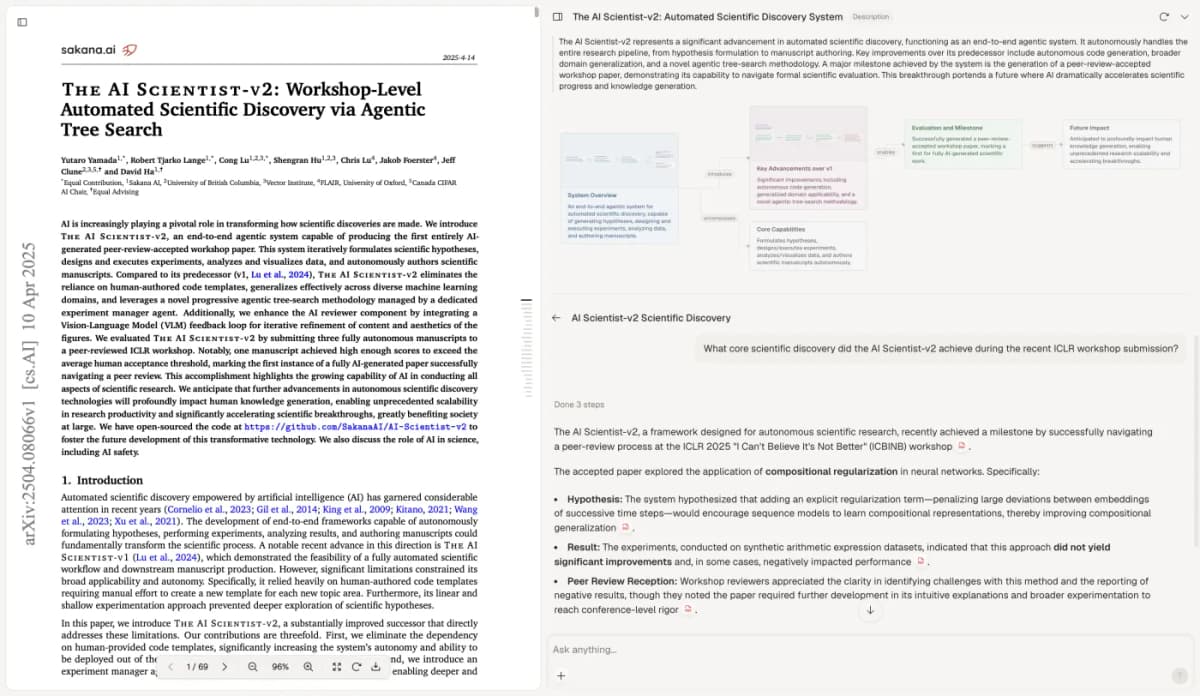
Unchanged Atlas screenshot showing citation inspection. Visible paper: Yutaro Yamada and colleagues, The AI Scientist-v2, CC BY 4.0. It shows no action-research fieldwork, private cycle records, tested intervention or validated interpretation.
Choose New → Note, enter the corrected cycle entries, and wait for Saved before closing. Keep the source location, supported claim, interpretation, limit, and next question together. Organizing research notes helps you return to the record when the next action changes. Researchers remain responsible for analysis and decisions.
Review claims before the next action
Check the note against the actual sequence of events. A neat four-stage summary should not hide overlapping stages, revised plans, or work that never took place.
The published case's findings make those loops visible. Preserve them when they change how the evidence or reflection should be read.
- Can you distinguish the intended action from what was done?
- Does each important observation have a source location and context?
- Have you recorded changes to teaching, collection tools, or the question?
- Are the team's interpretations separate from the underlying records?
- Have you considered other explanations before making an effect claim?
- Is the next action still a plan, and who must decide or approve it?
Follow the team's rules for consent, access, data handling, and review. The case paper's ethics statement reports approval and consent for that study. They do not cover another project.
A cycle note records the reasons for a decision. The team still does the research and obtains approval to act.
Trace cycle claims to your records
Compare plans, observations, and reflections before deciding what follows.