
Dependability in qualitative research concerns the study process and how it is explained. To assess it, trace what was planned, what was done, what changed, and why. A methods section that says the work was consistent gives you a claim to inspect, rather than proof by itself.
This guide builds a fictional process-change-rationale note from methods and dated records. It shows how to keep explained changes, a conflicting final report, and a missing reason distinct. The note supports human review of supplied sources; it does not certify the study or calculate reliability.

Trace process records in Atlas
Compare reported changes with their dates, reasons and source support.
What dependability asks about the process
Dependability focuses on the path of the inquiry. Can a reader understand how the study was carried out and assess the choices made along the way? Shenton's methods review calls for detailed reporting of the design, actual fieldwork, and reflection on the process. A short claim of rigor cannot show those details on its own.
An audit trail holds records that can support this judgment. It is not the judgment itself. Carcary's original practice paper links the retained record to the researcher's evolving reasoning. A folder may contain many files yet leave the reason for a key change unclear. Read the logic as well as locating the documents.
The process and the findings raise related but distinct questions. In Miller's external-audit paper, dependability concerns the process, while confirmability concerns the product's support in data. Our credibility guide examines fit between claims and accounts. These concerns can overlap, but a check of one does not settle them all.
Dependability does not mean a changed context must yield identical findings. Shenton's dependability discussion distinguishes repeating the work from necessarily gaining the same results. This reading task asks whether the process and its changes can be followed and judged. It does not impose a single test on every qualitative tradition or turn a source note into a score.
Trace the plan and dated changes
Start with the question the study was meant to address. Then locate the account of planned methods and the records of actual work. A protocol can show intention; a dated note may show a later decision.
Our qualitative audit-trail guide covers keeping these records. The task here is narrower: compare what the report says with the changes and reasons you can actually trace.
- Name the plan. Record the question, approach, source version, and relevant methods location.
- Name the change. State what was added, removed, revised, or carried out differently.
- Locate the date. Distinguish when a choice was made from when it was recorded or described later.
- Find the reason. Link the stated rationale to its source, keeping a later explanation distinct from a dated decision note.
- Trace the scope. Identify which sessions, files, or analytic work the change affected and what happened to earlier material.
- Keep gaps open. Mark a missing date, reason, or implementation record rather than filling it with a plausible story.
The CASP qualitative checklist asks how and why methods were modified. It also asks about the implications of changes, which can matter even when a reason is stated.
If two files disagree, preserve both locations and their roles. A late methods summary may omit a small revision, or the earlier record may describe a plan never used. The source comparison must establish that distinction.
Do not silently replace the old wording with the new version. Keeping the earlier record makes the change inspectable and shows why a reviewer has asked about it. A final report alone may not explain the route taken.
Check reasons and effects on interpretation
Use clear criteria for the review: fit with the study question, a source for the reason, actual scope, use of earlier data, and effects on what can be learned. These prompts guide the reading; they do not rate the method.
A change with a sound reason can help the study address its question. A new prompt might clear up a word people took the wrong way. Ask whether it changed what they were invited to discuss and how earlier accounts were used.
Carcary's paper stresses the actual research path, which may differ from a neat final account. Keep the reason and review beside the change rather than claiming that each new choice was a success.
A fixed process can also be a poor fit for the question. Using the same prompt throughout does not show it was clear, useful, or used as the report says. Read the source before making the larger claim.
Miller's account describes an audit as a human review of records and logic. A source-reading table can help you form questions for that work. It does not mean that a person outside the team has audited the study.
A missing reason limits what you can judge from the supplied files. The CASP guidance warns against guessing what the team did. Keep “not shown here” distinct from “not done” or “done badly.”
Build a fictional process comparison note
Imagine a made-up interview study about how learners choose a study space. All record labels, dates, excerpts, and changes below are fictional teaching material. No interviews were conducted for this guide, and the table describes no actual findings.
The draft methods summary says the interview guide and coding approach remained identical throughout. The supplied records include two explained changes and one change without a stated reason. The note tests that summary against the record.
| Fictional source | Process record | Stated reason | What remains to check |
|---|---|---|---|
| M1, plan dated 3 May, section 2 | Guide version 1 asks about a usual study space | Original plan for the study question | Whether the sessions followed this guide |
| D1, decision note dated 8 May, paragraph 4 | Guide version 2 clarifies the word “usual” | Note says early accounts used the word in different ways | Which sessions used each version and how earlier accounts were handled |
| D2, analysis note dated 14 May, paragraph 7 | A broad “noise” label is split into outside sound and group talk | Note says these concerns had different meanings in the source accounts | Whether the distinction was applied to relevant earlier material |
| S1, session log dated 16 May, entry 3 | One session moved from a room to an online call | No reason appears in the supplied log | Decision reason, source context, and effects on the account |
Table: Fictional process-change-rationale note. Dates, records, and study details are invented for teaching; no real participant data, completed audit, or certified study is shown.
D1 and D2 give reasons you can inspect, but neither row proves that the change was carried out well. Their open fields matter: the report must show which material was affected and how it was treated.
S1 establishes a recorded change of setting, not the reason for it. You could imagine a travel problem or a participant request, but neither appears in the supplied text. Leave those possible reasons out of the factual row.
The table also lacks a source for the final summary's claim that nothing changed. Keep that mismatch visible. A reviewer needs the underlying records, not a smoothed account that makes all files appear to agree.
The research audit-trail paper supports making reasoning visible. This original teaching table applies that narrow principle; it does not copy the paper's checklist or claim to be its validated implementation.
Correct a claim of unchanged methods
Review the draft with criteria tied to the actual sources: does the statement match the versions, dates, changes, and reasons? Here, “identical throughout” conflicts with D1 and D2, while S1 leaves an explanation open.
Revise it to: “The supplied records describe a clarified prompt and a revised code distinction, each with a stated reason. They also record a move to an online session without a reason in the supplied log. Their scope and implications require further source review.”
This corrected account preserves the changes without declaring the study dependable or undependable. It identifies what the reader can trace and what is still missing. It also avoids treating the note's transparency as proof that the methods were appropriate.
Shenton's discussion explains why process detail enables assessment. It does not mean that any detailed report passes that assessment, or that every change must be rejected.
A next check might locate the guide versions, the record of applying the code distinction, or a decision note for the online session. If the new record resolves a gap, revise the row and show the source. Do not add a reason from memory without identifying it as a later account.
The CASP checklist keeps unknowns visible during appraisal. Follow that boundary here: the supplied excerpt cannot show the whole study, so the conclusion should remain limited to the material reviewed.
Inspect process sources in Atlas
Add the methods report and dated records you are allowed to use to a project, then wait for processing. Start a chat and mention the files with @.
Clear versions help you tell a late report from an earlier record. The date on a file and the date of the event it describes may differ, so keep both when the source gives them.
Choose Project only beside + to stop new outside searches. Earlier context remains in the chat, including outside text already present. Use a fresh chat if that context would blur the files you want to compare.
Ask for a source-linked process comparison:
Compare the methods report with these dated process notes. For each change, cite the plan, the change, the date, the stated reason, and the data or steps it changed. Keep gaps and conflicts between records visible. Do not guess a missing reason or claim the study is sound just because it has records.
Open the citations and read nearby text. Our citation-tracking guide explains why the source route still needs review. Check whether a passage describes a plan, actual work, or a reason given later.
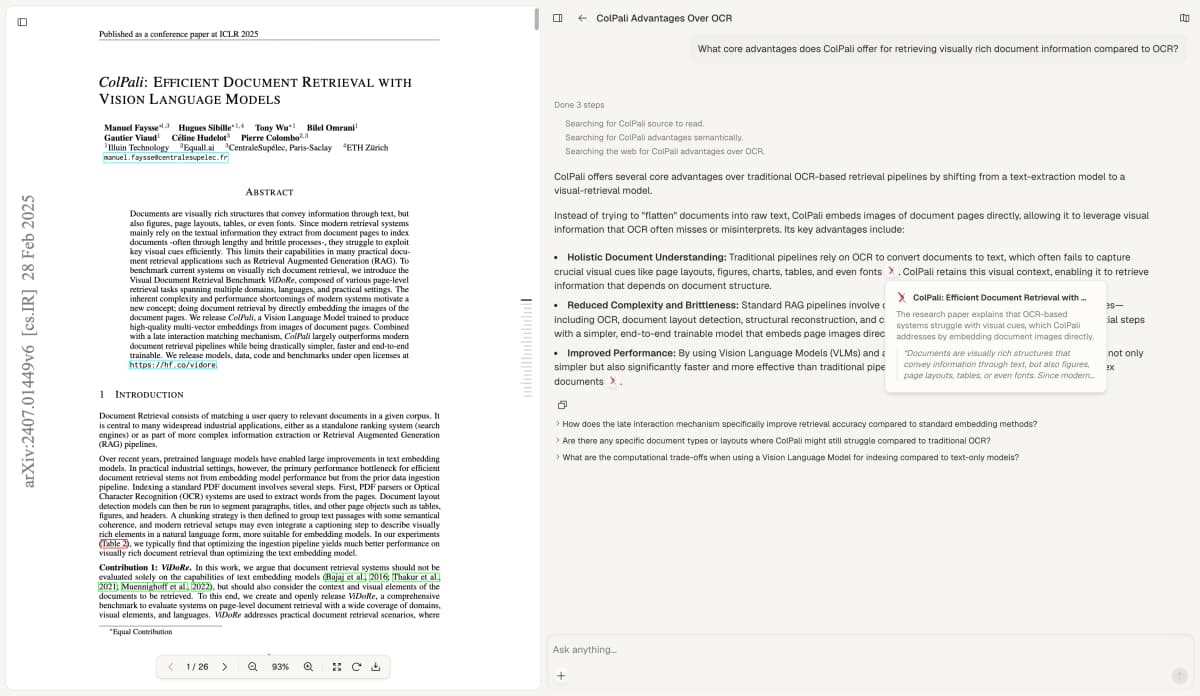
Existing Atlas screenshot about ColPali: it illustrates source inspection, not the fictional interview study, a formal coding database, or an external dependability audit.
Correct a row if Atlas guesses a cause for S1 or treats the two guide versions as the same. Ask for the exact passage behind the claim. Keep the gap if the source does not resolve it.
For larger sets, our research synthesis guide helps keep claims linked to sources. Atlas assists reading and notes; the study team judges the process, its context, and the method's fit with the question.
Save the reasoning and open questions
Before saving, trace one change through the plan, dated record, reason, and data or steps it changed. Check whether your final claim concerns these files or the whole study. Narrow it if the sources do not support that wider scope.
Select New, then Note, and wait for Saved before closing. Keep versions, source locations, the new claim, and open questions. A reader should see why “identical throughout” was removed without assuming the study failed.
Choose the next record to inspect, then share the note with its gaps intact. If a fuller source arrives, review the logic before changing the claim. A useful note makes the next check clear while leaving the final methods judgment with the researcher.
Trace process records in Atlas
Compare reported changes with their dates, reasons and source support.