

A case study research design connects a question to a defined case, the evidence you will collect, and how you will make sense of it. Start by stating what the case is and where it begins and ends. A place name or a list of interviews is not enough to explain the design.
This guide uses published methods and a fictional library rollout to build a case boundary and evidence plan. Researchers still choose the design, gain access, carry out fieldwork, and check the final claims. Atlas can support reading and comparison of permitted sources.

Compare case-study sources in Atlas
Check a design note against named methods and study sources.
What makes a case study design
Case study research looks closely at a case in its real setting. The Crowe methods commentary describes this as an in-depth approach to complex issues in context. The setting matters to how you understand the question, rather than serving only as a place to recruit people.
For example, you might study how one library branch introduced self-service checkout. The rollout is the focus, and the branch's staffing and routines are part of its context. Talking to staff can supply evidence about that case without making each staff member a separate case.
The Baxter and Jack guide addresses research questions, defining and binding the case, and evidence sources. These choices work together. Do not select interviews first and call the work a case study simply because everyone works at the same site.
The label alone can hide an unclear plan. A Sage methods critique notes published work that used “case study” without explaining its boundaries or methods foundation. Give the reader those reasons instead of relying on the title to convey them. If you are choosing a label for a clinical account, case report versus case study compares the purpose, sources, and analysis before you plan the design.
Define the case and its boundary
Write a question that requires a close look at the case. In the fictional library plan, ask: “How did the branch put self-service checkout into daily use during the autumn term?” This is more precise than “What do staff think about technology?”
Next, state what you are studying. A draft boundary could be: “One branch's checkout rollout from September through November, covering staff routines and visitor help during that term.”
This identifies the activity, place, and time. It does not yet claim that the design is feasible or that the branch stands for all libraries.
Explain what falls outside the case. The fictional plan leaves out other branches, later software upgrades, and a full assessment of library use.
Wider policies may still matter as context, but reading one does not turn the whole library network into the case.
Keep the case separate from the sources that describe it. Ten interviews about one rollout need not mean ten cases. If you want to compare several branch rollouts, explain what counts as each case and why that comparison helps answer the question.
Your method tradition should guide these choices. Flyvbjerg's argument about case research challenges the blanket claim that one case cannot contribute to wider knowledge. That does not mean any convenient site represents a population. State the kind of learning you seek and how the case selection supports it.
Compare published evidence choices
Read methods sections to find what the team did, not only what they called the design. Compare the question, case, data, analysis, and limits. A published plan can show choices to consider, but you still need to judge whether they fit your own question.
In Sheikh's team study, the authors spoke to researchers and community leaders, then used follow-up questionnaires. They also kept field notes and a record of how they analyzed the data. These sources gave them more than one view of the research issue.
The paper draws a clear line around its data. The team also held focus groups with people with asthma, but planned to report those data elsewhere.
They were not used in this article's analysis. Check which sources support the account you are reading, rather than assume it uses all the project's data.
Crowe's team describes other case-study evidence choices, with interviews, field observations, and documents used together. They also discuss data in the form of numbers. A case study need not use only text; choose each source for what it can tell you about the question.
For a written plan, Rashid's team describes a protocol that links the question, scope, access, data gathering, and analysis. Use this to set out your own choices. The authors' view of how knowledge is formed belongs to their approach; it is not a rule for all case studies.
Build a fictional evidence-source matrix
The following matrix is a plan for the made-up library case, not collected data or an Atlas result. The boundary remains one branch's checkout rollout from September through November. Each row names a possible source, the question it could help answer, and what it cannot establish alone.
Fictional teaching example: four evidence sources planned for one bounded library checkout case.
| Proposed source | Question it could help answer | Check before use | Limit to preserve |
|---|---|---|---|
| Rollout plan and staff guidance | What process did the branch intend to follow? | Version, date, author, and whether the guidance applied during the term | Intended practice is not proof of what happened. |
| Staff interviews | How did staff describe the change and its difficulties? | Consent, role, timing, and whether the account concerns this branch | An account is a person's perspective, not direct observation of every shift. |
| Field observations | How did checkout and help work during observed periods? | Permission, session times, recorded context, and researcher role | Observed periods do not cover every visitor or shift. |
| Service records | What recorded activity falls within the study period? | Definitions, coverage, missing entries, and permission to use the records | A recorded total may not explain why an event occurred. |
Table 1: Suppose a plan says staff should help visitors beside the checkout point. That supports a statement about intended practice.
To say staff always did so, you would need evidence about actual practice across the scope of that claim. The plan cannot supply that evidence itself.
A safer design note would say: “Compare the written help process with staff accounts and the periods observed. Record where they agree and where they differ.” This gives the planned sources distinct roles without inventing a finding about the branch.
The Baxter and Jack abstract identifies case binding and source triangulation as design topics. The matrix puts those questions into a planning record.
Its four sources are chosen for this teaching case, not a mandatory number or set for all projects.
Revise the plan if a source is unavailable. For example, if service records have gaps, note what you can still ask and which claims need to narrow. More files do not compensate for a source that cannot answer the question.
Plan how claims will be checked
Plan how you will bring the sources together before the fieldwork grows. Keep each claim linked to its source, time, and setting. Look for where accounts match, where they differ, and what is still unclear. Three matching accounts do not prove a claim by majority vote.
Sources may rely on each other. A manager may repeat the rollout plan in an interview, so the two accounts do not always provide separate support. Ask whether a match reflects daily practice, shared wording, or the same source used twice.
Keep differences in the record rather than erase one account to make the story tidy. If what a staff member says differs from what you saw, check whether the accounts refer to different shifts, dates, or situations. The original PLOS study's analysis section describes looking for data that could support other ways to read the findings.
Choose an analysis approach that fits your question and method. Inductive thematic analysis may help examine patterns in text, but it does not define the case for you.
If your aim is a causal account, process tracing adds specific questions about what evidence supports a proposed sequence or mechanism.
For several cases, first build a clear account of each one, then compare them. Crowe's analysis guidance makes this distinction. Set aside time to make sense of the data rather than gather so much that you cannot read it closely.
Check the design sources in Atlas
Atlas can help compare selected methods papers with your design notes. Use only material you have permission to process. Researchers remain responsible for participant consent, fieldwork, record accuracy, and the decisions about what the case includes.
In a project chat, type @ and select the methods paper and study note. Ask: “Compare this planned case boundary with the supplied method guidance. Cite the passages for each comparison. Identify the case, context, time limit, and proposed evidence sources. Flag unclear choices without selecting the design for me.”
Use Project only to stop new web or literature searches. Earlier outside context can remain in a chat, so start a fresh project chat if the old one has unrelated sources. Add other published studies by name when you want to compare their actual evidence choices.
Open each citation and read the surrounding text. Confirm that a claimed method rule comes from that source and fits its scope. Do not turn a study author's local choice into a universal requirement.
The citation tracking guide explains why a cited answer still needs this check.
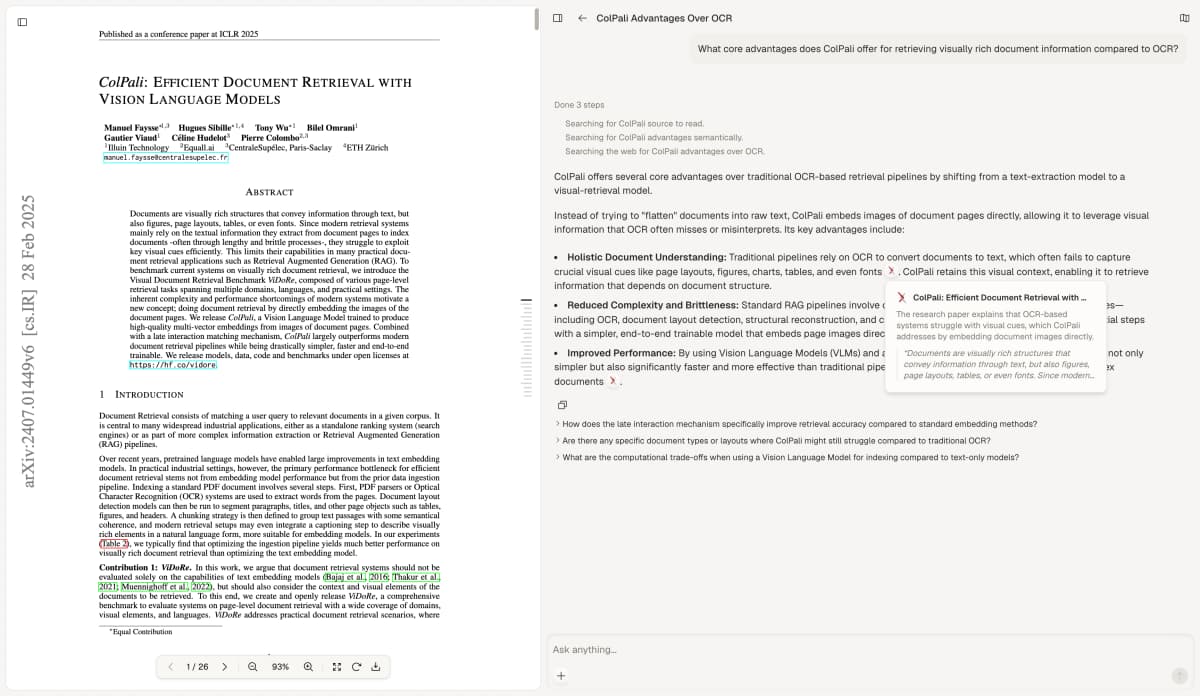
Atlas source-check capture, reused unchanged. Paper: Faysse and colleagues, ColPali, version 6 (2025), CC0 1.0. It does not show the fictional library case, fieldwork, or a design-quality test.
Correct the proposed note before saving it. If the answer calls the rollout plan proof of daily practice, replace that claim with the plan's intended process and the evidence still needed. Choose New, then Note, save the checked boundary and source plan, and wait for Saved before closing.
Review access and scope before fieldwork
Check whether you can study the case as planned. Confirm access to the site, people, and records with those who control it. A source list is not a workable plan until you have checked permission, timing, and limits on what you can do.
Follow your institution's process to protect people and their privacy.
In a small case, readers may know who or where you mean even if you remove names. Crowe's discussion of access and reporting explains why these issues affect both the fieldwork and the final text.
State how far the findings could reach. The external validity guide helps you check the fit with another setting, rather than assume one rich case stands for everyone. Keep what you say about this case apart from wider claims you plan to test.
Write a design note that joins the question, case boundary, reason for choosing it, sources, analysis, and open access issues. The Rashid protocol guidance is one source for linking those choices. Ask a researcher or supervisor to review the plan before you start fieldwork.
Compare case-study sources in Atlas
Check a design note against named methods and study sources.