


AI citation tracking tools answer 2 questions that often get collapsed into one vendor category:
- Where do AI answer engines mention, cite, or recommend my brand, page, or source?
- Does the cited source support the claim I am about to use?
Most commercial AI citation trackers are built for the first job. They run prompt sets across ChatGPT, Perplexity, Gemini, Copilot, Google AI Overviews, or AI Mode. Then they report which brands, domains, URLs, or rivals appeared.
Source verification is different. A cited URL, citation badge, or AI answer mention is not proof that the statement is correct. For research, analysis, and high-stakes content, you still need to inspect the passage.

Verify tracked claims in Atlas
Add the cited sources, check the tracked claim, and inspect supporting passages.
Quick answer
Use an AI citation tracking platform when you need to watch external AI presence. It can show which pages are cited, which rivals appear, which prompts trigger citations, and where gaps exist. Use a source-check workflow when you need to know whether a cited passage supports a claim.
For SEO and brand teams, the most relevant tools are AI presence platforms such as OmniSEO and Similarweb AI Search Intelligence. They track prompts, brand mentions, cited domains, cited URLs, rivals, and gaps.
Researchers, analysts, writers, and students usually need a source check. The practical question is whether the source supports the sentence you want to write.
Atlas helps with the second job. In Atlas, you can ask a grounded question. Then you can inspect citation badges, open the source passage, and revise the claim if the evidence is weak.
AI citation tracking criteria and categories
The phrase "AI citation tracking tools" now covers several jobs. Before comparing vendors, decide which proof you need.
Visibility, gaps, and brand reporting
- Answer-engine tracking: checks whether AI systems cite your domain, URL, brand, or rivals for a prompt set. OmniSEO's citation tracker describes this as tracking where content is cited across AI platforms, with rival benchmarks and cite events.
- Cited-source lists: show which domains and URLs shape AI answers. Similarweb's citation analysis page describes that source view. Its Knowledge Center article explains the same feature inside AI Brand Visibility.
- Brand tracking: is broader than citations. The Similarweb AI Brand Visibility product page frames the job as tracking brand appearances, topics, and citations in AI search answers. The Similarweb visibility index shows why teams now report AI presence apart from classic SEO ranks.
- Gap analysis: looks for prompts where rivals are cited and your site is absent. Practitioner roundups from RankMasters and Siftly use this buyer language. Check exact coverage against official vendor pages.
- AI presence suites: combine cite data with prompt, mention, and rival reports. Official product pages such as SE Ranking's AI Visibility Tracker, OmniSEO's platform page, and WebFX's OmniSEO page are better proof for exact features than roundups.
- Referral and analytics proxies: use logs, web analytics, webmaster tools, UTM tags, referrer data, or manual prompt checks. CXL's Bing visibility workflow shows the appeal and limits of this lighter path.
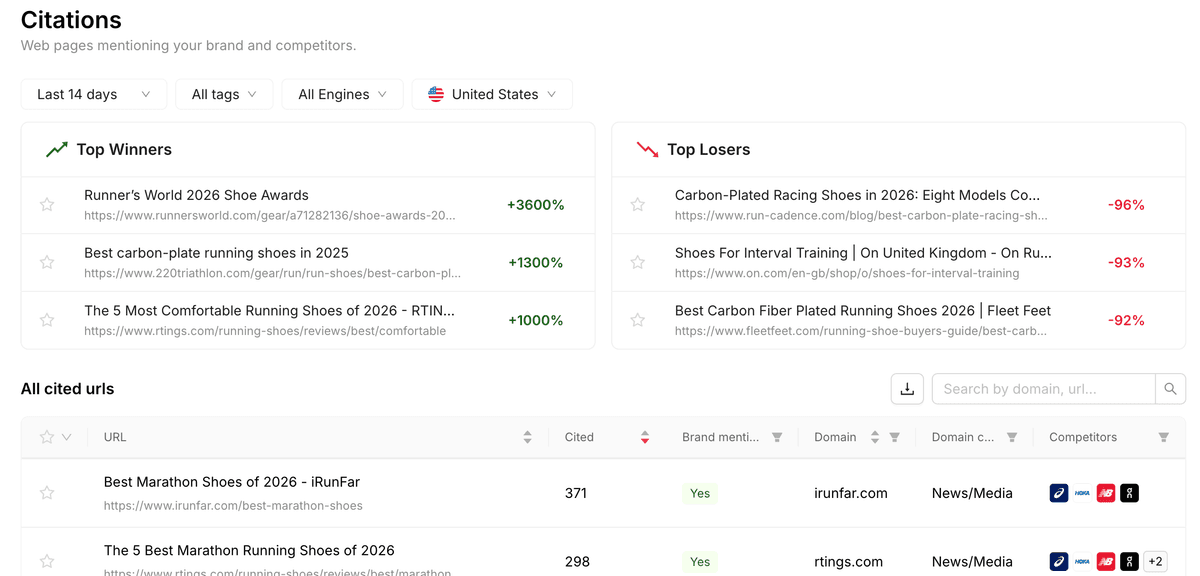
OtterlyAI's official help article illustrates a visibility report: it groups cited URLs, brand mentions, competitors, and changes over time. The rows shown are example data, not a market benchmark.
Use a report like this to find where an AI answer cited a page. Open the source and check the passage separately before treating that citation as support for a claim.
Research and source-support work
Academic tools map which papers cite each other. They help with literature reviews and research checks. They do not show whether ChatGPT cited your site. For the broader category split, see the companion guide to AI citation analysis tools.
Source-grounded checks ask whether a cited source supports a claim. Atlas belongs here. Grounded questions can return citation badges that open exact source passages. A citation is an inspection path. The reader still needs to check the passage.
AI citation tracking tools compared
The most useful comparison is not a universal ranking. Start with fit. What proof does the tool produce? What decision does that proof support? What can the tool not prove?
Buyer-fit matrix
| Workflow | Best fit | Evidence produced | What it helps decide | What it cannot prove |
|---|---|---|---|---|
| Dedicated AI citation tracker | SEO, GEO, and brand teams monitoring AI answer visibility | Cited URLs, cited domains, prompt-level mentions, competitor citation share | Which prompts and topics need visibility work | Whether the cited page supports a factual claim |
| AI brand visibility suite | Marketing leaders who need share-of-voice, topics, mentions, and citations together | Brand appearances, topic coverage, cited sources, competitor comparisons | Where AI answers already include or omit the brand | Whether an answer is accurate enough to quote |
| Citation gap analysis | Content and digital PR teams | Prompts where competitors are cited and your site is absent | Which pages, entities, or sources may need improvement | Whether closing the gap will produce traffic or conversions |
| Manual AI citation audit | Small teams validating a few priority prompts | Spreadsheet of prompts, AI answers, cited URLs, screenshots, and notes | Whether paid tooling is worth it before procurement | Stable coverage across engines, locations, and time |
| Analytics and referral proxy | Teams with existing SEO analytics but no AI visibility platform | Referral traces, AI traffic estimates, webmaster data, direct-traffic clues | Whether AI surfaces may already affect discovery | Which sources appeared inside the AI answer |
| Academic citation analysis | Researchers and librarians | Citation networks, scholarly context, support or contrast signals | How papers relate to one another in the literature | Brand visibility in ChatGPT, Perplexity, or AI Overviews |
| Source-grounded verification | Researchers, analysts, writers, and students checking claims | Claim, cited source, cited passage, and reviewer judgment | Whether a claim should be used, narrowed, or revised | External AI visibility across the open web |
Table 1: This table is also the procurement filter. If your team asks "Are AI systems citing our pages?", choose a visibility tracker. If your team asks "Can I trust this cited claim?", use a source-check workflow. If both questions matter, connect the workflows instead of expecting one dashboard to do both.
Use official product pages for current platform and workflow claims. Use Digiday, AirOps, Clearscope, or Indexly for category language, then verify coverage, pricing, engine support, and reporting details against the vendor's own site.
Source support limits
AI citation tracking can prove that a monitored answer included a brand, domain, URL, or citation at the time of the test. A stronger platform may also show the prompt, engine, answer text, rival set, and trend line.
It cannot prove that the cited source supports the AI answer. AI systems can cite a real page for the wrong reason. They can overstate a page, miss a caveat, or blend several sources into one confident answer. That is why the next step after a high-value citation is inspection.
For a marketing team, this difference changes the report. Citation share is a visibility metric. Source support is a quality metric. Treat them separately:
- Report cite rate, cited URLs, gaps, and rival presence to measure AI presence.
- Report source match, passage relevance, claim strength, nearby context, and conflicts to measure verification.
- Keep screenshots or answer exports for volatile AI surfaces, because answer composition can change by prompt, user, location, engine, and date.
- Do not count a citation as a content win until the page says what the AI answer implies it says.
Verify citation support
A practical workflow starts after the tracker finds a mention or cited source. The goal is to move from "the AI cited this" to "the source supports this exact statement."
Atlas verification workflow
- Copy the exact claim you need to check.
- Open the cited page, paper, document, or source passage.
- Check whether the cited source is the expected source.
- Read the exact passage and the nearby context.
- Decide whether the passage supports, partially supports, contradicts, or ignores the claim.
- Revise the claim and record the source passage you checked.
Atlas is useful when the source set is already inside your project. You can upload or collect sources, ask a focused grounded question, and inspect the citation badges attached to the answer. Open important citations and check source match, passage relevance, claim strength, context, and conflicts before using the result.
For example, a tracking tool might show that an AI answer cites your guide for "retrieval reduces hallucination." Inside Atlas, ask a narrower question:
Which source supports the claim that retrieval reduces hallucination, and what limitation does the source mention?
The answer is only useful if each important claim points back to a passage you can inspect. If the passage is related but weak, revise the claim. If the citation opens the wrong source, ask a narrower question. If the project lacks evidence, treat the claim as unverified.
Source-support checklist
Use this checklist before turning any tracked AI source link into a report, article, review, or recommendation:
| Check | Pass condition | Action if it fails |
|---|---|---|
| Source match | The citation opens the source you expected | Search for the correct source or rerun the query with source constraints |
| Passage relevance | The passage directly supports the sentence | Narrow the sentence or find a stronger source |
| Claim strength | The wording does not exceed the evidence | Add qualifiers, remove overclaims, or split the claim |
| Nearby context | Surrounding text does not reverse or qualify the claim | Add the caveat or avoid the claim |
| Conflict handling | Disagreeing sources are named | Compare sources and state the disagreement |
| Reuse readiness | The checked source and passage are recorded | Save the citation trail before publishing or reporting |
Table 2: The handoff works because the tools answer different questions. A tracker can tell an SEO team which answer surfaces matter. Atlas can help a researcher, analyst, or writer inspect cited evidence inside a controlled source set.
Atlas guides can help with deeper source checks such as following source links, fixing weak cited answers, and combining several sources. Related Atlas guides compare AI tools that cite sources, AI tools with references, and verifiable AI research.
Which tool should you choose?
Choose the tool by the decision you need to make.
Match the tool to the decision
- Report AI search presence: choose a tracker or AI brand suite with prompt lists, engine coverage, cited URL exports, rival benchmarks, answer snapshots, trend lines, and mention reports.
- Find content opportunities: prioritize citation gap analysis. The useful output is prompts, competitor sources, missing entities, and pages that deserve revision or digital PR support.
- Prove the category internally: run a manual audit first. Test 20 to 50 revenue-relevant prompts across the engines your buyers use, record cited URLs, and compare the results with current SEO rankings.
- Understand scholarly source links: use academic source tools rather than AI presence platforms. The Atlas guide to citation tools for research is a better starting point for reference-manager and research-citation decisions.
- Verify your own source set: use Atlas. Ask grounded questions, open citation badges, inspect the passage, and revise weak claims. Atlas should not replace an external AI visibility tracker, and an external tracker should not replace source inspection.
The operating model is a handoff. The tracker finds the AI answer, cited URL, and competitor gap. The content or research team checks what the source says. Atlas helps verify claims against uploaded sources when the task requires cited synthesis or reusable evidence notes.
That split keeps the metrics separate. Being cited is a distribution signal. Being supported by the source is an evidence standard. For adjacent research-tool comparisons, see the Atlas roundup of AI research assistants.
Conclusion
AI citation tracking tools are useful when the job is external presence. They show whether AI answer engines cite your brand, pages, rivals, or sources. When the job is source support, use the tracker as the discovery step. Then inspect the cited passage before reusing the claim.
For SEO teams, start with the tracker that covers your target engines, prompts, competitors, and reporting cadence. For researchers and writers, start with the evidence: open the cited source and check the passage. For teams that need both, let the visibility tool find the citation and let a source-grounded workflow verify the claim.
Verify tracked claims in Atlas
Add the cited sources, check the tracked claim, and inspect supporting passages.