

Qualitative document analysis is a way to study existing records as evidence about a question. The researcher chooses which files belong, examines who made them and why, then compares what the records show and omit.
A summary of each file is useful preparation; it is not the analysis itself.
Suppose a team wants to understand how a library explained a change in opening hours. A public notice, a staff briefing, and meeting minutes may tell different stories because each serves a different audience. The team should preserve those differences before making a claim.
Atlas can help compare selected files with citations. The researcher still decides which records to use and what they mean.

Compare selected documents in Atlas
Compare source passages, inspect citations, and save a checked note.
What qualitative document analysis examines
A document is more than a container of facts. Its author, reader, date, purpose, and route into the archive affect what can be learned from it. A public notice may explain a decision to patrons without recording internal disagreement.
Meeting minutes may list a vote but omit informal talk. An interview would answer a different question because it captures a person's account rather than an existing record.
The method can examine policy files, reports, letters, forms, minutes, websites, or other records. Morgan's methodological paper treats source choice and context as part of the research, not just a search for quotes. The Lumivero guide asks who made a record, what it means, and how far its account can be trusted.
Decide what the document can support. A meeting note saying that a timetable was approved supports a claim about what the note records. It does not by itself establish that every branch adopted the timetable or that patrons found it helpful. Keep observations from the text separate from your interpretation of them.
When documents can answer the question
Use records when the question concerns a decision, public message, practice, or change over time. You must be able to use the files with permission. They can show how groups describe the same issue.
Your evidence stops at the files you can inspect. Other accounts may exist.
A study of records alone has a narrower view than one that also talks to people or watches events. Files may be written for office needs, saved unevenly, or changed before release.
Missing files and unheard people limit what the team can say. Do not fill those gaps with guesses.
Write a bounded question before collecting files. “How did this library explain its opening-hours change in public and internal records from January through March?” names the topic, sources, and period. “What did all patrons think of the change?” cannot be answered from those files. The qualitative research questions guide covers how to refine a study-level question before choosing a method.
A qualitative methods guide likewise begins with a research question and source selection before coding or reporting. If interviews are needed, plan them as a separate source of evidence. If the job is to order dated legal events rather than study how records frame a topic, use a source-linked case chronology.
Define the corpus and record selection rules
Create a selection log before close reading. State the date range, organizations, document types, inclusion rules, exclusions, and how files were found. Keep a stable identifier and source location for each document. If a file is a later revision, record the version rather than silently replacing the earlier one.
For the made-up library case, the team might include public notices, staff briefings, and meeting notes from January through March. It would leave out unsent drafts and social posts when it cannot tell who wrote them. The rule limits claims to the files on hand; it does not make the other items unimportant.
| Log field | Example entry | Why it matters |
|---|---|---|
| Document ID and version | D-02, staff briefing, revision 2 | Prevents a later edit from being mistaken for the original record. |
| Origin and audience | Operations team to branch staff | Helps explain why this account differs from a patron notice. |
| Date and collection path | 12 February; internal archive | Separates when a file was produced from when the researcher received it. |
| Inclusion decision | Include because it describes the hours change | Makes the corpus boundary reviewable. |
Table 1: This made-up log shows how to explain choices; it is not a real library record. MAXQDA's ten-step account treats the question, file choice, coding, and analysis as separate steps.
The selection log helps the team avoid collapsing those choices into one software step. A reviewer can then see whether the selected files could answer the question the team actually asked.
Appraise each document and capture passages
Read each file well enough to understand its structure. Note author, purpose, audience, date, whether the copy is complete, and whether another source backs its account.
A scanned excerpt without its heading or attachment may be too thin for a strong claim. Record uncertainty rather than treating a missing page as agreement.
Capture excerpts that answer the question, including ones that challenge an early reading. Give each a page, section, paragraph, or other usable locator. Keep the exact wording or a faithful paraphrase apart from a tentative code such as “reason for change.”
Codes help organize material. A label such as “staff concern” is the researcher's choice and may change after comparing cases.
Do not count repeated wording as independent evidence without checking whether one file copied another. Two notices based on the same briefing may reflect one account.
Also ask whose view is absent. Perhaps no patron response was kept in the official file set. A negative-case analysis can help test a draft theme against accounts that do not fit it.
Build a source-linked document comparison
The example below is made up. D-01 through D-03 are not real files. The page and paragraph labels only show how to cite a source. The question is how one library explained shorter evening hours. Each row keeps the source text apart from the team's reading.
| Fictional document and locator | What the text says | Provisional reading and check |
|---|---|---|
D-01, public notice, paragraph 3 | Evening hours will end an hour earlier; the notice says this will match staffing levels. | The public explanation foregrounds staffing. Check whether the notice names affected branches. |
D-02, staff briefing, page 2 | The new schedule is described as a trial pending usage review. | “Trial” qualifies the apparent permanence of D-01. Check the briefing's version and approval status. |
D-03, meeting minutes, item 6 | Members ask for patron feedback before a final schedule is set. | This challenges a simple “decision was final” account. Minutes record the request, not proof that feedback was collected. |
Table 2: The three made-up files frame the change in different ways. Two mention a review before the final schedule. The team can claim only that the files say this.
It does not establish the actual reason for the change or how patrons experienced it. Look for later decisions and patron accounts before extending the claim.
Keep a short note beside the table: “The public notice stressed staffing. The staff note called the change a trial. The minutes asked for feedback. We have no checked feedback file or final vote.” This tells a reviewer what the team found and what might change its view.
Interpret patterns without losing context
Compare excerpts across files, then return to each whole source. A phrase that looks like disagreement in a table may make sense once the date or audience is restored. Look for revisions, silence, contrary records, and borrowed language.
Record why you grouped excerpts under a theme and why a rival reading was rejected or left open. The constant comparative method offers a deeper cycle for testing and revising categories as new cases arrive.
Say where the files came from, which versions you used, what was missing, and how you checked your reading. Bowen's paper covers both the value and limits of records as research data.
Records can provide context and a trail of decisions, but they are not always complete or free of bias. A framework analysis guide shows another way to compare cases against a defined set of questions.
If your study needs formal coding, checks between coders, people to take part, or ethics review, plan those steps too. An AI answer with three cited quotes does not prove the sample or the reading is sound.
The researcher remains responsible for permissions, method choices, and the final claim. The qualitative coding tool comparison covers software support for the distinct coding task.
Check a bounded comparison in Atlas
Add files you are permitted to use to an Atlas project. In chat, select the relevant ones with @. Ask: “How do these notices, briefings, and minutes explain the change in evening hours? Keep each file separate, cite each account, and flag conflicts or missing decisions.”
Open the citations and read nearby text in the source. Check dates, versions, and whether each cited line supports the comparison. If the answer treats the staff briefing as final policy, correct that in your note.
After checking the source, save the table, your reading, contrary quotes, and open questions in a project note. The Atlas view below shows where to check an answer beside its source. The pictured paper is not part of the made-up library case.
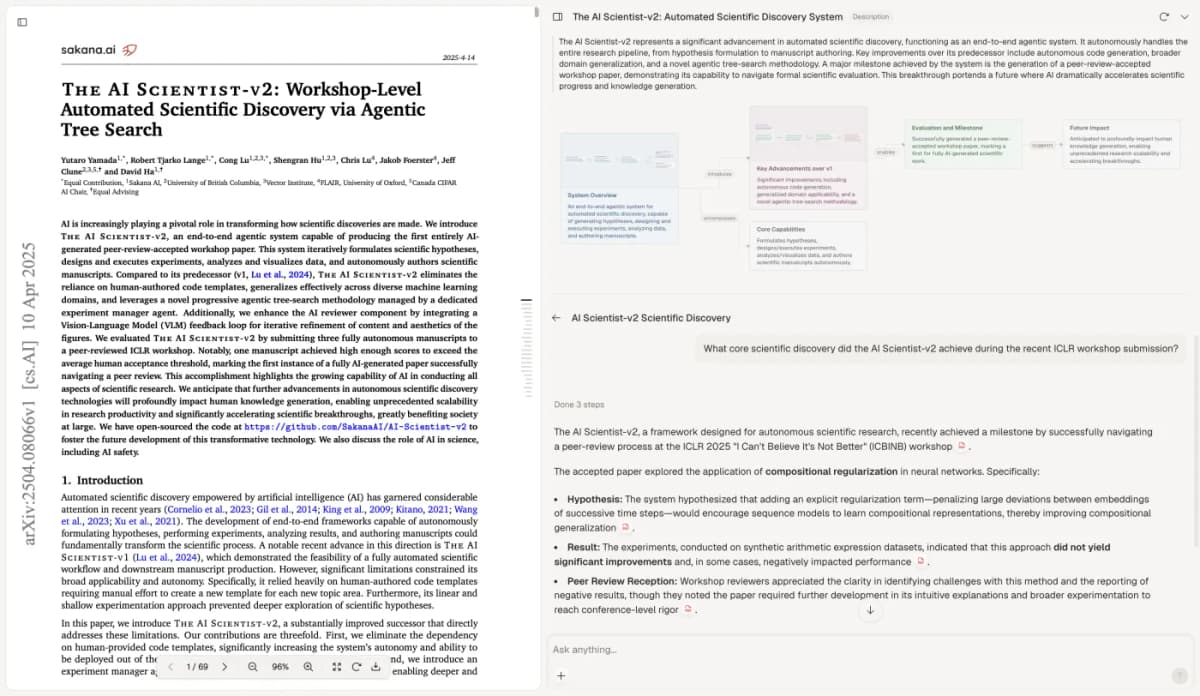
Atlas displays The AI Scientist-v2 by Yutaro Yamada and colleagues, licensed CC BY 4.0. This reused capture is unchanged. The paper supplies no evidence for the fictional library case.
Atlas helps with cited reading across selected sources. It does not build the corpus for you, certify that all relevant records were collected, or replace a coding method. An audit trail guide covers how to keep broader research choices traceable; a document analysis software comparison helps when you need a dedicated coding or extraction tool.
Compare selected documents in Atlas
Compare source passages, inspect citations, and save a checked note.