
Constant Comparative Method: Compare Cases and Revise Categories
Constant comparative method, explained with a worked example: compare new incidents with earlier cases, check contradictions, and document category revisions.
- Byline

Summary
Constant comparison tests a new case against earlier cases. The team changes a working category when a case no longer fits.
A memo records the source, what matches, what differs, and the team's next choice.
Repeated patterns do not prove saturation. Researchers still choose the cases and judge what they mean.
The constant comparative method asks a researcher to check each new incident against earlier incidents and the current category. An incident is a relevant event, statement, or action in the material. A category is the researcher's working idea about what a set of incidents has in common.
In Glaser's original account, the analyst compares a newly coded incident with prior incidents in the same category.
The comparison may support the idea, show a new feature, or make its boundary doubtful. The researcher writes a memo about what changed.
Imagine three fictional notes about where students study. Two describe finding a quiet room. A third describes reading on a bus because that is the only available time.
The third note challenges “finding quiet space” as a full account. A researcher might ask whether the category needs a broader boundary or a second category. More cases are needed before that choice can support a finding.
Atlas can compare selected, permitted notes and show citations to inspect. Keep the decision about category wording, missing cases, and the next sample with the research team.

Atlas

Compare selected excerpts in Atlas
Inspect cited passages and save a checked category revision note.
What the constant comparative method does
Constant comparison is a repeated analytic move: place an incident beside an earlier incident or a category definition, ask what is alike and different, and record what that means for the working idea. The analyst returns to the evidence as new material arrives.
Glaser's method paper made this a core part of grounded theory. It also calls for memos when a comparison sparks an idea about a category's properties.
A property is a feature that helps describe when the category fits, how it varies, or where it stops fitting.
Two excerpts can share a code such as “study location”: a library and a bus both count. Compare why each place was used and whether one category explains both. The Quirkos method guide warns against replacing this reading with code counts.
Choose what to compare and why
Start with an incident and its context
First decide which event or statement bears on the study question. Read enough of the surrounding note or transcript to know who was speaking, what happened, and what the words refer to. This context is part of the evidence; a short excerpt can lose its meaning alone.
Boeije's analysis of qualitative interviews starts with comparisons inside one interview.
She checks how passages coded alike relate to the person's full account, including apparent conflict. That is a useful test before treating a short phrase from two people as the same idea.
Change the comparison as the question changes
Later, compare incidents across interviews, cases, or groups. You can also compare a new incident with a category's stated properties.
Boeije describes different comparison targets and aims. Ask what each pair can tell you: does it clarify a feature, show a limit, or suggest a new question? The Boeije paper records the data, aim, questions, and result for each kind of comparison.
Constant comparison began in grounded theory. Fram's method commentary discusses its use in other study designs, where the chosen framework still matters.
If you are starting with first-pass labels, the open coding guide covers that task. Here the focus is what happens when a new case puts a working category under pressure.
Compare each new incident in a cycle
Reopen the earlier cases
- Name a provisional category in one sentence. State what it includes and one condition under which it might not fit.
- Select a new incident that may bear on it. Record its source and locator, then read the nearby passage.
- Reopen at least one earlier incident in the category. Compare actions, setting, sequence, and the speaker's stated reason.
- Note what supports the category, adds a property, or challenges its boundary. Keep an alternate reading in view.
- Write a dated memo with the possible change and the next case to inspect. Revise the category only after the researcher checks the evidence.
The cycle asks for a purposeful pair of excerpts. Glaser ties each new incident to earlier incidents coded in a category.
Boeije makes the aim of the comparison explicit. Choose a pair that can answer an analytic question; an exhaustive set of pairs is rarely the point.
Let a mismatch change the question
A new incident may support the category as written. It may add a condition that only occurs in one setting. Or it may show that the label groups unlike actions.
The Delve explainer calls these support, expansion, and contradiction. Those prompts tell the researcher what to check next. Each reading still needs the source passage.
When a case seems to clash with the category, return to the whole source. Ask whether the excerpt was read out of context, a different property explains it, or the category is too broad.
The Quirkos guide places this work across sources, codes, groups, and memos. Keep what people did and said in view alongside the code label.
Follow a category through three excerpts
The following study, people, excerpts, and locators are fictional. They show how to record a comparison. The imagined question is how students make time and find a place to study alongside paid work and other duties.
The team first writes “securing a quiet study space” as a provisional category. The ledger shows what each new incident might do to that idea. Each row keeps a source locator so a real analyst could reopen the full passage before deciding.
| Fictional incident | Comparison with the working category | Tentative reading | Next check |
|---|---|---|---|
| F1, note 4: “After my shift, I book the late library room so I can focus.” | Quiet room fits the category; shift time may also matter. | Support, with a possible time constraint. | Check what “late” means in the full note. |
| F2, note 9: “When the room is full, I sit in the lab lobby and use headphones.” | The student still seeks quiet but adapts to scarce space. | Expand the category with a property about making a place usable. | Compare whether access or noise drove the choice. |
| F3, note 15: “I read on the bus between child pickup and work. A quiet room is not an option.” | Quiet space is absent; a short time window is the main condition. | Challenge the category's boundary. | Inspect another case where time and place pull in different directions. |
Table 1: This fictional ledger shows one category being supported, expanded, and challenged by new incidents.
F1 and F2 could fit “securing quiet space.” F3 raises a wider question about available time. One candidate label is “making study possible under constraints.”
That idea would need clear properties for time, place, noise, and control so it does not absorb every case. The team could instead keep two linked categories if later cases warrant it.
The Boeije account shows why context matters. Its examples move between parts of one interview, cases in a group, and groups with different experiences.
A phrase shared by two people cannot, on its own, show that the same process is at work.
Write a memo when categories change
An analytic memo records the researcher's thinking when a comparison matters. Glaser's paper treats memo writing as part of the method.
Boeije uses memos to make analysis traceable. A memo records the evidence and the reason for a proposed change so another team member can test it against the sources.
Record the before and after
For the fictional student study, the earlier memo might read: “Category v1: securing a quiet study space. F1 and F2 show students finding or making a low-noise place after work.” It names the supporting cases and the category's current boundary.
A new memo could read:
F3 challenges v1: the student studies during travel and says a quiet room is unavailable. A wider label may be “making study possible under time and place constraints.” F3 might instead form a separate category about time windows. Reopen F1 and F2 for time constraints, then inspect another travel or care-duty case before deciding.
The countercase stays visible in the memo. One passage cannot settle how broad the category should be.
Delve's support/expand/contradict frame helps name the question. The team checks whether that reading fits the source and keeps the boundary unresolved if later cases do not support the new label.
Check source passages in Atlas
Put the source texts you may use, past examples, and current memo in one Atlas project. In chat, use @ to name the items for this check. Atlas can compare selected project sources and show cited passages. The team decides what it may add and share.
Ask: “Compare these new excerpts with the memo and past examples. For each excerpt, show a cited passage that backs, extends, or challenges the category. Keep the source wording apart from your suggested change. What else should we check?”
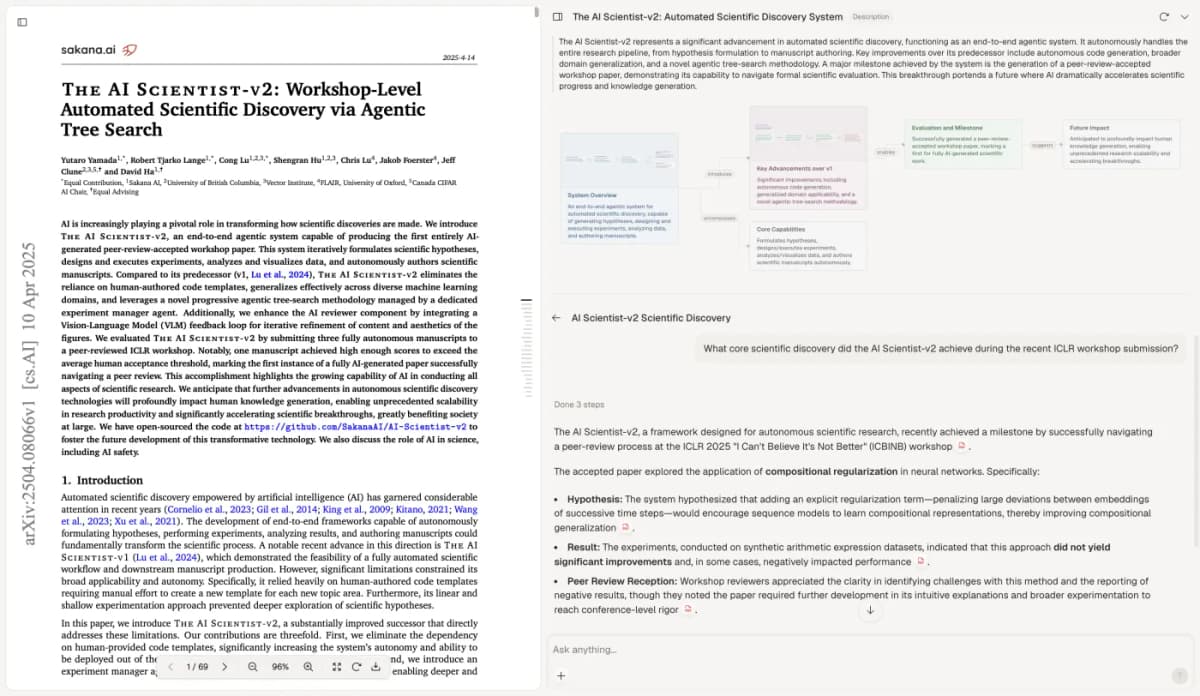
Open each citation that could change the category. Read the text around it. If Atlas misses a case, uses the wrong source, or treats new wording as new meaning, fix the ledger yourself. The document question-answering guide covers source checks in more detail.
Save a checked note with source locations, a possible change, another reading, and the next case to check. Revisit the note when more source text arrives. A cited answer can aid this check. The team still decides which case belongs in a category and what has been missed.
The screenshot shows an Atlas answer beside an open cited source. The visible paper is unrelated to the fictional student notes. It shows where a researcher can inspect source context before keeping a category revision.
Keep theory and saturation judgments human
Constant comparison can help a team refine categories and ask better questions of later data. It cannot prove that a category is complete or that a theory has been built.
Glaser's original account places comparison within wider work on category properties, memos, sampling, and theory writing.
Theoretical sampling is a choice about what data to seek next to develop or challenge an idea. F3 might lead a team to seek more accounts from students with care duties.
That choice depends on the study design, access, ethics, and current analysis. Atlas may help describe a gap in supplied text. The team decides whether and how to collect more.
Repeated wording, a stable code count, or an assistant's answer does not establish saturation. The team must judge the depth and range of a category and explain its basis for any claim.
The theoretical saturation guide shows how to document that judgment with category properties, contrary cases, and a bounded stop memo. Constant comparison supplies material for the memo; it cannot make the stop decision on its own.
Fram's discussion shows how a study can use constant comparison outside grounded theory while keeping its own aims.
The fictional ledger stops at a working choice. In a real study, keep the full passage, source location, case context, and memo together.
That record lets another researcher test why the category changed. For a wider view of the task, see the qualitative data analysis guide.
Atlas
Compare selected excerpts in Atlas
Inspect cited passages and save a checked category revision note.
Frequently Asked Questions
It is an iterative way to compare each relevant incident with earlier incidents and developing categories, using similarities and differences to refine the analysis.