
Theoretical Saturation: Test Categories Before You Stop
Theoretical saturation means testing new cases against a grounded theory. Use a worked case log to decide what to sample next and how to explain a stop.
- Byline

Summary
Theoretical saturation is a grounded theory stop call. New cases no longer add useful detail to a category or its links.
A repeated code or a fixed interview count cannot prove it. Check how cases change a category, test an exception, and choose the next case.
Keep a dated memo that shows what each new batch changed and why more sampling is or is not likely to help.
Theoretical saturation is a grounded theory stop call. You test a category with new cases. At some point, those cases may stop adding useful traits, conditions, or links within your study's scope.
This goes beyond hearing a phrase again. A methods review traces this meaning to grounded theory and sets it apart from other uses of saturation.
Imagine a study of why volunteers return to a food pantry. A new case may repeat the code commitment. Yet it may show that a person stays to mentor others while refusing extra shifts. That changes the idea behind the code.
You would check the passage against your current memo, seek a case that tests the new edge, and note what changed. Atlas can compare selected texts and show cites to check. You decide what to sample and when to stop.

Atlas

Compare new cases with your Atlas sources
Check cited cases against your memo before deciding what to sample.
What theoretical saturation means
In grounded theory, you study new data as you collect it. Early cases suggest categories. You then seek cases that might change them. Chun Tie and coauthors place case review, memos, and new sampling in this loop.
In this work, the unit to assess is an analytic category. Its traits help explain events, and its range shows how they vary. A category called owning a shift might include duty, freedom to change tasks, and trust from the lead.
New cases can change any of these with no new code label. The grounded theory framework treats this work as part of building a category.
The word theoretical matters. You ask whether more data, chosen to probe your emerging account, would still change it. A dental-practice study aims to know and back up the concepts in its growing theory. Hearing a familiar label alone does not settle the question.
Which kind of saturation matters
The word saturation serves more than one research aim. Saunders and coauthors map these uses. State your method and what you mean before you adopt a test from another study.
Code recurrence
A new text may contain no new codes. Record that result. Yet a known category may still gain a new cause, result, or meaning. The code list alone will miss that change.
A study of code and meaning saturation found that finding codes and grasping their depth are distinct tasks. Its case counts fit its own design. They do not set a stop point for all grounded theory work.
Depth of meaning
A case can add depth to a known topic without a fresh code. All volunteers may mention support, yet mean distinct forms of help. The saturation review treats depth as a distinct issue.
Read the cited passage and ask what support meant in that case. A label alone gives too thin a view.
Category development
Here you ask whether well-chosen new cases still change the categories and their links. Show what you tested, what varied, and what you could not sample.
A Drexel account describes checks of causes, effects, settings, and traits around a core category. These checks can show where an account fails, even when codes repeat.
Evidence worth checking before stopping
A stop memo needs more than one kind of evidence. None of the checks below is a fixed rule. Together they show how you reached the call.
Properties and range
State what the category means now. List its key traits and how each one varies. In the pantry study, role ownership might span choosing tasks, teaching peers, and taking charge when plans change.
A new case can widen or narrow that range. The grounded theory design paper links such changes to the growth of a category.
Connections between categories
Ask how the category links to others. Does ownership depend on freedom to change tasks? Can a person feel in charge yet work no extra hours? These cases might change the link even if their codes look familiar.
A grounded theory case study builds a set of linked concepts. That aim demands more than a topic list.
Contrary and missing cases
Keep the passage that fits poorly. Ask which person, site, or event would put the account under the most strain. Theoretical sampling guidance ties new cases to leads from the analysis.
Name any key site you could not reach. Its absence limits your claim, even if the work must end.
Compare each new case with categories
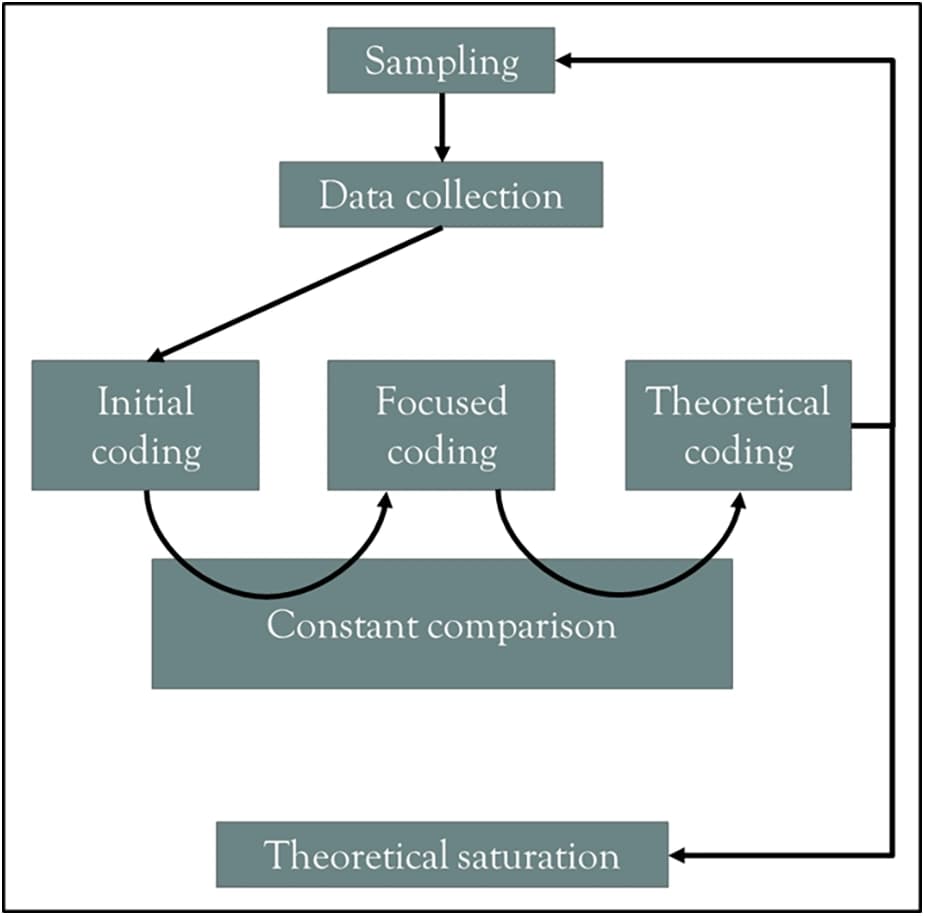
The work loops. A late case may change how you read an early one. Keep a clear trail from source passage to category to next case.
In a grounded theory study by Carrier and coauthors, coding feeds a loop of case review and further sampling. Their figure shows the return path. It depicts their study's process. Each team still needs to choose a fitting method and judge its own data.
Start with a dated category memo
For each category, note what it means now, its key traits, its links, and the case that fits least well. Point to the source for each claim.
Keep old versions when the meaning changes. A dated memo lets a reader see why your view shifted. The grounded theory framework places memos within the cycle of analysis.
Choose a case that could change it
Pick the next person, text, or site to test a weak trait or edge. Write down why you chose it before you read it. That is the logic of theoretical sampling.
If you can name an easy-to-reach case likely to change your view, you may need to look at it before you stop.
Compare the passage and revise
Read the new passage beside one that fits and one that resists the category. Mark whether it repeats an old trait, adds a condition, or changes a link.
The constant comparative method explains this move in depth. Here, use the result to decide what case could help next.
A worked category decision log
The food-pantry cases below are invented to teach the method. They do not report a real study. The question is whether role ownership helps explain why volunteers return for more shifts.
| Case batch and source note | Category state after comparison | What changed | Researcher's next move |
|---|---|---|---|
| A: two coordinators describe reliable volunteers | Version 1: ownership means accepting extra tasks | First claim is formed. No stop judgment. | Seek volunteers who stay without extra hours |
| B: a volunteer mentors a newcomer but declines extra shifts | Version 2: ownership can mean responsibility within fixed hours | New property contradicts version 1 | Sample fixed-hour volunteers at another pantry |
| C: fixed-hour volunteers describe mentoring only when coordinators trust them | Version 3: discretion and trust may condition mentoring | New proposed link between categories | Seek a fixed-hour volunteer with little discretion |
| D: that volunteer reports staying for peer ties despite little discretion | Version 3 has a boundary: another route to staying exists | Contrary case narrows the proposed explanation | Revisit earlier cases and test the peer-ties route |
Table 1: This invented log tracks changes, a case that resists the claim, and the next test. Batch D opened a second path to the outcome. The study is still in progress.
The team must decide if that path belongs in the theory. It then needs a case that can test it. Sampling guidance and category review help frame the choice. A table cannot make it for them.
Notice how a repeated word would miss the change. Batch B could still use the code commitment. Yet it changed a trait of that idea. Batch D might be missed if the team counted only the most common pattern.
To see how categories can fit around a core idea, read the guide to selective coding.
Write a bounded stopping memo
When more well-chosen cases seem unlikely to change a category, state what your stop call covers. Make the memo short and open to challenge.
The methods review shows why you should name the aim and the test behind a saturation claim. The bare word gives readers too little to judge.
Name the category and scope
Write what the category now means, who and what it covers, and the link it seeks to explain. Cite the cases behind each trait.
If the work covers one pantry network, say so. A local account has a local reach.
State the strongest test
Name the last case you chose to test the category. What did you expect it might change? What did you learn? Include a case that fit poorly and say how you dealt with it.
Theoretical sampling research places the link between your next case and your growing account at the heart of the method.
Record what remains open
End with the best untested case you can name. Note any access limit. Explain why more work seems unlikely to change the category within your scope.
If time or access forced a stop, say so. The grounded theory framework shows that the work loops. New evidence can reopen a category later.
Next step: check cited cases in Atlas
Add selected text transcripts and case memos to Atlas. Mention the files you want to check. Ask for one row per case: a category trait, a passage that fits, one that resists, and a cite for each claim.
Atlas can help with this source review workflow. You still choose the cases and read the text.
Open each cite and read the text around it. Fix any quote that gives a false sense of the case. Save your own memo with the current category and next sampling question.
Atlas can compare the selected sources and show cites to check. It has no way to judge the cases absent from your project. Its answer is not a formal saturation test.
Limits of any saturation claim
Your stop call depends on the question, sample, method, and depth of your categories. Saunders and coauthors show that saturation has several uses. Say which grounded theory path you used and what you did.
A flat curve of new codes can mislead. In a study of open-ended questions, the rate of new items changed with the size of the topic and how much each person said. That study tested item and theme counts. It did not test when a grounded theory category is well developed. Repeated items alone cannot carry the stop claim.
No tool can see cases you did not collect or tell whether your questions went deep enough. Nor can it settle whether a poor-fit case changes the theory. Keep the claim narrow and open to review, since a later case may give you good reason to reopen it.
Atlas
Compare new cases with your Atlas sources
Check cited cases against your memo before deciding what to sample.
Frequently Asked Questions
It is a grounded theory judgment that further data selected to probe an emerging category no longer add useful properties, variation, or relationships within the study's stated scope. The researcher must show how that judgment was reached.