
Selective Coding: Choose and Test a Core Category
Learn selective coding in grounded theory. Choose a core category, test it against contrary data, and trace each claim to a source excerpt and an open question.
- Byline

Summary
Selective coding tests whether one core idea can link the main categories in a grounded theory study. The researcher checks it against the data.
Some grounded theory schools place it after open and axial coding. Other schools use different steps and names.
A core idea must fit both supporting and contrary cases. The researcher keeps a memo and changes the claim when new data call for it.
Selective coding brings existing qualitative categories together around a possible core category. The core should help explain how the other categories connect. You then test that account against source passages, including cases that do not fit.
In an early Strauss and Corbin framing of grounded theory, this work follows open and axial coding. Other schools use other names and paths.
Atlas can compare selected project sources and show citations for you to inspect. You choose the category and judge its fit.

Atlas

Compare your qualitative sources in Atlas
Compare transcripts and check cited excerpts before revising your memo.
What selective coding does
A core category is a central idea that connects important parts of an emerging grounded theory. Selective coding asks whether that idea can explain a pattern across cases and conditions. It is more than choosing the code with the highest count.
The researcher writes a proposed link between categories, looks for source passages that support or unsettle it, and revises a memo. The result is a theory under construction, with a visible path back to the data.
A peer-reviewed methods comparison describes this work in the early Straussian sequence. It involves choosing a center and linking other categories to it.
A recent methods paper sets out checks for its reach, fit, and power to explain differences.
How to place selective coding
In the early Strauss and Corbin account, open coding names ideas in small pieces of data. Axial coding asks how categories and subcategories relate. Selective coding tests whether a central category can tie the important relationships into an account of what is happening.
The phase names have a history
This map is useful if it fits the method you chose. It is not a rule for all studies.
Rieger's comparison of grounded theory approaches shows that later Corbin and Strauss texts call this work theoretical integration. Glaserian and constructivist work use other paths.
Singh and Estefan's open-access methods review compares Glaser, Strauss and Corbin, and Charmaz. Their shared aim of building an account from data does not erase differences in how researchers code or describe the steps.
If you are still naming passages, start with open coding. If a participant's exact phrase becomes the code, see in vivo coding. Neither first-pass job settles which category should organize a theory.
Use the stage as a question
At this point, ask: Which category helps explain the others? Under what conditions does that link hold? What passage makes the link doubtful? A memo can keep both the proposed answer and the unresolved test in view.
Choose a candidate core category
Start with two or more plausible candidates rather than crowning a frequent label. Compare each with the research question, your category memos, and the full source passages. A count may tell you where to look; it cannot show how one category explains the others.
Check reach and fit
Use these questions as a working test:
- Centrality: Does the candidate relate to each important category, or does it leave a major part of the account outside?
- Reach: Can it explain different actions and conditions without becoming so broad that it says little?
- Fit: Do the cited passages support the proposed link in context?
- Variation: Can it explain why a case differs, or does the difference call for a narrower claim?
- Next inquiry: What new case or question could change your choice?
The selective-coding methods paper asks whether the core idea links key categories and explains differences. It also keeps categories that resist a neat model in the memo.
Use those checks to probe a candidate. No numeric score can choose it for you.
Compare two possible centers
Imagine a study of how people get clinic appointments. Fitting care around work might link shifts and call times. Yet it may miss people with free time who cannot find the right number.
Finding a workable route to care has more reach. It may also be too broad unless you show which barriers and responses it explains.
The second phrase is a candidate, not a result. The table below makes its links and gaps open to inspection.
Example with supporting and contrary excerpts
This example is wholly hypothetical. All people, transcript IDs, and quotations were invented to teach the method. No interview participant supplied these lines. The proposed core category is finding a workable route to care.
Earlier open codes might be calling during a break, waiting for a booking link, and asking a neighbor.
An axial pass could group them under time fit, finding the route, and borrowed help. Selective coding tests whether the core idea links them without forcing a case to fit.
| Proposed link to the core | Supporting fictional excerpt | Contrary or missing excerpt | Tentative inference | Follow-up question |
|---|---|---|---|---|
| Time fit shapes a workable route | T01, lines 18–21: “I called on my lunch break because the line closed before my shift ended.” | T02, lines 41–44: “I was free all morning, but I did not know which number to call.” | Time limits matter for T01, but do not explain T02. | Which routes are unclear even when time is available? |
| Finding information shapes the route | T02, lines 41–44: “I did not know which number to call.” | T03, lines 63–67: “The link was clear, but I wanted to ask someone I trusted first.” | The route may involve confidence as well as instructions. | What made the clear link insufficient for T03? |
| Borrowed help changes the route | T03, lines 63–67: “I asked my neighbor to go through it with me.” | T01, lines 18–21: no helper is mentioned in this excerpt. | Help can be one response, but the T01 record cannot show whether it was absent. | Read the rest of T01 before claiming a contrast. |
Table 1: This is a source-to-interpretation chain: a located excerpt supports a category link; another passage limits it; the memo states a tentative claim and a next check. The blank in T01 is marked as missing evidence, not proof that no one helped.
Revise the story memo
An early memo might say: “People find appointments by fitting calls around work.” The T02 and T03 rows make that too narrow. A revised memo could say: “People seek a route they can use and trust. Time, clear instructions, and help from others shape that route in different cases.”
The revised line still needs testing. T03 may have wanted reassurance for a reason the excerpt does not show. Keep the source location and the old wording so a later reader can see why the claim changed.
How to test and revise the explanation
Constant comparison means checking one incident against another, then checking the proposed category against new material. Look for cases that support the link, cases that work differently, and parts of the corpus the current account leaves out.
Let a contrary case change the claim
Suppose a fourth fictional person had a clear link, free time, and help. Yet they chose not to book because they expected poor care.
That case does not fit a claim about finding a route alone. Read the full account. Should trust become a condition, a separate category, or a reason to change the core idea?
Use negative-case analysis to examine this kind of challenge. Do not smooth the case into an exception before asking what it reveals. The methods paper's audit approach calls for testing the central category against contrary data.
Keep a revision trail
In the memo, record the old claim, the new passage, the revised claim, and the question still open. Include the source ID and locator. Return to earlier transcripts too; a new case may change how an old excerpt reads.
The grounded theory approaches review treats building an explanatory model as more than naming themes. A repeated label is useful evidence to inspect, but it cannot settle whether more sampling would change the category.
Next step: check category links in Atlas
Add transcript documents and category notes that you have permission to use to one project. Mention a small, relevant source set with @. Ask Atlas for a comparison that keeps each case separate and cites the passages behind each proposed link.
For the selected transcripts and category notes, compare evidence for “finding a workable route to care.” For each proposed link, give a cited supporting passage and a cited passage that differs or leaves the link uncertain. Do not decide the core category for me. Mark missing evidence.
Open every citation. Check the speaker, full answer, and nearby text. If the answer blends cases or turns a missing detail into a fact, fix your memo from the source. Save only checked links and open questions in a note.
Atlas's public guides support selected-source comparison, citation checks, and notes. They do not show a formal grounded theory coding system or a test of saturation. For broader choices about AI and qualitative work, see qualitative data analysis with AI.
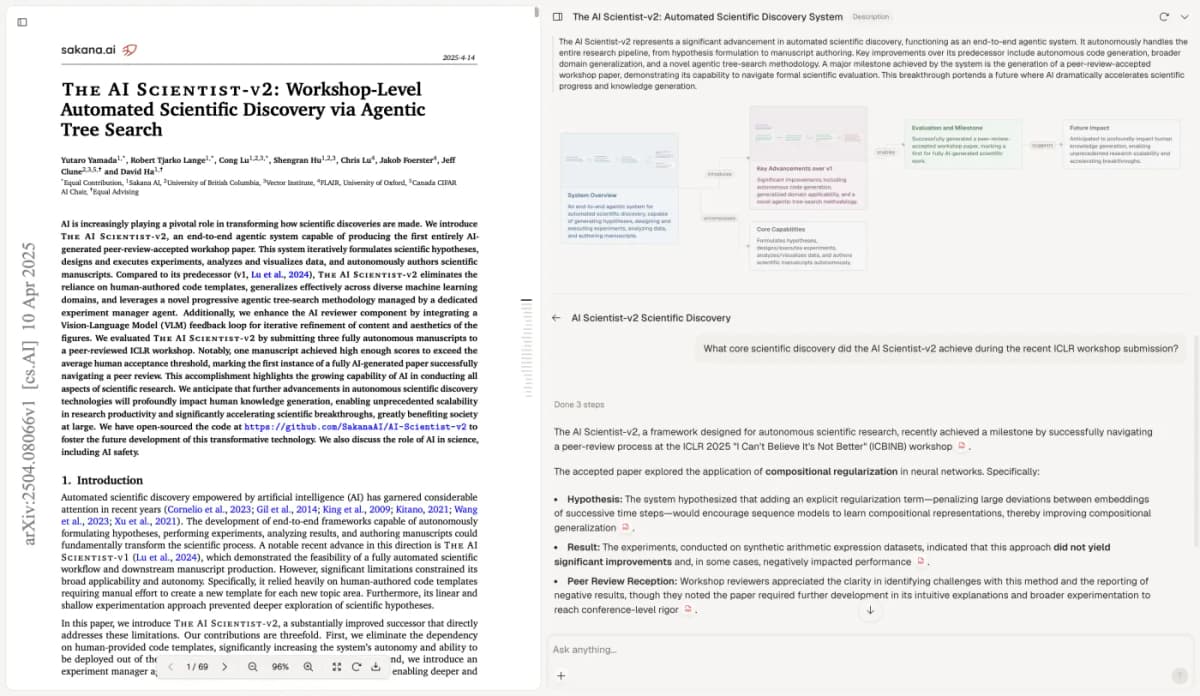
The screenshot shows an unrelated research paper beside a cited Atlas answer. It illustrates source checking, not selective coding, and it does not verify the fictional table above.
What the table cannot prove
The table helps you examine links. It does not complete a grounded theory. A plausible core category still needs sustained reading, comparison, memos, and the sampling choices that fit your study's approach.
Check what remains unexplained
Before saying that more data add little, ask which groups or cases remain thin. Could another interview change a link to the core? Is the contrary case explained or set aside?
These are your judgments. A table or AI answer cannot certify saturation. The separate guide to theoretical saturation shows how to log category changes, contrary cases, and the next plausible sample before making a bounded stopping claim.
Atlas works with the text you supply here. It does not infer tone from audio or video absent from that text. Check permissions before adding a transcript. An answer may miss a relevant passage or cite one without its full context, so open the source before you use it.
The methods comparison shows why your stated approach matters. Keep your own role in the memo: what you expected, what surprised you, and why you changed a link.
That trail makes the claim more useful than a tidy diagram alone.
Atlas
Compare your qualitative sources in Atlas
Compare transcripts and check cited excerpts before revising your memo.
Frequently Asked Questions
In grounded theory, selective coding focuses analysis around a core category that integrates other important categories. Researchers compare that explanation with excerpts, memos, and new cases and revise it when the fit is weak.