

Thematic analysis AI helps you read interviews, surveys, and other text. It can sum up the text, suggest codes, group related ideas, and draft possible themes. The term covers 2 different jobs. Search results often mix them together. The first job is finding themes: a tool reads your material and suggests codes and patterns.
The second job is comparing a set of sources that you chose. A workspace helps you compare that material and links each claim to a passage you can check.
These jobs need different tools. A tool that groups patterns quickly may not show the exact quote behind each theme. If a reviewer, client, or committee asks where a finding came from, you need to open the source and show them.
This guide covers tools that use AI as their main feature, established research software that has added AI, tools for customer research, and Atlas. It also gives you a 5-point check for any AI-made theme.

Build a cited theme table in Atlas
Add transcripts or notes and build a cited theme table you can verify.
Thematic analysis AI overview
Thematic analysis AI helps you read text, suggest codes or themes, and check those ideas against the source. There is no useful ranking that fits every project because each type of software does a different job. AI can speed up summaries, an early coding pass, pattern grouping, and quote lookup. You still need to decide what a theme means, read it in context, and choose what to report.
If you need formal qualitative coding with an audit trail, MAXQDA or NVivo fit that workflow. If you want an AI-native tool built around thematic analysis, Evidano is built for that job. If the project is a UX or CX research repository, Looppanel, Thematic, and Dovetail fit team-scale feedback and interview programs.
Atlas fits when you already have transcripts, notes, or research papers. Add them as sources, then ask for a theme table with evidence and citation columns. Open each citation before you save a finding.
Evaluation criteria for thematic analysis AI
Before you choose software, decide what help you need. A user researcher, a PhD student, and a customer support team will need different features.
Method and evidence fit
- The material it can read: interviews, written survey answers, support tickets, reviews, focus groups, or several file types.
- Audio and video: whether the tool makes transcripts or requires you to bring them.
- Control over codes: whether you can create, edit, and merge codes yourself.
- Links to the source: whether each theme opens the exact quotes or passages behind it.
- Quote lookup: whether you can find a theme's supporting quote without rereading a whole transcript.
Team, trust, and delivery fit
- Record of changes: whether the tool saves coding choices, versions, and edits for peer review or your methods section.
- Teamwork: whether people can code, review, and comment in the same project.
- Privacy: how the vendor handles participant data, private transcripts, and saved data.
- Exports: whether you can export themes, codes, and quotes in a file your supervisor or client can read.
- Review: whether the tool makes it easy to check a theme against the raw text.
For an academic project, put the record of changes and control over codes first. For a short product study, links to the source and fast quote lookup may matter more. The team needs to support a decision quickly, while the academic team may need to explain every coding choice.
The right thematic analysis AI tool is the one that lets you defend a theme in the same amount of time it took the tool to suggest it.
Thematic analysis AI tool categories
Start with the type of tool you need, then compare vendors. AI features change quickly. Check each vendor's current file limits, price, app links, and rules for stored data before you choose.
AI-native qualitative analysis
Evidano focuses on AI coding and thematic analysis. Check the source behind any accuracy claim before you cite it.
Established QDA platforms
MAXQDA and NVivo help researchers code text and keep a record of how quotes became themes. Both support many research methods and have added AI features. A more focused coding tool appears in the detailed list below.
UX and CX insight repositories
Looppanel, Thematic, Dovetail, and Conveo help teams study interviews, support tickets, surveys, reviews, and other customer feedback. Conveo can also run voice and video interviews before it pulls out themes and quotes.
Source-grounded synthesis
Atlas fits when you already have transcripts, notes, PDFs, or research papers. It can build a cited theme table with source passages you can open and check.
The type of tool matters more than its place in a ranked list. Coding software, AI-first analysis tools, customer research tools, and source-based workspaces solve different problems.
Thematic analysis AI in practice
Atlas fits after you have the raw material, such as interview transcripts, survey exports, meeting notes, or PDFs. It does not replace coding software. It turns a set of sources that you trust into a table you can check before you report a finding.
A practical pass looks like this:
- Add your transcripts, notes, survey exports, or documents to an Atlas project as sources.
- Ask a focused question. For example: "Build a table of possible themes. For each one, include quotes that support it, quotes that disagree, the number of sources, and a citation."
- Compare the number of sources. A theme from one interview should not carry the same weight as one found across most transcripts.
- Open the citation for each key row and read the text around it. A short quote can hide details that change its meaning.
- Revise weak themes. Narrow the wording or split a theme that turns out to contain 2 separate patterns.
- Save only the themes the source text supports, along with the citations you checked and any open questions for later review.
This process does not replace your judgment or your account of the research method. It gives you a faster route from raw transcripts to a table you can defend. Every row points back to text you can reread.
A cited theme table is not the finished analysis. It is the checkpoint that makes the finished analysis defensible.
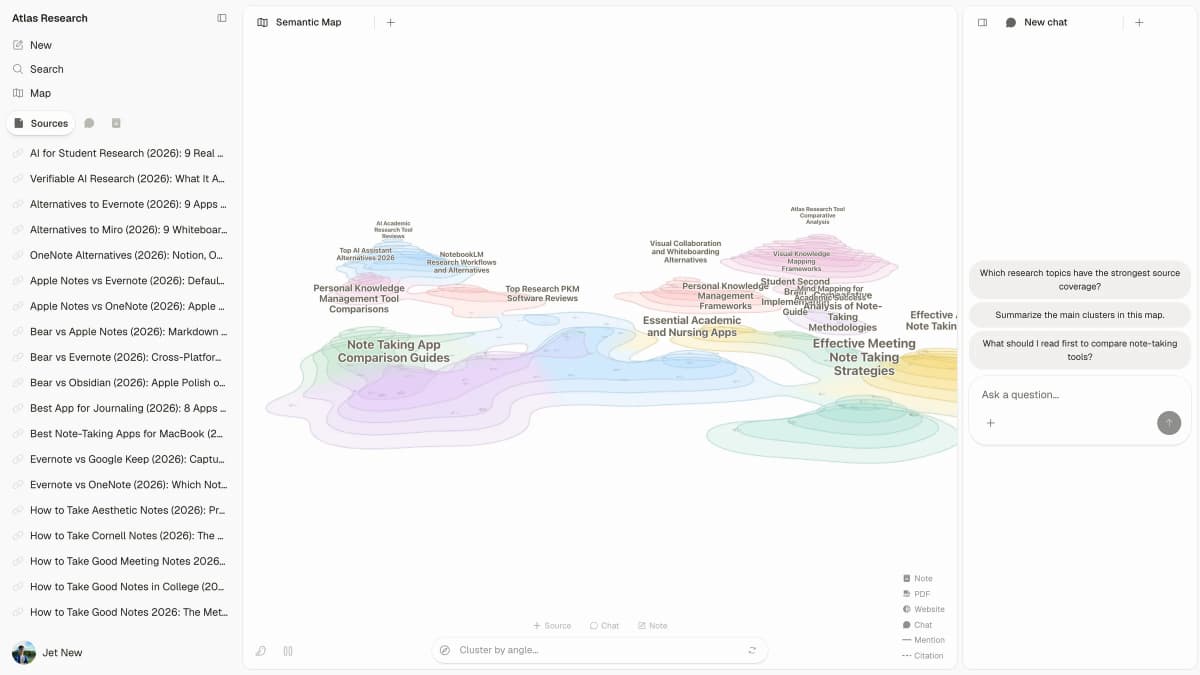 Source: first-party Atlas product screenshot, showing how a source set can be mapped before you decide whether a theme has enough coverage to report.
Tool choices by research workflow
The tools below are grouped by the job they do. Each note also tells you what to check before you rely on a product claim.
AI-native qualitative analysis
Atlas
Atlas fits once your transcripts, notes, survey exports, or PDFs are ready. Ask a question across those sources and request a table. Each row can include a claim, supporting text, a limit, and a citation.
Atlas does not provide a formal coding system, an ethics review process, or a full record of coding changes. It helps you turn a chosen set of sources into a cited theme table. You still need to explain what the themes mean and report how you used AI when required.
Evidano
Evidano is an AI tool for studying interviews and written survey answers. It can suggest codes and themes. It fits teams that want AI to handle the first pass instead of adding AI to a manual coding tool.
The company's pages make strong claims about accuracy and research use. Check those claims on the vendor's page and read any proof it links before you repeat them in a report.
Established QDA platforms with AI
MAXQDA
MAXQDA is established research software. It can make transcripts, help you code text, and use AI for summaries or an early coding pass. You still keep control of the code list.
Check current privacy rules, where data is stored, and supported devices on the vendor's site. Older reviews may no longer be correct.
NVivo
NVivo can study interviews, written survey answers, documents, audio, and video. It combines coding and search tools with an AI assistant. It fits teams that need a clear coding system as well as AI help.
NVivo's AI Assistant can speed up coding and summaries. You still need to review the coded text, settle differences, and explain your method.
Delve
Delve helps you code text, group codes, and arrange quotes into themes. It fits students and researchers who want a focused tool instead of a large research suite.
Delve keeps you in control of the coding process. Its product page covers coding, team review, and quote lookup. Check its current AI features before you assume that it can automate a given step.
UX and CX insight platforms
Looppanel
Looppanel is made for user research teams. It tags interview transcripts, notes, surveys, and written NPS answers. Its product page says that tags link to the source and that teams can edit AI notes and tags.
It fits a team that must review many interviews and still check each tag against the recording. Check current transcript limits, connected apps, and security details on the vendor's page.
Thematic
Thematic is made for large customer research teams. It groups written feedback from reviews, support tickets, and surveys. It fits ongoing programs that need to support decisions with a large body of customer feedback.
It is a better match for ongoing customer feedback than for a small academic interview study. Treat results shown on its site as company claims until you check them elsewhere.
Dovetail
Dovetail keeps interviews, tickets, highlights, and research notes in one place. It uses AI to find trends and themes across projects. It fits teams that want one shared research library.
It works best when the team already keeps its research in the platform. Check current plan limits and how long it stores data on Dovetail's site.
Conveo
Conveo can collect the data as well as study it. Its AI host runs voice or video interviews, then the platform pulls themes and quotes from the answers.
It suits customer, product, and market research more than a project with finished transcripts. Check its product page for current support for study design, finding participants, languages, and exports.
Source-grounded synthesis
Methodology and trust limits
Thematic analysis asks what a pattern means. It is more than a count of how often words appear. AI can suggest a meaning before it has enough proof. Keep 3 limits in mind when AI helps with codes or themes.
You decide what themes mean
You are responsible for the meaning. AI can group similar quotes and suggest a label. You must decide what the pattern means for your question and participants, then record that choice.
Protect participant privacy
Check participant privacy before you upload a transcript. Interviews and surveys can include names, health details, workplace conflicts, or other private facts.
Check the consent form, the tool's rules for data, and your organization's policy before you upload. State how you used AI when your journal, school, or client requires it.
Check every quote
AI can get a quote wrong, blend 2 people together, or sound more certain than the source allows. A tool that shows a theme without its quotes makes these errors hard to catch.
A theme label without a visible excerpt is a claim waiting on a check.
Run this check before any AI-assisted theme moves into a report:
- Can you open and reread the quote behind the theme?
- Does the tool show quotes that disagree as well as quotes that support the theme?
- Does the theme appear in more than 1 source, unless you are reporting a single case?
- Have you recorded which coding or review choices involved AI?
- Would the finding survive a colleague opening the same source and reading the same passage?
You can use AI in academic thematic analysis if you state how you used it, protect participant data, and check each theme against the source. The tool cannot do those jobs for you.
Choose a thematic analysis AI workflow
Choose based on the work your project requires.
- MAXQDA or NVivo for formal coding with a saved record of who applied each code. They suit dissertations and funded research.
- Evidano for a fast AI-led first pass. Check every result against the transcripts.
- Looppanel, Thematic, or Dovetail for a team that studies customer or user feedback over time.
- Atlas when your transcripts, notes, or papers are ready and you need a cited table of themes, evidence, and limits.
Do not use Atlas as a formal coding record or ethics review system. Use it after that structure exists and you need to compare a chosen set of sources.
For other stages, see tools for research analysis. The guide to synthesizing research papers shows how to turn papers into a review. The best AI research assistants guide covers finding papers first.
Conclusion
AI can sum up long transcripts, suggest early codes, group similar quotes, and find text that supports a theme. You still decide what the theme means. AI cannot approve your privacy choices or research method.
Pick the type that fits your project:
- Formal coding software when you need a saved record of coding choices.
- An AI-first tool when speed matters more than manual control.
- A customer research tool when a team studies feedback over time.
- Atlas when you need a cited theme table from sources you already chose.
Whichever tool you use, verify the theme against the source passage before you publish the finding.
Build a cited theme table in Atlas
Add transcripts or notes and build a cited theme table you can verify.