
The best market research AI tool depends on the method you need. Start with the proof you must defend.
-
Use Atlas when reports, interviews, PDFs, articles, or notes need to become cited findings.
-
Use Manus for fast desk-research reports.
-
Use GWI Spark for questions that fit GWI's survey data.
-
Use quantilope for automated consumer research.
-
Use Qualtrics for large research programs.
-
Use Optimo for quick marketing prompts. Updated July 2026: market research AI tools split into six jobs.
For pricing, product, or investment choices, treat fast AI output as a draft. Check the source, dataset, respondent method, or cited passage behind the claim.

Synthesize market research with cited sources
Compare reports, notes, and interviews in a cited synthesis table.
How to choose by market research job
Market research AI tools now cover several jobs. Start with the business choice. Then choose the method that can support it.
- Desk research and market scans: Use this for a fast first read on a market, rival set, region, trend, or customer problem.
- Audience data: Use this when the answer depends on known survey or panel data.
- Survey automation: Use this for study design, concept tests, tracking, dashboards, and repeat work.
- Synthetic tests: Use this for early ideas. Bring in real customer proof before a pricing, product, or funding call.
- Market monitoring: Use this to watch rival pages, launches, ads, reviews, and shifts over time.
- Source-backed synthesis: Use this when the team has trusted source material and needs cited claims, limits, and next steps.
That last job is where many tool lists get thin. A generated report can frame the topic. A survey result, customer quote, filing, analyst report, page change, interview note, or cited passage gives you proof to inspect.
If the source pack is mostly PDFs or analyst reports, the next step overlaps with AI document summarizers. If the source pack is mostly interviews or open-ended responses, compare the choice with qualitative data analysis AI. For PDF-heavy packets, the PDF summarizer guide covers source checks in more detail.
Market research AI comparison table
Use this table as a first shortlist. Check each vendor page before you rely on plan limits, methods, data reach, integrations, or compliance claims.
| Tool | Best fit | Data or source basis | Typical output | Verification strength | Watchout |
|---|---|---|---|---|---|
| Atlas | Synthesizing a gathered research packet | User-added PDFs, websites, notes, and other sources | Cited answers, notes, and synthesis tables | Strong when citations are opened and checked | Not a panel, survey engine, or market database |
| Manus | Fast desk-research reports | Manus research workflow and gathered web context | Market reports and competitor analysis | Useful for first pass when sources are reviewed | Generated reports still need source review |
| GWI Spark | Consumer insight questions | GWI survey and consumer data | Natural-language audience answers | Stronger when the audience matches GWI coverage | Dataset fit matters for niche or local markets |
| quantilope | Automated consumer research | Survey methods, panels, and dashboards | Research dashboards and study outputs | Stronger when sample and method fit the decision | Check current methods, panel reach, and pricing |
| Qualtrics | Enterprise research programs | Research workflows, feedback, and platform data | Studies, dashboards, and insights | Strong for governed research operations | More platform than a quick prompt tool |
| Optimo | Lightweight marketing prompts | User-entered industry or audience prompt | Audience snapshots and idea starters | Directional unless checked against market data | Not a research platform or cited synthesis system |
Table 1: The Optimo row belongs in the quick-prompt lane. It can help start a rough audience note. Check the claim with customer proof before it supports strategy.
Source-backed synthesis comparison table in Atlas
Atlas fits after the first gathering pass. At that point, the team moves from finding market material to defending a claim with source evidence.
A practical Atlas synthesis pass looks like this:
- Add the source pack to one project. Use analyst reports, rival pages, interview notes, call notes, public articles, PDFs, and internal notes.
- Ask a narrow question. For example: "Compare these sources in a table with claim, proof, limit, source, and next action."
- Keep sources separate. A strong customer quote should not carry the same weight as a weak trend post.
- Open citations for key claims. Check whether the passage supports the claim you plan to save.
- Revise weak claims. Ask Atlas to narrow claims, name conflicts, or use only the right market, segment, or region.
- Save the checked synthesis as a note with the question, citations checked, open questions, and next step.
Here is the synthesis table pattern I would use for a market-research packet:
| Finding | Supporting evidence to inspect | Limitation | Source check | Next action |
|---|---|---|---|---|
| Customers mention setup time as a buying barrier | Interview notes and onboarding-call summaries | Small sample may overrepresent recent buyers | Open cited passages for each quote | Validate with a survey or sales-call review |
| Competitors are shifting messaging toward compliance | Competitor pages, release notes, and ad copy | Page copy may lag product reality | Check dates and archived versions where possible | Add claims to a positioning tracker |
| Category demand is rising in one segment | Analyst report and trend article | Secondary source may define the segment differently | Compare definitions across sources | Run audience or keyword validation |
| A proposed feature maps to a repeated workflow pain | Customer interviews and support notes | Research may not include non-customers | Inspect source context for each pain point | Test concept with target buyers |
Table 2: Use this table to keep each market claim tied to proof, limits, and a next step.
Best market research AI tools
Atlas
Atlas is best after a team has gathered trusted material. It can work with PDFs, websites, academic material, notes, and other source context. It can answer with citations that link back to source text. That helps when the output must become a memo, brief, research note, or table someone else can audit.
Use Atlas when the inputs are split across reports, web pages, customer notes, and PDFs. Ask where sources agree, where they conflict, and what each claim rests on. Open citations before you save a finding.
Do not use Atlas as a respondent panel, survey tool, social listening database, or proprietary consumer dataset. It is strongest when the team has chosen the sources and needs a reliable way to compare them.
Manus
Manus fits fast desk research when you want to describe a market, region, time frame, or rival set and get an AI-generated report. Its page frames the tool around market analysis, rival insight, strategy notes, no-code use, and broad business users. If the shortlist includes ChatGPT-style research, compare the model-led path with Atlas vs ChatGPT and Atlas vs Perplexity.
That can help at the start of a project. A founder, marketer, or product manager can use it for a first market map. Before you use the report in a pitch or pricing call, check the sources. Separate facts from advice.
GWI Spark
GWI Spark is best when the answer should come from GWI's data. GWI describes Agent Spark as an AI analyst. It answers plain-language questions from GWI survey data.
That is a different job from asking a general LLM for "Gen Z trends." If your audience fits GWI's reach, Spark can give stronger survey-based insight. For a niche, local, technical, or B2B audience, check the data fit first.
quantilope
quantilope is best when the team needs research methods, panel access, live results, and dashboards. Its public pages describe an AI-powered insight platform with automated research tools.
Use it when you need a structured research program. It can help with study setup, analysis, and reports. Before buying, check the methods, panel fit, region, sample needs, and support model.
Qualtrics
Qualtrics is best for large research programs. It fits teams that need rules, repeat work, market and rival research, product tests, UX research, or brand tracking. Its market research platform is built for teams that manage work from concept to launch and tracking.
Qualtrics can be more than a quick market scan. It is a research ops platform. The choice should include team process, data rules, workflow owners, and AI admin settings. It fits best when research is recurring work with studies, dashboards, and repeat reports.
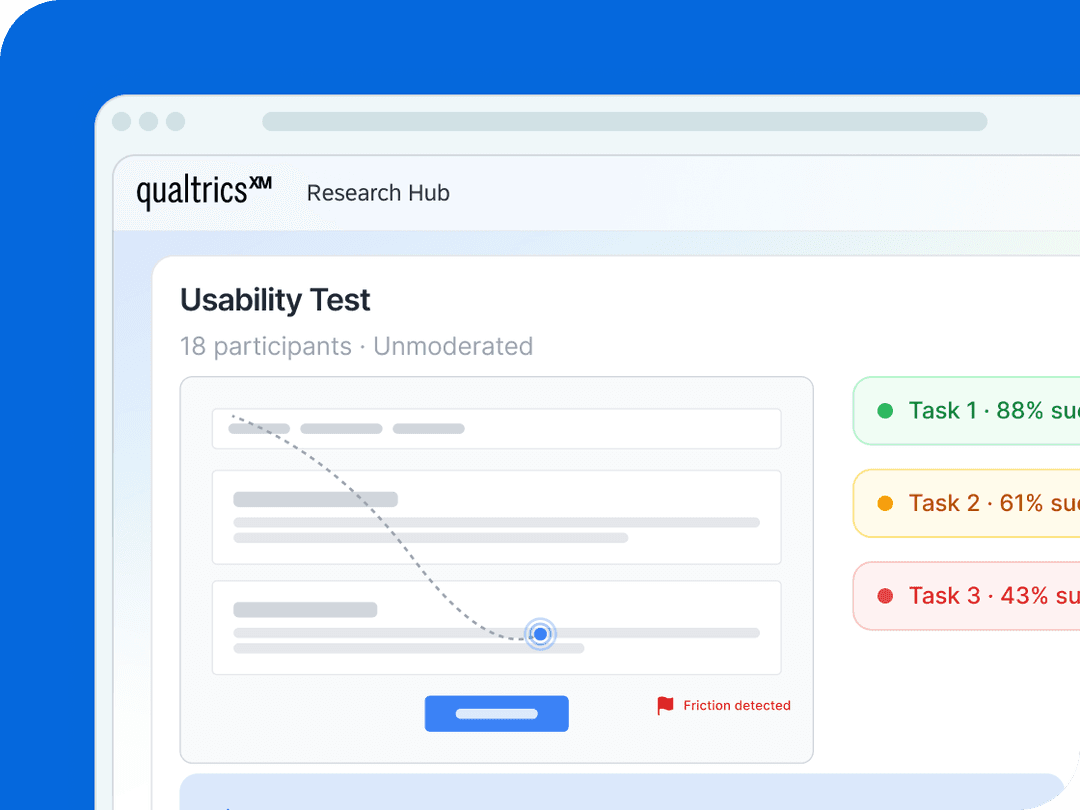
Qualtrics' official product image shows a concrete research-operations output: an unmoderated usability test with 18 participants, task-success rates, and a flagged friction point. The dashboard helps teams find what to review; it does not explain why a participant struggled without the session evidence.
Optimo
Optimo is best for light marketing prompts when you want a quick audience snapshot. Its market research tool is free. You enter an audience or business context and get fast marketing output.
Use it for early ideas. It can help a marketer start a brainstorm or create a first list of audience guesses. Check those ideas against customer data, calls, survey proof, search data, or source-backed research.
AI market research reliability checks
AI market research can shorten the path from question to draft answer. The risk is that speed can hide weak proof. Run these checks before a finding moves into strategy, pricing, or product planning.
The market research challenges guide shows how to diagnose source gaps, sample limits, and conflicting findings before choosing a tool or making a claim.
Evidence checks
- Source check: Can you open the source, data, respondent quote, or citation behind the claim?
- Freshness check: Is the source current enough? Rival copy, pricing, and AI features can change quickly.
- Method check: Is the answer based on desk research, survey data, calls, social data, synthetic users, or a model estimate?
- Audience check: Does the dataset or source match the customer segment, geography, company size, and buying context?
Governance checks
- Synthetic user check: If the tool uses simulated people, treat the output as a first idea. Use real customers when the choice cannot tolerate that risk.
- Private data check: Do not paste sensitive calls, contracts, sales notes, or unreleased plans into tools first. Review the data rules.
- Judgment check: A tool can sum up patterns. A researcher or operator still needs to decide what the proof means.
The useful rule is not "never use AI for market research." It is "match the AI output to the evidence standard of the decision." A social caption idea and a pricing change do not need the same level of proof.
How to pick the right option
Choose by the research job:
-
Pick Atlas when the next step is synthesizing an existing research packet into cited findings that can be inspected.
-
Pick Manus when you need a fast desk-research report and will verify the important sources afterward.
-
Pick GWI Spark when you need consumer insights from GWI's data and the audience fits its coverage.
-
Pick quantilope when you need automated research methods, panel workflows, and live dashboards.
-
Pick Qualtrics when research is an enterprise program with governance, recurring studies, testing, and brand or product tracking.
-
Pick Optimo when you want a free, lightweight marketing prompt for quick audience or demographic ideation. For serious market research, choose a sequence of tools rather than one winner. A team may use a desk-research tool to map the market. It may use a survey or audience platform to collect stronger proof. Then it can use Atlas to turn the final source set into claims, limits, source links, and next steps. If the research job is closer to interviews, usability feedback, or product discovery, use the Atlas guide to UX research AI. For broader document sets, use an AI document reader.
Synthesize market research with cited sources
Compare reports, notes, and interviews in a cited synthesis table.