
Qualitative Data Analysis AI Tools for Traceable Themes

Compare qualitative data analysis AI tools by coding support, transcripts, theme discovery, source traceability, privacy, and when to continue in Atlas.

Byline
Jet New
Jet New

Summary

  • The best qualitative data analysis AI depends on the evidence job: use QDA suites for coding, insight tools for feedback, and Atlas for cited synthesis.

  • Qualitative data analysis AI can speed up coding, summaries, theme discovery, and quote lookup. You still own interpretation, reflexivity, and method fit.

  • Atlas fits after you import transcripts, papers, reports, or notes and need cited synthesis, theme tables, linked claims, and knowledge maps.

Qualitative data analysis AI is useful when it handles repeat work without hiding the evidence. It can summarize transcripts, suggest codes, cluster open-ended responses, retrieve candidate quotes, and draft theme tables. It cannot judge method fit on its own. It also cannot decide whether a participant quote is safe to use or whether a finding should survive review.

The best tool depends on the kind of qualitative work you are doing. MAXQDA and NVivo make the most sense when you need a formal QDA workspace. CoLoop and Thematic fit research and customer-insight teams that need faster synthesis from interviews, surveys, or repositories. Atlas fits when the sources already exist and the next job is cited synthesis across them.

If the narrower question is how AI changes thematic analysis itself, the thematic analysis AI guide separates method risks, theme verification, and tool categories in more detail.

Quick verdict

Choose a qualitative data analysis AI tool by the job you need to finish. Feature lists matter only after the tool matches the evidence standard.

  • Choose MAXQDA AI Assist or NVivo when your project depends on coding, codebooks, coded segments, mixed-methods workflows, and a familiar CAQDAS environment.
  • Choose CoLoop or Thematic when your project is closer to research operations, customer feedback, interview synthesis, survey response analysis, or insight reporting.
  • Choose Atlas when you need to bring qualitative sources together, ask source-grounded questions, inspect cited passages, and turn verified findings into notes or maps.
  • Use generic AI chat only for low-stakes brainstorming, memo drafting, or code-label ideas after sensitive-data handling and source verification are already clear.

The important split is formal coding versus evidence review. If your dissertation, evaluation, or client project requires a maintained codebook and audit trail, use a QDA suite. If you need to compare 20 interviews, reports, or field notes, use a cited synthesis workflow. Check the passages before you write the finding down.

Criteria for qualitative analysis AI

AI helps most when the task is mechanical, repetitive, or retrieval-heavy. It is weaker when the task requires judgment, reflexivity, sampling decisions, consent review, or method defense.

In practice, qualitative AI support tends to fall into seven jobs:

  1. Transcript and document summaries. The tool condenses interviews, focus groups, reports, or open-ended responses so the researcher can triage the corpus.
  2. Candidate code suggestions. The tool proposes labels for passages, often from open coding or from criteria the researcher supplies.
  3. Codebook application. The tool tries to find segments that match an existing code or coding instruction.
  4. Theme discovery. The tool clusters patterns across participant statements, survey answers, or customer feedback.
  5. Quote retrieval. The tool finds passages that may support a claim, theme, or insight.
  6. Cross-source synthesis. The tool compares sources and returns a table of claims, evidence, conflicts, and citations.
  7. Reporting and handoff. The tool drafts summaries, reports, or notes that a researcher can review before sharing.

Those jobs are not interchangeable. A tool that is strong at auto-summarizing interviews may not be the right place to maintain a rigorous codebook. A tool that helps with formal coding may be more than you need if the immediate job is to check which source supports each theme.

If your project is mainly transcript review, start with an AI transcript summarizer. If your project is broader research triage, compare market research AI tools before choosing a QDA-specific environment.

Qualitative data analysis AI tools compared

The table below is a routing matrix. I would start with the row that matches the project's evidence standard.

Then check current vendor docs before uploading sensitive material or committing a team to a coding, synthesis, or reporting process.

ToolBest fitSource types and workflowAI coding or theme supportEvidence traceabilityGovernance noteWhen not to use it
AtlasSource-grounded synthesis across imported qualitative sourcesPDFs, websites, YouTube transcripts, academic papers, Markdown or text notes, and other project sourcesGood for cited questions, theme tables, source comparison, and maps after import. Use a QDA suite for formal coding.Citation badges and source passages help researchers verify claims before saving themUse approved handling for participant or regulated data. Atlas does not replace IRB review, de-identification, or compliance review.Choose a QDA suite when the project requires formal codebook management or coding audit trails
MAXQDA AI AssistResearchers already using MAXQDA who want AI inside a QDA suiteMAXQDA projects, documents, coded segments, memos, and summariesSupports AI report drafts, AI Coding, code label suggestions, chat with data, summaries, explanations, and translationsMAXQDA describes reference markers and responses connected to source text for reviewIts page currently makes data-protection, GDPR, storage, and retention claims. Verify the current terms before using sensitive dataHeavier than needed for a quick cited synthesis across existing documents
NVivoInstitutional qualitative or mixed-methods research teamsInterviews, focus groups, meeting transcripts, survey data, documents, and mixed methods workNVivo describes AI suggested child codes and automatic coding using text patterns, word frequency, headings, or speakersBest suited to teams that need QDA project structure around coded materialCheck current Lumivero documentation for licensing, AI feature availability, and institutional data handlingMore structure than needed for one-off theme exploration or source checking
CoLoopResearch and insights teams analyzing interviews, focus groups, surveys, and repositoriesRecordings, transcripts, open-ended responses, repositories, and research-material uploadsBuilt for qualitative research synthesis, patterns, themes, sentiment, and evidence-backed insight workflowsCoLoop positions outputs as linked back to evidence for reviewIts FAQ says it is aimed at primary qualitative analysis and spoken content. Static PDF or slide-deck analysis sits outside that core fit.Formal academic coding and static document-heavy research usually need a different tool
DelveMethod-aware qualitative coding guidance and QDA comparison contextQualitative coding workflows, especially for researchers thinking through method fitIts comparison frames AI features around assistance, transparency, and human interpretationUseful as a practitioner lens for evaluating QDA AI featuresTreat competitor comparisons as secondary evidence. Verify product claims against each vendorUse official vendor documentation for current feature limits
ThematicCustomer feedback, open-ended survey responses, and theme-oriented insight reportingFeedback and response analysis workflows rather than formal academic CAQDAS projectsFocuses on automatic theme discovery and qualitative analysis stepsStrongest when the deliverable is insight reporting from feedback dataVerify current product and privacy details before uploading customer dataUse a method-heavy coding tool for dissertation audit trails or cited cross-document research synthesis

Table 1: This matrix leaves room for overlap. A research team might code interviews in NVivo, synthesize reports in Atlas, and use a research repository for stakeholder readouts. The costliest mistake is pretending one tool can satisfy every evidence, method, privacy, and handoff requirement.

For Atlas specifically, the matrix points to a narrower job than formal coding. The useful test is whether a theme can survive passage review.

If a synthesis answer says "participants distrust automated recommendations," the researcher should be able to open the supporting transcript passage. Then they can see who said it, check the surrounding context, and decide whether the wording belongs in the final report.

That source trail is also the handoff surface. A teammate, supervisor, or client reviewer should not have to trust an AI-generated theme because it sounds plausible.

They should be able to inspect the source, compare contradictory evidence, and see which findings were saved after review. Atlas gives the synthesis step a citation check before the finding becomes a note, recommendation, or map.

In a qualitative project, that check usually happens before writing the findings section. Build the draft table, open the passages behind the strongest themes, revise any overclaim, and only then move the theme into the research memo.

The same evidence habit applies to AI tools that cite sources, literature review software, systematic review tools, and source-heavy research paper synthesis. Citations are useful only when the reader can inspect the passage behind the claim.

Build a source-linked theme table in Atlas

Atlas is most useful after you have sources worth comparing. Those sources might include interview transcripts, field notes, survey summaries, and policy docs. They might also include research reports, papers, customer-call transcripts, or notes from prior analysis.

The goal is not to make Atlas "code" the data for you. The goal is to ask a grounded question and keep every important theme tied to the source that supports it.

Atlas logoAtlas

Analyze qualitative sources with citations in Atlas

After the article shows why traceability and human interpretation matter, Atlas should invite readers to add transcripts or documents and generate a cited theme table they can verify.

Here is the source-checking sequence I would use for a qualitative corpus:

  1. Import the sources into one project. Put the transcripts, notes, reports, or papers in the same project and wait until processing finishes.
  2. Ask a narrow synthesis question. For example: Across these interviews, what themes explain why participants abandoned onboarding?
  3. Request a table with evidence columns. Ask for columns such as theme, supporting source, representative quote or passage, citation, contradicting evidence, and confidence caveat.
  4. Inspect the citations. Open the cited passages for themes that will influence a recommendation, report, or paper. Check whether the quote supports the theme and whether nearby context changes the meaning.
  5. Revise the theme table. Ask Atlas to narrow overclaimed themes, separate conflicting sources, or split a broad theme into smaller categories.
  6. Save only verified findings. Turn the checked synthesis into a note that records the question, verified themes, citations inspected, disagreements, and follow-up questions.
  7. Generate a map when structure matters. Use a knowledge map as a reading guide for concepts, claims, methods, evidence, and caveats, then verify important nodes in the source text.

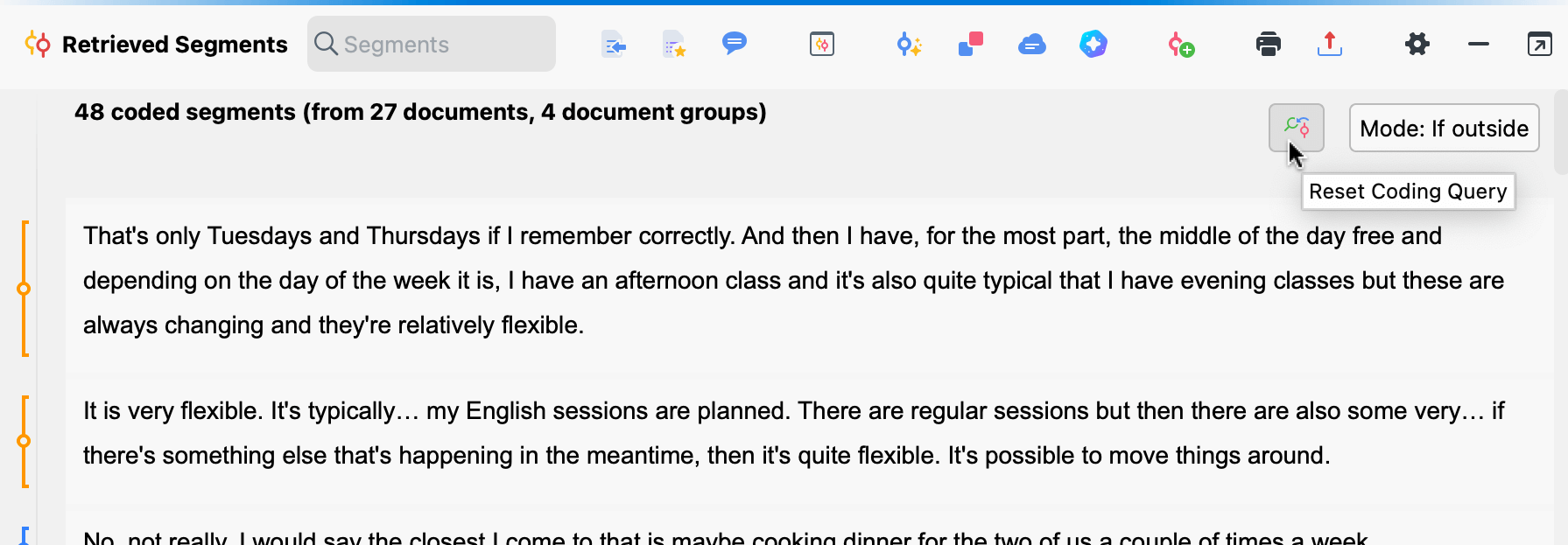
MAXQDA Retrieved Segments window showing coded interview excerpts ready for AI Chat analysis.

The MAXQDA screenshot shows a qualitative analysis step: coded interview segments in the Retrieved Segments window must stay connected to the original passage before a theme becomes a research memo.

This source-checking sequence fits research questions that depend on traceability. A theme like "participants distrusted automated recommendations" needs a source trail. Check which participant, transcript, or report supports it and whether the passage says that.

Best fit by qualitative workflow

Atlas

Use Atlas when the analysis has moved from raw material to source-grounded synthesis. It is strongest when you need to compare what several sources say. Keep claims connected to citations, then turn checked findings into notes or maps.

That makes it useful for literature-adjacent qualitative work, market research synthesis, policy review, evaluation notes, and projects where a final claim must point back to a passage.

Do not position Atlas as a CAQDAS replacement. It is not where I would manage a formal codebook, transcript repository, or coding audit trail. Use it when the next question is, "Which sources support this theme, and can I verify the passage?"

MAXQDA AI Assist

MAXQDA AI Assist belongs inside the MAXQDA workflow. Its official AI Assist page describes AI report drafts, AI Coding, code-label support, chat with data, summaries, term explanations, and reference markers.

Those reference markers connect AI report sections to source passages. That fits researchers who already need MAXQDA's broader QDA workspace and want AI support inside it.

The current page also makes data-protection and retention claims. Those claims are important, but they are volatile. Check the current MAXQDA terms and your institution's policy before uploading confidential transcripts.

NVivo

NVivo is the institutional QDA choice in this set. Its product page positions it for qualitative and mixed-methods research.

The page also describes AI suggested child codes. It also names automatic coding based on text patterns, word frequency, headings, or speakers. That fits teams with interviews, focus groups, meeting transcripts, and survey data inside a structured QDA project.

Choose NVivo when the project needs that structure. Skip it when you only need to synthesize a small set of already-clean documents and verify citations.

CoLoop

CoLoop fits research and insights teams that work with interviews, focus groups, surveys, recordings, transcripts, and research repositories. Its site and FAQ focus on patterns, themes, sentiment, transcripts, open-ended responses, and evidence-linked outputs.

That makes it a stronger fit for insight teams than for a paper-heavy academic workflow.

The boundary matters. CoLoop's FAQ says it is not built for static documents, slide decks, or PDFs. If your corpus is mostly reports, papers, and notes, use a document-grounded synthesis workflow instead.

Method-aware QDA comparison

This source is useful here as a method-aware QDA reference point. The AI features comparison centers transparency, method fit, and human judgment. Use those criteria when judging AI features in qualitative work.

Use that guidance to sharpen your evaluation questions. Then verify current claims against each product's official docs.

Thematic

Thematic fits customer feedback and open-ended response analysis. Use it when automatic theme discovery and insight reporting matter more than formal academic coding.

Its qualitative data analysis guide helps explain manual and automatic workflows. It also fits teams that need to understand feedback patterns at scale.

For dissertation-style coding or research that depends on a defensible audit trail, use a formal QDA environment. For cited synthesis across documents, use a tool that keeps every claim tied to inspectable evidence.

Method, privacy, and verification

The main risk in qualitative data analysis AI is not that the tool is useless. The risk is that it produces a plausible theme faster than the researcher can check the context.

Review these boundaries before uploading or relying on qualitative material. The goal is to decide whether the source can enter an AI system, whether the output can support a finding, and who needs to review the evidence before it leaves the research team:

  • Consent and data handling. Participant transcripts, client interviews, student data, patient data, or regulated research material may require approved storage, redaction, or review before any AI upload.
  • Transcript quality. Speaker labels, cross-talk, missing context, and transcription errors can change the apparent theme.
  • Method fit. Grounded theory, reflexive thematic analysis, content analysis, framework analysis, and UX synthesis do not use evidence in the same way.
  • Codebook control. If the project depends on a stable codebook, AI suggestions should be reviewed against the code definition and examples.
  • Quote accuracy. A quote retrieved by AI still needs passage-level review. Check whether the quote is complete, attributed correctly, and not contradicted nearby.
  • Over-clustering. AI may merge distinct participant experiences into one theme because the wording looks similar.
  • Export and handoff. A useful theme table should leave the tool with enough source, citation, and context for another reviewer to inspect.

Child Trends' case study on using AI with qualitative interview transcripts is a useful caution. AI can support analysis, but research rigor, interpretive depth, ethics, and the human-machine balance still matter.

A good QDA comparison should ask whether AI features assist the researcher, show their trail, and preserve human judgment.

The same caution shows up in academic and practitioner context. NYU's AI and qualitative research guide places AI inside research-method choices and ethics review.

A PubMed-indexed review on AI support for qualitative data analysis signals the same need for human review. A broader AI in qualitative data analysis guide is useful for separating assistance from replacement before you evaluate any vendor claim.

Choose a qualitative AI workflow

The right choice becomes clearer after you name the evidence standard and decide what would make a finding defensible.

When the audit trail matters

Choose formal QDA software when the project needs coding structure, coded segments, codebook decisions, or memos. It also fits team review, mixed methods, and a defensible audit trail.

MAXQDA and NVivo belong in this lane.

When the team needs insight reporting

Choose research-insight software when the team needs to analyze interviews, focus groups, survey responses, recordings, or feedback repositories.

This lane turns qualitative material into backed themes for product, market, or customer decisions. CoLoop and Thematic belong in this category.

When the claim needs citations

Choose Atlas when you already have sources and need to synthesize them with citations. This lane fits analysis that needs a theme table, source separation, conflicting evidence, cited passages, saved notes, or a knowledge map for review.

When the stakes are low

Choose generic AI chat only when the stakes are low or the material is already safe to use. It can help brainstorm code labels, rewrite a memo, or generate questions for a second pass. It should not be the only place where participant evidence is interpreted, stored, or verified.

The review test is whether another researcher can inspect the theme, source name, participant or document context, and cited passage. If the tool gives you a theme without the evidence trail, treat the output as a prompt for the next analysis pass.

Conclusion

Qualitative data analysis AI is best understood as a set of assists around a human research workflow. It can reduce the time spent summarizing, retrieving, clustering, and drafting. It should not erase the decisions that make qualitative research credible: method fit, context, reflexivity, consent, and evidence review.

For formal coding, start with MAXQDA or NVivo. For insight teams, look at CoLoop or Thematic. For source-grounded synthesis, use Atlas to build a cited theme table. Inspect the passages, then save only the findings you can defend.

Atlas logoAtlas

Analyze qualitative sources with citations in Atlas

After the article shows why traceability and human interpretation matter, Atlas should invite readers to add transcripts or documents and generate a cited theme table they can verify.

Frequently Asked Questions

AI can assist with qualitative data analysis by summarizing transcripts, suggesting codes, finding candidate themes, retrieving quotes, and organizing evidence. It should not replace researcher interpretation, reflexivity, consent review, or method-specific judgment.

Further Reading