
Negative Case Analysis: Test a Theme Against Contradictions
Learn negative case analysis by seeking disconfirming passages, checking context, and recording how each case changes a qualitative finding in your study.
- Byline

Summary
Negative case analysis looks for data that may challenge a working claim.
Read each case in context. Then keep, narrow, revise, or drop the claim, and record why.
Finding no counterexample in a search does not prove that none exists or that the claim is sound.
Negative case analysis means looking for data that challenges a working claim. If your draft says, “Everyone found the service easy to reach,” a person who describes a long trip may change that claim. Read the full account before calling it a contradiction.
In Atlas, you can ask about a stated claim across selected transcripts. Open citations behind the candidate passages. Then write your own memo on whether the case challenges your claim.

Atlas

Check counterexamples in Atlas
Add your sources, inspect cited contradictions, and save a revision memo.
Define negative case analysis
Negative case analysis is a deliberate search for cases or passages that do not fit a provisional finding. A provisional finding is a claim you are still testing against your data. You compare a possible exception with supporting cases, read its context, and record what happens to the claim.
The Wiley reference entry on negative case analysis frames negative or deviant cases as part of qualitative comparison. The method is more active than adding a line about outliers to the limitations section. It may lead you back to coding, sampling, or the wording of the theme.
Rarity alone is not the test. A rare account may fit your claim. A common account may challenge a claim that is too broad. In one interview, the same person may speak in ways that pull against your first reading. Research on conflicting discourses within narratives shows why a search only between participants can miss that tension.
How much weight you give a case depends on your question and qualitative approach. In a reflexive study, the aim may be to deepen an account rather than test it like a fixed hypothesis. You still owe readers an explanation of how you handled data that did not fit.
Distinguish contradiction from missing information
Name the claim before you search. “Most participants liked the service” and “Every participant could reach it” invite different checks. A passage becomes a possible negative case only in relation to a stated claim and a relevant context.
| What you found | What it may mean | First response |
|---|---|---|
| A participant says the service was hard to reach, against a claim that all found access easy | Contradiction to the broad claim | Read the surrounding account and compare with other cases |
| Access was easy for nearby participants but hard for those far away | Boundary condition on where the claim holds | Narrow the claim and check that boundary across cases |
| A participant says “it worked” without saying whether “it” means travel or booking | Ambiguity in the passage | Read more context or leave the classification open |
| A transcript never asks about access | Missing information | Mark the gap; do not code silence as agreement |
Table 1: The examples in this table are hypothetical. They show four distinct analyst tasks. A search result that looks like a contradiction may change class once you read the next answer or learn when the event took place.
The negative-case practice guide also stresses deliberate source review. A tool label or keyword hit gives you a lead to check. Keep the passage and its source location beside the working classification.
Search for cases that challenge the claim
Start with a short claim that could be wrong. State who it covers, the setting, and the experience at issue. For example: “All interviewees who used the campus support desk said booking was easy.”
Now look for a person who struggled, a condition that changes the experience, or a different meaning of “easy.”
Search across cases
Review the full set of interviews, notes, and coded excerpts that bear on the claim. Search for direct denials and less clear cases. A person may praise staff yet describe a failed booking attempt.
Mark the source ID and passage range for both parts. Do not choose just the convenient sentence.
If the first set of cases leaves a question open, your design may call for more data or a new sample. Jennifer Lane's method argument shows how overlooked views can challenge a dominant account.
A single search query cannot establish that you have checked the whole corpus.
Search within one account
Read each person's answers across the interview. Their view may change over time. General praise may sit beside a clear exception.
The study of conflicting narratives shows why you should inspect tension within one case. One code may flatten a person's account.
Write down where you looked and what you did not inspect. That record matters if a later reader asks why a case was missed.
An inductive thematic analysis can help you build a theme. Negative case analysis tests its current wording against source data.
Read each possible exception in context
Open the full passage before you decide. Who is speaking? What question were they answering? What happened before and after the line?
Check whether the account concerns the same service, time, and meaning as your claim. A later change in staff could explain why two statements differ.
Compare with supporting cases
Put the possible exception beside at least one supporting case. Ask what both say. If the theme is “booking was easy,” a statement about friendly staff may support a different theme.
The University of Northern Iowa's method text describes going back to earlier analysis when new data trouble a category.
Some contradictions will remain. You do not have to erase them by making the claim so broad that nothing can challenge it. A useful revision says where the pattern holds and what the exception taught you.
Choose the response that fits the evidence
If the passage refers to another service, retain the claim and record why. If the claim holds only for a subgroup, narrow its scope. If the case changes the proposed cause, revise the explanation. If the data no longer support the claim, abandon it.
Fife and Gossner's method paper treats support, conflict, and refinement as inputs to a theory revision. The right response depends on the claim, the case, and your method.
Record the case and revise the finding
The following log is fictional. Cases A, B, and C, their passage markers, and their words are invented to show the decision process. No row reports a real interview finding.
| Provisional claim and candidate | Source passage to inspect | Context and classification | Researcher decision and wording |
|---|---|---|---|
| “All users found booking easy.” Case A appears to support it. | A:42–49 says the website showed an open slot. | A booked online from nearby housing. Support, within that setting. | Keep as one supporting case. No group-wide claim yet. |
| Case B reports a failed booking attempt. | B:68–79 says the website showed no slots after several tries. | B later booked by phone. Boundary case for the online route; access was not uniformly easy. | Narrow: “Online booking was easy for some users, while at least one needed another route.” |
| Case C calls the visit useful but says little about booking. | C:91–99 discusses staff advice. Booking was not asked about in the excerpt. | Missing information for booking. A helpful visit does not answer the booking question. | Leave the cell open. Read the rest of C before a final count or claim. |
Table 2: The revision in row B shifts attention from the whole service to its booking route. It limits “easy” to the people and route the source can support.
Recheck A for later booking trouble. Search the rest of B for context before using the revised sentence.
Case C shows why an unresolved case belongs in the log. You cannot turn missing information into support or contradiction. A framework matrix can hold that open cell beside the source locator while you compare cases.
Keep the old wording and reason
Save the first claim, passage, context, case type, decision, and revised wording. Date the memo and list the cases to check again. Readers can then see how the finding changed.
A guide to negative case analysis also lays out an explicit search and revision record.
Check cited counterexamples in Atlas
Add transcripts you are allowed to use to one Atlas project. In chat, type @ to select the intended sources. State your working claim. Ask for passages that support it, challenge it, or leave its scope unclear.
Ask for one source and passage per row. Atlas's public guide supports this selected-source comparison with citations.
In these selected transcripts, examine the claim “online booking was easy for all users.” List passages that support, challenge, or leave the claim unresolved. Give the case ID, source citation, and a short reason for each. Keep each participant's account separate.
Open each citation and read the text around it. If an answer blends cases, ask Atlas to split them. Check each apparent exception against your coding and the full set of data in scope.
Atlas's grounded-question guide tells users to compare an answer with its source. It does not show how many possible exceptions the answer found.
Save a checked decision memo in a note. Record which claim you tested, where you searched, what the passages said, what you left unresolved, and why the final wording changed. Atlas notes can hold that memo, but the researcher owns the classification and conclusion.
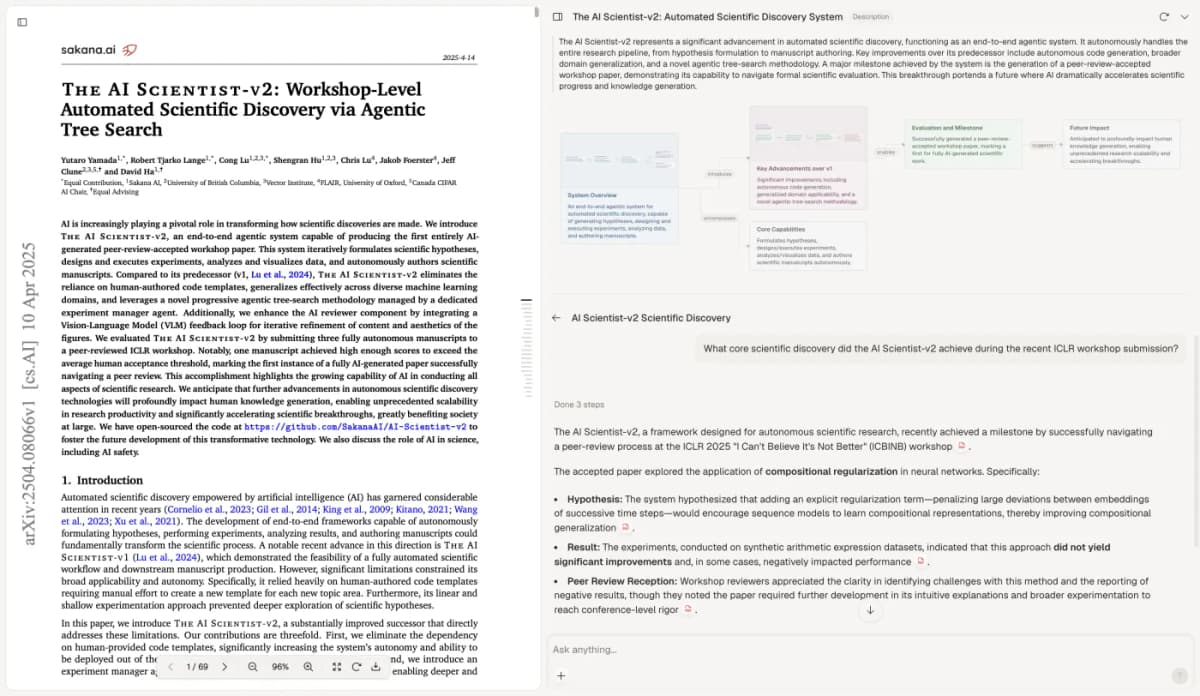
The screenshot below shows a source paper beside a cited Atlas answer. The paper is unrelated to the fictional service interviews. Use the view as a reminder to open cited material before classifying a candidate passage.
Report what changed and what remains uncertain
Report the original claim, your search scope, the cases that troubled it, and your final wording. Say whether the case was a contradiction, a boundary, an ambiguity, or a gap. Include the passage location or an approved excerpt so a reader can follow the reasoning.
Do not write “no negative cases” as proof that the finding is valid. The corpus may be small, the search may miss a passage, or the claim may be too vague to test. Lane's paper also reminds us that whose perspectives enter the sample shapes what can challenge an account.
How you describe the outcome should fit your method. Some studies revise a bounded statement; others use a contradiction to ask a new question about power, timing, or meaning. In each case, the report should show the analytic decision rather than hide the awkward account.
The qualitative findings presentation guide shows how to place a checked qualifying passage beside a bounded theme claim for readers.
Next step: test one working claim
Take a claim from your current draft and write its exact scope. Search two or three relevant transcripts, then read the full context around each candidate passage. Record one reason to retain, narrow, revise, or abandon the wording. Keep any unresolved case open.
The thematic-analysis tools guide covers a broader software workflow. This method page supplies the decision record you can use with any tool: a claim, a cited case, its context, and a reasoned revision.
Atlas
Check counterexamples in Atlas
Add your sources, inspect cited contradictions, and save a revision memo.
Frequently Asked Questions
It is the deliberate search for data that challenges a provisional qualitative interpretation, followed by documented examination and possible revision of that interpretation.