
Credibility in qualitative research concerns how well a study's findings fit the data and setting it studied. As a reader, ask whether you can follow the move from people's accounts to the authors' claims, including the cases that do not fit neatly.
A quote can support part of a claim without proving the whole explanation. Read who said it, what they were discussing, and how the authors used it. Then look for other readings and for the steps the authors took to examine their analysis.
This guide uses made-up seminar accounts to show a claim check. The output is a claim-account-counterexample note with source links and unresolved questions, not a score that certifies the study.

Check how a claim fits its sources
Compare findings with accounts and reported quality practices.
What credibility asks you to examine
Credibility is often one part of a broader trustworthiness framework. Shenton's methods paper also asks how findings may apply elsewhere, how the process is recorded, and how claims relate to data and the researcher's role.
Keep these other quality concerns in view without treating them as the same question.
Start with the scope of a finding. Does it describe a few people's accounts, a pattern in a setting, or a suggested reason? Compare the wording with the data shown and how the authors say they worked. The CASP qualitative checklist asks readers to consider data for and against a claim.
Your review can be useful even when it leaves gaps. A report may not give access to all interview text, field notes, or choices made during the work. State what you can check from the sources you have and what you cannot tell.
Read what each practice actually did
Named techniques are a starting point for questions, not a guarantee. You need to know why the authors used a practice, how they carried it out, and how it affected the reading of their data.
The table gives four ways to examine that account of the work without turning the technique names into a score.
| Reported practice | What to inspect | Limit to preserve |
|---|---|---|
| Compare sources or methods | Which sources were compared and what differed | Agreement may reflect shared limits or context |
| Examine contrary cases | Which account challenged the claim and what changed | One exception may narrow the claim rather than dismiss the study |
| Seek participant feedback | What was returned, who replied, and how feedback was used | Checking a transcript differs from discussing a theme |
| Reflect on researcher influence | How position and assumptions affected decisions | A short personal statement alone does not show the effect |
Table 1: Read the described work and its consequences for the claim, rather than counting named techniques.
Source comparison and contrary cases
Different accounts may add detail, reveal a boundary, or challenge an explanation. Shenton discusses comparing data sources and revisiting cases that do not fit. For your appraisal, record what differs before trying to reconcile the sources.
If a study says all students avoided asking questions because they feared judgment, an account of someone asking freely matters. Read whether that person had a different setting, relationship, or task.
The result may be a narrower claim, a competing explanation, or a gap that needs more data. Negative case analysis covers that specific review in more depth.
Participant feedback and researcher influence
Birt and colleagues explain why returning transcript text differs from seeking feedback on a study's themes. Ask what the feedback could check. Someone can confirm that written words match what they said without agreeing with every later reading.
Read how the researcher's role shaped access, questions, or how they made sense of data. A teacher asking their own students about class may get different answers from a peer. CASP includes prompts about this influence. Look for what the authors noticed and did, beyond a stock paragraph about bias.
Worked claim check for study groups
The seminar report and accounts below are made up to show a source check. They are not findings from a real study or a tested Atlas answer. Imagine that the report's draft claim says peer groups made every student more willing to ask for help.
Keep the supporting account in context
Account A describes a student asking a classmate they knew to explain a reading before class. It shows that this student sought help from a peer that day. It does not show that the group caused a change in confidence or that everyone did the same thing.
The CASP appraisal prompts encourage checking how data support findings. Apply that question to the word “every” and the claim about change. What data show earlier behavior, other students, and the basis for the proposed explanation?
Use the account that challenges it
Account B describes another student avoiding the peer group because they did not want classmates to see what they had not understood. Keep B beside A. It challenges the draft's all-students wording and suggests that comfort with peers may differ.
A better working claim is that these accounts show different ways of seeking or avoiding peer help. A sought help from a classmate they knew; B feared being judged. You still need to ask whether group design, prior ties, or something else explains the difference.
The fictional methods section says participants checked their transcripts, but says nothing about feedback on the final themes. Birt's distinction prevents the note from turning that statement into “participants validated the explanation.”
Save the practice as reported, with the theme-feedback question unresolved.
Keep reporting gaps separate from failures
To review a report, read the finding, the excerpts used to support it, and the methods section together. Note the claim's scope, cases that do not fit, and how the authors reached their claim. Keep their stated quality checks beside this note. These steps guide your reading; they do not replace the study's method.
Reporting guides can help you find the details to look for. EQUATOR's SRQR record points to guidance for writing up qualitative studies. A clear report makes review easier. A checklist alone cannot settle how well the claims fit the data.
Keep “not reported” apart from “not done.” If the paper does not say how a contrary case was handled, record that gap. You do not yet know whether the researchers ignored it. CASP's tool allows a cannot-tell answer and asks for reasons, rather than a score.
Make judgments that fit the study's approach. Some studies ask people for views on the researchers' reading of their accounts. Others have reasons to use different checks. Member checking is one practice to examine. It need not serve the same purpose in every study.
Compare the claim sources in Atlas
Use Atlas when you have the findings, excerpts you may use, and the authors' account of their quality checks. Keep your review notes in their own source so your judgments stay apart from what the authors reported.
Ask for support and counterexamples
Open the project and start a chat. Type @ to select the findings, excerpts, and methods source. For the made-up seminar example, you might ask:
Compare the claim about peer groups with these accounts and methods. Cite passages that support or challenge it. Keep transcript checks apart from feedback on themes. Show other readings and missing details. Do not certify credibility or infer data absent from the sources.
This asks Atlas to compare named sources. It does not guarantee that the answer will find every useful passage. To group a larger set of accounts first, qualitative coding explains tools and checks of code-to-passage links.
Inspect the passages and revise
Open each citation and read the text around it. Check whether A and B refer to the same kind of help and time period. Look at the methods passage that describes transcript checks. Ask whether the answer has gone beyond what those sources say.
The source-and-answer view below illustrates reading a document beside a cited response. It displays an unrelated research paper, not the fictional seminar material. Use that review step to decide whether the answer's wording fits its passage.
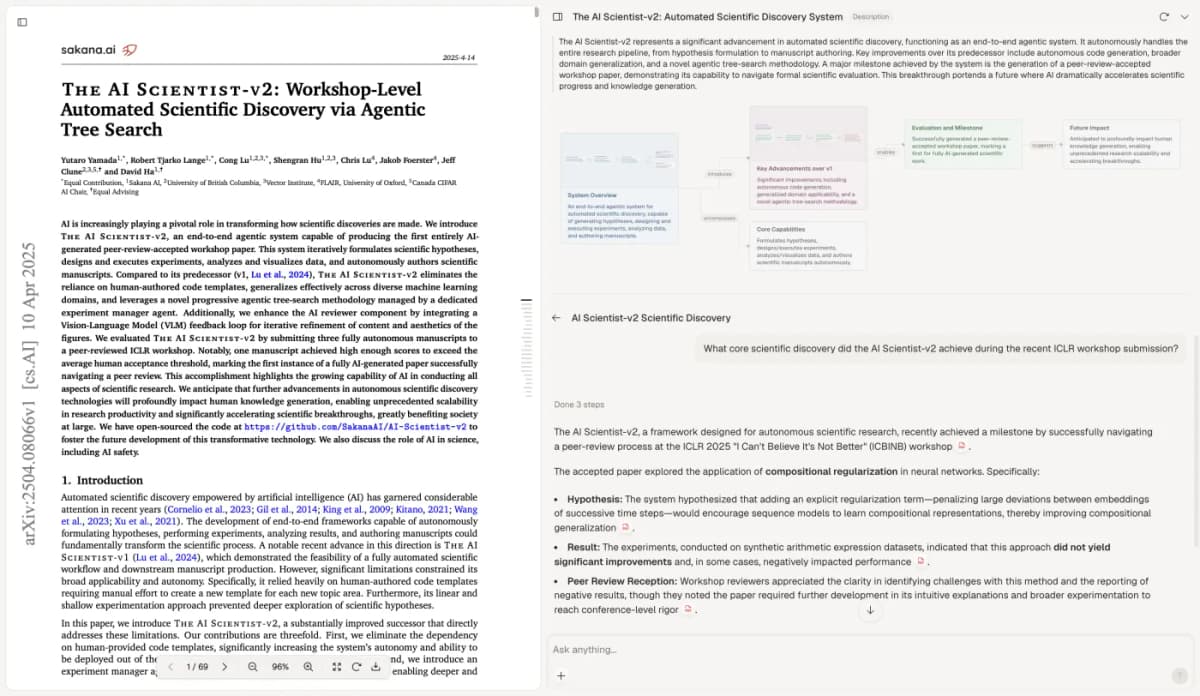
Atlas source-check capture with AI Scientist-v2 by Yutaro Yamada and colleagues, CC BY 4.0, shown unchanged. This unrelated paper does not assess the fictional seminar.
If the answer says the findings are “fully validated,” remove that guarantee. In the example, the supplied accounts support a contrast, while the basis for a change in confidence remains unclear. A missing citation should remain an open item until you find and review the intended source.
Save the bounded note
Select New → Note and give it a title that names the claim under review. Keep the claim, supporting account, contrary account, reported practice, revised wording, and open questions together. Wait for Saved before closing.
For the made-up seminar, record the move from “every student became more willing” to differing accounts of peer help. Record transcript checking as the reported practice. Leave theme feedback and the reason for the difference unresolved, rather than asking Atlas to fill those gaps.
Save a bounded appraisal decision
A useful appraisal explains what supports the claim, what challenges it, and what the available report cannot resolve. Keep the source passages beside your reasoning so a colleague can examine the same reading and offer another explanation.
Revisit the note when you gain a fuller report, an additional account, or feedback from the research team. New material may strengthen, narrow, or change the claim. Your task is to justify that decision from the sources and method, not to collect enough technique names to declare the study credible.
Check how a claim fits its sources
Compare findings with accounts and reported quality practices.