

Qualitative research design is the study plan that links your question to the people, setting, data, and analysis needed to answer it. Curtin's methods guide explains how the design shapes those choices and the researcher's role.
Start with what you want to learn, then compare approaches that could support that claim. Choosing interviews or a coding tool does not settle the design.
This guide compares five common approaches and works through a made-up project with a provisional case-study choice and an unresolved access question.

Compare design guidance in Atlas
Check design sources against your question, then save the rationale.
What qualitative research design decides
A design explains how the parts of a study fit together. It connects the question, your assumptions about knowledge, who or what you study, the data you need, and how you make sense of it. A methods section should show those links rather than just name a tradition.
The NIH guidance on qualitative inquiry describes work focused on meaning, context, and human experience. Such work can draw on interviews, observations, and documents. Those sources help researchers understand a problem in depth.
Design sets the plan. Data collection brings in material, analysis makes sense of it, and software helps manage tasks. These terms can overlap across traditions. A tool still cannot explain why your study answers its question.
For example, interviews may support a case study, phenomenology, or grounded theory. Coding interview text does not turn all three into the same design. You still need to explain the aim and how the approach fits.
Compare five common qualitative designs
The following approaches offer different ways to learn about the same broad topic. Use them as starting points, then explore other designs if needed. Tomaszewski and colleagues show how the approach affects questions, source choices, and how you interpret the data.
| Approach | Question fit | Data you may need | Demand to plan for |
|---|---|---|---|
| Case study | How does a bounded case work in its context? | Interviews, records, and observations tied to the case | Define the case and its limits |
| Phenomenology | What does a shared lived experience mean to those who lived it? | Rich accounts from people with that experience | Choose and follow a coherent philosophical and analytic tradition |
| Ethnography | How do a group's shared norms and practices work? | Field observations, conversations, and relevant records | Gain sustained access to the group's setting |
| Grounded theory | What process can a theory built from data explain? | Data collected and compared as concepts develop | Let analysis guide further sampling and collection |
| Narrative inquiry | How do people tell and make sense of their stories? | Stories and context that preserve sequence and meaning | Analyze the telling as well as the events told |
Table 1: Grounded theory aims to build theory. Amsterdam Public Health's guidance links gathering data, making sense of it, and choosing whom to seek out next. A single set of interviews and a themes list cannot establish that design.
Other options may fit better. McMaster's design guide includes qualitative description for a straightforward account close to people's words. Action research may fit work in which participants help shape cycles of inquiry and change.
The choice also depends on the version of an approach you adopt. Phenomenology and grounded theory each have distinct traditions. Read methods sources for that tradition before treating a broad label as a complete plan.
Match the design to your question
Write the question before choosing a label. Is the intended result a close account of experience, an explanation of a process, a story, or an account of one case in context? Each aim points toward different data and claims.
Name the claim you hope to make and the group or setting it concerns. Research objectives can help turn a broad topic into a clear goal. Avoid a question so wide that no feasible set of sources could answer it.
Then define the unit of analysis. If the case is one service team, the people interviewed may be sources within that case. They do not automatically become separate cases just because you interview each one.
State your stance in plain language. For example, do you want to understand how people make meaning in their setting? The APH handbook explains how your view of knowledge shapes what you ask and how you read the data.
A claim to discover one fixed truth may need a different basis from an account of how people see events. State which kind of claim you intend to make.
Check that sampling, source collection, and analysis fit that aim. There is no single sample-size rule for all qualitative designs. Describe whom you need to hear from, why their accounts matter, and how you will judge whether you have enough depth for this question.
Worked question-to-design choice
Suppose a library team wants to study how graduate students seek help with difficult source checks. The project is fictional. The team has access to staff interviews and service documents, but permission to observe help sessions is not yet settled.
Its current question is: "How do students and staff navigate source-checking support in one university library during the autumn term?" The intended output is an account of that service in context, including how formal rules and day-to-day practice fit together.
Three designs could address parts of the topic:
- Case study: fits the current question because one service, place, and term bound the case. Staff and student accounts can be read alongside service records.
- Phenomenology: could fit a revised question about what it is like to feel stuck and seek help. That would shift the aim toward lived experience rather than the service as a whole.
- Grounded theory: could fit a revised aim to build a theory of how help seeking unfolds. The team would need to gather and compare data in cycles. Findings would guide whom to seek out next.
For the question as written, a qualitative case study is a reasonable provisional choice. Crowe and colleagues' case-study guidance supports defining boundaries and using multiple sources to study a case in its real setting.
The team should still resolve the observation gap. Without it, the plan may rely mostly on what people say happened. The researcher must decide whether interviews and records can answer the question adequately or whether to narrow the claim.
The choice remains open until the question and source plan fit. Access to a few interviews helps, but convenience alone cannot justify the design.
Check access, ethics, and study quality
A named design does not grant access or settle consent. Plan how you will approach people, protect sensitive accounts, store data, and handle a change in the project. Use the required institutional ethics process before the relevant work begins.
Small cases can be easy for insiders to recognize even when names are removed. A rare job title or a detailed incident may identify someone. The research team needs to judge those risks in the specific setting.
The source table below comes from Crowe and colleagues' case-study paper. It links pitfalls to actions on case boundaries, source relevance, ethics, and theory. These are planning concerns that remain after you choose a design.
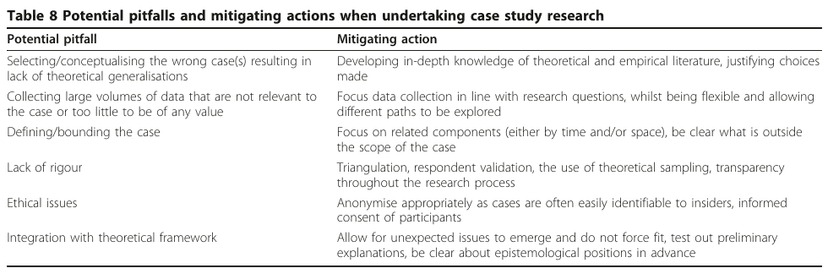
Crowe and colleagues' The case study approach, Table 8, published in BMC Medical Research Methodology (2011), is shown unchanged under CC BY 2.0. The table was exported from the original PDF. Apply these points within their case-study scope.
In the example, case boundaries need to state which service and term are included. The source plan needs enough depth to address the question, while leaving room for unexpected issues. Both decisions belong to the researcher.
Record how your role may affect what people share. Staff may hold back when a fellow employee asks about their work. Explain how your position affects both the accounts you gather and how you read them.
Explain how you will make sense of the data. The guide to inductive thematic analysis can help with that part of the plan. To justify the design, check how the approach fits your aim beyond finding themes.
When a completed study is written up, the SRQR checklist helps locate its reported qualitative methods and researcher role. Reporting a field is a different task from deciding whether this design fits your question.
If you also need to estimate how often something happens, you may need a plan to study numbers. The NIH mixed-methods guidance calls for a clear plan to join the two strands.
Using several kinds of qualitative source does not by itself make a study mixed methods. Explain what each strand adds and how their findings will come together. For a study that needs both strands, the mixed methods research design guide helps you choose their sequence and specify where the findings connect.
Compare design sources in Atlas
Use Atlas to compare methods guidance with your question note before writing the rationale. Upload only sources you have permission to use. This step supports source reading and planning, while you retain the methods judgment.
- Add the question note and selected methods sources to one project. Include your known access constraints in the note and wait until source processing finishes.
- Open chat and select Ask a question. Type @ to choose the note and methods sources, then use Project only to keep new retrieval inside the supplied project material.
- Ask for a comparison of two or three plausible approaches. Keep fit, mismatch, source support, and open decisions in separate fields.
- Select Send, open each numbered citation, and read the supporting passage and nearby qualifications. Exact page or passage locations depend on the source.
- Correct the comparison and choose New, then Note. Save your checked rationale and open questions, and confirm Saved before closing it.
For the library example, you could ask:
Compare case study, phenomenology, and grounded theory against the question and access limits in my note. Use the selected methods sources. For each approach, state the fit, what would need to change, supporting citations, and unresolved researcher decisions. Do not choose on my behalf or infer access I have not confirmed.
If an answer recommends grounded theory solely because interviews will be coded, inspect its source citation. Ask it to check whether the study aims to build theory and can use findings to guide further sampling. Save the reason for your choice with the label.
Atlas cannot obtain ethics approval, recruit participants, perform fieldwork, or certify that the design is sound. A methods source can support your rationale, but the researcher must decide whether its guidance applies to this project.
Write a defensible design rationale
Replace "We chose grounded theory because we have interviews and a coding tool" with a reason tied to the question and plan. For the fictional project, you could write:
We propose a qualitative case study of source-checking support in one university library during the autumn term. We want to understand how staff and students make sense of this service in its setting. Interviews and service records will support the account. We still need permission to observe help sessions. Phenomenology would shift the aim to lived experience. Grounded theory would require an aim to build theory and a plan to let findings guide further sampling.
Use this example to start a fuller methods section. Add whom you will recruit, how you will study their accounts, and the ethics decisions still needed. Ask your supervisor to review the plan. The design-alignment paper can help you check how the question, approach, data, and analysis fit together.
Keep the comparison and sources beside your reason for choosing the design. If access or the question changes, revise the choices that depend on it. This record shows why you chose the design and when to review that choice.
Compare design guidance in Atlas
Check design sources against your question, then save the rationale.