
What Is Reflexivity in Qualitative Research? A Worked Example
Learn what reflexivity means in qualitative research. See a worked memo that links an initial assumption, checked source, revised reading, and next decision.
- Byline

Summary
Reflexivity asks how your position, relationships, and choices shape a qualitative study and what you make of its data.
A useful memo links a prior assumption to a source passage, a changed reading, and the choice you made next.
Atlas can help compare your own notes and sources with citations to check. You still write and judge the memo.
Reflexivity in qualitative research means asking how your own role affects a study. Your past experience, relationships, and choices can affect what you notice and what the data mean.
The University of Melbourne's guide treats the researcher as part of the research process. Reflexivity asks you to examine that role as the work goes on.
For example, a researcher might read short interview answers as lack of interest. A field note and the full exchange may show that the questions were rushed. That could change the researcher's reading.
A reflexive memo would record the first guess, the source that tested it, the new reading, and the next choice. This is a hypothetical example. It is not a report about a real person.
Atlas can help compare notes and supplied source passages with citations to inspect. The researcher decides what their own role means and writes the final account. Check each cited answer against the source before using it.

Atlas

Compare your research notes in Atlas
Compare selected notes and sources, then write a checked reflexive memo.
What reflexivity means in qualitative research
Reflexivity is more than knowing that you have a point of view. It asks how your view and the setting affect the questions, contact with people, analysis, and final account. The AMEE practical guide treats this as ongoing work, often shared by a team.
A researcher may ask: Why did I choose this question? Did my role change what people told me? Which reading did I favor first? What changed when I checked the source again? Each question points to a choice that can be examined.
Your own view is part of qualitative work. Examine its effects in the choices you make. The AMEE guide names personal, social, method, and setting influences. Ask how each mattered in this study.
A short note with source links lets readers examine your reasoning. Dodgson's account says that a clear account of researcher–participant ties helps readers judge a study. Space may be tight, so focus on choices that affected the finding.
Separate reflexivity from reflection and positionality
Reflection notices a reaction
A reflection note might say that an interview felt tense or that an answer surprised you. That is a useful record. It does not yet explain your part in the exchange.
Ask whether your wording, role, or first guess steered the answer you heard or the meaning you gave it.
Positionality names a standpoint
Positionality describes where you stand in relation to the topic and the people in the study. Your job, life experience, status, or beliefs about knowledge may matter.
Melbourne's researcher examples show how past work can inform a question or an interview.
A statement about identity or background can orient a reader. It does not by itself show what happened when an assumption met a source passage. Disclose what is relevant to the research account; do not treat a long list of identities as a universal test of rigor.
Reflexivity traces an effect on a choice
The reflexive step links a standpoint or reaction to a choice. You may revise a question, rethink a silence, change a code, or report a limit. The thematic analysis guide covers the wider task of developing codes and themes.
The AMEE guide asks researchers to examine their influence as work unfolds and explain choices that matter.
These practices can overlap. A field note may start as reflection, name a relevant position, and become reflexive when you test how that position guided your reading. Give readers an account they can follow without trying to label each sentence.
Look for your influence throughout the study
When framing the question
Record why the topic matters to you and what you expect to find. Ask whose concerns your question includes and what it leaves out.
A clinician studying care may bring useful knowledge and a role that informs the question. The Melbourne guide gives examples of past experience influencing research.
During encounters and data collection
After an interview or observation, note when your wording, status, or reaction may have changed the exchange. Keep the full context in view. A short answer may reflect your question as well as the person's view.
The AMEE guide treats such ties as part of the inquiry. You may need a new follow-up question or a closer reading of the transcript.
During interpretation and reporting
When an early reading feels clear, look for a passage that might unsettle it. Keep the passage as evidence for why you kept, changed, or left the reading open. In the final account, explain the choices that most affected the finding. The AMEE authors advise weaving this work through the report. For a wider view of turning sources into findings, see the qualitative data analysis guide.
No single timeline is required for every study. A team may discuss assumptions together; a solo researcher may use field notes and memos. What matters is that the questions return when new encounters and interpretations arise. Dodgson stresses giving the reader enough context to assess the account.
Write a source-linked reflexive decision memo
A short memo can turn a private thought into a traceable decision. These four fields can prompt your own account:
- Prior assumption: What did you expect, and where might that expectation come from?
- Encounter or passage: What specific note, transcript span, observation, or exchange challenged or reinforced it? Record a locator you can reopen.
- Revised or unresolved reading: What now seems plausible? What other reading remains possible?
- Researcher decision: What will you change, keep, check next, or disclose in the methods account? Give your reason.
Date the memo and keep the source reference beside it. If another reader sees a different meaning, record that gap rather than hiding it. Researcher triangulation gives a team a fuller way to compare independently prepared readings of the same material.
The AMEE guide describes memo writing and team discussion as ways to work reflexively. Dodgson calls for a clear account of the research setting.
Keep an alternative reading
A source locator supports a claim about what was in the material. It cannot prove your reading or tell you whether a person felt safe to speak.
Reopen the nearby text, check your earlier note against it, and say what you decided. That gives readers more than a bare claim that you were reflexive.
For a broader record of research choices, see the audit trail guide. This page focuses on the narrower question of how the researcher's part in an encounter changed one interpretation.
A reflexivity example from note to decision
The following memo is entirely hypothetical. The participant, interview, field note, and locators are invented teaching devices. No passage below is a quotation from a real person.
- Prior assumption: I expected staff to find the new schedule hard to use. After the interview, I read one person's short replies as resistance to the change.
- Encounter and source to check: At invented interview locator T4, minutes 08–12, I asked three closed questions in quick succession. The invented field note F4, line 6 says I was worried about time.
- Revised reading and alternative: The short replies may reflect my rushed format. They might also reflect the person's limited time or view of the process. This record cannot settle which reading fits.
- Researcher decision: I will reread the exchange, add an open follow-up to the next interview, and mark the resistance label as provisional. I will explain this change in my report.
The decision follows a check of the exchange. It does not declare the first reading wrong. It keeps another reading open and makes the next question clear.
The AMEE method guide treats this attention to questions, contact, and analysis as part of reflexive work.
In a real study, use only material you are permitted to place in your workspace. Check the transcript span and field note yourself. If the record lacks enough context, write that the interpretation is unresolved. Do not manufacture a participant quote to make the memo feel complete.
Next steps for checking sources in Atlas
Create a project with permitted transcripts, field notes, and earlier notes. In Atlas chat, use @ to choose the sources for this check.
Ask: “How does my earlier note describe the exchange, and what do the selected transcript and field note show nearby? Cite the passages. List possible differences without deciding my standpoint or next action.” Atlas can compare selected sources and show citations to check.
Open each citation beside the answer and read the nearby material. If a comparison loses the interview context, revise it yourself. Then write the four-part memo in a project note and confirm it is saved. Keep your alternative reading and decision in your own words.
Atlas can organize a comparison of supplied text and show citations. It cannot infer the meaning of your identity, perform reflexivity for you, remove bias, or certify a study's rigor or ethics. Its public docs do not establish a controlled evaluation of reflexive research outcomes.
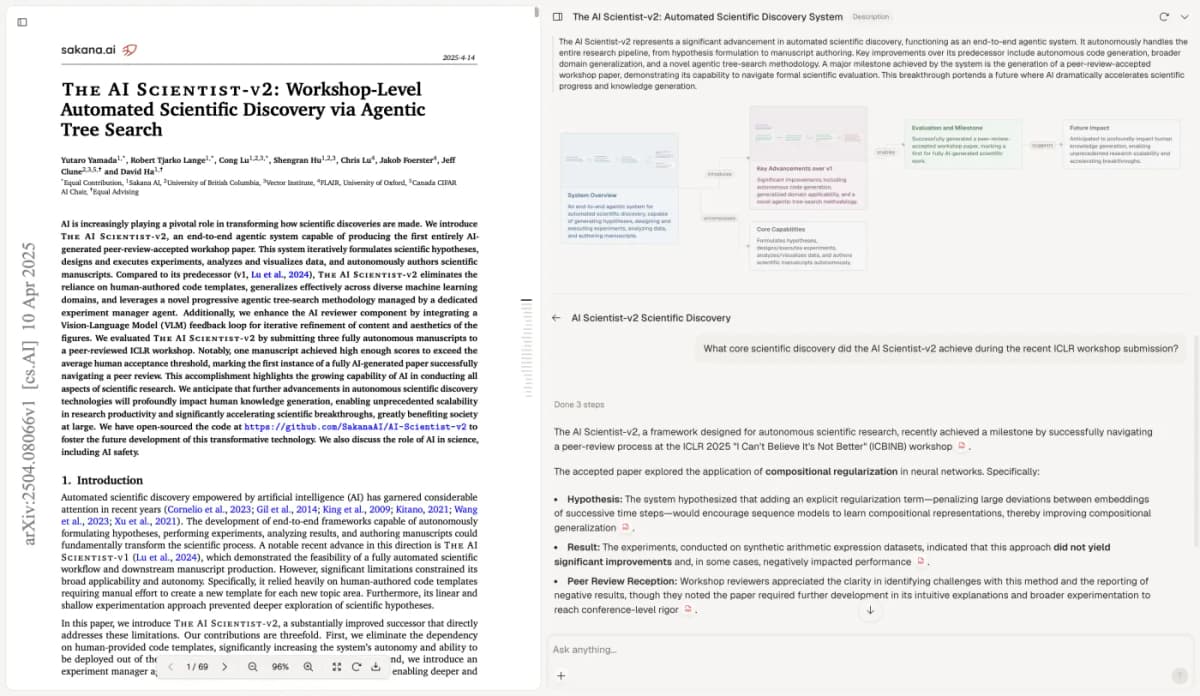
The image shows an Atlas answer beside an open cited source. Its visible paper is unrelated to the fictional interview above; it illustrates where a researcher can inspect a passage before writing a memo.
Report what reflexive practice can establish
A reflexive memo can show how you tested an assumption and why you changed a question or interpretation. It can make a decision visible to a collaborator or reader. It cannot prove that every influence was found, that the analysis is neutral, or that the study meets all ethical duties.
A positionality paragraph can explain where you stand. A journal can keep track of your thoughts. You still need to trace the choices that mattered to a finding.
The AMEE guide advises weaving key reflexive choices through the report rather than placing them in one isolated paragraph.
Reporting needs vary by method, field, and venue. Dodgson notes that journal space can be tight, but readers still need enough context to judge the work. Explain the trail behind your claim. No one disclosure formula fits all studies.
If you work with sensitive interviews, follow the permissions and procedures for your study before adding any material to a tool. Reflexive care can raise ethical questions, but a memo or cited answer does not resolve them. The researcher and the study's responsible team retain that work.
Atlas
Compare your research notes in Atlas
Compare selected notes and sources, then write a checked reflexive memo.
Frequently Asked Questions
It is ongoing critical examination of how a researcher's position, relationships, assumptions, and choices shape the research process and interpretation.