

The SRQR checklist has 21 reporting standards for qualitative research. It helps authors show what they studied, how they gathered and made sense of their data, and what the findings mean. A completed checklist should point to the text that answers each item. Readers still need to check that text.
Use the guideline to match each item to a passage in your draft. Note the draft version, where you found the text, and what it answers. If the passage gives only part of the answer, name the missing detail and ask the author to check the study record.

Check manuscript reporting in Atlas
Compare your manuscript with SRQR and inspect each proposed passage match.
Get the official SRQR checklist
Start with the EQUATOR Network's SRQR record. It links the original guideline by O'Brien and colleagues, with extra notes that explain the items. Use those sources for the exact wording. Then check whether your target journal asks you to use its own form.
SRQR covers the whole qualitative report. You can use it while keeping study records and writing, as well as in the final check. The original guideline allows the report's structure to vary with the study and journal. You do not need 21 headings to make the answers easy to find.
If you are choosing a guideline, COREQ focuses on interviews and focus groups and has 32 items. SRQR covers qualitative work more broadly. The JAMA Surgery explanation of SRQR and COREQ explains how both seek to make study reports clearer. Choose the one that fits your study and the journal's rules, along with any extra guidance that applies.
For cohort, case-control, or cross-sectional observational studies, the STROBE checklist guide covers a different reporting scope.
Understand the 21 reporting items
The items cover different parts of a report. These groups help you read the original checklist. Keep the item numbers so you can return to each full description:
- Items 1–4: name the study in its title and abstract, explain the problem, and state the purpose or research question.
- Items 5–8: explain the qualitative approach, the researcher's influence, the setting, and how people or material were chosen.
- Items 9–12: report ethics, how data were gathered, the tools used, and the people or material studied.
- Items 13–15: describe how data were prepared and analyzed, and the steps used to support trustworthiness.
- Items 16–17: explain the findings and show the source material that supports them.
- Items 18–19: link findings to prior work, explain what they add and where they apply, and address the study's limits.
- Items 20–21: report relevant interests and funding, including the funder's role.
Read the notes for the items that relate to each passage. Saying the team used thematic analysis names an approach, but may not explain how codes and themes were formed. Saying interviews were recorded may leave out how the team made and prepared the transcripts.
The task is to make study choices and actions clear. A study does not have to use every technique named as an example in the checklist. Report the steps the team took and give reasons where relevant.
Map items to manuscript passages
Name the draft before you review it. A filename or version date helps the team know which text you checked when the draft changes. If you use a supplement too, make clear which file each passage comes from.
For each item, note where you found the text and what it answers. Your working map can include the item number, passage, review status, and an action for the author. Keep a short excerpt or note beside the page number so the reader knows which text you mean.
Use review statuses to show which kind of issue needs attention:
- Addressed: the text answers the item, subject to author review.
- Partial: some relevant text is there, but a named detail is missing.
- Not found: you did not find the detail in the material you checked.
- Applicability needs review: the team needs to decide whether the item applies and give a reason.
These statuses help you group questions for the authors. Judging study rigor needs further review of the methods and their use. One paragraph may help answer several items, while one item may need text from the methods, results, and a supplement.
EQUATOR's peer-review toolkit advises checking whether the report answers each item fully and noting missing or partial details. It also asks readers to check the reasons for items marked not applicable. Read the passage itself to judge whether the answer is complete.
Worked SRQR reporting review
This teaching example uses a fictional sentence in Methods, paragraph 2: "We recorded interviews and analyzed the transcripts thematically."
The sentence touches three reporting items, but each asks for different details. A reader could start with this map, then ask the author to fill the gaps from the study record.
| Item | Passage found | Provisional review | Author action |
|---|---|---|---|
| 10: collection procedures | Methods, paragraph 2 mentions interviews and recording. | Partial: the collection process is unexplained. | Describe how the interviews were conducted and relevant timing or changes. |
| 13: data preparation | The sentence mentions transcripts. | Partial: their preparation and checking are unexplained. | Check the study record for transcription, verification, and any de-identification procedures. |
| 14: analytic development | The sentence names thematic analysis. | Partial: the path from material to interpretation is unexplained. | Explain the analytic steps and who performed them, with the rationale where relevant. |
Table 1: The three rows ask what needs to be reported. They do not add steps the author has yet to confirm.
The author might find the details in study records, or explain that a suggested step was not used. Revise the text to reflect that answer. A broad claim that the analysis was rigorous would leave the same question open.
A published example shows why you should also check where the text is. Livermon and colleagues' completed SRQR supplement gives page numbers and section names for the items. The excerpt below covers approach, reflexivity, context, and sampling.
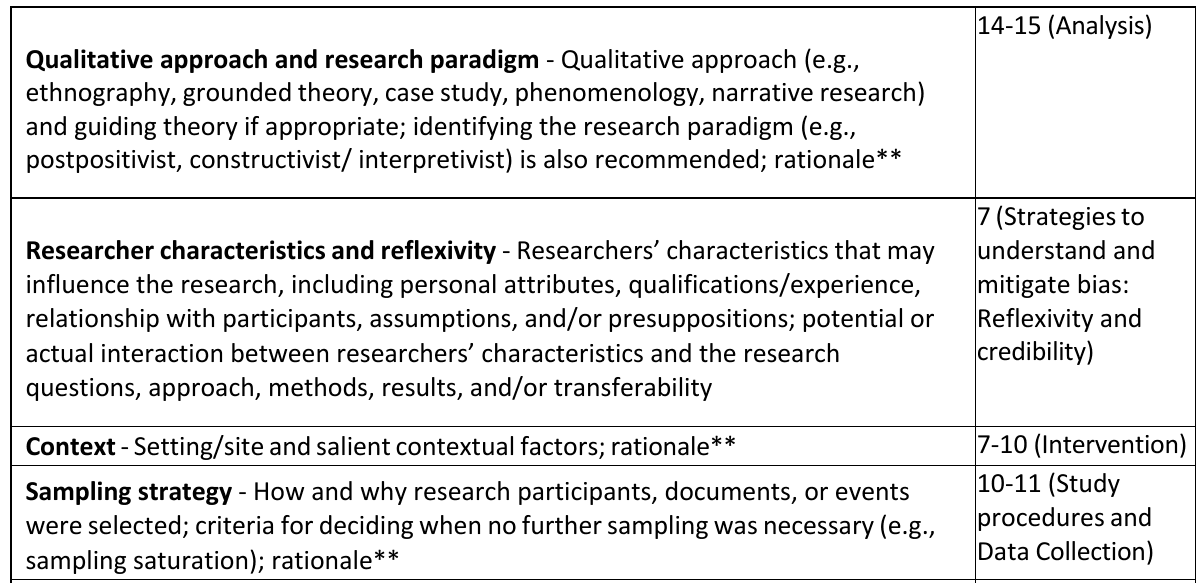
The location column pairs page references with section names. Excerpt from Livermon et al. (2025), reproduced under CC BY 4.0.
The supplement points reflexivity to page 7. In the current published article PDF, that named section is on printed page 4. There, the authors discuss their possible influence and steps to support credibility. Printed page 7 has details about the participants and related text.
The different page numbers do not prove a flaw in reporting or study quality. They show why you need the draft version and section names to find text when page numbers differ. Check the numbers in the file you will submit before filling the form.
Resolve gaps without inventing methods
When an item is partial or not found, ask a question the author can answer from study records. For item 13, you might ask whether transcripts were checked against recordings and how excerpts were de-identified. Keep these as questions until the author confirms what happened.
Keep gaps in the report separate from what the team did. The draft may leave out a step the team took, or it may describe a choice that needs a reason. Text comparison alone cannot tell you which is true.
If a step was not taken, report the relevant fact and reason. Do not rewrite the study's history to fill a row. If an item does not apply, explain why for this study and check the journal's rules. N/A on its own does not let readers judge the choice.
The reflexivity guide explains how to record the researcher's role and influence. To trace choices made during analysis, use the qualitative audit-trail guide for help with study records. The draft still needs a truthful account of the work.
Check proposed matches in Atlas
Atlas can compare named sources and give citations you can check. Use it to suggest where your draft answers an SRQR item and which details may be missing. The authors still need to review these matches.
- Add the draft you may use and the chosen guideline to the same project through Add a source, then Upload files. Open both after processing and check that the text you need is there. Give any supplement its own name.
- Start a chat, type @, and select the draft and guideline. Ask: "Compare this manuscript with SRQR items 10, 13, and 14. For each item, point to the draft passage, explain what it answers, and flag missing or partial details. Cite both sources. Do not assume the team took steps the draft does not report."
- Open the citation beside each suggested match. Read the draft passage and the full guideline item, including any limits on what each says.
- Review the status and question for the author yourself. For the fictional sentence above, mentioning transcripts does not show that the team checked them or removed identifying details.
- Select New, then Note, and save the checked map with the draft version, correct passage locations, and author questions. Wait for Saved before closing it.
If a citation opens the whole source, find the passage yourself. Mark a suggestion unresolved until you can check text that supports it. A citation helps you find the source, but the author must judge whether the item has been answered.
Refresh the map before submission
After edits, check all 21 items again. The three-item example shows how to do the check. The final form needs to cover what the journal asks for.
Check the final draft and supplements together. If text moved to a supplement, name the file and give a location the reader can follow. Page numbers, headings, and text can change after a review, so an old map may point to the wrong place.
Before handing the map to coauthors, work through these checks:
- Open each referenced passage in the final manuscript version.
- Ask the author to resolve partial or missing details.
- Review the reasons for items marked not applicable.
- Check reported steps against the team's study record.
- Compare the form, draft statement, and supplements with the journal's rules.
To check how source material supports a finding, use the qualitative data presentation guide. Make the needed changes in the draft, then refresh the SRQR passage locations before the final author review.
Check manuscript reporting in Atlas
Compare your manuscript with SRQR and inspect each proposed passage match.