

The usual distinction in case report vs case study is purpose. A clinical case report tells the course of a patient's care and the lesson it offers. A research case study asks a planned question about a defined case in its real setting.
Both can use a detailed account of one case. The title or number of people will not settle the difference. Look at what the authors wanted to learn, what they treated as the case, and how they used the evidence.

Compare your case evidence in Atlas
Check the purpose, sources and claims before choosing a research label.
Compare the purpose and evidence
The Journal of the Medical Library Association editorial separates case study as a research method from case report as a publication type. That is a useful starting point when a title uses the terms loosely.
In clinical reporting, the account often follows a person's presenting problem, findings, care and follow-up. In research case study work, the case may be a person, team, service, event or institution. The researcher defines its bounds and studies it in context.
The table compares these common uses. It gives questions for reading a paper, rather than a rule that every field uses the same labels.
| Evidence question | Clinical case report | Research case study |
|---|---|---|
| What is the purpose? | Share a clinical observation and lesson | Understand a case through a planned question |
| What is the case? | Usually a patient's course of care | A defined person, group, service, event or setting |
| Which sources matter? | Care record, tests, treatment and follow-up | Sources selected to answer the case question |
| How is evidence used? | Explain the course and clinical reasoning | Analyze evidence in relation to the question and context |
| What guides the report? | CARE and the journal's instructions | The chosen case-study approach and journal instructions |
| What limits the claim? | An observed course alone cannot show general treatment effects | Findings need their case boundaries and context to be understood |
Table 1: Do not choose by which label sounds more rigorous. A clear report and a clear inquiry do different jobs. Describe the work that was done so readers can judge the claim on that basis.
Read past the label in the title
There is no clean naming rule across all disciplines. The original CARE guideline even allows the words case report or case study in its title item. The rest of the checklist makes clear that it concerns clinical reporting.
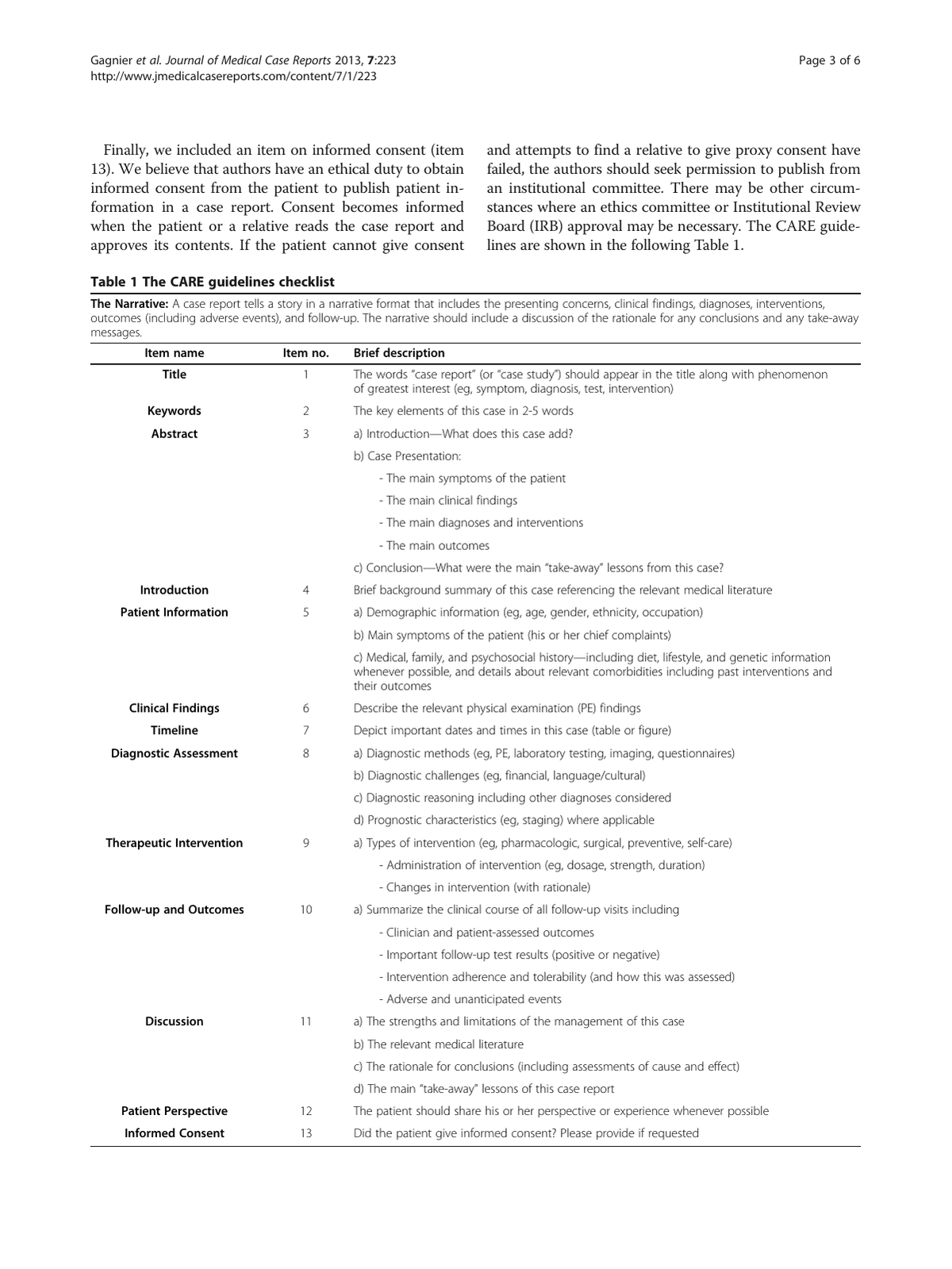
Gagnier and colleagues' 2013 guideline, reproduced under CC BY 2.0, shows how clinical reporting can use both labels.
The source page organizes a clinical course through patient information, findings, a timeline, diagnostic assessment, care, follow-up and outcomes. It also includes the patient's perspective and consent. Those items help identify the report's purpose even when the title says case study.
A research case study needs an account of the inquiry too. Read the methods for the research question, how the case was selected, what was inside its bounds, how sources were collected, and how the authors made sense of them.
One person's experience can be the subject of that inquiry. Several patients can also appear in descriptive reporting. Counting people alone loses the more useful distinction between an account of events and a planned way of studying a case.
Classify paired examples from the same setting
Imagine two fictional manuscripts from the same hospital service. Neither describes a real patient or recommends treatment. Their setting is shared, but their questions and evidence differ.
The first manuscript follows one person's unusual course through the service. It describes the presenting concern, what was found, the decisions made, and what happened during follow-up.
Its lesson comes from that clinical sequence. In the usual clinical sense, this is a case report.
The second asks why the service's referral process changed over six months. The authors define the service and time period as their case. They compare staff interviews, referral documents and meeting records, then examine where the accounts agree or differ.
That second manuscript fits a research case study if its methods support the planned inquiry. Its unit is the service during that period. The interviews are sources within the case, rather than separate cases merely because each staff member was interviewed.
If you extend the inquiry to two hospital services, define each service as a case. A comparative case study keeps case boundaries, periods and count units beside the cross-case claims. Comparing staff interviews within one service does not by itself create a second case.
Now consider a gap: the second manuscript contains only a manager's narrative and no explanation of how it was analyzed. You cannot infer a completed research design from its title. Record what the text supports and ask the authors how the question, sources and analysis were connected.
Match reporting to what was done
For a clinical report, use the CARE checklist and the target journal's current rules. Map the clinical timeline and reported outcomes to the manuscript. A completed checklist helps find missing reporting, but does not prove that a care decision caused an outcome.
For a research case study, use the chosen case study research design. Explain why the case was selected, what defines its boundaries, and how the evidence answers the question. The design must be visible in the account of what was done.
Crowe and colleagues' methods guide explains case study through in-depth inquiry in context. It discusses different purposes and sources. Use those distinctions to read a research report, while keeping its precise method and scope in view.
Ethics review, access to records and permission to publish need their own checks. Weill Cornell's guidance is one institution's process. Follow your own institution and journal when resolving your work's status. A change of title does not grant permission to use or publish information.
Build a checked comparison note in Atlas
Atlas can help compare method descriptions in papers you supply. Add only material you have permission to upload. Published papers and a permitted method summary may be enough for this task. Do not upload identifiable clinical records without the needed approval.
Open the project, start a chat and use @ to name the two papers. Choose Project only to keep new search within your project and supplied sources. Ask for a note that compares purpose, case boundary, sources, analysis and reporting rules.
For the fictional service example, ask:
Compare the purpose and methods in the named papers. What is the case in each? Which sources were used, and how were they analyzed? Cite the passages behind each point. If the method is missing, mark it as unclear.
Open the numbered citations and read enough surrounding text to check the answer. If Atlas calls each interview a separate case, return to the passage defining the service as the case. Correct the note so it reflects the stated unit.
If the paper does not explain its analysis, keep that point open. A citation to the title will not fill the gap. Ask the research team or supervisor for the missing method details before accepting the classification.
Use New, then Note, to keep the checked comparison. Include source references and open questions, and wait for Saved before closing it. The note passes your review when each label has passage support and each uncertainty stays visible.
Choose the description and resolve open questions
Write a short account of the work without either label first. State the purpose, what the case includes, which sources were used and how they supported the conclusion. Then choose the term that fits that account and the journal's category. Compare other research article types if the manuscript serves a different purpose.
If you are still choosing the inquiry method, review qualitative research design with your supervisor. If the work is complete but the description is unclear, resolve the missing details before rewriting the title.
Keep the final claim within the evidence. A clinical course can suggest a question for future study. A case inquiry can explain what happened within a setting. Readers need the scope and limits to judge how that lesson may apply elsewhere.
Compare your case evidence in Atlas
Check the purpose, sources and claims before choosing a research label.