

Research article types group papers by what they add. An original study reports findings, a methods paper explains a research technique, a review brings prior work together, and a perspective advances an interpretation or argument.
To sort a set of papers, record both the journal's label and your account of the paper's purpose. They may use different words. The useful question is what kind of evidence the paper offers for your task.

Sort your paper types in Atlas
Compare each paper's purpose and evidence, then check the cited passages.
Use a purpose-and-evidence taxonomy
There is no single list that every journal uses. The Taylor and Francis article-type guide includes many categories and mappings. A reader can start with broader families, then check the exact journal label.
The table groups six common families by purpose. Use it as a reading aid. A journal may combine categories, use different names, or offer only some of them.
| Family | What the paper adds | Evidence to inspect |
|---|---|---|
| Original study | Findings from a completed inquiry | Study question, methods, results and limits |
| Brief report or research letter | A focused set of original findings | Enough methods and results to judge the narrow claim |
| Methods paper | A research technique or protocol | Procedure, comparison, validation and scope |
| Review | A synthesis or interpretation of prior work | Sources selected, synthesis approach and claims |
| Perspective or commentary | An argument or interpretation | Reasoning, cited evidence and boundaries of the claim |
| Study protocol | A plan for a study | Planned question, design, measures and analysis |
Table 1: The Springer Nature author tutorial explains several of these broad groups. The Taylor and Francis author tutorial also describes methods and brief reports. Neither replaces the rules for a target journal. Frontiers' Methods guidance also accepts established methods or protocols, so novelty is not a universal rule for this family.
Clinical reports, data papers, software papers and other formats may need extra rows in your own note. The case report vs case study distinction helps separate a clinical account from a planned case inquiry. Add them when they occur in the set you are reading. Do not force a paper into a family simply to keep your table short.
Separate journal labels from paper topics
A title describes the subject, but may not identify the contribution. A paper about reviews can offer writing advice. A paper about experiments can argue for a policy change rather than report a new experiment.
The first page below provides a real example. Marco Pautasso's paper discusses how to write a literature review, yet the journal labels the article Editorial. The title's review wording refers to the writing task being taught.
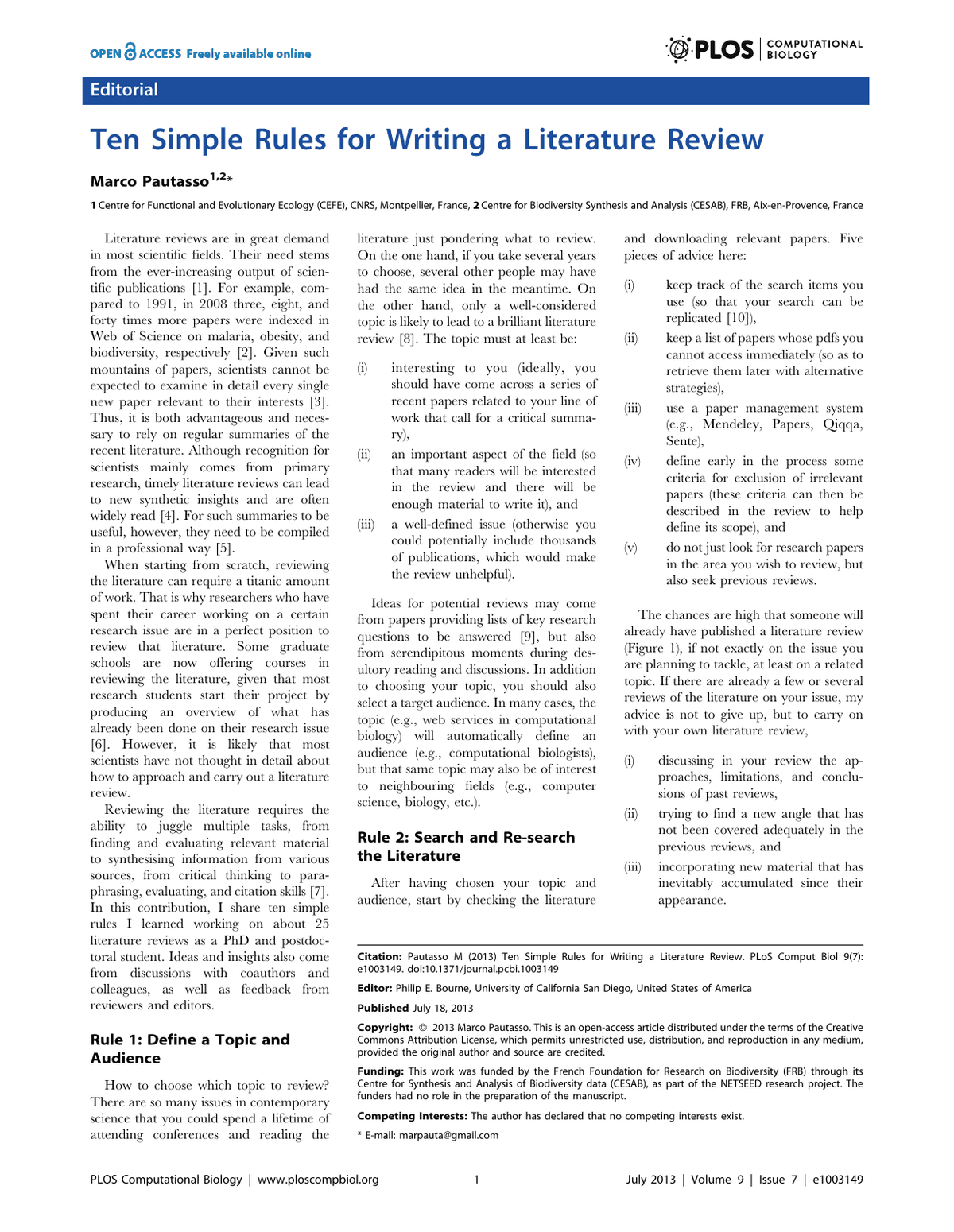
The first page of Pautasso's 2013 writing guide, reproduced under CC BY 4.0, makes the journal label visible above its topic.
In your note, keep the journal label Editorial and describe the purpose as writing advice. That tells you how to use the paper. Its title does not make it a systematic review that answers a specific study question.
Keep both fields in the note. One tells you how the journal published the paper. The other tells you what it adds to the task you are doing now.
Read the contribution before assigning a type
Start with the stated aim. Does the paper ask a question about the world, propose a technique, synthesize prior work, make an argument, or set out future work? Then look for the evidence it uses to answer that aim.
Read the methods and results together when present. A completed study should explain what was done and what was found. A protocol describes planned work. A review may have detailed search methods while using earlier papers as its source material.
For a methods contribution, ask what technique is described and how it was tested. Follow the methods paper guide when your next task is to connect the procedure with its validation and limits. The presence of a method section alone does not settle the type.
Record a source location for your judgment. A note that says “methods paper, based on the stated development aim and validation results” is easier to check than a label alone. Keep the journal's category in a separate field.
Keep mixed and uncertain cases visible
The groups can overlap. A methods paper can report new test results. A brief report can contain a full small study. A perspective can cite many papers. Choose the main purpose and keep the other traits in your note.
Journal rules show why labels need checking. QRB Discovery has separate types for research, reports, perspectives and comments. It sends reviews to a sister journal. That list is specific to this journal.
SLAS's article-type guidance includes protocols and technical briefs as well as full studies. A paper that explains a new tool or procedure may have its own type. Check what the journal means by that name before you submit.
If the supplied text does not show what the paper adds, leave its type open. An abstract may leave out how sources were chosen or how a method was tested. Get the full text or ask the author before you settle the label.
Check a paper classification in Atlas
Add papers you have permission to use to an Atlas project. Open a chat and name the intended papers with @. Choose Project only if you want new search limited to your project and supplied material.
Ask for a note about each paper's aim, methods and evidence. Give the answer space to explain each label. For a mixed paper set, ask:
What does each named paper aim to do, and what evidence does it use? Keep the journal's label in a separate field. Show the passage behind each type you assign. Mark cases that the text does not resolve.
Open the numbered citation beside each answer. Read the aim and the nearby methods or results to check the claim. If Atlas calls Pautasso's guide a systematic review, correct it with the Editorial label and the writing advice in the text.
If a citation opens only the title page, keep reading to confirm the contribution. If the full text is unavailable, preserve that gap. A confident label is not a substitute for the evidence you need to support it.
Use New and Note to save your checked labels and source references. Wait for Saved before closing it. Accept a purpose claim only when the source text backs it. Keep open cases marked so you can return to them.
Choose the next research task
The classification should help you choose what to do with the paper. Read an original study for findings and limits. Read a methods contribution for the procedure and how it was tested. Read an argument for the reasoning and evidence it cites.
When drafting, choose the format before building a research paper outline. A full study and a research letter need different room for their evidence. Check the journal's current instructions before fixing headings or word counts.
Keep article type separate from quality and authorship. A category does not show whether the work was well conducted, and an author contribution statement answers who did what. Those questions need their own evidence.
Sort your paper types in Atlas
Compare each paper's purpose and evidence, then check the cited passages.