

A research letter is a short paper that reports a new study. It works best when readers can grasp one finding, how the team reached it, and what limits the claim.
Before you shorten a draft, choose the finding that deserves the space. Keeping each minor result while cutting the method can make a paper hard to judge. Start with an outline that ties the main claim, key methods, and study limits to the source text.

Build your research letter evidence outline
Check study claims against your sources and the journal's rules.
Decide whether a research letter fits
A research letter usually reports new study findings. A comment letter discusses a paper that has already been published. Some journals group both as letters, so read the rules for each type before choosing one.
The JAMA editors' research-letter guidance favors a narrow question and a small set of clear results. Choose the form based on what the study needs to explain. A long paper may need its space to make the result clear.
Ask whether a reader can judge the main finding with the methods and figures that fit. Some results need checks of several groups or models. Others need a long account of why several causes could explain a finding. A fuller paper gives those details room.
A short communication or brief report can serve much the same role. Check what the journal means by each name. If you need a summary for the start of a full paper, use a structured abstract. A research letter stands on its own as the paper.
Record the target journal's rules
Open the current rules for the journal and paper type. A publisher's research-letter format sheet can provide a starting layout.
Write down the word limit and what counts toward it. Note the headings, sources, tables, figures, and extra files allowed. Keep that list with the draft so the whole team uses the same rules.
At JAMA, a research letter can have 800 words of text, up to 10 references, and up to two small tables or figures.
It generally uses Introduction, Methods, Results, and Discussion. It has no abstract or key points. Extra files can contain brief needed methods, but cannot add results or discussion.
JCI's revised-manuscript rules set a 1200-word limit. That count includes the title page, references, and figure legend or table, with stated exceptions. The main paper can have one table or figure. A draft that fits a text-only limit elsewhere may be too long under this rule.
The American Journal of Human Genetics uses this form for single findings from focused studies. It allows 800 words of text, one figure or table, and no extra files. Check the funding and conflict sections too.
Use these examples to see what can vary. Keep the page URL and check date in your working note. If a counting rule is unclear, ask the journal how to apply it before you trim the draft to fit.
Build a finding-method-limit outline
Choose the main result before writing sentences. Find the passage, table, or checked output behind each claim. Use a research paper organizer if these sources are spread across files. Check that you are using the final versions.
Consider a fictional check of data-sharing statements in one journal issue. The team found 60 papers that met its rules. It checked whether each statement linked to a data record that opened on the check date.
Forty-two links opened a record and 18 did not. The team did not test whether the data were complete or ready to reuse.
The outline below shows how to plan the letter. Its source locations are also fictional.
| Part of the letter | Essential content | Supporting location | Boundary to retain |
|---|---|---|---|
| Introduction | Why data access matters for this issue | Background paragraph 2 | Scope is one issue |
| Methods | Eligible article set, link-check date and access rule | Methods paragraphs 1–3 | Define what counts as an accessible record |
| Results | 42 of 60 eligible articles linked to an accessible record | Results table 1 | Keep the denominator and the 18 remaining articles |
| Discussion | Access differed within the selected issue | Discussion paragraph 2 | Access alone does not establish data reuse |
Table 1: The outline catches a claim the study cannot support. A draft might say that most papers shared data ready for reuse. But the team only checked whether links opened a record. Describe that result and leave data reuse as an open question.
You can cut a long history of data policy while keeping how the issue was chosen, which papers were included, and when the links were checked. Those facts give the count its meaning. Keep the study's own results and account of uncertainty. Ask the study team to resolve any missing checks.
Preserve facts readers need to judge findings
Keep the facts readers need to judge the result. In the example, a count of 42 needs the total of 60 papers. A claim that the links worked also needs a date and a rule for what counted as working. Cutting those facts changes how readers might use the count.
For studies that observe rather than assign an exposure, a reporting guide can help spot gaps. STROBE covers cohort, case-control, and cross-sectional studies. It helps authors report what they did and found. Use it with the journal's rules, while keeping the study design in view.
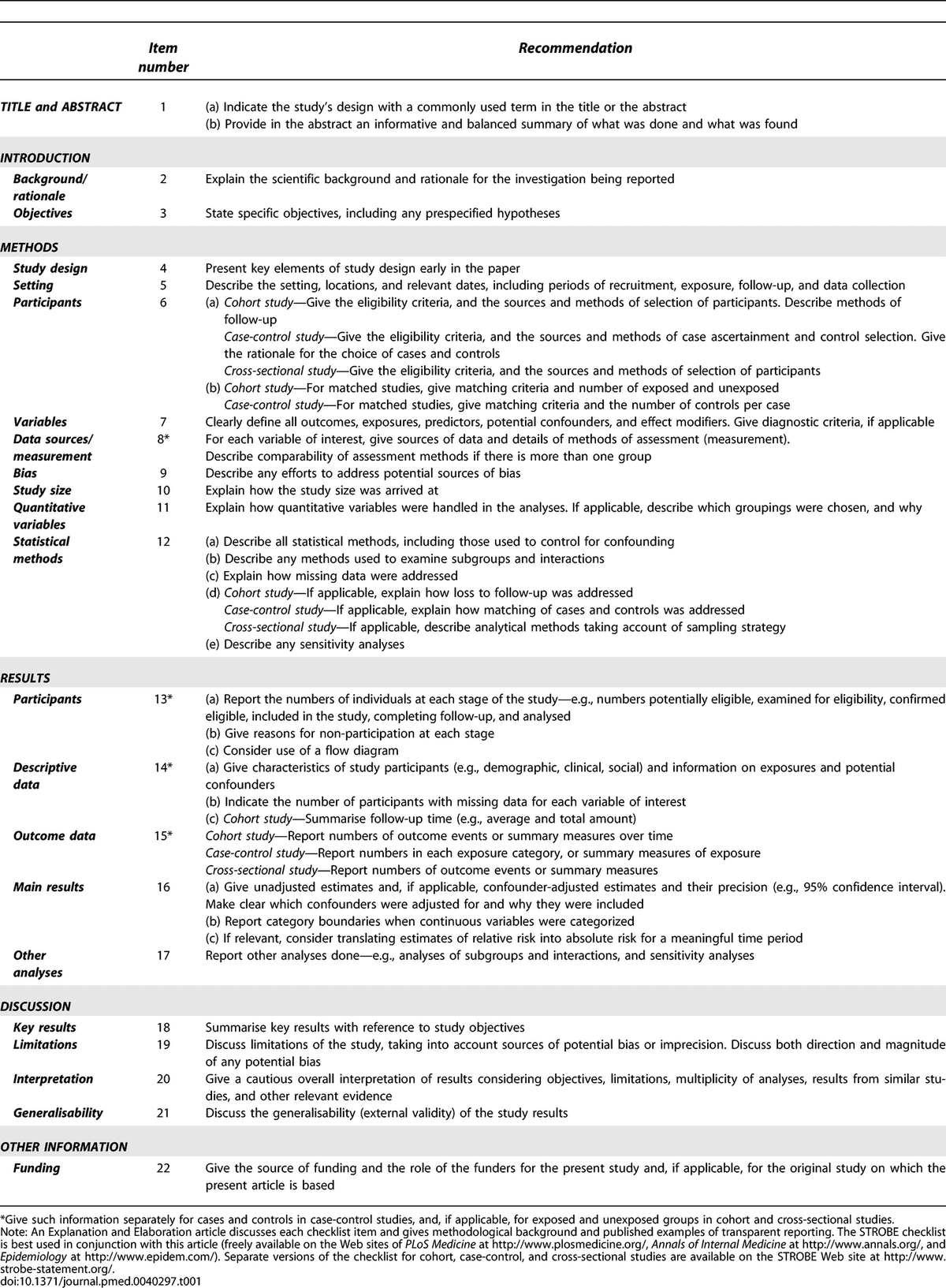
Table 1 by von Elm and colleagues, © 2007, from the STROBE Statement. The article grants Creative Commons Attribution reuse; see PLOS’s reuse terms. PNG palette re-encoding retained the table content and dimensions.
The source table separates methods, findings, and what the findings mean. Check each part in your draft. Keep where and how the study took place, who or what was included, the counts and estimates, and the limits on the claim. Cut repeated background before cutting facts that let readers judge the result.
Read the draft beside the study text. Flag any wording that now claims a cause when the study only found a link. Check for lost dates and missing groups in comparisons. Ask the team member who did the analysis to resolve those points before you polish the prose.
Check the outline against sources in Atlas
Atlas can help compare your study text with the journal's rules. Add the finished draft, its relevant results text, and the rules if you have permission to upload them. Keep restricted data in the systems your project allows.
Open the Atlas project and start a chat. Use @ to name the draft and rules you want it to read. Choose Project only to keep new search within the project and supplied text. For the fictional audit, ask:
From the named study draft and journal rules, make an outline for a research letter. Show the passage behind each claim. Keep the total number of papers, the link-check date, and the rule for a working link. Flag claims the draft does not support.
- Open the numbered citation beside each claim and read the text around it. If the answer says the data are ready to reuse, check the method and correct that claim.
- If a passage does not open, find the source by name and read it there. A citation is useful only when the text backs the claim.
- Create a note through New and Note. Keep the checked outline, source references, and open questions there. Wait for Saved before closing it.
Each study claim must match the final draft or checked output, and each format rule must match the journal's current page. The study team must still do any missing analysis.
Revise the letter before submission
Draft from the checked outline, then review the content and format in two passes. Read just the question, main finding, and final claim first. They should concern the same study and level of certainty. Then check the methods, tables, and figures against the results. Look for lost exclusions, units, dates, and group labels.
Trim repeated background and side issues first. Each figure or table should explain the main result or a key method. Keep what readers need to judge the claim in the paper. Follow the journal's rules for extra files when deciding where other details can go.
Finally, count the parts the journal includes in its limit. Check author names, funding, conflicts, ethics statements, and any required account of AI use. Resolve the team's open questions before you submit. For a conference, follow the conference abstract call and its own fields and limits.
Build your research letter evidence outline
Check study claims against your sources and the journal's rules.