
A conference abstract describes the work you plan to present and what the audience can learn from it. A useful draft makes the question, approach, finding or argument, and its value easy to follow.
Start with the current call for submissions. There is no universal word count, set of headings, or rule for unfinished projects. Build an outline that fits your chosen track and keeps supported claims distinct from work you still plan to do.
This guide uses a fictional project to show the process. Adapt the outline to your own sources, then check the final text with your coauthors and the conference rules.

Check the evidence behind your abstract
Compare your project evidence with the conference instructions.
Read the current call first
Save the call for the exact year and track. Papers, posters, workshops, and teaching sessions may ask for different things at the same event. UC San Diego's preparation guide also advises checking the event's own rules before writing. Record the URL and date checked so an older sample cannot quietly become your submission rule.
Note the limit and what it counts, required headings, title rules, whether review is anonymous, and which project stages qualify. Check extra fields for references or learning goals, and which format preferences you may request. Keep author details outside the abstract text unless the call says to include them.
Two dated examples show why the count matters. AGU26's rules allow 2,000 characters for the abstract, excluding spaces but including punctuation, plus a separate title limit. ASHEcon's 2026 call allows 500 words without a fixed paragraph layout. These closed calls illustrate different rules; they are not open invitations to submit.
For a teaching session, check whether the call asks for learning goals and teaching methods. Kathy Van Dusen's AACN advice covers those elements when requested. If a rule is unclear, ask the organizers about that exact point while drafting the parts your sources support.
Build the abstract outline
Draft a working outline before fitting the text to the portal. Its labels help you edit; they do not have to appear in the final abstract. Start with a question narrow enough for the planned talk or poster to address.
If the call requires labeled sections, the structured abstract guide explains how to map claims to headings. Its journal examples illustrate the format; your conference's year, track, and submission rules determine which headings to use.
Describe how you studied it. For an empirical project, name the setting, people or material, and method. For an interpretive paper, name the texts or objects and the argument you build from them. Neither case needs every detail from the full paper, but readers should see where the claim comes from.
State the finding or argument your sources support. ASHEcon's experienced reviewers discuss a clear question, framing, data and methods, available results, and implications in their applied research context.
A draft that gives only background leaves reviewers guessing what you will add.
Finish with what this audience can learn and the claim's limits. A result from one setting should not become a claim about everyone. Choose an accurate title once the outline is stable and check that you can deliver what it promises.
Choose what earns the space
Give each sentence a job: name the question, explain the method, state a supported claim, or show why it matters. Where two sentences do the same job, keep the more specific one or combine them. Cut background the audience already knows before cutting details needed to judge the finding.
Keep the group, setting, or comparison that gives a claim its meaning. If removing a qualifier makes the result sound broader or more certain, revise the claim instead. The aim is a shorter account of the same work, not a stronger claim than the work supports.
Worked conference abstract outline
Imagine a fictional qualitative study of how university transfer students find advising help. Interviews and an initial review of themes are complete, but a planned comparison with administrative records has not started.
The fictional call accepts qualitative work and asks for a short abstract without headings. No actual conference or student data are represented here.
The team keeps the methods memo, theme memo, project plan, and call together. This outline shows which source backs each part and what stage the work has reached.
| Component | Working content | Source and status |
|---|---|---|
| Question | How do transfer students describe barriers to finding advising help? | Project plan; established question |
| Approach | Interviews explored advising experiences; the team grouped accounts into themes. | Methods memo; work already done |
| Finding | The first review found uncertainty about which office handled each question. | Theme memo; early interpretation |
| Contribution | The talk examines how students make sense of advising roles and where they get confused. | Theme memo; bounded to these accounts |
| Limit | The team has not compared records with interview accounts. | Project plan; planned work, not a result |
Table 1: Fictional working outline: the source column is a private author-review record, not a field every conference requires.
The abstract can focus on one contribution: how students make sense of advising roles. Keep the setting and early status where they affect the claim. The planned records comparison does not belong in a sentence about findings.
A compact fictional opening could read:
This study examines how transfer students find university advising help. Interviews explored how students chose an office for their questions. An initial review of themes found uncertainty about which office to contact in the accounts studied.
This passage shows how to connect the question to the work done. It is not a finished submission: the real abstract needs the actual method details, supported findings, contribution, and required fields.
Keep a source note behind the theme; source-checked qualitative coding can help organize the passages that support it.
If the records comparison is later completed, update the outline from its results. The plan alone does not justify a finding. New work might qualify the first interpretation, fail to support it, or point toward a different contribution.
Label unfinished work honestly
Check that your project stage qualifies before deciding how to describe it. A track that requires completed results may reject a plan for future work. Generic advice to submit early cannot change that rule.
Some disciplinary guidance allows work in progress. The ASCS guide discusses a project with a viable original argument, rather than a bare proposal.
This helps with humanities work that develops an interpretation, but does not establish eligibility for another event.
Keep work already done, early findings, and planned work distinct in your notes. Say that you conducted an interview only if it happened. Say that you plan a comparison if it has not happened. Keep an early theme labeled as such until further work and review support stronger wording.
Repair an unsupported claim
In the fictional study, this claim goes too far: “Unclear advising roles cause students to leave.” The interviews show doubt about who can help. They do not show that students left or that the doubt caused them to leave.
A narrower version would be: “Students described doubt about which office could help; the talk explores that doubt through their accounts.” This keeps the claim within what students said. It does not promise that the planned records check will back the claim or produce a favorable result.
Check words such as improves, proves, effective, and significant against the work behind them. If all you have is a guess or a future task, change or remove the claim. For a result with numbers, copy the measure, denominator, and limits from the checked analysis. Do not guess them to fill a gap while editing for length.
Check your outline in Atlas
Atlas can help compare supplied project documents with the call while you retain source review. Add permitted PDF or DOCX files, such as the call, methods memo, and findings summary. Check that each source has finished processing before using it.
The research-paper analysis workflow explains the broader task of checking claims against source text.
In chat, type @ and choose the sources. Ask for an outline that separates the submission rules from research claims. For example:
Using the selected call, methods memo, and findings summary, propose an abstract outline for this track. Cite the passage behind each rule and research claim. Keep work already done, early findings, and planned work distinct. Flag missing support and unclear eligibility; do not supply missing findings.
Open the citation for each rule and check the year, track, counted field, and surrounding conditions. Then open the citation for each research claim and check what the passage establishes. Choosing a source guides the task but does not make every proposed sentence correct.
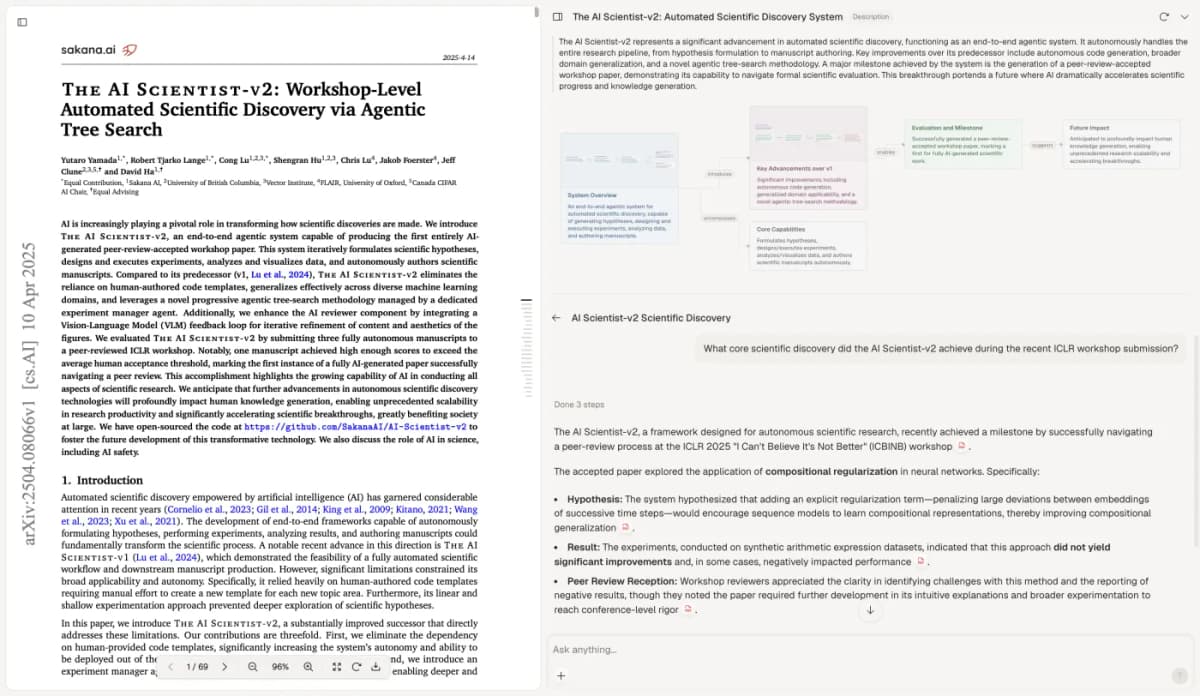
This unchanged Atlas screenshot shows The AI Scientist-v2, by Yutaro Yamada and colleagues, under CC BY 4.0. The paper is separate from the fictional advising study.
The screenshot shows the source PDF on the left and a cited answer on the right. Use that view to compare a claim with the passage behind it. It illustrates source inspection, not a conference-specific accuracy test or proof that an abstract meets the call.
Correct claims with partial support, planned work stated as a finding, or rules from the wrong year. Keep questions open where the sources do not settle them. Create a note through New → Note, save the checked outline and locations, and confirm Saved.
The guide to synthesizing research papers covers the same need to check source material before using a combined statement.
Review the submission copy
Format the checked outline as the call requests. Use its exact headings when required and check whether they count toward the limit. For an unstructured paragraph, remove the working labels while preserving the flow of ideas.
Count the final text by the event's rule. Put the title, author details, disclosures, references, learning goals, and attachments in the right fields. The dated ASHEcon 2026 instructions did not require bibliographic information within the abstract; do not transfer that policy to another event.
Paste the text into the portal and read the displayed copy. Check breaks, symbols, special characters, and lost formatting. Recheck the count after the last edit. Your local document and the text that reaches the reviewers must say the same thing.
Ask coauthors to approve the final text, names, affiliations, and stated project stage. Give a colleague both the abstract and the call so they can assess the promise and the rules. UC San Diego's abstract workshop offers annotated examples to help review how the parts fit, while the actual call remains authoritative.
Before submitting, ask whether you can deliver the promised contribution with the evidence available for the presentation. If it depends on unfinished work, revisit the call and wording. Retain the approved copy with its sources and resolved questions so the final promise can be traced to what the team checked.
Check the evidence behind your abstract
Compare your project evidence with the conference instructions.