
A structured abstract sums up a paper under named headings, such as Background, Methods, Results, and Conclusions. NLM defines the format as distinct, labeled sections that help readers grasp the work quickly.
Start with the journal's rules and your full paper. Match each abstract claim to an exact passage or table. Then draft under the right headings and within the word limit.
This guide gives you a worked evidence map and a made-up abstract. Use the steps to check a draft based on your own study.

Map abstract evidence in Atlas
Compare manuscript passages with required headings, then check each cited claim.
What makes an abstract structured?
The labels set a structured abstract apart from an unstructured one, which often runs as one paragraph. Both formats must give a fair account of the paper.
Labels help readers find facts. They do not prove that the study's methods or findings are sound. A Methods heading can hold too little detail to explain what was done.
There is no set of four headings that fits all papers. NLM notes that journals use different formats. Some split design, setting, and study groups into their own sections. One journal may use more than one format.
The field and type of paper matter too. IEEE's templates give research questions and a literature review their own space. Four standard clinical headings would leave out part of that format.
Confirm the required headings first
Open the rules for the exact journal and type of paper. Note the heading names and order, word limit, and extra statements needed for funding, data, or trial records. Check how the upload form counts headings and handles line breaks.
For a conference submission, use the conference abstract guide to build an outline from the current call and your project evidence. The call may request one paragraph or named fields that differ from a journal's structured abstract. Follow that venue's format and word limit.
The ICMJE guide for authors says to use the chosen journal's format. It also describes extra statements needed for some medical papers. Check the rules for this paper even if your last journal used a similar layout.
Keep a dated copy of the rules beside the draft you are using. Name the paper's version in your working notes so the next reader knows what you checked.
If version 4 changes the sample size or main finding, an abstract based on version 3 may be wrong. Check both again after the study team changes the paper.
Create the needed headings with space below each. Keep working notes outside the abstract, such as a page number or a figure you still need to check. Resolve each note before you copy the final text into the journal's form.
Do not set a word count for each heading too soon. Purdue OWL's guide treats the abstract as a short form of the paper. Keep the main finding clear and the background brief.
Build a manuscript evidence map
The paper in this example is made up. It uses a cross-sectional survey, which asks people about their status at one point in time. Graduate students at one campus were asked about library training and how often they checked source citations.
The draft has 200 submitted forms and 180 complete ones. Of those, 54 of 90 students with recent training and 36 of 90 without it said they checked a source citation each week.
The paper gives no confidence interval for the group difference. The numbers are made up to show how to check claims. They are not findings from a real study.
| Abstract heading | Manuscript locator | Candidate content | Author check |
|---|---|---|---|
| Background | Introduction, final paragraph | Whether recent library training is associated with weekly source checking | Keep the stated research question |
| Methods | Methods, sections 2.1–2.3 | Cross-sectional survey at one university using self-reported behavior | Do not describe random assignment |
| Methods | Results, participant flow paragraph | 180 complete responses from 200 submitted questionnaires | Distinguish complete responses from submissions |
| Results | Results, Table 2 | Weekly checking reported by 54/90 trained and 36/90 untrained respondents | Verify denominator, group labels, and timeframe |
| Conclusions | Discussion, first and limitations paragraphs | Training and weekly checking were associated in this sample | Preserve self-report and single-university limits |
Table 1: Each row gives a place to look and a claim to check. Finding a passage does not mean you have checked its meaning. Read the table labels and notes too.
If Table 2 defines recent training as within the past year, keep that rule in the abstract. Do not widen it to mean any training at any time.
Keep gaps in the map. Here, note that you did not find an estimate of uncertainty in the paper. Do not add a confidence interval, a claim of significance, or a new analysis as though the study team had already done it.
Ask the study team to check the gap. They may need to add a valid analysis or narrow the claim. The MLA writing guide stresses clear, accurate results. A need for exact figures is no reason to make them up.
Turn the map into an abstract
Here is a short teaching example based on the made-up paper above. Check the journal's rules before you draft a real abstract. Use these four headings only if the outlet asks for them.
Background
This study asked whether recent library training was linked to weekly source-citation checks among graduate students at one campus.
Methods
A cross-sectional survey asked students about training and source checks. The study used 180 complete responses from 200 submitted forms. Groups were based on whether students said they had library training within the past year.
Results
Weekly source-citation checks were reported by 54 of 90 students with recent training and 36 of 90 students without recent training.
Conclusions
Recent library training was linked to more weekly source checks in this sample. The cross-sectional design cannot show that training caused the difference. Results are based on students' own accounts at one campus and may not apply to other groups.
This sample makes no claim of statistical significance. The made-up paper has no analysis to support one. A real journal may need more results or estimates of uncertainty. Resolve those needs before you treat a short draft as complete.
Suppose an early draft says, "Library training caused students to check sources more often." The map shows why this claim is too strong. The study asked students about training and checks at one time. It did not assign students at random to receive training.
Use the bounded claim above because two things can be linked without proof that one caused the other. Other group differences could help explain the result.
When you cut words, preserve the limits, time period, group counts, and setting. Trim repeated background before you remove a caveat that changes what readers can infer from the result.
For help with the wider writing process, see AI for academic writing. If you need to combine several studies, see research synthesis guidance. This abstract should sum up what this paper adds.
Check content beyond the headings
A Methods label can hide a missing design. A Results label can contain only vague praise for the findings. Under each heading, ask what the reader learns about the question, study, finding, and meaning.
This source table from the 2008 CONSORT for Abstracts guide shows that point for randomized trials. The Methods rows cover who took part and what each group received. The Results rows cover group counts, effects, and harms.
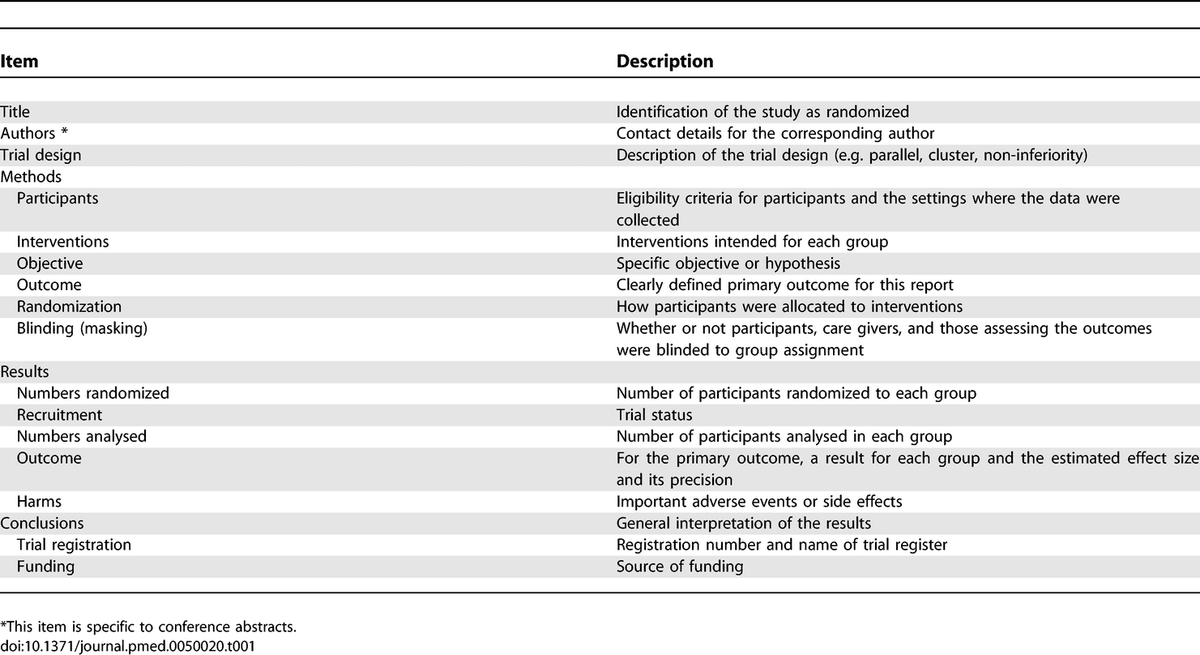
Hopewell and colleagues' PLOS Medicine Table 1 (2008) is reproduced unchanged under Creative Commons Attribution, with reuse permitted by PLOS's license policy. For submission, use current guidance for your study and journal rather than this older trial example.
One heading can hold several facts that readers need. The table also includes trial records and funding. It does not apply as a whole to the made-up survey. Choose the right guidance for your study before checking what belongs in its abstract.
Watch for claims that go beyond the group studied. A link found at one site cannot prove a cause for all groups. External validity explains how to judge where a finding may apply.
Review the evidence map in Atlas
Use Atlas to compare your paper and the journal's rules. You still decide what the study means. Select both sources so the answer can draw on the paper and its required format.
Add only files you have permission to upload. Wait until Atlas finishes processing them before you ask about their contents.
- Put the full paper and dated journal rules in one project. Add any allowed supplement needed to make sense of the results.
- Open chat and choose Ask a question. Type @ to select the paper and rules. Use Project only to bound new retrieval to the project. Earlier chat context remains available, so name the paper and rules you intend to compare.
- Ask for a heading evidence map before polished prose. Name the paper's version and ask to keep gaps and doubts in view.
- Open each numbered citation and read nearby text. Check that the source supports the claim. Exact page or passage links depend on the source.
- Fix the map, then choose New and Note. Check for Saved after editing before you close the note.
For this example, you could ask:
Compare the paper and journal rules I selected. For each abstract heading, list source passages, where to find them, claims to check, and open questions. Keep the study design and group counts clear. Mark facts you cannot find. Do not infer missing results or claims about cause.
If a Results row says the study used 200 complete forms, open its source citation. The paper says 200 forms were submitted but only 180 were complete. Fix the row before you use it in the abstract.
Save the checked map with open items still in view. You decide which claims have enough support to go into the final abstract.
Atlas can help find and compare text. It cannot create missing results, prove that the analysis is sound, or ensure that the journal's rules are met.
Verify the final submission version
Open the final paper and check each abstract number against its table or passage. Check group labels, units, time period, and which way the result went. If the paper changes, check the abstract again.
Check the headings, word limit, extra statements, and upload fields next. Keep the working map separate from the text sent to the journal. Page notes help you edit. They do not always belong in the abstract itself.
The ICMJE guide calls for this check between the abstract and full paper. Have the authors approve the final findings and claims after edits. Then submit the checked version under the journal's current rules.
Map abstract evidence in Atlas
Compare manuscript passages with required headings, then check each cited claim.