

A dissertation abstract is a short, standalone account of your completed study. It tells readers what you asked, what you did, what you found, and what those findings mean. Portsmouth's writing guide stresses factual work and actual findings.
Build it from checked chapters, then fit the text to your own rules. The fictional interview study below shows how to check each claim against a chapter passage. That check helps keep the abstract within what the work supports.

Check abstract claims in Atlas
Compare your finished chapters and abstract rules, then check each claim.
What a dissertation abstract must do
The abstract helps a reader decide whether the full work is relevant. It should make sense on its own, even when the reader cannot see your chapter headings, tables, or glossary. Define a term if the summary depends on it.
Keep the aim, methods, main findings, and final claim linked. A methods sentence explains how you answered the question. The closing claim should follow from the results you report. UNSW's thesis-writing guidance teaches this compact, standalone form.
An abstract for completed work differs from a plan for future work. If you have not obtained a result, leave it out of the final-results claim. An early draft can help you think, but it needs another check once the work is finished.
Write for a reader who knows the field but has not read your study. Explain the problem and answer. You do not need to retell each stage of your search. The CUHK writing chapter links the abstract to the aim, methods, results, and their meaning.
Check your institution's abstract rules
Use your current graduate-school handbook and course guide to check these rules:
- Length and layout: find the word limit and whether headings are allowed. Check any separate repository field too. Save the version of the rules you used.
- Local exclusions: Utah's handbook sets a 350-word limit and excludes subheadings, diagrams, and citations. Apply the rules for your institution rather than copying Utah's limit.
- Requirements versus suggestions: Cornell's official page explains which formatting advice is suggested. Find what is required for your degree and department.
- Permitted tool use: read the policy before sharing text with a service or using wording it suggests. Keep a record of use when the rules call for one.
- Conflicting instructions: ask the department or graduate school which rule controls. Resolve that issue before polishing the final layout.
A journal may require structured abstract headings. A meeting sets its own conference abstract rules. Check where you will submit the text before you reuse it.
The original UWA handout below is useful as a writing prompt. It asks about the topic, aim, methods, findings, and significance. Use those questions to think through content, then follow your own rules for the final format.
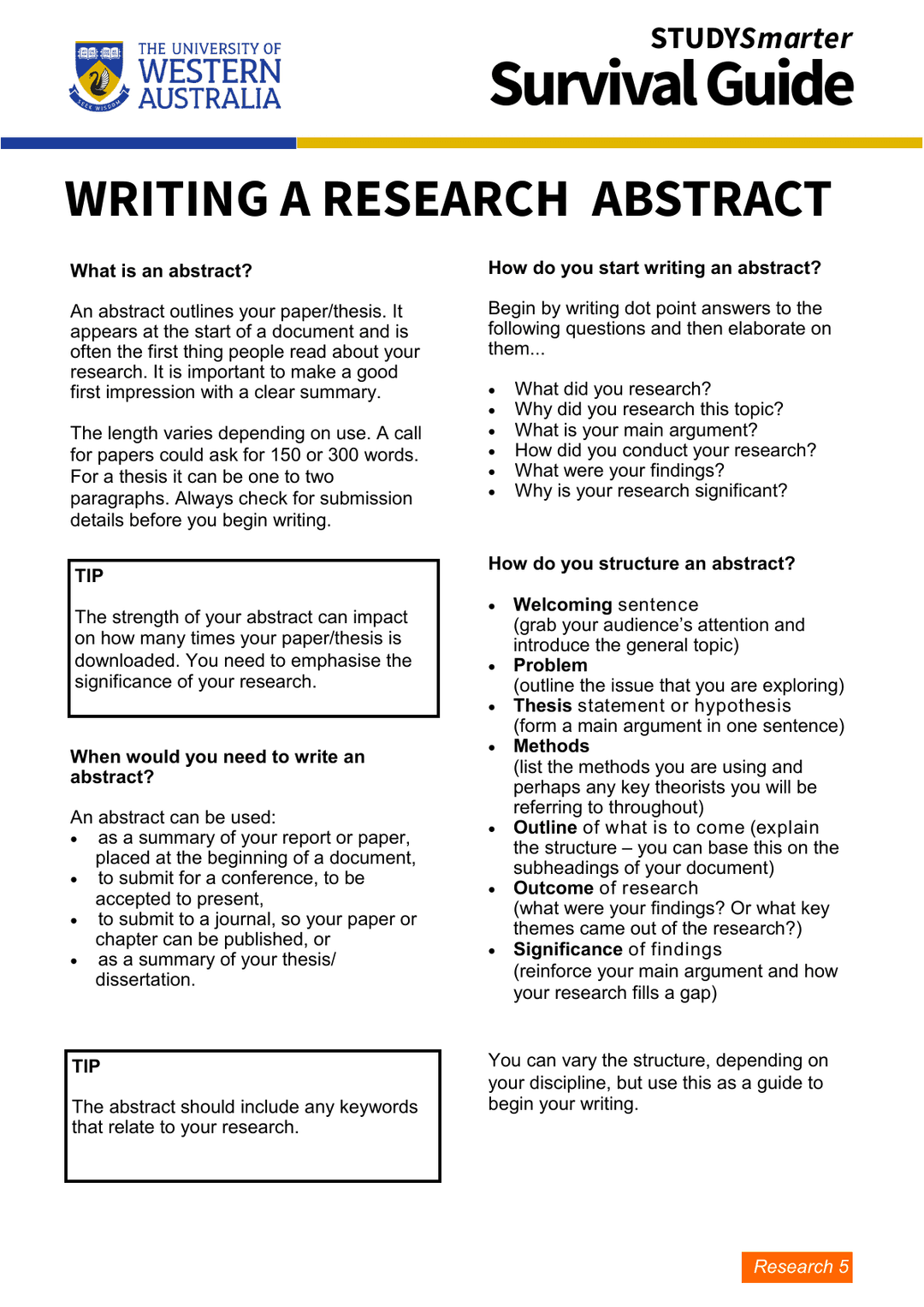
Page 1 of the University of Western Australia STUDYSmarter handout, Writing a Research Abstract, is reproduced here. The unchanged page keeps the STUDYSmarter heading and UWA logo, as requested by its reuse notice.
Map chapters to abstract claims
Start with a simple evidence map. For each claim you might include, note the chapter passage that supports it. This is a working checklist. It does not require you to give every chapter the same space in the abstract.
Suppose a fictional dissertation explores how commuter students use library study spaces. It uses 18 interviews at one campus and identifies barriers around opening hours and travel. The following map uses made-up chapter details for teaching.
| Abstract role | Chapter evidence to check | Fictional checked fact |
|---|---|---|
| Aim | Final question in the introduction | Understand how commuters fit library use around travel and classes |
| Design | Methods chapter and study scope | Interview study at one campus |
| Participants | Final sample description | 18 commuter students interviewed |
| Main finding | Results themes and supporting accounts | Opening hours and travel shaped reported access |
| Meaning | Discussion tied to those themes | Access plans need to consider students' daily travel constraints |
| Boundary | Limitations and conclusion | Accounts describe one campus and do not test an intervention |
Table 1: Check the final version of each chapter. Use the dissertation methodology guide to check the sample and steps against the final study records. The number invited may differ from the number interviewed. A theme may have been removed after later review. Update the abstract to match the checked work.
Use your research objectives to check that the stated aim matches the question the study answered. If the scope changed during the work, change the aim sentence. Do not keep a broader promise from the plan.
Keep page or section numbers in the working map. They make each claim easy to recheck after edits. CUHK's guidance suggests drawing key points from the whole thesis and keeping only those most relevant to the brief account. If a result has no clear source passage, stop and check the chapter. Mark the gap in your note. Do not invent a finding just to fill the abstract.
Use the dissertation conclusion guide to trace the final interpretation to findings and limits before condensing it into the abstract. The closing claim should match what the finished work supports.
A worked dissertation abstract example
Here is a short abstract for the fictional commuter study. The people, findings, and setting are all made up. It shows how the claims fit together. Check your own word limit before using this approach.
This dissertation explored how commuter students used library study spaces at one campus. It asked how travel and class times affected when they could visit. Eighteen students took part in interviews about their study routines. Their accounts were coded to find recurring barriers and choices. Students described a mismatch between opening hours, class gaps, and the times they could travel home. Some made shorter visits or studied elsewhere to avoid a longer journey. These accounts suggest that study-space planning needs to consider travel as well as opening hours. The findings concern reported experiences at one campus. The study did not test whether longer hours would improve grades or access for all students.
The opening names the problem and aim, then tells readers what was done. The findings show what the study learned. The ending keeps the claim within the evidence.
This example has no test of changed opening hours, so it cannot claim that a new policy worked. Keep that limit in the abstract because some readers will never open the full discussion.
Portsmouth's guide separates findings from conclusions. What students said is the finding. What it suggests for planning is your reading of those accounts.
The balance will differ for archival, theoretical, and quantitative work. Keep the main answer and how you reached it. Each study needs wording that fits its own methods and claims.
Check the chapter evidence in Atlas
Use Atlas to compare finished chapters with the abstract and current requirements when your institution permits the intended use. Upload only text you are allowed to share. Keep sensitive research data in the approved systems for your study.
- Add the finished chapters, the draft abstract, and the relevant requirements to one project. Wait for source processing to finish.
- Open chat and use Ask a question. Type @ to select the chapters and draft. Choose Project only to keep new retrieval inside the supplied project material.
- Ask for a claim-by-claim check. Request the supporting passage, a mismatch or missing-support flag, and the rule that applies to length or format.
- Select Send and open each numbered citation. Check the passage in context, including the count, study scope, and any nearby qualification.
- Correct the text yourself, then choose New and Note. Save the checked abstract and evidence map, and confirm Saved.
For the fictional study, you might ask:
Check each claim in my abstract against the selected finished chapters. Cite the aim, methods, participant count, main findings, and conclusion. Mark claims the chapters do not support. Keep reported barriers separate from any proposed policy benefit. Compare the format with the selected institution rules, and leave unresolved decisions for me to review.
If a citation points to the proposal rather than the finished methods, select the final source and ask again. Open the corrected citation before keeping the claim. A fluent answer still needs a source check.
Atlas helps with source reading and textual comparison. It does not invent missing results, perform your analysis, or certify that the text meets academic rules. The author decides what the work supports and what can be submitted.
Revise claims before cutting words
Fix the meaning before cutting words. In the fictional example, "The study improved library access for commuters" would claim a tested benefit. The interviews only show what students said about access.
Replace it with "Students reported barriers linked to opening hours and travel." That wording preserves what the study found. You can then explain the possible planning implication without saying a policy was tested.
Watch claims about cause in other designs too. A link between two measures does not prove that one changed the other. The guide to confounding variables explains one reason such claims need more evidence.
Cut background that the reader does not need to understand the question. Keep enough methods detail to make the finding clear, and give the main result space. A long literature-review chapter need not dominate a short abstract.
If you use a research-paper summary workflow to draft notes, check them against the finished dissertation. One paper may cover only part of the work.
Joining notes from separate papers may miss the main point of the thesis. Check how they fit together and answer the main question.
Read the draft aloud as one account. If it sounds like a list of chapter announcements, join the ideas around the research question. Prefer "The interviews identified..." to "Chapter Four discusses..." when the task is to report the finding.
Finish the submission check
Recheck the final aim, design, counts, main result, and conclusion after the last chapter revision. Every abstract claim should still have a clear basis in the version you will submit.
Then apply the local word limit and layout rules. Check whether the repository asks for its own abstract. Make sure both versions agree. Remove working page numbers from the text you submit when the rules require it. Keep them in your evidence map.
Ask the appropriate supervisor or reviewer to assess the final draft. Keep open questions visible until they are resolved. A checked abstract lets readers see what the dissertation did and what its evidence can support.
Check abstract claims in Atlas
Compare your finished chapters and abstract rules, then check each claim.