
Historiographical Essay: Compare Historians' Arguments
Write a historiographical essay by comparing historians' claims, source bases, and methods. Use a worked reading matrix to turn source notes into an argument.
- Byline

Summary
A historiographical essay is an argument about how historians have interpreted one historical question and why their accounts differ.
Compare each work's claim, sources, method, scope, and setting. Then build a thesis about the pattern or change in the scholarship.
The worked 1918 flu example shows how a national memory account, a wider memory collection, and a later European study ask different questions.
A historiographical essay makes an argument about how historians have written the history of a topic. Its main sources are the historians' works. You ask what each author claims, which evidence they use, and why their accounts differ.
Agnes Scott College's guide puts arguments, sources, and points of dispute at the center of this task.
For example, a paper about the memory of the 1918 flu could compare a book on US national memory, a later collection on memory in many places, and a study of European accounts. The job is to explain how the question and source base change across those works.
Keep a passage or page beside each claim. Atlas can compare selected texts and show cites to check, while you decide what the works mean together.

Atlas

Compare your history sources in Atlas
Check each historian's claim against a cited passage before you draft.
What a historiographical essay does
A history essay may ask, "What happened in 1918?" A historiographical essay asks, "How have historians explained or remembered 1918, and why do their accounts differ?" The past is still the subject, but historians' writing is the evidence you analyze.
West Chester University's writing guide describes this shift in the role of a source.
The finished essay needs a thesis about the scholarship. It could explain a dispute, a change in scale, or the effect of a new archive. The UW Oshkosh history guide warns that a retelling of events or a string of book summaries misses that job.
Your course may set a word count, a required set of works, or a citation style. Follow its rules. The steps here show how to turn readings into a claim that can be checked.
Choose a question and comparable works
Start with one historical issue. "The 1918 flu" is broad. "How have historians explained the pandemic's place in public memory?" gives you a shared question.
The works can still differ in date, place, and method. Those differences are often what the essay should explain. Agnes Scott's guide starts with historians' arguments about a shared topic.
Set the scope
Name the event or process, the question, and the places or years your paper will cover. You might compare US memory with European memory. You would then say why that change in scale matters. A claim about all memory of the pandemic would need a much wider reading list.
The assignment may give you the works. If you choose them, start with a course reading list, a field guide, or a scholarly essay's footnotes. Princeton's library guide points students toward existing historiographic essays and articles.
Check that each candidate work asks a question close enough to yours.
Check what you can read
Get the full work when possible. A publisher blurb can help you decide whether a book is relevant. It rarely tells you enough about the book's use of evidence or how its chapters handle rival views. Keep an access note beside each source. If you have only a catalog entry, mark every related judgment as provisional.
Read for argument and evidence
Read each work with the same short set of questions. Agnes Scott asks about the author's main claim, agreement with other authors, source use, and omissions.
Rutgers history faculty also ask readers to test how evidence supports an argument.
Identify the author's question
Write the question the historian seems to answer. Then write the central claim in plain words. Mark the page or passage that states it.
If an author studies public memory in one country and another studies private recollection across countries, they may differ because they ask different questions. That is more useful than saying only that their views "disagree."
Inspect the source base
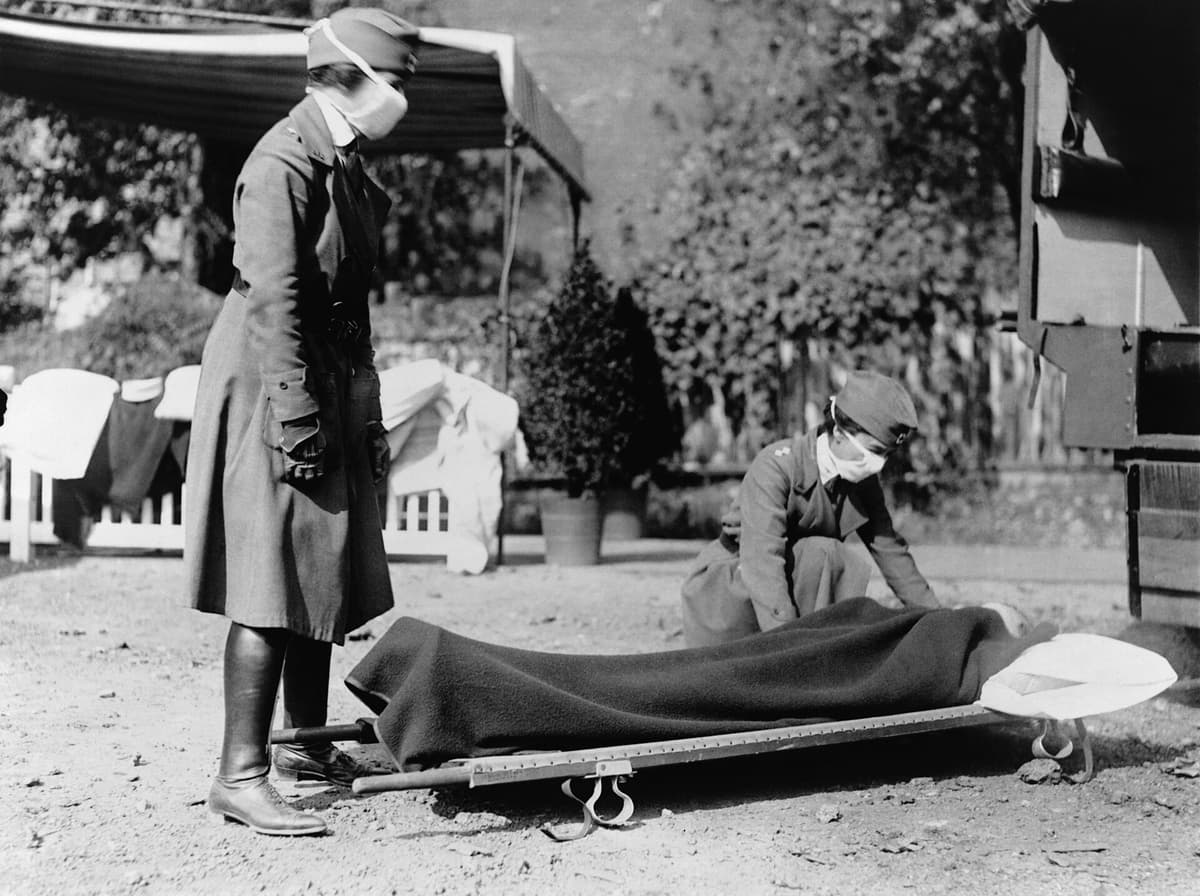
List the kinds of evidence used: archives, letters, oral histories, newspapers, census data, or prior scholarship. Ask what each source can show and what it may miss. A photo from 1918, for instance, is evidence of a recorded scene and of choices by its maker. It cannot on its own show how later historians explain a century of memory.
The Library of Congress photo below shows a Red Cross ambulance scene in Washington, DC, in 1918. It gives a concrete primary source to ask questions of: who made it, what was staged or selected, and what is outside the frame?
Our worked matrix later compares historians' writings instead. Keep those two levels of source distinct.
Note method and context
Ask whether the author writes social, cultural, political, medical, or other history. Note the publication date and debates the author addresses.
Those labels should come from the work, not from a guess about the writer. Rutgers' guide asks readers to assess a historian's approach and evidence.
A worked historiography matrix
Here is a limited teaching comparison on how the 1918 flu has been remembered. It draws on the full text of John P. R. Eicher's article and publisher descriptions of Alfred W. Crosby's book and Guy Beiner's edited volume. Treat the matrix as a reading plan, with a final column naming the full-text reading still needed; we have not read every chapter of the two books.
| Work and date | Question and visible claim | Visible source or method basis | What to verify in the full work |
|---|---|---|---|
| Crosby, America's Forgotten Pandemic, 2nd ed. 2003 | How did the flu affect the US, and why did it fade from national memory? The publisher describes a largely forgotten event. | Publisher description names a US social history and a memory question. It does not lay out the full source base. | Read chapters and notes before judging his archive, reasons for forgetting, or full scope. |
| Beiner, ed., Pandemic Re-Awakenings, 2021 | How did people remember, forget, and rediscover the flu in varied settings? The publisher says memories persisted unevenly. | A collection of 23 scholars across personal, communal, medical, and cultural history. Claims differ by chapter. | Read the editor's introduction and selected chapters. Attribute each claim to its author. |
| Eicher, "A Provincial Pandemic," online 2025 | Why was the flu hard to grasp as a shared European event in 1918? Eicher calls for a wider frame. | Open full text uses nearly 1,000 recollections from ten European countries plus archives in France, Germany, and Switzerland. | Check how each type of source bears on the European claim and where the cases leave gaps. |
Table 1: This matrix yields a question worth writing about: how does moving from national loss of memory to varied local recollection change what counts as being "forgotten"? The Crosby publisher page and Beiner volume abstract support the broad contrast.
Eicher's open paper supplies more detail on sources and argument.
The three works do not prove that all flu history moved in one straight line. They also differ in form: a single-author book, an edited set of chapters, and one article.
A sound essay would read the full works, choose specific passages, and test other scholarship before stating a field-wide trend. A recent review of flu history shows how many themes and methods such a larger map would need to consider.
Turn the comparison into a thesis
A weak thesis says, "The 1918 flu was forgotten, then historians remembered it." That is a claim about the event's later reception. It gives little account of how the historians worked. It also treats forgotten as a yes-or-no fact, though the selected works use different scales and forms of evidence.
A better provisional thesis would say that the selected works shift from a US account of lost national memory toward varied local and cross-border memory. That shift changes which sources can challenge the word forgotten.
The Beiner volume's scope and Eicher's source base make this a plausible line of inquiry. It needs full-text checks of Crosby and the Beiner chapters before it becomes a final essay claim.
Make the reason visible
The thesis should tell readers why the accounts differ. Look for a change in question, place, period, source base, or method. Test each proposed reason against passages from the works. Agnes Scott's guide asks writers to weigh the sources that each historian uses, not only their conclusions.
Keep the claim within your sample
Say "in these three works" when that is what you studied. Avoid naming a whole school from one author's blurb. If a fourth work cuts across the pattern, revise the thesis. Rutgers' guide treats a thesis as a claim that changes as the writer checks the evidence.
Structure the essay by debate
Organize each main section around a point the historians address together. A date order can work if it explains a change in questions or evidence. UW Oshkosh's guide asks writers to explain what differences between historians mean.
Open with the question and thesis
In the introduction, define the historical issue, the works you selected, and the claim you will make about their debate. Give only enough event context for a reader to follow the scholarly question. State any limit, such as a US-and-Europe sample rather than all global histories of the flu.
Put historians in the same paragraph
One body paragraph could ask what forgotten means at different scales. It might contrast Crosby's national question with the Beiner collection's local and global scope. The next could use a checked passage from Eicher to ask how cross-border sources alter that frame. Each paragraph needs a point, evidence from the works, and your reasoned link between them. UW Oshkosh stresses the meaning of similarities and differences.
End with what the comparison changes
The conclusion can name what the selected debate reveals and what it leaves open. It should not announce a winner on taste alone. If source access limited your analysis, say what the full readings could change. The Rutgers writing guide links claims to evidence that readers can check.
Next step: check source claims in Atlas
If you have the texts you chose, add them to one Atlas project. Mention the intended works in chat. Ask: "For each work, list its question, main claim, stated source base, and a cited passage. Keep the authors separate. Mark any point the text does not establish."
This follows the same source-check habit as a research synthesis matrix.
Open every cite and read its context. If Atlas merges claims from two works, ask for each work's part and correct the row. Save your checked matrix in a note. Atlas can help compare selected sources and cite passages. It cannot decide which archive is enough, place a book in a school by itself, or judge the final history thesis. For broader prose synthesis choices, see narrative synthesis.
Check scope and common mistakes
An essay can fail while every individual book summary is accurate. If the paper gives one section to each author and never brings them together, revise around shared questions. The Agnes Scott guide asks you to explain agreement and disagreement and weigh source choices.
Do not let an event timeline replace the debate. When you use a historical photo or document, explain how a historian used that kind of source. A primary source does not, by itself, prove a claim about later scholarship. The UW Oshkosh guide keeps the essay's focus on historians' approaches.
Finally, check whether the assignment asks for a literature review, an annotated bibliography, or historiography. They share careful reading, but the finished forms have different jobs. The guide to literature reviews and annotated bibliographies explains the source-entry versus synthesis choice. Follow your course's terms and citation rules.
Atlas
Compare your history sources in Atlas
Check each historian's claim against a cited passage before you draft.
Frequently Asked Questions
It is an argument about how historians have interpreted a defined historical question. It compares their claims, evidence, methods, contexts, and points of disagreement rather than retelling events.