
Literature Review vs Annotated Bibliography: A Worked Example
Literature review vs annotated bibliography: compare purpose and structure, then see the same sources turn from annotations into a checked synthesis paragraph.
- Byline

Summary
An annotated bibliography gives each source its own entry. A literature review links sources to answer a question.
Check the task verbs. Choose source entries for an annotate prompt and review prose for a synthesize prompt.
You can use old source notes in a review. Group their facts by theme, then check each claim against the source.
An annotated bibliography follows the sources: a citation, then a note about that source, then the next citation. A literature review follows a question. It brings several sources into the same discussion to explain what they show together, where they differ, and what remains uncertain.
Utah's writing center says a note can sum up a source or weigh its use. Purdue OWL asks writers to show how sources speak to each other.
If your assignment asks for an annotated bibliography first and a review later, the notes are useful preparation. The move between them is to change the organizing unit from one source to one claim about several sources. Atlas can compare papers already in your project and show citations to inspect, but you still decide what the sources support.

Atlas

Compare your annotated sources in Atlas
Compare selected papers and check cited passages before drafting synthesis.
The difference in one decision
Ask what the reader should learn from the finished work. If they should be able to inspect what each source argues and why you might use it, an annotated bibliography is a good fit. If they should understand a field's conversation around a question, write a literature review.
An annotation can do more than summarize. Utah's guide distinguishes descriptive entries from analytical ones that examine strengths, weaknesses, and relevance. That evaluation is useful work.
It remains a source entry until you use the evidence to explain a relationship among sources. A review still needs accurate descriptions of each study's methods and limits.
Your instructor's rubric decides the submission format. Citation style, annotation length, number of sources, and whether the review stands alone vary by course and discipline.
Compare purpose and structure
The table shows where a reader would look for each kind of claim. Your assignment may set a different layout, so treat the rows as a way to check the work's purpose.
| Decision point | Annotated bibliography | Literature review |
|---|---|---|
| Main purpose | Describe or evaluate each chosen source and its possible use. | Explain what sources together say about a question. |
| Organizing unit | One citation followed by its annotation. | A claim, theme, method, period, or debate supported by relevant sources. |
| Typical structure | A sequence of source entries, often ordered by author or another assigned rule. | Connected paragraphs and sections that develop an account of the literature. |
| Evidence use | Capture a source's argument, method, strengths, limits, and relevance. | Compare those details across sources before making a larger claim. |
| Citations | The full citation anchors each annotation. | Citations appear beside claims in prose, with a reference list under the required style. |
Table 1: The Utah annotated bibliography guide grounds the left column. Utah's literature review guide says review paragraphs should connect sources by a shared theme. The subject of a review paragraph is the point those sources help make.
Purdue adds other ways to group the sources. A question about change over time may need a time order; a question about study design may need a method-based order.
Neither format is automatically more scholarly. A detailed annotation may reveal a source's weakness that a vague review would miss. A well-written review shows how that weakness affects a cross-source conclusion.
From entries to claims
The source remains the unit of an annotation. The claim becomes the unit of a review paragraph. Utah's review guide makes this shift clear when it asks writers to link sources by theme.
Criteria for choosing the format
Choose by the work the reader must be able to inspect. If they need a record of each source's argument, method, limits, and possible use, write entries. If they need an account of agreement, disagreement, or a gap around a question, write connected review prose.
Also check the rubric's required sequence. A course may ask for annotations as a research stage and a review as the later submission. Purdue's guide suggests keeping such notes while you research. Regroup their evidence before writing the review. The literature review process guide covers the broader sequence.
Which format does the assignment require?
Read the verbs in the prompt before you start formatting. Choose an annotated bibliography when it asks you to annotate, describe, or evaluate each source and explain its relevance. Choose a literature review when it asks you to synthesize findings, compare studies, trace a debate, or identify a gap.
A prompt that uses both sets of verbs may ask for two pieces of work. Utah's bibliography guide shows why a source note can include critique, which can feed a later review.
When the prompt asks for source notes
For example, “find six studies and explain the method, strength, limitation, and relevance of each” asks for a source-level artifact. “Explain how six studies disagree about the relationship between sleep and learning” asks for an account grouped by the disagreement.
The number and topic are illustrative; the difference lies in what the reader must learn.
When the prompt uses both terms
If the rubric says “review of the literature” but asks for one block of text per source, follow its rules. Ask the instructor where to discuss links among sources. You may need a short synthesis after the entries or a later paper. The title alone does not turn source entries into a review.
A review also has a list of works cited at the end. That list names the works. In a bibliography with notes, each entry adds a short account of the source. Use the style your course asks for.
The same sources in both formats
Here is a small example using three real university writing guides as the source set. It shows how the same material changes form. These pages give writing advice. They do not test student outcomes or teaching methods.
Three source-level notes
Suppose the working question is: How do university writing guides explain the move from source notes to a literature review? The source-level version might begin with these abbreviated annotations:
- University of Utah, “Annotated Bibliography”. This guide sets out two kinds of entry: one that tells what a source says and one that weighs its use. It asks the writer to note the source's aim, strengths, weak points, and use in the project. It does not give a sample review paragraph.
- University of Utah, “Literature Reviews”. This guide asks writers to group sources by theme and link them in prose. It warns against giving each author a whole paragraph. It helps show when a list of notes has become a review.
- Purdue OWL, “Writing a Literature Review”. Purdue says sources should speak to each other. A review may group them by time, theme, method, or theory. Purdue also suggests making a source list with notes while you research; those notes can help with the later review.
Each entry has a citation and a judgment about one guide. To start a review, pull comparable claims out of the entries. Keep the page link beside every note so you can reopen the passage before drafting.
Kennesaw State's guide also describes synthesis as drawing connections between sources.
A theme-by-source check
| Question for the draft | Utah bibliography guide | Utah review guide | Purdue review guide |
|---|---|---|---|
| What does a source-level note retain? | Purpose, strengths, weaknesses, and planned use of one source. | Source summaries remain useful but should be connected by theme. | Annotations can collect material during research. |
| What changes in the review? | The guide does not prescribe a review paragraph. | Paragraphs connect several sources around an idea. | Sources enter a conversation organized by a chosen lens. |
| What should be checked? | Whether an entry accurately describes the source. | Whether a claimed agreement or difference fits the source passages. | Whether the chosen organization serves the review question. |
Table 2: This small matrix compares the three guides' stated advice. Empty or limited cells mark where a guide gives no answer to that question.
One review paragraph from the same notes
A review paragraph from those notes could read:
These writing guides treat source notes as a start. Utah's bibliography guide asks writers to weigh each source's aim, strengths, and use. Purdue says the notes can help with a later review. The task then shifts. Utah's review guide asks writers to link sources by theme, while Purdue offers other ways to group them. Both treat the notes as a base for prose that shows how sources relate.
The paragraph claims agreement only on what the opened guides support. It does not claim that all universities teach one required method, or that the guides tested whether this approach improves writing.
If a source said something narrower than the paragraph suggests, the claim would need to be narrowed too.
Turn annotations into synthesis
Pull useful facts from each annotation and regroup them by your review question. Williams College's writing center treats annotations as part of review preparation. Purdue describes the later task as drawing links among sources.
Build a comparison before prose
- Write the review question in one sentence. A question about methods calls for different groupings than one about historical change or competing explanations.
- Extract four details from each note. Keep the source's relevant claim or finding, method or basis, limitation, and exact passage location. A guide page may have a section heading; an empirical paper may need a page or table number.
- Group by a shared issue. Put sources that address the same question in one row of a small working matrix. Record both support and disagreement. A source that does not address the issue should stay blank rather than be made to agree.
- Draft a claim about the relationship. Begin with the common idea, difference, or sequence, then cite each source at the point where it supports that part of the claim. Explain why a method or context could account for a difference when the evidence allows it.
- Open the cited passages again. Check that each passage supports the wording and its scope. Separate the source's statement from your inference. If a gap claim rests only on your three selected papers, say “these selected papers do not address...” rather than “no research exists.”
Joining six annotations with transition words preserves their source-by-source structure. Synthesis requires a new claim whose parts can be traced to more than one source.
If the sources genuinely do not connect, you may need a narrower question, another source, or separate sections rather than a forced agreement. The literature review mistakes guide shows more ways a source-by-source draft can stall.
For a complete review workflow—from question and search through final citation checks—use the literature review writing guide. This comparison stays with the earlier choice and the conversion step.
Check cross-source claims in Atlas
Atlas is useful once you already have the materials you want to compare. Put the selected papers or notes in one project. In a chat question, type @ and select the intended sources. Ask a bounded question: “Across these three sources, what do they each say about the role of source-level notes in a literature review?” Atlas can return a cited comparison; the source-comparison procedure gives a broader example.
The image shows a real Atlas paper view beside a cited answer. The paper is unrelated to the writing-guide example; the image shows where to inspect a passage.
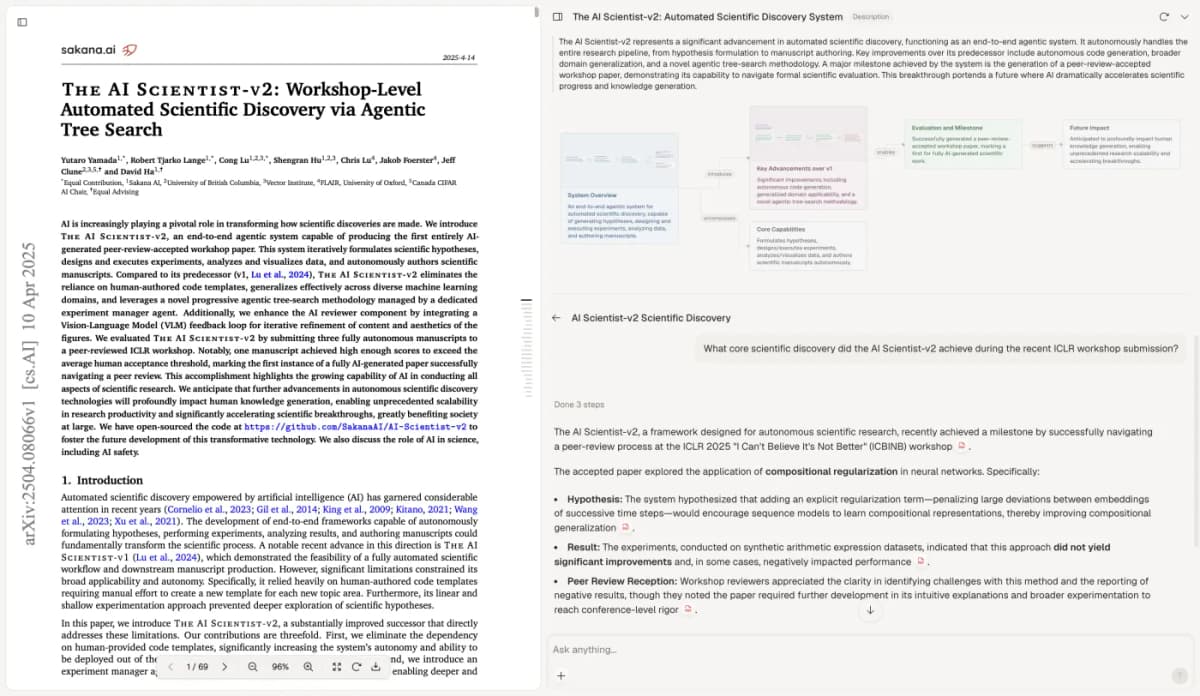
Open every citation that matters. Check that it points to the selected source and that the passage supports the claim. If an answer merges two sources into a claim you cannot trace, ask for each source's contribution. If the cited text does not support agreement, revise the claim before it becomes review prose.
Save the checked comparison and unresolved questions in a project note. Keep your own wording for the final interpretation and follow the required citation style. Use the Atlas citation to reopen the source passage. Then format the reference as your course requires. The public Atlas guides describe these actions but do not establish perfect retrieval or citation accuracy.
Check the finished artifact
Choose the annotated bibliography label if the finished artifact is still a set of source entries, even if each entry is thoughtful. Choose the literature review label if its main paragraphs bring sources together around an idea and explain agreement, disagreement, or a limit.
A good review can still pause to examine one pivotal study. The question is what organizes the piece as a whole.
History courses may ask for a historiographical essay. This form of synthesis examines how historians have argued over a defined question by comparing interpretations and source choices across works.
Before submission, compare your draft with the rubric. Check each cross-source sentence against the cited passages. Check that methods and limits remain visible and that the reference list follows the required style.
If both formats were assigned, keep the annotations as their own artifact. Let the review make a separate argument from the evidence they helped you collect. Purdue's guide describes the shift from notes to linked claims.
Atlas
Compare your annotated sources in Atlas
Compare selected papers and check cited passages before drafting synthesis.
Frequently Asked Questions
No. An annotated bibliography places a description or evaluation after each source citation. A literature review organizes prose around a question, theme, method, or debate and connects evidence across sources.