

Quote integration joins a source's exact words to your own writing so the reader can see who said them, what they mean and how they support your point. A citation identifies the source. Your context and analysis explain why its words belong in the argument.
Choose the passage first, check it in the original and draft a sentence around the words you need. Then explain the connection to your claim. The worked example below keeps a printed page locator beside those choices so you can review the whole paragraph.

Check your quote in its source context
Compare the passage with your claim before keeping it in the draft.
What quote integration needs to do
A useful quotation has a job in your argument. It might provide words you want to analyze, a precise distinction or a statement you plan to question. Nevada's quote-integration guide explains why exact wording can matter and why a quote needs an introduction and relevance.
Give the reader enough context to understand the source's point. Keep its words accurate, cite the source and explain your own use of them. The Illinois source guide connects source evidence to the writer's intent and argument.
Fit the pattern to your paragraph
The familiar introduction, quote and explanation pattern can help you plan. It does not require three fixed sentences every time. A brief quoted phrase may fit within a longer sentence, while a difficult passage may need more space for analysis.
UC Davis's quick guide permits several placements for your own words around a quotation. Choose the form that helps the reader follow the point. Keep your reasoning visible even when the quoted phrase is short.
Choose the words your argument needs
Ask why you need the source's exact words. If you plan to examine its tone or a key phrase, a direct quote can give the reader the language under review. If only the idea matters, a faithful paraphrase may be clearer.
The Arkansas guide lists language for analysis among the reasons to quote. The Illinois guide separates quotes, paraphrases and summaries by what the writer needs from the source. All three still need attribution.
Keep context beside the selected words
Use primary source analysis to check the passage in context. Record the speaker, work, edition and location. Note any condition that changes the meaning. A sentence about one setting may become misleading if you present it as a rule for all settings.
Keep those notes where you can reopen the original. Our research paper organizer guide helps with finding sources and working notes again. A neat quote collection is useful only if each fragment still leads back to its context.
Choose the shortest passage that preserves the meaning you need. Shortening a quote should help your reader see the key words. It should not remove a qualification that your argument would prefer to ignore.
Join the quotation to your sentence
Write the claim in your own words before deciding how to introduce the quote. Then read the combined sentence aloud. It needs to work as a complete sentence and make the change of speaker clear.
Illinois Valley's sentence guide explains three useful ways to join your words to a quotation. The examples here use a short phrase from Thoreau's Walden, checked on printed page 98 of the linked 1854 edition.
Introduce the speaker with a signal phrase
Thoreau states, "I wished to live deliberately" (98).
The phrase names the speaker and introduces his words. Choose a verb that fits what the source does. Writes is a neutral choice. Proves would add a claim about the force of the evidence that the passage may not support. The Arkansas signal-verb examples show how verbs can mark different source actions.
Use a complete sentence before a colon
Thoreau names an aim for his life in the woods: "I wished to live deliberately" (98).
The words before the colon form a complete sentence. That is why the colon fits. Illinois Valley's punctuation guidance distinguishes this form from a shorter introductory phrase that takes a comma.
Fit quoted words into your grammar
Thoreau explains that "I wished to live deliberately" (98).
Here that joins the quote to the sentence, so no comma separates it from the verb. You can also quote only the words your analysis needs. Avoid adding a comma simply because quotation marks begin. The UC Davis integration guide treats sentence structure as part of source use.
Check the chosen citation style
These examples use a short MLA-style author-page pattern. Purdue's MLA guide gives prose and verse their own length rules. MLA prose longer than four typed lines uses a block indented half an inch, without quotation marks.
APA uses a different threshold. Its block format starts at 40 words, as explained in Purdue's APA guide. APA direct quotes also use author, date and a page or other suitable locator. Check the actual style and assignment before formatting the passage.
Work through a quote-context-claim check
The source page below lets you inspect the quotation in place. The printed page number is 98. The paragraph explains Thoreau's purpose in going to the woods and places deliberate living beside attention to the facts of life and learning from them.
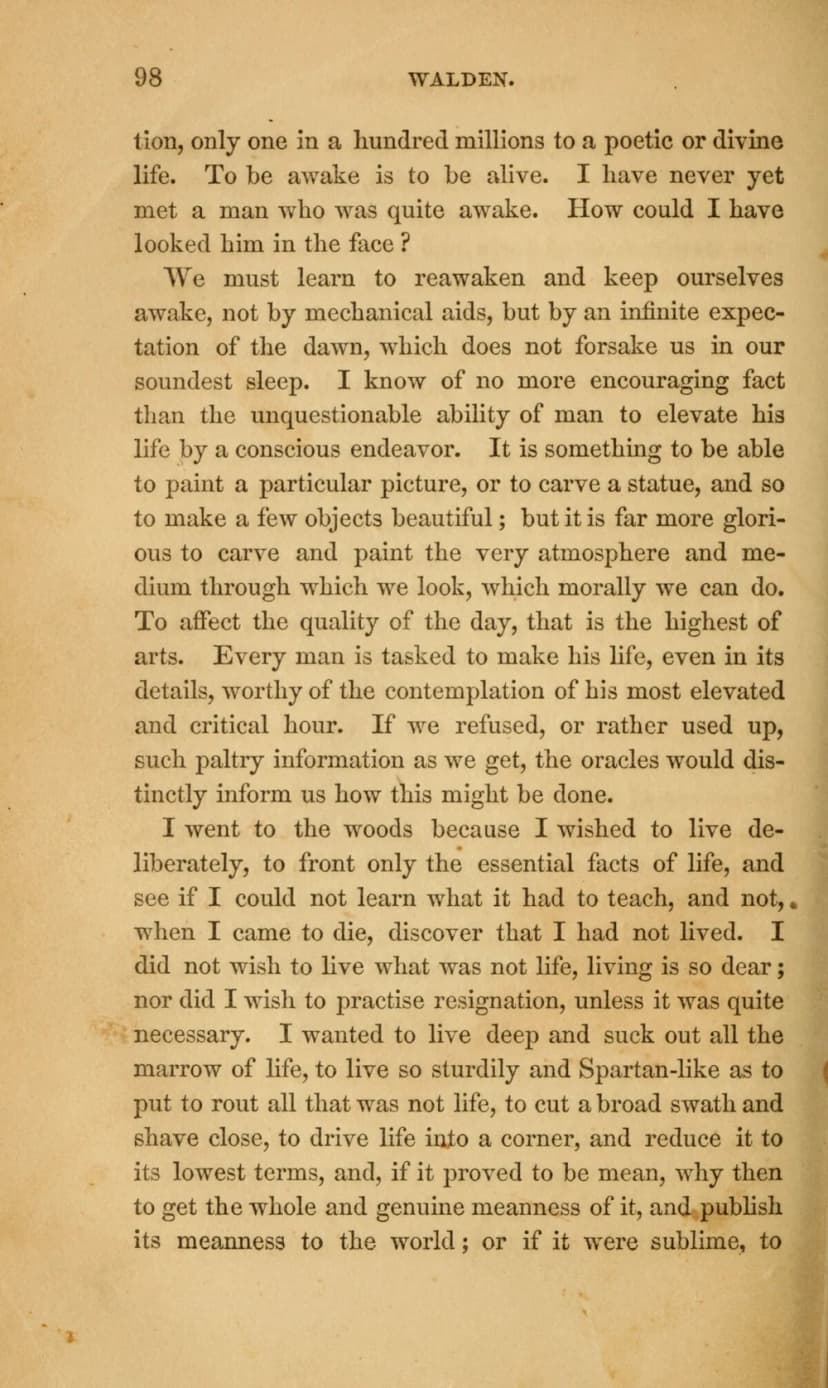
Page 98 of the 1854 Walden scan, contributed by Boston Public Library to Internet Archive. The original work is in the public domain.
Read the printed words rather than relying on the scan's OCR. The phrase in the sentence examples is visible within a longer account of the author's purpose. The printed page gives a reader a stable locator for this edition, while the viewer's image number is a different kind of location.
A modern edition may place the same passage on another page. Use the page in the edition you actually read.
Review the claim with its limit
| Check | Working note | Source locator | Decision |
|---|---|---|---|
| Exact words | I wished to live deliberately | Walden, 1854, p. 98 | Verify each word in the scan |
| Context | The author explains his purpose in going to the woods | Same paragraph | Retain the purpose and learning context |
| Claim | The passage presents deliberate living as a chosen aim | Same paragraph | Explain the key wording |
| Limit | The passage gives no measured outcome for modern readers | Same passage | Reject a universal success claim |
Table 1: This checklist links the quote to a purpose and a bounded reading. The Illinois source-integration method asks writers to clarify how evidence connects to the argument. Naming a source alone leaves that work unfinished.
Write the paragraph around the checked passage
Thoreau presents his move to the woods as a chosen way to examine life. His wish "to live deliberately" gives the move a stated purpose (98). In the same passage, he links that purpose with facing life's essential facts and learning what life can teach. Read together, these details support a view of the move as an attempt to learn through a way of living.
The paragraph explains words from the passage and connects them to its teaching claim. This is an original example of literary analysis. It is open to debate. This passage-level analysis can support a critical book review, but it does not assess the whole book.
Reject a claim the passage cannot establish
An early draft might say the quotation proves that moving to the woods makes everyone successful. The passage reports a purpose, without a test of modern readers' outcomes. The quote cannot establish that broader claim.
Narrow the paragraph to the author's stated aim or find evidence suited to the other claim. A smoother introduction would not repair the mismatch. Nevada's relevance guidance helps explain why integration includes the work after the quote as well as its lead-in.
Preserve meaning when editing a quote
If the original wording does not fit, try revising your sentence first. Quoting a shorter phrase may also solve the problem. Keep a copy of the full passage beside the edited version so you can see what changed.
Purdue's MLA guidance on additions and omissions explains brackets for added words and ellipses for omitted text. These marks disclose a change. They do not make a change faithful if it removes the source's central qualification.
Keep conditions and the original speaker
Suppose a source says a result applies only under one condition. Removing that condition can change the claim even when the remaining words are exact. Restore the needed context or choose a passage that supports your point without that edit.
Check whether your source quotes someone else. The Arkansas guide's indirect-quotation advice recommends finding the original when available. If you cannot consult it, follow the chosen style's rules for an indirect quote and make the source you actually read clear.
Compare the passage and draft in Atlas
Add the permitted original source and argument draft to one project. After the sources finish processing, start a chat. Type @ and select the source and draft so the question names the files you want compared.
Ask for a bounded review:
Compare the quoted passage with this draft paragraph. Check exact wording, source context and the claim the paragraph makes. Show a supporting passage for each check. Flag omitted qualifications and any claim that goes beyond the source. Keep the writer's interpretation separate from the source's words.
Open each citation and compare the answer with the original. Verify the quoted words yourself, including punctuation and any marked changes. Reopen the source by name if a citation does not give a useful page or passage location.
For the Walden example, reject a review that calls the passage proof of an outcome for all modern readers. Retain the author's stated purpose and your narrower interpretation. If you compare several sources, our research synthesis guide explains how to keep their contributions distinct.
Choose New, then Note, to save the corrected paragraph and its source locator. Wait for Saved before leaving. Atlas supports reading and working notes. You remain responsible for exact words, citation style and any permission the quoted material requires.
Review the paragraph before submission
Read the paragraph without the quote. You should still be able to identify your point. Then read it with the quote and check what the source adds. The analysis should explain that contribution instead of praising the quote or restating it.
Compare the quoted words with the original page one last time. Check the in-text citation and full reference against the style you are using. If you use software for a first pass, our AI citation checker guide explains why source verification still needs attention.
Keep the checked passage, edition and locator with your draft notes. If you change the claim later, revisit the context before reusing the same quote. Its exact words may be unchanged while the new use asks it to support something different.
Check your quote in its source context
Compare the passage with your claim before keeping it in the draft.