

A critical book review judges how well a book makes its case and what it adds to a field. You explain what the author wants to show, then use parts of the text to give reasons for your view.
Begin with the book and a few questions you can answer from it. If you call a work clear, weak, or useful, say why.
For each claim in your review, keep the part of the book that supports it and a note on how you reached that view.
The outline below reviews one line of thought in John Stuart Mill's On Liberty. It uses Chapter II, a limit stated in Chapter III, and a scholar's reading of the text.
This teaching example covers those parts of the book. A full book review would need a wider reading.

Check your critique against the book
Compare book passages and scholarly sources before choosing your judgment.
What a critical book review does
Your review needs two distinct claims: what the author argues and how well you think the case works. Hamilton's writing guide asks readers to judge the book's purpose, support, and success. State the author's view fairly before showing where you find it strong or weak.
Use the primary and secondary source guide to distinguish the book's own passages from later commentary before citing them.
An academic review goes beyond reporting what is in the book. It also differs from a star rating or a plot summary. A literature review brings a wider set of studies and texts together around a question. A book review keeps the chosen work at the center, even when other texts help you judge what it adds.
Critical does not mean hostile. A favorable judgment still needs reasons, while a mixed judgment can recognize a strong argument and a real limit. Carleton's guidance treats critique as a supported response and calls for a unified essay. Avoid arranging the review as answers to every question on a checklist.
Choose criteria that fit the book
Criteria are the grounds on which you judge the work. Choose ones that fit its purpose and genre. A history book may need close reading of records and rival accounts. A work of philosophy may rely on reasons, examples, and replies to objections. ANU's review guidance helps you judge each by the kind of support its task calls for.
Find the argument and its support
Read the chosen text before writing the verdict. Put the author's main claim in your own words, then find where the book builds on it. Note the kind of support used and the steps that link it to the final claim. ANU's guide asks readers to examine aims, key ideas, argument, evidence, and what the work adds to the field.
Ask what would make the argument succeed on its own terms. Does an example illustrate a point or establish a wider claim? Is an objection answered or left open? Explain why a missing point matters to the book's stated aim before treating it as a flaw.
If you need a routine for reading a chapter first, use the SQ3R reading strategy. Keep recalling the author's view separate from judging it.
Choose a useful comparison source
Use other scholarship to test a reading or place the book in a debate. Choose a source that deals with the same claim, period, or method. A recent date alone does not make it useful for judging an older book. Explain why you need the source. Agreement with its author is too little reason to cite it.
Check who wrote the source, why, and how it supports the claim you need. The CRAAP test can help you record whether a source fits that task. You still need to judge its reading of the book. Return to the text and compare the reasons. The UNSW review guide links judgment to clear criteria and related texts.
Worked book-claim-to-evidence critique outline
Mill's Chapter II argues that open discussion matters even when a disputed opinion seems false. Our outline assesses the reasons for that position and a nearby limit. The first column records the book's argument, while the last column gives our proposed reviewer judgment.
| Book claim or qualification | Source location | Comparison or check | Proposed assessment |
|---|---|---|---|
| A silenced opinion could be true. | Chapter II opening and reply to presumed certainty. | Read the objection about acting despite possible error. | The argument makes room for correction, but fallibility alone needs a further defense. |
| Competing views can each contain part of the truth. | Chapter II passage on conflicting doctrines sharing truth. | Check that this is a separate reason for discussion. | The case extends beyond a simple choice between wholly true and wholly false views. |
| Discussion helps people understand a true belief. | Chapter II treatment of learning both sides of an argument. | Brink's section 3.3 distinguishes true belief from reasoned understanding. | This gives a further reason to hear objections even when the belief is correct. |
| Expression can be restricted when it instigates harm. | Chapter III opening corn-dealer example. | Compare the same statement in print and before an excited crowd. | The defense has a stated limit, so a claim of unrestricted speech misreads it. |
Table 1: We wrote these paraphrases and possible judgments for this guide. The locations point to chapters in the linked text. Use page numbers from the edition you read. The outline covers one argument and a limit that affects it. For a whole-book task, you would need to read and judge the rest of the work.
Keep the author and reviewer separate
The book provides the passages, but you choose the final verdict. In Chapter II, Mill considers an objection: people must act on their best judgment even though they might be wrong.
He replies that this judgment needs to be open to challenge. Read both sides of this exchange before deciding how well he answers the objection.
David Brink's account of Mill supplies a useful comparison in section 3.3. It distinguishes seeking true beliefs from developing the ability to justify them. Brink also identifies limits in a defense based only on reaching truth.
This helps sharpen a review question: does Mill's case depend entirely on discussion producing correct beliefs, or does understanding the grounds of a belief provide another reason?
Read the qualification in context
The opening of Chapter III changes how far the review can take the speech claim. Mill contrasts a claim about corn dealers circulated in print with its delivery to an excited crowd outside a dealer's home.
He treats the circumstances and the role of expression in prompting a harmful act as relevant.
Our review can value the case for open discussion while asking how its limits work. A claim that the book rules out every speech restriction would miss that part of the text. This old example also cannot settle a current legal question. Keep the reading and its scope clear when bringing the book and scholarship together.
Turn the outline into a review
Use the outline to choose a reviewer thesis you can defend within the word limit. Calling the book interesting gives the reader little to judge.
A stronger thesis says what the work adds and why you think it succeeds. It might explain a useful distinction while naming a question about how it works in practice.
Build the structure around your judgment
Start with the author, title, date, and other details your assignment requires. Explain the book's purpose and main argument briefly, then state your judgment.
Build the body around the few issues that support it. Give each issue room for a passage, your reasons, and a useful comparison. Close with what your review shows the book adds.
The UNC teaching examples show how summary can leave readers without an assessment. UNSW suggests devoting roughly a quarter to a third of the review to summary. Follow your assignment or publication for the final balance.
Write a paragraph from checked passages
We wrote the following possible paragraph to teach a chapter-focused review. The wording is ours, and the paragraph has not been submitted as a student review.
Mill's defense of discussion is strongest when it explains what readers gain from hearing a challenge to a true belief. Chapter II gives discussion a role in understanding why a belief is held, as well as in correcting false ideas. This makes the argument broader than a simple promise that debate will always produce truth. Brink's distinction between seeking truth and developing reasoned understanding helps make that strength clear. Yet the opening of Chapter III shows that Mill's defense has limits: the same opinion can take on a different role when voiced to a crowd ready to act. The argument therefore offers a strong reason to preserve discussion while leaving the reader with a practical question about recognizing harmful instigation.
The paragraph links a judgment to the text and a comparison, keeping the limit in view. A full review would develop the reasons and use the required citation style.
You could defend a different view with the text.
One draft claim to reject is that Mill rules out all limits on speech. Chapter III shows why that reading fails.
A checked replacement says that his case for discussion includes a limit on speech that prompts harm. This changes the review's thesis. Adding a footnote while keeping the old claim would leave the error in place.
Check book passages in Atlas
Add the book or permitted chapter and relevant comparison scholarship to an Atlas project. Check that the files include the passages you need. Start a fresh chat, mention the specific sources, and use Project only when appropriate. Earlier messages can remain context in an existing chat. Keep the task narrow enough that you can inspect the answer yourself.
Ask for an outline that separates the author's claim, its supporting passage, a relevant objection or qualification, and a possible reviewer judgment. Request source locations and unresolved questions. For this example, name Chapter II, the opening of Chapter III, and Brink's sections 3.3 and 3.5. Do not ask for a whole-book verdict from a single supplied chapter.
Open each citation and read the surrounding passage. A citation opens the related source, with exact navigation where available. Find the passage manually when needed. Check whether the answer attributes a claim to Mill, to the edition's separate introduction, or to Brink. Correct the unrestricted-speech claim and mark missing support as unresolved.
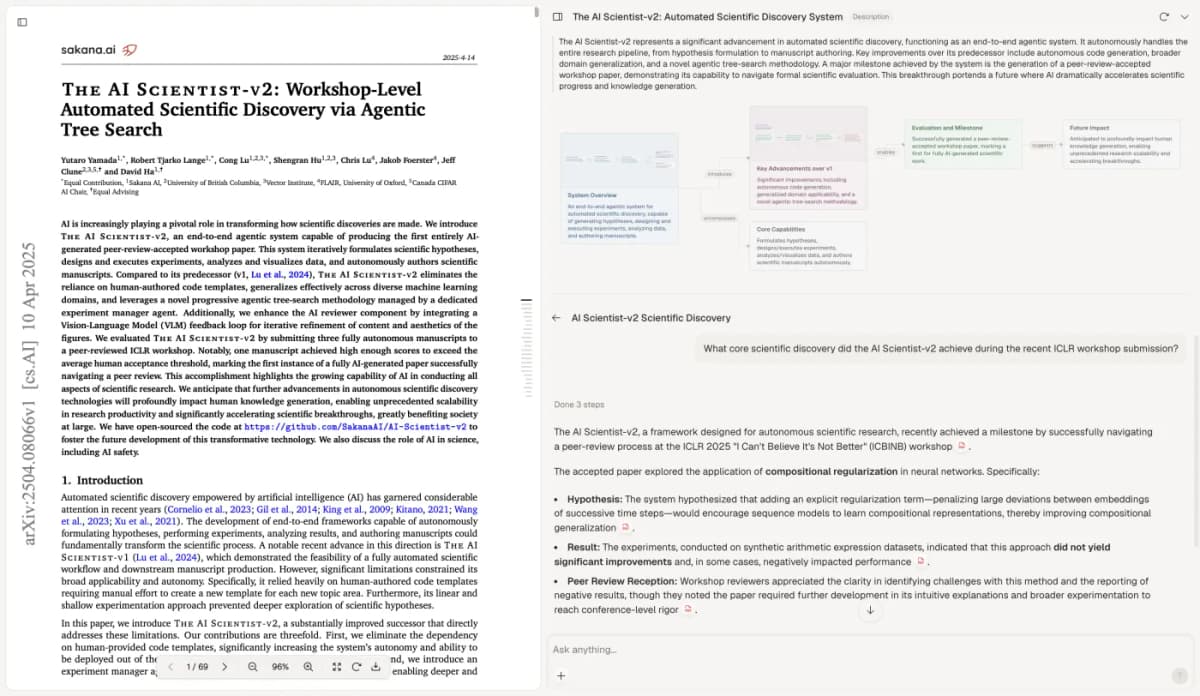
This Atlas capture illustrates source inspection with an unrelated paper. It shows neither a tested book review nor the Mill example and does not verify an assessment. The paper shown is The AI Scientist-v2, by Yutaro Yamada and colleagues, under CC BY 4.0. Part of its first page appears in this unmodified Atlas screenshot.
Choose New → Note, enter the corrected outline, and wait for Saved before closing. Keep the book claim, location, comparison source, your judgment, and open question together. Organizing research notes around checked claims helps you return to the passage when revising the review. Atlas supports this comparison work. You remain responsible for the assessment.
Review the evidence before submitting
Read the review against the book as well as your notes. Could the author recognize the argument you say they made? Does your own judgment follow from the passages and reasons you give?
A smooth paragraph cannot repair a mistaken reading.
- State whether the review covers the whole book or an assigned chapter.
- Verify the title, edition, publication details, and every quoted word.
- Use page numbers from the edition you read or the locator your citation style permits.
- Distinguish the author, an editor's introduction, comparison scholarship, and your own judgment.
- Explain why each strength or limitation matters to the book's purpose.
- Follow the assignment's length, structure, source, and citation requirements.
Claims about the book's originality need wider scholarship.
If you lack a chapter or cannot check a quote, narrow the claim or keep it open until you can read the source.
Check your critique against the book
Compare book passages and scholarly sources before choosing your judgment.