

Primary source analysis explains what a source can show about a historical question. Start with the source itself, then connect its details to its creator, audience, purpose, and setting. Your final claim should show why the evidence matters and where its reach ends.
A summary of a proclamation might say what it ordered. An analysis asks how its wording defines the order's reach and authority. The worked example below uses the Emancipation Proclamation to build a short note that keeps source text, historical context, and your own reasoning distinct.

Keep your historical claims linked to sources
Compare source text and context, inspect citations, and save a checked note.
Explain what the source can show
The National Archives document-analysis guidance moves from meeting and observing a source to making sense of it and using it as evidence. A letter, public notice, map, or speech may help with different questions.
Choose a question the source can help you explore. Then gather the details you will need to write about it. Use the primary versus secondary source distinction to establish the item's role for that question before interpreting what it can show.
Summary gives the reader the source's main content. Analysis connects a detail to a claim: why this phrase matters, how the intended reader affects the message, or what the source leaves unresolved. The Carleton history guide asks readers to assess what a source can and cannot help them answer.
You do not need to answer every prompt in a source worksheet. Select the details that matter to the task. Keep other observations in a working note so you can return to them if the argument changes. The point is to build a claim someone else can inspect, with the source and reasoning available.
Establish the source and its version
Record where the source came from
Provenance means where a source came from and how it reached you. Note who made it, its date, type, title, where it is held, and which version you used. Mark unknown details as unknown.
The National Archives written-document worksheet asks who wrote and received the document, when it was made, and where it came from. These details guide later questions about its message.
For the example, begin with the National Archives transcript dated January 1, 1863. Record it as a transcript, with a link to the archive page. The archive exhibit also shows scans of the signed pages.
You can read the words in both forms, but the scans let you inspect details that plain text may leave out.
Check what the version leaves out
A transcript helps with wording. It may leave out layout, handwriting, marks, paper, or other features. Do not infer those features from plain text.
The Calgary source-analysis handout also calls attention to copying, editing, and translation. A modern edition can preserve the historical text while adding choices you need to identify.
Keep versions distinct. The Library of Congress PDF identifies a lithographic copy of Lincoln's final draft. The first pages add context and notes from editors. Keep those notes distinct from Lincoln's words. This draft copy is a different object from the signed record held by the National Archives.
Read the whole source and context
Read the whole text before choosing a phrase. Check the sentences around a passage and any conditions that limit it. A striking line can become misleading when detached from the rest. The Library of Congress printed-text guide asks you to use details, possible explanations, and questions to guide the next check.
As you learn more, go back to what you first noticed. A detail that seemed minor may now bear on your claim.
Then read suitable historical scholarship. In this example, John Hope Franklin's essay gives a historian's account of how the order took shape, its limits, and why it mattered.
Keep the essay's author and date in the note. It helps you ask better questions about the source. It is a later account of events, distinct from the 1863 text you are reading.
Work from wording to a claim
The question for this teaching example is: How does the proclamation present the authority and scope of its emancipation order? Keep that close-reading task in view. We are asking how the text frames an order. We are not asking it to tell a full history of freedom or to show how each person felt and acted when they heard the news.
Locate the passages that matter
In the National Archives transcript, the paragraph beginning “Now, therefore” names Lincoln's military role and introduces the designated places. Later paragraphs state the order and its scope. Use these paragraph cues in a working note when the webpage supplies no page numbers. The table records brief phrases and the questions they raise.
| Source location and short phrase | Observation | Question for analysis |
|---|---|---|
| Paragraph beginning “Now, therefore”: “Commander-in-Chief” | The text names a military office | How does this stated role support the order's authority? |
| Same paragraph: “war measure” | The document gives a wartime justification | What claim can be made about its stated purpose? |
| Paragraph beginning “And by virtue”: “designated States” | The order ties its reach to named places | Which conditions and exceptions must the claim retain? |
Table 1: These notes connect small pieces of wording to questions, without treating a phrase as a complete explanation of the historical event.
Add context without replacing the text
Read the named places and exceptions alongside the short phrases. The National Archives exhibit's account of scope explains that the order left loyal border states outside its reach and excluded parts of the Confederacy. It also links the promised freedom to Union military success. A mistaken first version of our teaching claim says the order ended slavery at once across the country. These limits show why that claim needs to change.
The National Park Service's Freedom's Eve account adds context about what enslaved people did before the order and how they awaited it. Their actions are part of the story too. Keep this later account named in the note. Do not turn it into a firsthand source you never read or assume that all people felt and acted in the same way.
Write a claim with a clear boundary
An original teaching claim could be: The proclamation presents emancipation as an exercise of Lincoln's wartime authority, with an order whose reach depends on designated places. This reading joins the role, reason, and scope stated in the text. Check it against the LOC representation of the final draft and the transcript. Keep the exceptions when you write more about the claim.
For the claim about effect, make a different move. Remove “immediately ended slavery throughout the country” and explain the source's stated reach. Franklin's historical discussion distinguishes the decree's limits from its wider meaning. To show what happened to people under the order, you need more records and historical study. The note now gives a claim you can defend and a question for the next check.
Separate observation context and interpretation
Observation records what you can inspect
An observation identifies a visible detail, a stated date, a word, or a feature of the source version. You should be able to show another reader where it appears.
Keep this layer precise: the heading names an office; the paragraph contains an exception; the edition adds a note.
The LOC analysis tool provides separate places for observation, reflection, and questions. Use that distinction in your own note. A blank in the creator field means you have not established the creator. It does not mean the creator wanted anonymity.
Context comes from identified outside evidence
Context explains a relevant setting, convention, or event using named sources. Record which historian, archive description, or course reading supplies it. Avoid a long background section that never changes how you read the source. Useful context helps answer the question you chose.
The Calgary writing advice connects author and audience to surrounding research and asks readers to consider the source as a whole.
Keep a later account's claim linked to that account. If a contextual source quotes an earlier document, locate the earlier item before presenting it as something you inspected firsthand.
Interpretation explains the connection
Interpretation shows why the detail and context support your argument. State the reasoning so that a reader can challenge it.
If a notice asks readers to act, the request supports a claim about the message. To claim that readers obeyed it, you need evidence of what they did.
The Carleton guide's distinction between prescription and description helps frame that check. A source may tell us what its author thought should happen. That does not settle what happened. Write the bridge between wording and claim instead of letting a quotation do all the work.
Test the limits of your argument
Match audience and purpose to evidence
Find who the source was meant for by reading it and checking the context. If you infer a reader, say how you reached that view. A private letter and a public notice raise different questions about what the writer chose to share. The National Archives worksheet's recipient and purpose prompts help you find what is stated before proposing an explanation.
Avoid claiming a single hidden motive from one phrase. A text may serve more than one purpose and speak to several readers.
If your claim rests on a motive, show the evidence for it and which other reading remains possible. When private intent is still unclear, stick to the purpose the text states and explain what you have yet to check.
Ask what silence can establish
A source's omission may lead to a useful question. It does not automatically prove that the missing topic was unimportant or that an event never occurred.
First check the source's genre, task, surviving extent, and the specific question you are asking of it.
The Calgary handout's discussion of breadth and limits links what a source covers to its form, purpose, and viewpoint. Record a gap as a gap, then name the evidence needed to investigate it. A payroll record, a letter, and a policy order are not interchangeable accounts of someone's life.
Compare sources without counting copies as agreement
Look for other records that bear on the claim. Ask whether they describe the same event, time, place, and question. The National Archives evidence prompts include identifying other documents that can help explain the topic. Agreement matters only after you understand what each source contributes.
Two websites may reproduce the same document or repeat one historian's account. Their agreement is not two independent observations. The SIFT method's original-context check helps you trace a reposted claim to its source before treating coverage as fresh evidence. Use the research synthesis workflow to retain source relationships when comparing scholarship.
A source's viewpoint can also be evidence for a question about its message, even where it limits claims about wider events.
Compare supplied source texts in Atlas
Use Atlas to compare texts you are permitted to add: the historical source, its repository description, suitable scholarship, and your working claim. Keep their roles clear.
Source-text comparison cannot authenticate an object, prove complete archival coverage, or settle a historical interpretation.
-
Add the source text and contextual material to one project. Give each a clear title and record its date or edition. Wait for processing to finish.
-
Start a chat and use @ to select the exact source and context items.
-
Ask: “For my claim about wartime authority and designated scope, distinguish wording in the proclamation from context in these accounts. Give citations. Flag any claim of immediate nationwide effect or private motive that these sources do not support. Leave missing facts unresolved.”
-
Open each numbered citation. Read the passage and nearby text. Check whether the answer cited the historical text, an editorial note, or later scholarship.
-
Correct the note yourself. If the answer calls the LOC draft copy the signed original, use the repository descriptions to fix the source version. If it claims nationwide immediate effect, return to the scope and exceptions.
-
Choose New, then Note. Save the claim, source locations, context, corrections, and open questions. Wait for Saved before closing.
The actual capture below shows a ColPali paper beside a cited Atlas answer. That paper is unrelated to this historical example. The capture shows where to inspect support; it is not a live source-analysis test or accuracy benchmark.
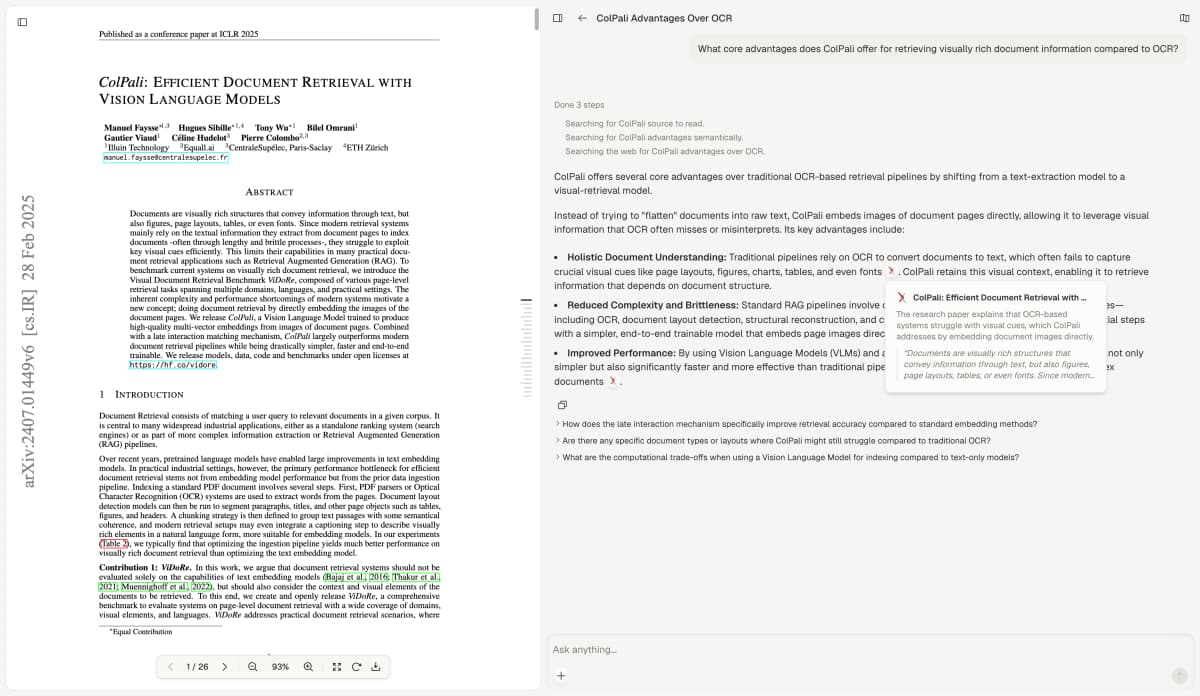
The visible paper is ColPali by Faysse et al., version 6, released under CC0 1.0. The screenshot was encoded as WebP without cropping or changing pixels.
Read the source passage and nearby text before keeping a claim in your note.
If a citation opens the wrong item, name the source you meant and ask again. If it cannot open, locate the item directly. Follow the AI citation checker workflow for the passage check. Keep a claim open when the available material does not support it.
Draft and review the analysis note
Build the paragraph around the question
Begin with the claim the evidence supports. Introduce the source details the reader needs, cite a selected passage, and explain its role in the argument. Give context where it changes the reading. End by making the claim's limit or next question clear.
The Calgary guide's advice on selective depth supports choosing a few useful details rather than covering every possible question. Follow your assignment's required format and citation style. Retain the full note even when only a small part belongs in the final paper.
Leave the source trail usable
Review the source title, creator, date, repository, version, and passage cues. Make sure the quote matches what you read. Check that each context claim points to its actual source and that you have labeled your interpretation. Keep unresolved questions alongside the evidence needed to answer them.
For a larger project, use the literature review process to develop the scholarly context. Your primary-source note remains a record of what you observed, how you reasoned from it, and where the argument needs more evidence. That trail lets a later draft build on the reading without losing its limits.
Keep your historical claims linked to sources
Compare source text and context, inspect citations, and save a checked note.