
Common method bias can skew a link between scores when the way they are measured affects both answers. To review the concern, compare who gave each score, when they did so, and how the questions were asked.
A paper may report safeguards without showing how much bias remains. Keep those two statements separate when you write a limitation. The worked survey below shows how to record a shared method and correct a claim that goes beyond the evidence.

Check the measurement behind the association
Compare methods and safeguards, then save a source-linked limitation note.
What common method bias means
Common method variance means scores vary in part due to a shared way of measuring them. Bias concerns how that skews the link you want to study. Finding a shared method does not tell you how much it changed the result.
The 2003 methods review looks at how people form answers and how design or data checks might help. The concern goes beyond using one form. How people read and answer related questions can also matter.
Suppose a survey links support from a boss with how engaged people feel at work. Support is the predictor used to explain differences. Engagement is the outcome being explained. Both scores may reflect the intended concepts and the way the answers were gathered.
For example, someone who wants to make work look good might rate both highly. This could skew the link, but it does not prove the link is false. A 2024 review explains that several sources of method bias may occur together.
Trace the two measurement paths
Identify the source and occasion
Find the methods passage for each score. Was support rated by the worker, boss or someone else? Was engagement a self-report or a separate record? Two parts of one worker's survey are still the same source.
Then check the dates. A gap between measures changes the design, but it does not prove that all shared response effects went away. Write down the gap and why the authors chose it.
Read the instrument and context
Look at the item wording and response choices. Did both measures use agreement statements? Were they adjacent? Could the first questions shape how respondents understood later ones? The instrument can answer questions that a short methods summary leaves open.
The CDC-hosted survey guide groups concerns by question wording, form design and how the survey is run. Use those groups to locate the concern. A vague item and a shared setting call for different follow-up questions.
Check who ran the survey and what people were told. Were answers private from their boss? Survey administration guidance helps you locate that part of the method. The stated promise shows what the procedure was meant to do.
It does not show that all staff felt able to answer freely. Look for the instructions before assuming what people were promised.
Worked example of a workplace survey
Consider a made-up study linking support from a boss with how engaged staff feel at work. Staff rated both in one online survey. The report says no names were taken and claims that common method bias was removed. This example supplies no results or staff records.
Use the trace below to check that claim. The shared features are reasons to ask questions; none gives a bias estimate by itself.
| Feature | Fictional report statement | Evidence to check | Limitation to keep |
|---|---|---|---|
| Source | Employees rated both variables | Methods for each measure | Same respondent supplied both scores |
| Time | Both were collected in one session | Collection schedule | Same occasion may share response influences |
| Format | Both used agreement items | Full questionnaire | Item and scale details need inspection |
| Safeguard | Responses were anonymous | Instructions and access procedure | Anonymity was reported; its effect was not measured |
Table 1: Each row describes the fictional survey; a real trace needs a passage for every reported fact.
Correct the bias-free conclusion
The claim “anonymity eliminated common method bias” goes beyond what the procedure shows. A revised note could say: “Both measures came from the same staff survey. The report says no names were taken, but does not show how much shared-method influence remains.”
If you have only an abstract, name that limit in the note. Write “item order is not stated in this abstract” rather than claiming the authors failed to split the items. The full report may give that detail.
Separate possible explanations
A tendency to agree could affect both sets of items. An acquiescence-bias check focuses on that response style. It is not the name for all common method problems. Check item wording before assuming that agreement style explains a result.
A third factor could also affect real support and engagement. That is the question covered in confounding variables. Separating those concerns helps you ask for the right evidence rather than using one bias label for the entire design.
Read safeguards without declaring victory
Match the safeguard to the concern
Using a second source, a later date or a changed scale can alter a shared feature. Ask what each measure gains and loses. If the boss rates staff engagement, the score now depends on that person's judgment. That may bring new limits.
The 2003 review looks at which remedies fit which settings. Keep the authors' reason for a safeguard and the concern it targets. A list of steps taken does not tell you how much bias remains.
Avoid statistical assurance shortcuts
A scale can give stable scores while measuring the wrong thing. The BCcampus chapter explains this as the gap between reliability and validity. Items that agree well with each other do not settle the shared-method question.
An original analysis shows flaws in the popular one-factor test. Do not turn a stated pass into a claim that no bias remains. A trained analyst needs to choose a model that fits the data and design.
The same analysis shows why direction needs care. In some cases, a shared method can shift a negative link toward zero or beyond it. Check the study's data before claiming that its link grew or shrank due to bias.
Build a checked note in Atlas
- Add the paper, instrument, supplements and relevant methods guidance to one project. Use material you have permission to share. Keep the instrument version tied to the correct study.
- In Ask a question, type @ and select the sources. Ask: “For each measure, who gave the score, when, on what scale and in which setting? Cite each fact. Which safeguards were stated? What shows they worked?”
- Open each numbered citation. Read enough surrounding text to check which variable and stage it describes. If the answer treats two survey sections as separate sources, correct that interpretation.
- Revise the claim using the note above. For a real paper, keep the methods passages and mark missing item wording as a gap. A source synthesis workflow helps you retain what each document adds.
- Select New → Note, save the checked comparison and wait for Saved. Add questions that require the instrument or a statistical reviewer. Atlas supports the reading and note; the researcher judges bias and any remedy.
The image places source text beside a cited answer. Use the same side-by-side check for a measurement statement. The visible paper concerns AI research, so it supplies no evidence about the fictional survey or common method bias.
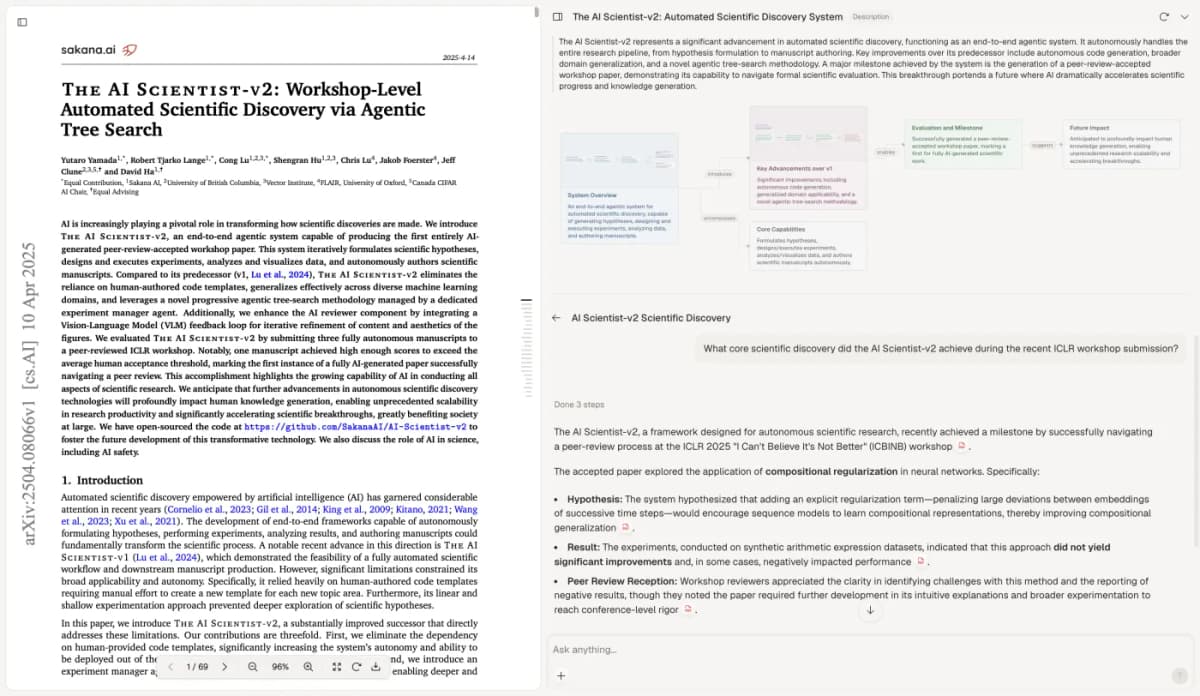
Read the original methods passage before accepting an answer about who supplied a measure. Capture includes The AI Scientist-v2, Yutaro Yamada et al., CC BY 4.0, shown within Atlas; copied unchanged.
Match the limitation to the evidence
Before using the note in a review, split facts from possible causes and unknown effects. “Same person and session” is a fact about the design. “This made the link larger” needs more proof. Keep that difference in the words you save.
If scale details are missing, ask for them rather than filling the gap from a familiar name. A paper-analysis workflow can help compare methods and claims.
Use a literature review process to keep these checks tied to each paper when reading several studies. Take model and data-correction questions to a trained analyst who can review the full design.
Check the measurement behind the association
Compare methods and safeguards, then save a source-linked limitation note.