

Acquiescence bias is a tendency to agree with survey statements no matter what they say. An “agree” answer may reflect this habit as well as a person's real view. To check the risk in a paper, start with the words and choices people saw.
Then check what the authors did to limit the concern and what shows that it worked. A sentence saying “items were reverse-scored” describes data coding. It does not show that the questions changed how people answered.

Check what agreement means in the item
Compare the instrument and paper, then save a source-linked safeguard note.
What acquiescence bias means
Someone may agree with a statement because it fits their view. The bias concerns a habit of agreeing even when the claims differ. You cannot tell which it is from one “agree” answer alone.
Pew's question-writing guide explains why agreement formats deserve care. The survey gives people a claim and asks them to agree or disagree. That can invite a habit of accepting the claim. Check the format and answers before judging the risk.
Wanting to give an answer that others approve of is a different concern. A person might deny an unpopular view to look good, even when denial means disagreeing. Keep that distinction in a note about the study; one label does not explain all responses.
If the same response style affects two scales, it may also raise a common method bias concern. That broader task asks how shared measurement affects a link between variables. This guide focuses on what agreement means in the item itself.
Inspect wording, choices, and scoring
Read the full item
Find the actual question in the instrument or supplement. A scale name in the methods section is not the item text. Check the language, version, answer labels and any stem that appears above a group of statements.
For example, “The course materials are helpful” asks for agreement with a supplied view. “How helpful are the course materials?” asks for a degree of helpfulness. This latter form is called an item-specific question because its choices address the topic directly.
Saris and colleagues' experiment found higher response quality for item-specific questions in its tested surveys. Use that finding to check format. It does not show how much bias affected a different course survey.
Separate meaning from coding
A reversed item changes the direction of a claim. “The materials help me understand” and “The materials do not help me understand” point in opposite directions. A reversed score changes how the stored answer contributes to a total. Changing the order of answer labels is a separate change.
The CDC-hosted questionnaire review keeps wording problems apart from form design. Check the actual item to see what changed. Adding “not” can make an item harder to read while reversing its meaning.
Worked check of a course survey
Suppose a fictional report says its course survey used positive and negative items, then reverse-scored the negative items to remove acquiescence bias. The supplied appendix contains two statements but no pilot results. This is a teaching case, not a survey finding.
Trace the claim across wording, choices, scoring and testing. Each stage needs its own support before it can justify an assurance about bias.
| Check | Fictional source detail | What it shows | What remains open |
|---|---|---|---|
| Item meaning | Helpful and confusing materials statements | The items differ in meaning | Whether both ask about the same thing |
| Answer format | Strongly disagree through strongly agree | Both use an agreement scale | How this format affected answers |
| Coding | Confusion item was reverse-scored | Its score direction was changed | Whether people understood the item |
| Testing | A pilot is mentioned, without results | Authors say they ran a pilot | What the pilot checked and found |
Table 1: The table describes fictional source details; a real note needs the actual item and methods passages.
Revise the safeguard claim
Do not carry “reverse scoring removed bias” into the review as a fact. Write: “The authors used items with different meanings and reversed one score. The supplied material does not show that this prevented a tendency to agree.”
This does not prove that the scale failed. It describes the support you have. Ask for the pilot report. If you cannot get it, note that it is missing before making a stronger claim.
Keep alternative explanations open
If someone agrees that materials are helpful and confusing, the answers might reflect agreement style. They might also mean that some parts help while others confuse. The items need not oppose each other from the person's point of view.
Research on reverse wording found no evidence that reversed items stopped response bias in the studied fatigue scale. Its data suggested confusion could affect scores.
That is a reason to inspect understanding, not to label this fictional respondent careless.
Judge the evidence behind safeguards
Look for tested understanding
Ask what the pretest did. Did people explain the question in their own words? Were the answer labels clear? Was a revised item tested in the language used for the final survey? “Pilot tested” alone does not answer these questions.
Pew's pretesting guidance supports checking how people understand new questions. Keep the finding beside the version it refers to. A pilot of an earlier draft may not support the final item.
Weigh the change and its cost
Item-specific choices focus on the topic rather than agreement. They still need to fit what the study aims to measure. “How often did the materials help?” measures frequency. “How helpful were they?” measures degree. Those questions may serve different research aims.
Reversed wording can also change reading demands. The PLOS study makes that risk concrete. Balance across item directions is a design choice to evaluate; it is not a reason to rewrite a validated scale without testing it.
The format experiment compares quality under one design. Use it to frame a question about the supplied instrument. It does not promise the same result for other topics, languages or groups.
Save an item-check note in Atlas
- Add the paper and the files that show the exact item version, scoring rules and any pilot results you have to one project. Use material you have permission to share. Name which files belong to the same survey.
- In Ask a question, type @ and select those sources. Ask: “For each item, show its wording, answer labels and scoring direction. Cite the source. What did the authors do about agreement bias, and what passage shows the result?”
- Open each citation and read the surrounding text. Check that item wording comes from the final instrument and coding comes from the scoring rule. A paper-analysis workflow can help keep those source roles apart.
- If the answer treats reverse scoring as proof of reduced bias, correct it using the revised note above. Keep the pilot finding marked as unknown until you have its source. Compare the passages with a source synthesis workflow.
- Select New → Note, save the checked item-format-safeguard note, and wait for Saved. Atlas supports reading and record keeping. Researchers still judge the scale and any need for testing or score correction.
The image shows a source next to a cited answer. Use that view to compare a claim about an item with its source wording. The visible AI paper is unrelated to the course example and does not demonstrate a survey bias test.
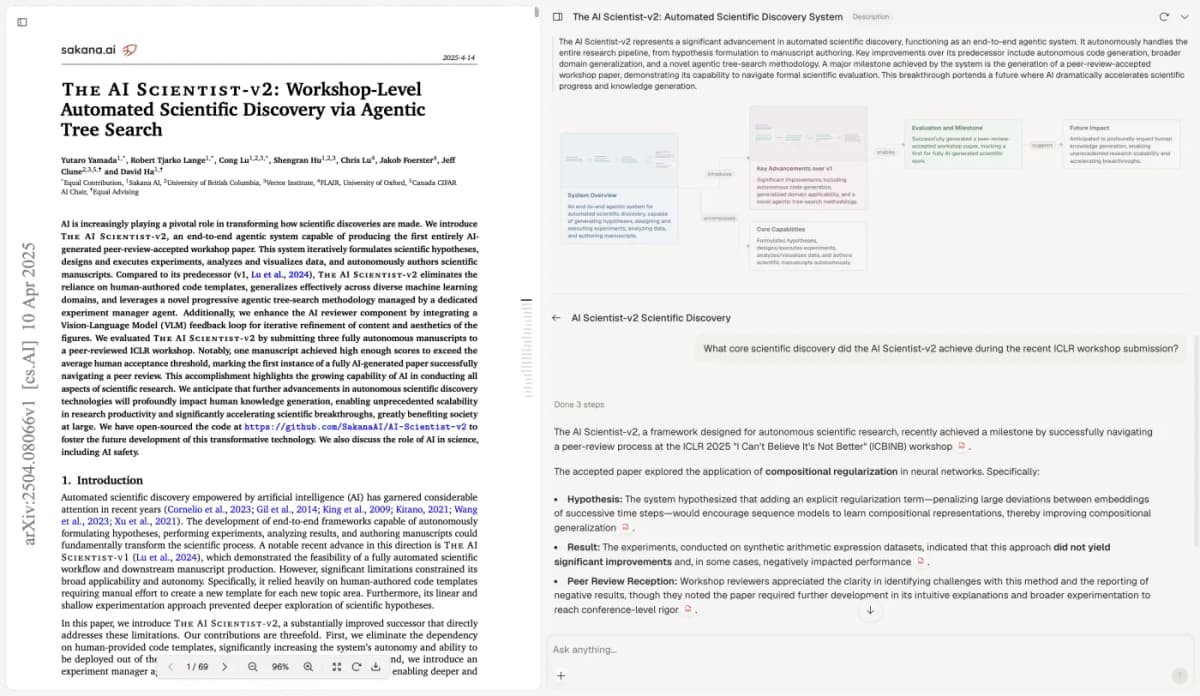
Check whether the cited passage describes wording, scoring, or a test result before combining them in a note. Capture includes The AI Scientist-v2, Yutaro Yamada et al., CC BY 4.0, shown within Atlas; copied unchanged.
Keep the unresolved item questions
Your final note should preserve the item version, the meaning of agreement and the test evidence. If a scale differs from one used in earlier work, record the difference. Pew's guidance on trends explains why changed wording and context affect comparisons over time.
Ask the researcher for missing instrument or pilot material. Keep the concern conditional until you can review it. A tendency to agree is a possible response mechanism; a source-reading note does not diagnose a person or supply a corrected score.
Check what agreement means in the item
Compare the instrument and paper, then save a source-linked safeguard note.