

The Hawthorne effect is a change in how people act because they know they are being studied. It may occur, but being watched does not prove it did. Nor does the term mean that people always work better.
Read a study in three layers: what people knew, what changed, and what backs the claim about the cause. A paper can give clear facts for the first two layers while leaving the cause open.

Check observation claims in Atlas
Compare study passages, open citations, and save a qualified evidence note.
What the Hawthorne effect means
The concern is that the act of research may change the thing being studied. People may take more care with a task when watched. They may also avoid a task, hide a response, or act in ways the study did not predict.
The review by McCambridge and colleagues found evidence that taking part in research can affect behavior. The studies varied widely, so the review could not give one clear account of how or when this happens.
Keep the direction of change open. If a paper reports better scores, you can describe those scores. If it reports only that staff knew they were watched, you cannot add an improvement that the paper did not measure.
For a review, record what each source means by the label. One may mean a person watching a task. Another may include extra contact or questions. These are different ways of taking part in a study, even when authors use the same name.
Why the factory story needs care
The name comes from studies at Western Electric's Hawthorne Works. A common version says that changes in lighting raised output because workers knew they were watched. That version is too neat to use as settled proof.
Levitt and List checked the original lighting data and challenged familiar accounts of the trials. Their work is a reason to trace the facts behind the story, rather than copy it as a law of human behavior.
A dispute about an old trial does not show that being in a modern study has no effect. It changes what the old story can support. Keep the history of the name apart from evidence about the people and task in a new paper.
When a source cites the factory story, ask which trial it means. Lighting tests, assembly work, and later accounts are not the same source. Follow the cited paper and keep that distinction in your note before using the claim elsewhere.
Separate awareness from other explanations
The systematic review's discussion examines different uses of the term. A named pathway is more useful than a label that could stand for several different problems.
Demand characteristics concern cues about what people think the study wants them to do. A person can know they are watched without knowing which answer the study team would prefer.
Social desirability bias concerns answers that make a person look good. Someone may give a flattering account of a habit without changing that habit. What people say and what they do need separate checks.
Observer bias concerns how the person watching records or judges events. Selective notes may change the recorded result even if staff act as usual. That is a different pathway from staff changing their behavior.
Practice effects may occur when people learn a task through prior attempts. If they get faster over time, check that pathway as well. Order effects ask whether the place of a task in a sequence matters.
Read the evidence in three layers
Start with what people knew. Did they see an observer, hear about a recording, or receive study instructions? Find the relevant text and mark their awareness as reported, absent, or unclear. Do not fill a gap from your own guess.
The research-participation account treats a study as a series of contacts. Its figure starts with first contact and follows the path through consent, group assignment, and later follow-up.
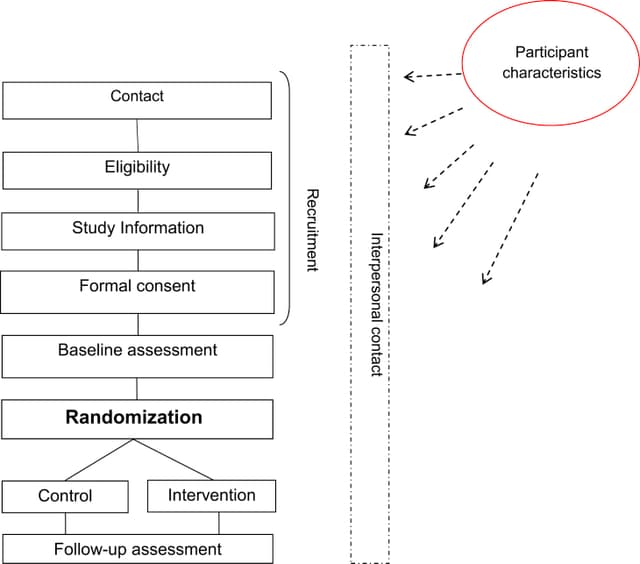
Contact starts before group assignment. The diagram locates study contacts, without measuring their effects. Use the boxes to find the methods text and check whether a proposed cause was tested. Figure 1 comes from McCambridge, Kypri and Elbourne and is reproduced unchanged under CC BY 3.0.
Next, record what changed and how it was measured. A higher self-rating does not prove a change in the habit itself. Note the measure, the dates, and the source passage so you can check the claim again.
Finally, ask what backs the claim about cause. Does a comparison separate being watched from training, time, or extra contact? A confounding variable may give a rival account when these changes occur together.
Keep a note with three fields: what people knew; what changed; what supports the cause. Add a page or passage for each field. A blank field means evidence is missing, not that the cause has been ruled out.
Work through an observation example
Consider a hypothetical workplace study of a new checklist. A researcher watches staff use it, and the report says more checks were completed that week. These invented details show how to read a study; they are not real findings.
The first layer asks whether staff knew who was watching and why. The second asks how completed checks were counted. A clear answer to both questions still does not tell us why the count rose.
The third layer asks what else changed. Staff may have had training, reminders, or more time to learn the list. A busy week may also differ from a quiet week. Look for the details rather than choosing a cause from the label.
If there is no useful comparison, write: “More checks were completed during the watched week. The study does not separate the effect of being watched from training or prior task use.” This preserves the finding and its limit.
If the paper compares groups, check how contact differed. The phrase “control group” does not tell you whether both groups were watched in the same way. Read what each group experienced before claiming the design addressed the concern.
A useful limit explains what the result can support. It does not prove that the checklist failed, staff lied, or being watched caused all the change. You can retain a finding while keeping the causal claim narrow.
Evaluate precautions without assuming success
A study may use the same script, give groups similar contact, or track behavior over time. Record each step and what it was meant to address. Then check whether the paper reports evidence about the effect that may remain.
Equal contact may help compare two groups while leaving a wider question open. Do the groups differ under study conditions? Would either group act the same way outside the study? Those questions need different evidence.
Longer contact may let people get used to the setting. There is no fixed number of days after which you can assume all change from being watched has gone. Look for evidence from the study rather than adding a waiting rule.
Consent and ethics review still matter. Trying to reduce awareness does not give a reader permission to record people in secret. Assess what the study reports; leave choices about consent and methods to the research team and its review process.
For your review, name the gap in plain terms: who knew what, which habit was measured, and which comparison was missing. This gives the reader more to check than a sentence that says only “Hawthorne effect.”
Keep a checked note in Atlas
Once you have sources you may use, add the study report and a methods source to an Atlas project. Name those sources in your question. Asking about a fixed set of papers gives you claims you can check against supplied text.
Try: “From these sources, list what people knew about being watched, what changed, and what backs the claimed cause. Cite each point. Mark facts that are missing. Do not infer a Hawthorne effect from awareness alone.”
Use the citation-checking workflow to open each cited passage and read the nearby text. If the answer turns a concern into a proven cause, correct the note to match the source's narrower claim.
Save the three fields with source locations and the question that remains open. Keep the measured change and the account of its cause in separate sentences. A later review can then reuse the facts without losing the caveat.
Atlas helps you compare supplied text and keep a checked note. The research team still chooses methods and assesses causal claims. If the source lacks the needed facts, keep the note qualified rather than asking the tool to invent them.
Check observation claims in Atlas
Compare study passages, open citations, and save a qualified evidence note.