

Structured observation uses set categories and rules to record selected behaviors. Before the study starts, you decide what counts as an event, when to record it and what to do if the case is unclear.
The hard part is matching a rule to what you saw or heard. A tick in a box can look clear even when the event behind it is not. The help-desk example below keeps the rule, the event and the open question together, so you can check what each mark means.

Check categories against recorded events
Preserve matches, unclear cases and the rules behind each decision.
What makes observation structured
An observer follows a set plan for what to record. You might track a spoken request, whose turn it is to speak or how long a task lasts. Choose features that you can see or hear and that answer the study's question.
Navigating Social Worlds explains observation schedules as plans for what to observe and record. How much structure you need depends on the question and what you already know. The schedule should help an observer decide what belongs in the record.
The rules for recording and the control over a setting are separate choices. You can use fixed categories in a meeting that would happen anyway, or in a task arranged for the study. Explain both choices so a reader knows where the record came from.
Thompson Rivers University's teaching chapter gives examples of selected behaviors and the conditions for watching them. Those details show what a count covers.
A count made at one desk during a set task cannot stand for every event in the whole service.
Taking part is another separate choice. Participant observation focuses on the researcher's role in the setting. A structured scheme focuses on what gets recorded and how. State your role as well as the rules, rather than assuming that a set form tells a reader how you took part.
Define categories before recording events
Write each category as a rule, with examples of what fits and what does not. Give an observer enough detail to explain a mark by pointing to the event. “It seemed like help-seeking” is a broad impression; “the person asked the helper to explain this form” names what was heard.
For a fictional help-desk exercise, define spoken request for assistance as a statement you can hear, addressed to a helper, asking for help with the current task. Leave out silent gestures and speech about needing help in the past.
This is a teaching rule, not a validated instrument. It tells you which actions fit the exercise.
It does not tell you why the person acted, how sure they felt or whether they liked the service. Those are other questions that need their own evidence.
Fix and colleagues' observation paper includes the semi-structured template below. It combines set constructs with space for definitions and open notes, so an observer can keep context beside the marked fields.
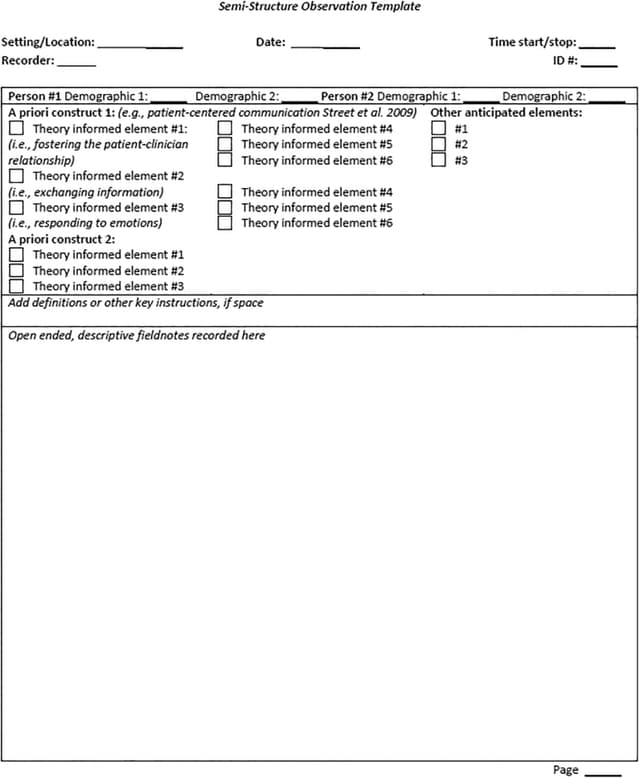
Fix, Kim, Ruben and McCullough's Figure 2 keeps categories beside definitions and description. It is reproduced unchanged under CC BY 4.0. A fully structured schedule may leave less room for open notes. This source form does not validate the help-desk rule.
Decide what each mark means and keep it linked to its rule. Retain enough context to check why you made it. The A priori codes guide covers applying supplied labels to text. This exercise matches an observed event to a recording rule.
Specify the observation window and unit
State what an observer should watch and when. One desk for ten minutes and the whole service for a day are different scopes, even if both use the same categories.
Decide whether to record every event that fits or to check at set times. A time sample leaves other periods outside the record.
It cannot tell you that nothing happened between checks. Treat those periods as unwatched, rather than adding zero events for them.
For this fictional exercise, use one audible request as the unit. Count a repeated sentence in the same exchange as part of that request. A new request after the exchange ends is a separate event under this rule.
Test that boundary before relying on totals. Two observers may disagree about when an exchange ended or whether the words were meant for the helper. Use the study's process to settle how the rule should work, and record that choice so later marks use the same boundary.
Glazier's applied library account shows choices about when activity can be observed and how plans change in the field. Keep any change to the intended times or scope in your records, so a reader can see what was actually watched.
A worked category application check
The following events are fictional. Schedule S1 covers the desk from 10:00 to 10:10. Rule R1 is the spoken-request definition above. The question is which requests fit that rule during the watched period, not how much help the whole service gave that day.
Compare what the record says with the exact rule before deciding whether an event belongs in the count for this window.
| Record | Recorded example | Rule decision | Remaining check |
|---|---|---|---|
| O1, 10:02 | Person asks helper to explain the current form | Fits R1 | Confirm speech and recipient in source |
| O2, 10:04 | Person points silently at screen | Outside R1 | Preserve gesture separately |
| O3, 10:06 | Speech inaudible in the record | Uncertain | Check permitted original material |
| O4, 10:12 | Person asks helper about form | Outside S1 window | Exclude from S1 count, retain locator |
Table 1: O1 fits the rule. O2 is a silent gesture, O3 lacks clear speech and O4 is outside the time window. Only the first of these records supports a fit under R1 and S1; the other rows still need to stay in the working note.
The table does not show that the service had only one request. It checks four supplied records under one rule and time window. Other desks and exchanges that were not recorded remain outside the check. Keep that limit with the result, rather than treating four excerpts as a complete service log.
A working note could say: “O1 fits R1 under S1. O2 records a gesture outside the spoken category. O3 lacks audible content. O4 occurs after the window. These records do not tell us why each person acted.”
Adding gestures would change the category. Keep the first rule and give the new version its own label, then list which records need another review. Do not widen the rule after seeing the results without saying that you changed what the count means.
Preserve ambiguity before calculating counts
Keep a watched period with no event separate from a period you could not watch. A sound you cannot hear clearly, a blocked view and a missing interval each leave a different gap. They should not all become zero events just because no box was ticked.
For O3, leave the category open until a source check that the study permits can answer it. If no such source exists, keep the uncertainty under the study's analysis plan. Forcing the event into or out of a category makes the total look clearer than the note allows.
Simply Psychology's observation guide discusses consistent coding and agreement between observers. A clear rule helps people make marks in the same way. Agreement alone does not prove reliability or show that the instrument measures what you need.
Record disagreements and the reasons behind them. Two observers can agree while both read the event wrongly or apply the wrong rule. Check the event and rule as well as the agreement.
Agreement on a category also does not establish the quality of a clinical trial. Reviewing PEDro scale criteria calls for evidence about the trial's methods and reporting, which answers a different question from whether two observers made the same mark.
Keep corrections in an audit trail. If a source recording clarifies O3, add the new decision and where you found the evidence. Keep why the earlier reading was unclear too, so someone can follow how the mark changed.
Check supplied records in Atlas
Add the category definitions, schedule and recorded examples that the project is allowed to receive. Keep the rule version, times and source locations. Follow the study's data-use plan for names and private details before adding the sources, rather than leaving that decision to a chat answer.
Start a chat. Type @ in Ask a question and select the schedule, definitions and records to check. Choose Project only for new retrieval from project sources. Earlier chat context is still available, so check what is already in the chat as well.
Ask: “Compare O1–O4 with R1 and S1. Show which event fits, which action is excluded, which content is unclear and which event is outside the window. Cite the rule and example for each decision. Do not infer motives.”
Open each numbered citation and read the text around it. If the answer calls O2 a request because the person wanted help, check whether the source recorded that motive. Then check whether a silent gesture fits R1. Wanting help and meeting this spoken rule are separate claims.
Correct the result: “R1 requires audible speech. O2 records a silent gesture, so it falls outside this category.” Read the revised answer and citations to check that the event is now judged by the rule, without adding a claim about intent.
Select New, then Note, and save the rule, recorded example, decision and open question together. Include unclear cases, assignments you ruled out and the next source checks. Wait for Saved before closing the note, so you can return to the checked record later.
Atlas helps compare supplied sources. Researchers choose the categories and how to analyze them. This source check is not a formal coding database, a live observation session, a reliability test or a statistical result. Keep its role clear when you use the note in the study.
Report rules alongside the results
Before reporting a count, give the rule, unit, time window and sampling plan. State how you handled unclear cases. Readers need those details to know what the number means.
Revisit the observational-research examples from Thompson Rivers University when explaining what was watched and under which conditions.
Keep changes to the schedule and say which records you checked again. If people supplied their own repeated accounts, rather than an observer's event records, a diary study calls for a different reading of that evidence. The source of the record matters to what you can claim from it.
A precise category name cannot fill gaps in the source. Report the decisions that the records support, with the rules and limits beside them. That lets a reader see what you counted, what you left open and what you did not watch.
Check categories against recorded events
Preserve matches, unclear cases and the rules behind each decision.