

A diary study asks people to keep notes about events and feelings as time passes. Those entries let you track what each person reports across dates, including shifts in mood, setting and daily life.
Keep each account tied to its date and context. A later note should not erase an earlier problem, and a missed entry should not become a success. The worked example below shows how to keep these gaps and mixed accounts in a checked note.

Compare dated diary entries
Keep experience, context and missing evidence together in a checked note.
When a diary study fits
Choose diaries when your question spans more than one session. You might want to learn how people settle into a role, cope with breaks in their work or use a service through the week.
The Victoria government method guide says that diary entries are self-reports. They tell you what a person chose to share. A note that someone booked a room is their account of that action; it does not show you every step they took.
If your question calls for a field researcher to take part and keep notes, consider participant observation. If an observer needs set rules for what to count, structured observation addresses that task.
Diaries can include thoughts and feelings that you cannot see from outside. They can also leave events out, arrive late or show how a person wants to be seen.
Choose the method to fit the question. A large pile of entries is not, by itself, a reason to choose it.
The GitLab research handbook uses diaries for feedback over repeated uses of a service. That sequence gives you more than a single account told at the end. You still need to check which dates and events each note covers.
Plan entries around the research question
Decide which events matter, when people should log them and what else you need to know. A question about breaks in work needs different prompts from a question about how sure someone feels while doing a task.
NN/G describes three ways to time entries: after an event, at set times, or in response to a signal. Match the choice to what you want to learn and how much work the diary will ask of each person.
An entry made just after an event may keep its details fresh, but frequent prompts can break up a person's day. A note at the end of the day may be easier to keep up, while leaving the exact event time unclear. Try the prompt with the people who will use it before the full study.
The source timeline starts with planning and a briefing. It then shows a period of entries, a final interview and analysis, with payment points along the way. These are parts to plan for, not a fixed set of dates or a rule for what to pay.
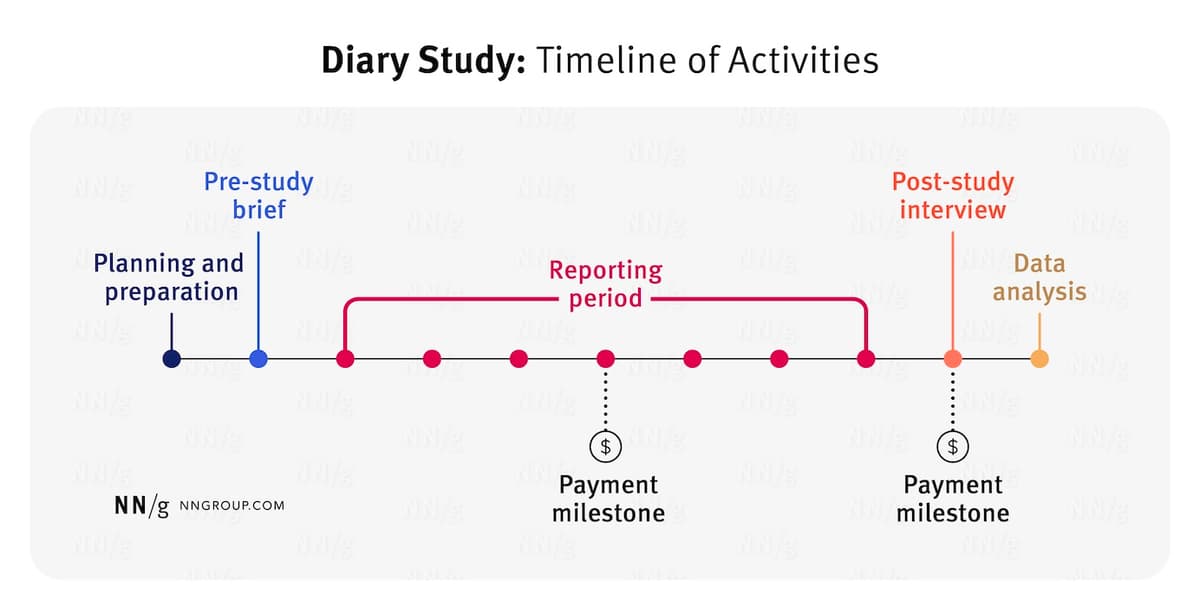
In Kim Flaherty's timeline, the diary entries sit inside a wider study. Once entries are in, you still have to ask what needs checking and what the accounts mean. The end of the logging period is not the end of that work.
Agree on the study dates, entry format, how to stay in touch and how to leave the study before it starts. Explain what to do if an entry names someone else or includes a private event at work.
Consent to join the study does not cover every later use of its notes. Before adding them to a service, check the study's data-use plan. Remove details that the service is not allowed to receive; do not treat a new use as covered just because the person agreed to keep a diary.
The User Interviews field guide compares open and structured diaries. A set form helps you line up accounts. A freer form lets people share things you did not think to ask about. Your question should guide how much freedom the entry allows.
Prepare diaries for a fair comparison
Give each person a stable ID and each entry a place you can find again. Keep the original words beside any cleaned text.
If you fix spelling or turn speech into text, a later reader should still be able to check what was said.
Keep the event date and the date the entry arrived as two fields when you know both. A note sent Friday about Monday should not become a Friday event. If you do not know when it happened, leave that time unknown and make the gap clear.
Stephens, Ottrey and Matthews discuss written, audio and video diaries and the choices each form brings. For an audio entry, check the text against the source clip if a word or tone changes how you read the account.
Start with one person's sequence. Ask what they said earlier and later, what else changed, and what stayed the same.
Then compare accounts across people. Show where one person has a full set of notes and another has gaps, so those gaps do not vanish into a shared theme.
For each possible change, keep four things together: the dated account, its context, your reading and the next check. A label such as “less trouble” needs the entries behind it. Keep the dates in view so the label does not hide how you reached it.
A worked diary synthesis note
These entries are fictional teaching materials about a library booking service. They are not study findings. The question is how people's accounts of booking trouble changed through the first week.
Each row keeps the entry beside what you still need to check. The dates do not, by themselves, show that each person got better at the task.
| Entry | Reported experience | Context | Interpretation and check |
|---|---|---|---|
| P01, day 1, E1 | Could not find confirmation | Phone, hurried between classes | Reported uncertainty; check which screen was used |
| P01, day 3, E2 | Found confirmation easily | Laptop, quiet evening | Improvement in this account; device and time also changed |
| P01, day 4 | No submitted entry | Event status unknown | Missing report; do not infer a successful booking |
| P02, day 3, E3 | Still could not confirm booking | Phone, evening | Contrary experience; inspect entry and follow-up context |
Table 1: P01 says the task was easier on day 3. P02's account still describes trouble. With no entry for day 4, you have no account from that day to compare. The gap cannot tell you whether a booking took place or how it went.
A checked working note could say: “P01 reported less trouble in E2 than E1, but used a different device at a different time. P02 still reported trouble in E3. The notes do not tell us what happened on day 4.” This keeps the claim tied to the accounts you have.
An overclaim would be: “Users learned the service and stopped having problems.” It merges two people, fills in a missing day and assumes that learning caused the change. None of those steps follows from the entries in the table.
Keep possible reasons as questions. Was the screen easier to read on a laptop? Did a quiet setting help? Did someone show P01 what to do between entries? Keep any follow-up answer beside the first account, with its own date and source location, so you can see what it adds.
Check gaps and conflicting accounts
A missed entry differs from a note saying that no relevant event took place. In the first case, you do not know what happened. In the second, the person has told you there was no event to log under the study's prompt and time window.
Two accounts that differ may both be true. They may cover different devices, tasks or settings. Before calling them a conflict, check what each person was doing and when. A booking made on a phone in a rush is not the same event as a booking made at home on a laptop.
Keep accounts that do not fit the pattern you first saw. Negative case analysis can help you check a claim against those cases. In this example, E3 should stay in the note even if you hoped to show that booking got easier for everyone.
Building themes and tracking change over time serve different aims. Inductive thematic analysis develops patterns of meaning. A dated comparison keeps one person's earlier and later accounts in view. Use the approach your study calls for, and show how its findings relate to the dates.
Check who sent entries at each point and where you lack notes for a fair comparison. If P01 sends ten notes and P02 sends two, you may know more about P01's week. That does not make P01's week more typical of everyone who uses the service.
Compare permitted diary sources in Atlas
Use Atlas once you have prepared sources that it is allowed to receive. Keep the dated entries, context and study question in the same project. Give sources clear names and keep the locations of each entry, so you can go back to the right note when checking an answer.
Start a chat. In Ask a question, type @ and select the sources you want to compare. Select Project only for new retrieval from the project. Earlier chat context is still available, so check what that chat already contains as well as the sources you select.
For the fictional example, ask: “Compare P01's E1 and E2 before P02's E3. Keep dates and device context. Show what each person said changed, what might explain it and what we still do not know. Cite the entries for each claim.”
Open each numbered citation and read the text around it. Check that an easier booking has not become a claim that someone learned the service. Look for P02's trouble in the answer too. A neat account of progress is wrong if it leaves that entry out.
If the answer says that everyone improved, correct it with the named entry: “E3 still reports trouble. Keep that exception in the conclusion and leave day 4 unknown.” Check the revised answer and its citations. The fact that you asked for a fix does not show that the fix was made.
Select New, then Note, and save the checked comparison. Include the source IDs, open questions and the changes you made to the claim. Wait for Saved before closing it. When new material that you are allowed to use arrives, return to this note and check how it changes the earlier reading.
Atlas helps you compare sources and keep notes. It does not run the diary study or decide that a pattern is valid. You decide how to read the accounts, what consent covers and what the final report can claim. Keep those judgments tied to the study's own rules and evidence.
Report change with its limits
State whose entries and which dates support the finding. Describe how people were prompted and which parts of the context matter. “P01 found booking easier on day 3” is a claim about an account. “P01 learned the service” adds a reason that needs its own support.
Include exceptions and gaps where they affect the conclusion. If a later answer changes how you read an entry, keep the earlier note too. An audit trail helps you show which source changed the claim and why, so a reader can follow the change rather than just see its result.
A diary synthesis can describe what these people shared over these dates. It does not, on its own, tell you how often the same thing happens in a whole population, what caused a change, or what took place when nobody logged it. Those claims need a study design and evidence that answer those wider questions.
Compare dated diary entries
Keep experience, context and missing evidence together in a checked note.