

Participant observation means taking part in a setting while watching what happens and keeping field notes. A researcher might help with a task, join a meeting or share in daily routines, then keep a record of what they saw and heard.
Your role is part of the evidence. To check a claim, a reader needs to know what you saw, what you did and what was beyond your sight or hearing. The kitchen example below shows why those details can change how you read a scene.

Check interpretations against field notes
Keep recorded events, your role and open questions in one checked note.
What participant observation involves
The University of Toronto's guidance draws a distinction between taking part with people and watching without that contact. The setting and length of the study depend on what you want to learn.
Joining one meeting and living in a place for months do not give you the same view.
Taking part can help you see things that are hard to grasp from outside. It also shapes who talks to you and what they choose to share.
Knowing a place well can help you read a scene, but you still need the notes behind each claim. A strong sense of what happened is not a substitute for that record.
Participant observation is a method; ethnography is a broader research approach. A study may use field notes alongside interviews, documents and other sources. Taking part in one task does not, by itself, give you a full account of a group's life or make the study ethnographic.
Check who made each record. In a diary study, people keep notes about their own lives or use of a service. Here, the field researcher takes part and makes the record. Those accounts may both be useful, but they come from different views of the scene.
Describe your role and access
Keep three questions separate: What did you do? What did people know about your study role? Where could you go or listen?
Helping with the work does not show that everyone knew you were also doing research. State what was disclosed, rather than leaving a reader to infer it from your role.
Scribbr's method guide describes different observer roles. Start with what you did and who you worked with, then choose a label that fits. The label alone does not tell a reader which events you could see or which people would speak to you.
For example, helping make a meal may let you hear talk at a worktable. It does not let you hear an earlier planning meeting or a private exchange outside the room. Keep those gaps in view when you write about why someone acted as they did.
The photograph below appears in an OpenStax anthropology chapter. The source names Josphat Mako and Stuart Butler and describes a greeting during a walking visit among Maasai villages.
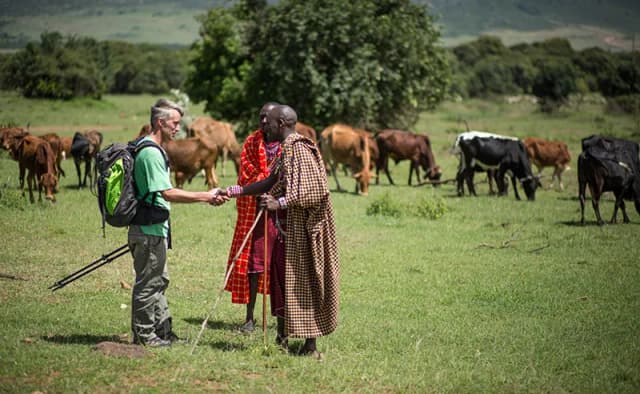
Make It Kenya Photo / Stuart Price's public-domain photograph shows the greeting. The source account matters too. The picture alone cannot tell you why the visit took place, what was agreed or what role the visitor held.
Use the same care with your notes. Explain how you came to be in the scene and what you could see from that position. A picture or a role label cannot supply those facts on its own.
Separate events from interpretations
Field notes should show what you saw or heard and what you think it means as separate parts. Mark direct speech, your own summary of it and any memory added later.
Keep a date and a source location so another reader can find the note and check how the claim was built.
In its participant-observation reference, Newcastle University links to method guidance and discusses field records. Make the event easy to trace in your own notes before you use it to support a wider claim.
“The coordinator moved the tray” records an action. “The coordinator wanted to exclude the newcomer” adds a claim about intent. Seeing the tray move does not tell you why it moved. You need more evidence to support the second sentence, such as a relevant account or further notes about that event.
Keep a person's later account separate from the first note. What they say about an action may help you understand it, but that answer comes from a new exchange. Record when you asked, what you asked and what they said, so it does not look as though you knew it at the time.
ResearchProspect's guide discusses field notes and observer roles together. Keep that link in your own record: what your role let you see, and what taking part may have changed. A note about the event alone can hide that second part.
A worked field-note evidence check
This community-kitchen scene is fictional teaching material. The question is how new members are told what to do while making a meal. The researcher is a volunteer who has disclosed their study role and is helping arrange supplies.
Field note F1 records a coordinator asking newcomer N to wait before using a machine. F2 records the coordinator fetching a safety sheet. F3 records the researcher offering N a different task. The researcher does not hear a later private exchange and has no account of its contents.
This check keeps the event and the researcher's role beside each proposed claim, so a reader can see what supports it and what still needs a check.
| Proposed claim | Recorded evidence | Researcher role | Decision |
|---|---|---|---|
| N was told to wait | F1 records the instruction | Within hearing at worktable | Supported as a recorded instruction |
| Waiting meant exclusion | F2 records a safety sheet being fetched | Saw the return, not prior planning | Motive uncertain; safety is an alternative |
| N independently changed tasks | F3 records researcher suggestion | Suggested the new task | Revise to retain intervention |
| A later dispute occurred | Private exchange unheard | Outside hearing range | Unsupported in these records |
Table 1: The records support waiting and a task change suggested by the researcher. They do not show that N was being excluded or that a later dispute took place. The safety sheet gives you another reason to check before treating the wait as exclusion.
A checked note could say: “N was asked to wait in F1. The coordinator fetched a safety sheet in F2. The researcher suggested a different task in F3. We do not yet know the reasons for waiting or what was said in the later exchange.”
The question can now guide follow-up through the study's approved process. Ask how new members are given tasks, and keep who answered and when with that account. Until you have support for a reason, leave it as a question rather than writing it into the finding.
Protect participants and record influence
People's roles and agreements may change during fieldwork. Toronto's ethics guidance discusses evolving contact and differences in power. Check the study's arrangements again when what you do or how you use the data changes, rather than assuming the first agreement covers every later use.
Use the names or IDs that the study permits. Protect details about people who did not agree to the research. Permission to enter a room does not, by itself, let you record every exchange there or add the notes to another service.
Write down how you shaped the scene. Looking at your own position and assumptions is often called reflexivity. The OpenStax discussion of fieldwork links taking part with learning through relationships. In the kitchen example, offering N a task matters: it changes what happens next.
Look for notes that do not fit your first reading. Negative case analysis can help you check the claim against those cases. Keep them in the working record, rather than choosing only scenes that make the claim look sound.
Check field-note claims in Atlas
Add only field notes, role records and method guidance that the project is allowed to receive. Keep source locations and mark people's speech separately from your own reading. Do this before asking Atlas to compare the notes, so the answer has a clear source set to work from.
Start a chat. Use @ in Ask a question to mention the sources you want to check. Select Project only for new retrieval from the project. Earlier chat context is still available, so check what is already in that chat too.
Ask: “Check the claim that N was excluded against F1–F3 and the role record. Show what was seen, what people said and what the researcher inferred. Flag anything outside their sight or hearing and cite the passages for each claim.”
Open each numbered citation and read around the passage. Check both the event and any claim about what it means. If the answer says N freely chose the new task, compare that wording with F3, where the researcher offered the task.
Request a correction from that passage: “Keep that the researcher suggested the task. Do not use the change as proof of N's own choice.” Check the revised answer and citations to see that the role record is now part of the claim.
Select New, then Note, and save the checked note with the role, event, proposed meaning and evidence together. Include the claims you ruled out, other possible reasons and the next check the study permits. Wait for Saved before closing it.
Atlas helps compare supplied records and keep notes. It cannot hear the missing exchange or decide that your reading is valid for the study. You retain that judgment and the duty to check the sources behind it.
Report what the records support
Explain what you did, what you could see or hear and which records support the claim. Show how the claim would change if you read a field note differently or received a new account from someone who was there.
Keep a record of changes through an audit trail. If you change “exclusion” to “waiting with uncertain reasons,” retain both readings. Explain which notes led you to the narrower claim and what remains unknown.
If the study needs set categories applied to observed events, review structured observation. Checking what a field scene means and applying a fixed rule to an event are different tasks. Choose the method that fits the question you need to answer.
Check interpretations against field notes
Keep recorded events, your role and open questions in one checked note.