

Ethnographic research design is a plan for understanding how people live and work in a social setting. It links your question to a field site, your role there, the events you will observe, and the records you will use to make sense of them.
Start with the practice you need to understand, not a fixed interview count. Plan how you will learn what people do, what they say it means, and how the setting shapes both. Then state what you cannot observe or claim.
This guide uses a fictional campus repair workshop to show those choices. It also shows how to compare methods sources and save a checked design note in Atlas. The example contains no actual fieldwork or participant findings.

Check the sources behind your fieldwork plan
Compare method guidance with your field context and notes.
Decide whether ethnography fits
Ethnography fits questions about shared practices, meanings, and social life in context. For example, how do newcomers learn who can offer help in a repair workshop? The Reeves, Kuper, and Hodges overview describes the study of social interactions and perspectives within groups and settings.
Interviews can contribute, but a set of interviews alone does not explain your field engagement. Specify what you will observe and how you will relate those events to people's accounts. Government methods guidance describes a mix of observation, conversation, documents, and fieldnotes chosen for the question.
A long-term study may follow routines and change across a setting. Focused or rapid work narrows the question and scope, while digital work studies practices in online spaces. Do not choose a label merely because your schedule is short. Explain how the fieldwork can answer your question and what it will miss.
Plan the fieldwork and records
If your question concerns power over access or whose views enter decisions, consider critical ethnography. Make the lens explicit and test it against competing readings of the field evidence.
Write a provisional plan before entering the field. It should explain where you will work, how you will gain access, your role, the situations you need to see, and how you will record them. Keep room to revise the plan as the field raises new questions.
Define the setting and your role
Set a boundary that makes the question workable. A campus workshop includes more than its weekly opening hours: preparation, informal advice, tools, notices, and group rules may all shape the practice. Decide which parts your question needs and which are outside the study.
Describe whether you will mainly observe or take part, and how people will know your role. Joining a repair activity may offer insight, but it also changes what you can notice and how others treat you.
Uta Papen's methods chapter links getting access, watching events, talking with people, and reflecting on your role.
Plan access and consent
A workshop organizer can help you enter the setting, but their permission does not stand in for everyone's agreement. Explain the research, what you will record, and how people can decline.
The AAA ethics principles require informed consent and necessary permissions alongside duties to avoid harm and protect records.
Plan for people who arrive after the study starts, and for situations you should not record. Keep the fieldwork plan aligned with your institution's review and the community's agreements. If access is refused, narrow or change the question rather than treating an unseen event as known.
Build a fieldnote routine
Record the time, place, roles present, sequence of events, and relevant words or actions. Mark exact speech only when you recorded it as such; a remembered paraphrase should remain a paraphrase. Write fuller notes soon after the session while details are still fresh.
Keep separate labels for what you observed, what someone told you, and what you think it means. Add questions and reflections on your role.
The government fieldnote guidance includes both event records and researcher reflections; their relationship should remain easy to inspect.
Worked field-context and source plan
Suppose your question is: “How do newcomers learn when and whom to ask for help at a campus repair workshop?” This is a fictional design example. You plan repeated visits at different session stages and brief conversations about events you have seen, subject to access and consent.
The plan below links four parts of that setting to records and checks you could use.
| Field context | Proposed record | Question to keep open |
|---|---|---|
| Arrival and sign-in | Fieldnote of the welcome, visible notices, and first interactions | Does the welcome explain how to seek help, or do newcomers learn later? |
| Repair activity | Event sequence showing who asks, answers, redirects, or waits | Does silence mean confusion, concentration, or something else? Ask rather than infer. |
| A participant's account | Consented conversation note linked to the event discussed | How does this person explain the action, and does another account differ? |
| End-of-session work | Fieldnotes and permitted copies of relevant workshop guidance | Which roles and rules become visible when work ends? What remains outside your access? |
Table 1: Fictional source plan: proposed records and open questions, not observed behavior or findings.
Watching and asking each add something to the plan. A note can show who passed on a request. Asking the person can help you learn how they understood it. A notice can show a stated rule, but it does not prove that people follow it. Papen's chapter record describes observation and discussion as parts of fieldwork rather than substitutes for each other.
Do not set a universal visit count from this table. You need enough engagement to address the relevant routines and variation.
The government guide's rapid-study example also reports limits in what the selected methods could reveal about participants' experience. A short design needs an explicit account of its reach.
Check interpretations and fieldwork limits
A design note should show how you will question early explanations. Check a pattern across events, roles, and records. Agreement can help you understand a practice, while disagreement may reveal a part of the setting you have missed.
Separate an event from a motive
Imagine a fictional note says, “The newcomer ignored the volunteer because they did not trust experts.” The visible action might be turning away after a greeting. Distrust is an interpretation, not something the action alone establishes.
A corrected note could say: “After the greeting, the newcomer turned toward the tool bench. I did not hear a reply. Ask how they understood the greeting and check whether similar events occur.” This preserves the event and makes the next inquiry clear without inventing a motive.
Examine your own role
Reflexivity means asking how your role and choices shape the study. Who talks to you, who stays away, and what do people think you are doing there? A guide to reflexivity can help you turn those questions into notes beside the evidence they affect.
The authored primary-care methods guide also treats reflection on researcher assumptions as part of ethnographic work. For your setting, record what your access and role let you see and what they hide. Do not treat your account as a complete view of every participant's experience.
Keep records according to the agreed research plan. The AAA principles include duties to protect and preserve them. Before using an external tool, decide which material is permitted there and whether names or other identifying details need removal under your study's rules.
Compare your design sources in Atlas
Atlas can support a cited comparison of supplied methods sources and permitted study notes. Start with a small set of relevant papers and a note stating the field question, access, role, and record plan. A research paper analysis workflow helps locate the methods passages you need.
Use this sequence to draft and check the design note:
- Add the permitted materials. Keep methods papers separate from fieldnotes and participant accounts. Use clear source names and wait for processing to finish.
- Mention sources with
@. Select the papers and your design note. Ask which features of the proposed fieldwork each source supports, with citations. - Separate guidance from field evidence. A methods paper explains an approach; it does not establish what happened in your workshop. Ask for that distinction in the answer.
- Check the source passages. Open each citation and read its surrounding context. Correct a comparison that drops a limit or makes your narrower plan sound like a complete study of the community.
- Preserve open questions. Mark access gaps and uncertain interpretations. If a note does not support a motive or pattern, keep it as a question for fieldwork.
- Save the corrected note. Use
New → Note, add the checked plan and references, and confirmSaved. Revise the note as fieldwork changes your understanding.
A useful prompt is: “Compare @Methods Papers with @Fieldwork Plan. For each design choice, cite the method guidance, explain the proposed fit, and list what we still need to check. Keep method claims separate from observations and participant accounts.”
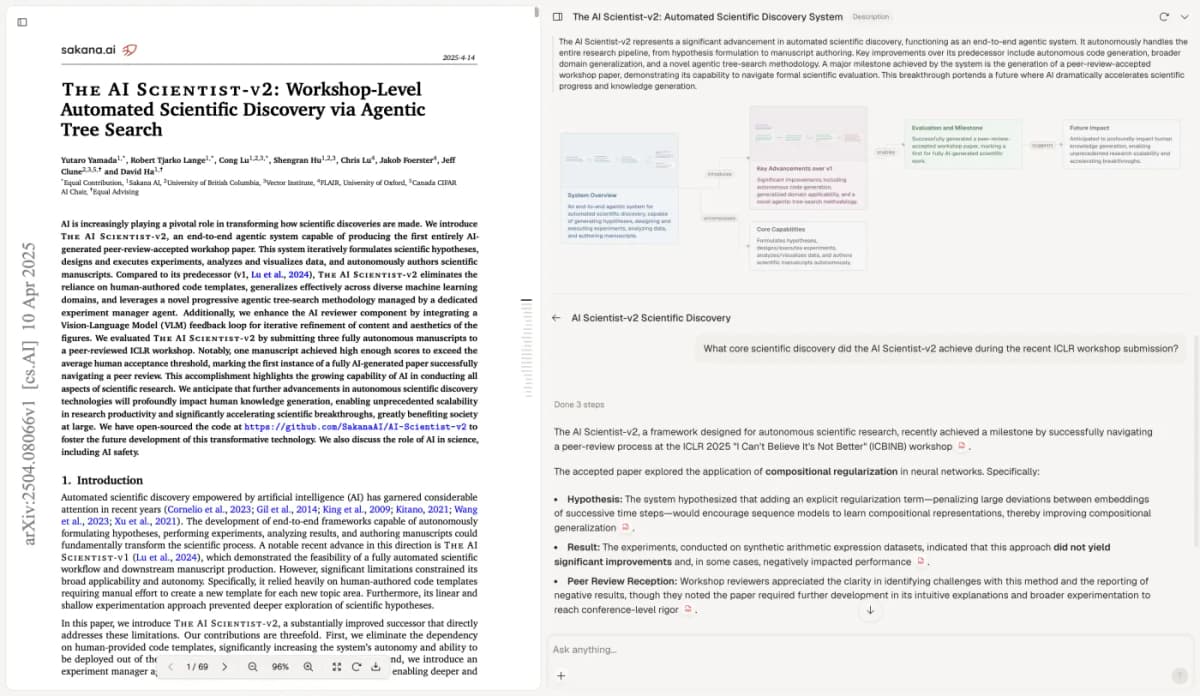
Atlas source-and-answer capture, reused unchanged. Paper: Yamada and colleagues, The AI Scientist-v2 (2025), CC BY 4.0. The paper is unrelated to the fictional workshop and does not validate its design.
For your own sources, open the cited passage and correct the draft note. The screenshot does not establish fieldnote-analysis accuracy. Atlas cannot observe a missed event or verify a participant's account for you.
Revise the design as you learn
After each fieldwork phase, note which situations you saw, what remains unclear, and what should change in the next phase. Keep a reason for that change, such as a role you have not heard from or a routine that occurs outside your current visit times.
When you begin grouping material, a qualitative coding workflow can support source organization. Link each code to its source event or account. Revisit cases that do not fit your first reading. The design and analysis should remain responsive to the field rather than forcing every note into your first idea.
Review the revised plan with your research team or supervisor. Check that the question, access, records, interpretation, and claims still fit together. A useful design note shows the next fieldwork decision and its limits, with the evidence that led you there.
If your question centers on a bounded event or organization, compare a case study research design. It defines the case and its evidence boundaries; ethnographic planning explains engagement with practices and meanings in the field.
Check the sources behind your fieldwork plan
Compare method guidance with your field context and notes.