

Critical ethnography studies social life and asks who holds power within it. To read an account well, keep what happened, the local setting, the stated theory, and the researcher's role in view.
A booking rule can prompt a question about who controls access. The rule alone cannot tell you why a person made a choice or what every member of a group thinks.
The worked note below uses made-up room-booking records. Use Atlas to compare accounts you have permission to use, check cited passages, and save a note. People still conduct the fieldwork and judge what the accounts mean.

Check your accounts in Atlas
Compare permitted accounts and save a checked power-lens note.
What makes ethnography critical
Critical ethnography uses fieldwork to study social life and challenge unequal power. Read what the researcher seeks to change, which theory guides the work, and what the field records show.
In Madison's method chapter, pages 5–10 link this purpose to fieldwork, the researcher's role, and dialogue with others. Show how the records support the reading. A firm belief about what should change does not make that belief an observed fact.
The Palmer and Caldas abstract names the aim of challenging unequal power. Some projects work with community members through research and dialogue. Check who helped make study decisions before calling it participatory research. The methods can overlap, but the names alone do not show how people took part.
For field access and records, use an ethnographic research design. Here, the job is to compare accounts with a stated power lens and role note. Other forms of ethnography can also study power and reflect on who is doing the work.
Set account-and-lens review criteria
Ask how this account supports a reading of power in this setting. Your research objectives help decide which records you need.
Read the account before applying the lens. Keep a dated field note separate from a person's view of that event. Then find the theory note that states what the researcher is looking for and why.
Use these criteria for each row:
- Account: What was seen, written, or said, and where is the passage?
- Context: When did it occur, under which local rules?
- Power lens: Which stated idea guides the reading of access or unequal treatment?
- Researcher position: What did this role and access let you see?
- Open check: Which other reading or missing source could change it?
An expert review of critical methods by Tichenor and colleagues finds varied approaches in acute-care studies. Show how a theory informs study choices, since the method name cannot supply those links. The review covers selected work in that setting, so it does not describe all practice elsewhere.
A worked account-context-power-lens comparison note
Imagine a researcher reading records about room access after work at Campus R. All campus details, records, and roles in this example are fictional. They are teaching material, with no real quotes or findings.
The set has four records: desk note F1, club account A1, meeting note M1, and rule R1. Lens note L1 asks how the need for formal approval gives some people control over access.
Role note P1 says the building manager pays the researcher. They attend meetings held before 5 p.m. but have no field notes from later events yet.
This lens looks at power over access. It raises questions about who can grant it and whose needs enter the rules. It does not show that each delay reflects unequal treatment.
| Account and locator | Context retained | Reading through L1 | Competing reading or open check |
|---|---|---|---|
| F1, desk note: staff seek manager approval before confirming an evening booking | One request at an afternoon desk visit | Approval places a gatekeeper between a club and access | Check whether the rule applies to all requests and whether the room was free |
| A1, organizer account: members with evening shifts rarely attend afternoon meetings | One organizer's report about club members | Meeting times may limit whose needs reach decision makers | Seek permitted accounts from affected members and check other ways to contribute |
| M1, meeting note: no objections recorded after the manager proposes a booking rule | Notes from one meeting, without each person's response | The manager's role raises a question about room for dissent | Silence may reflect agreement, uncertainty, or an incomplete record |
| R1, written rule: all clubs may submit requests, subject to approval | A formal document, with no record of enforcement | Submission rights and approval authority are distinct | Compare permitted booking records and accounts before judging everyday access |
Table 1: The rows have different kinds of support. F1 records an event, and A1 gives one person's account. M1 shows what entered the meeting notes, while R1 states a formal rule. Keep those source types clear when you compare them.
The records raise questions about who grants access, who can attend meetings, and how dissent is recorded. They do not yet show that the manager intends to exclude workers. Keep that gap in the note so the next reader knows what needs review.
Make the researcher position visible
Positionality means where the researcher stands in relation to the people and setting. Role, background, access, and beliefs can affect what they see and how they tell the story. Reflexivity means checking those effects as the work goes on.
P1 records payment by the manager and access to daytime meetings. Do staff see the researcher as speaking for the manager? Can workers on later shifts contribute to the account? Check those questions before claiming to know how people viewed the researcher's role.
A research team's reflection on identity and power by Muhammad and colleagues concerns community-based participatory research. It links the team's role to study choices and how they tell the story. It also shows why a fixed insider or outsider label can be too simple.
That work offers useful questions about role and access. It uses a different method from the room example, so drawing on it does not make the room review a participatory study.
In a role note, record who gave you access and which events you could attend. Include what you hoped to change and who could challenge your reading. Revise it when your role changes, so the note explains later choices too.
Correct claims that outrun the accounts
An early draft says the manager intends to exclude clubs with workers on late shifts. F1 shows only that staff sought approval. A1 adds a report about meeting access, but neither source states the manager's motive.
A checked version can state that staff sought approval for one booking, while one club organizer said some members rarely attend daytime meetings. Check other booking records and members' accounts before making a claim about intent. This keeps the concern about access and makes the gap clear.
A second draft says everyone agreed to the rule because nobody objected. M1 has no recorded objections, but it does not show each person's agreement. Correct it to These notes record no objections. We still need to check people's views and their chances to disagree.
In Powell's school-study abstract, fieldwork raises questions about how to show children's views, whether to intervene, and the researcher's role. He describes an ongoing review of methods and power. That supports revisiting your reading, but it does not settle the made-up room dispute.
Keep disagreement and missing voices visible
If a later account says afternoon meetings are convenient, retain it beside A1 and ask whose schedules each describes. Both may be accurate for different people, so combining them into a single group view would lose that context.
A written rule and daily practice also answer different questions. R1 says who may submit a request, while a booking record may show how it was handled. Neither alone shows every club's access over time.
Madison's discussion of dialogue, pages 8–10, keeps the researcher's work with others open to questioning. A response that challenges the lens belongs in this note. It may reveal a missing detail or weak link in the reading.
Name the missing voices. The current made-up set has no field notes from late events or accounts from the affected members. Leave those gaps open. Do not turn them into a claim that people were silent or pleased with the rule.
Use a literature review process to compare studies that help explain the context. A pattern found elsewhere can guide a question, but it cannot replace records about Campus R.
The publisher's guide to Madison's third edition lists a range of theories and methods. State which lens your study uses and how you apply it to the accounts. The method name does not imply one fixed theory.
Compare accounts and context in Atlas
Use only material you have permission to bring into the project. Researchers decide how to protect people and their private details. These steps help you read supplied records, with fieldwork and judgment left to people.
- Add the permitted field accounts, local documents, context sources, framework note, and researcher-position note to one project.
- In Ask a question, type @ and select the records you want to compare. Name the relevant dates and account labels.
- Ask for separate account, context, lens, position, and open-check columns with citations, then select Send.
- Open each citation and read the surrounding passage. Confirm that the row attributes an account to the right person and separates the record from its interpretation.
- Correct unsupported meanings. Select New, then Note, to retain the checked comparison and its source references. Check for Saved.
A useful prompt for these records is Compare these accounts with the supplied framework note. Show what each source states, what the lens suggests, and which competing reading or missing account remains. Do not infer motives from silence.
Project only keeps new retrieval within the project. Earlier chat context remains available, so make the intended account set clear. When a cited row is hard to trace, ask Atlas to separate the source contributions and review them.
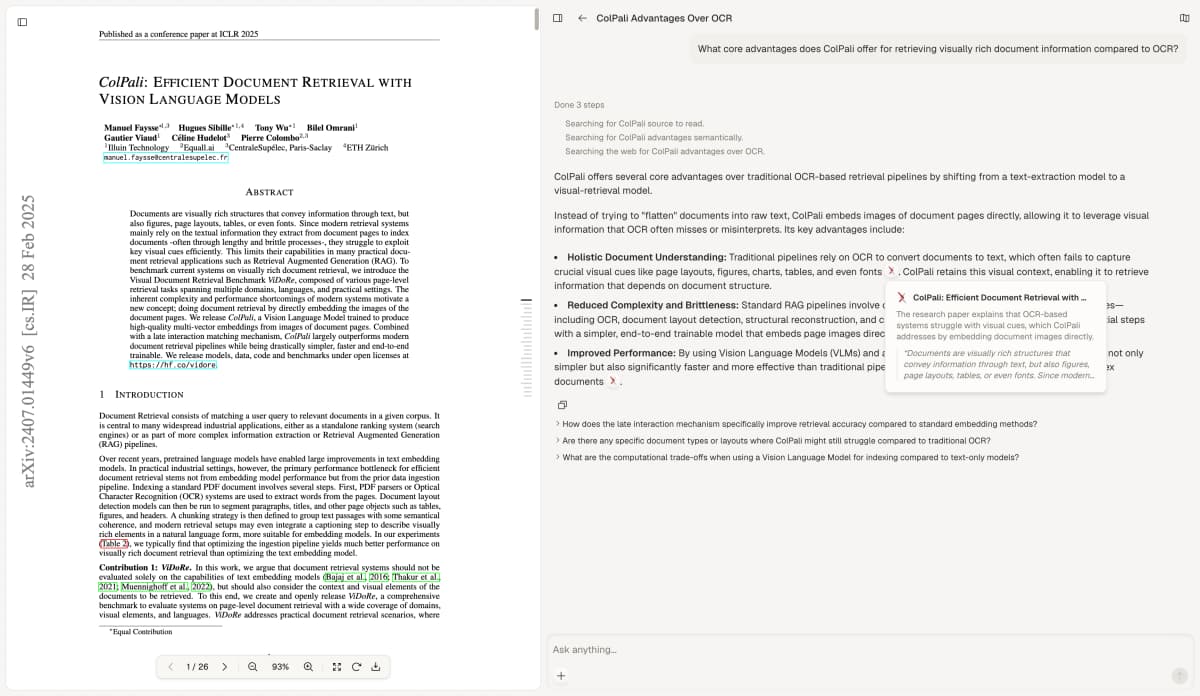
The PDF and preview let a reader compare a cited passage with the answer. This unchanged Atlas capture shows Faysse and colleagues' ColPali paper (CC0 1.0), which is unrelated to the room accounts. It shows how to inspect a source, without field data or a test of the reading. Check the surrounding text as well as the preview when you review your own row.
Citation location varies with the source. A PDF citation can open near a passage when its location is known. If the source opens more broadly, find the passage yourself before keeping the claim.
Save the note for further review
Keep account labels, dates, source passages, context, lens, role note, and changes together. State what you can claim now and which missing records could change it. Clear research notes help you revisit each choice.
When a new account or review arrives, return to the row it concerns. Check whether it changes the context, weakens the reading, or adds a view. Keep the reason for each change so another reader can follow it.
Use the saved note to discuss the accounts. People still choose the method, conduct fieldwork, protect those involved, and decide which reading they can defend.
Check your accounts in Atlas
Compare permitted accounts and save a checked power-lens note.