
Research Objectives: Turn a Question Into a Workable Plan
Research objectives state what your study will do. Use a worked evidence-to-objective map to connect the question, prior studies, method, and project limits.
- Byline

Summary
Research objectives are the specific actions a study will take to answer its research question and meet its broad aim.
Start with the problem and prior evidence. Then name the gap, method, and real limits for each proposed objective.
A worked map shows how to revise a vague objective into a task that sources and a feasible study design can support.
Research objectives say what a study will do to answer its question. Each one should name a clear task that the project can carry out. The broad aim gives the destination; the objectives make the route visible.
Before you write an objective, check what your chosen sources already show. For example, one study of students who had visited librarians cannot tell you why students at your own campus never sought help. That limit might shape a new question. It does not prove that nobody has studied the question elsewhere.
Atlas can help compare the studies you add, with citations you can open. You decide what your proposal will ask, what data you can collect, and which claims the sources support.

Atlas

Check the evidence behind your objectives
Compare selected studies, open citations, and save a scope note.
What research objectives do
A research objective is a specific action in a study plan. It links the question you want to answer to work you can describe, such as interviewing a defined group, comparing records, or testing a stated prediction.
The University of Portsmouth guide moves from a focused question to a broad aim and then to concrete objectives. Trent University's proposal guide says the objectives should be clear, realistic, and tied to the design.
An aim can say, “Explore how new students seek help with research.” An objective says, “Interview first-year students about where they turned when they could not find sources for their first paper.” The second line tells a reader what evidence the study plans to collect.
Objectives may change as a project takes shape. Keep the question, source base, and method in view when you revise them. An objective that reads well but cannot be carried out will not rescue the proposal.
Align problem, aim, and question
Start with a problem worth studying. In our fictional teaching case, a university library wants to know why some first-year students ask for research help and others do not. The campus, study plan, and student accounts in this example are invented.
The aim is broad: understand how first-year students decide where to seek help for an early research assignment. The question narrows it: How do first-year students at this campus decide whether to ask a librarian, course staff, a peer, or no one when they get stuck?
An objective should move the project toward an answer. For this question, the team could first map what published studies say, then interview consenting students, then compare the paths students describe. Each step has a reason and a way to check it.
Keep each statement in its lane
The problem explains why the issue matters. The aim states the overall purpose. The question states what you want to know. An objective states a piece of work that can help answer it.
These terms vary across courses and grants. Trent University notes that some fields frame objectives as questions. Follow your course or funder's form while keeping the logic clear.
Give the method a place
“Explore help-seeking” alone leaves the reader unsure what you will do. “Interview consenting first-year students who worked on a research paper this term” names a possible route. It still needs a plan for sampling, consent, and analysis.
The NIH Specific Aims instructions ask grant applicants to state specific goals and expected outcomes. That is a funder rule for its own forms. It does not set one template for every class project.
Match the words to the work you plan. “Measure” implies a measure and a design that can support it. “Describe” may call for interviews or records. “Compare” needs two defined groups, cases, or periods and a reason that comparison matters.
Check prior evidence first
Read enough background work to see what is already known. Then state the limit of your own search. Two papers can show what those papers cover. They cannot prove a field-wide gap.
Trent's proposal guidance asks writers to place a proposed study beside past work and justify their choices. This is the link many short objective lists skip.
Read claims with their setting
In a qualitative study at Pepperdine, Vinyard and colleagues interviewed ten undergraduates who had already used in-person librarian help. They asked how students searched and what led them to ask a librarian.
Those interviews offer insight into students who made it to a librarian. The paper itself notes the sample cannot show much about students who never asked for that help. Keep that sample limit beside any use of its findings.
A study of live chat in higher education compared views from online and blended psychology students. It reports how those students viewed real-time chat help. It concerns a different service and group from a local first-year library study.
The two papers do not give one answer for our invented campus. They do show why service type, who was sampled, and study setting matter when you draft an objective.
Phrase a local open question
Our fictional library might ask how first-year students decide among a librarian, course staff, peers, and self-help. The chosen papers do not answer that exact local question. More searching may reveal a closer study, so call this a question for the local project rather than a novel global gap.
A literature synthesis can group what papers agree on, where they differ, and how their methods limit a claim. Keep a short source note for each statement you use in the proposal.
For a wider search and screening plan, follow the literature review process. The objective map here begins only after you know what your chosen papers can and cannot support.
The next step is to ask whether local interviews can answer the question. If the team has no access to first-year students, the question or objective needs to change.
A worked objective map
The map below combines real, cited prior studies with an invented campus proposal. It is a teaching plan. No interviews were run for this article, and no new finding about students is being claimed.
The first two rows record what the selected sources cover. The last three rows are proposed tasks. Their limits remain visible so the draft does not turn a narrow source check into a claim about all research.
| Starting point | Proposed objective or decision | Method or source | Check before approval |
|---|---|---|---|
| Pepperdine's in-person help study interviewed students who had used librarians. | Ask how the invented campus can include students who did not seek that help. | Read the paper's sample and limits; plan local recruitment beyond library users. | A selected paper's sample limit is not proof of a worldwide gap. |
| The live-chat study concerns online and blended learners. | Decide whether the local question includes online, in-person, or both forms of help. | Compare the study settings with the proposed campus service. | A finding about chat cannot stand in for all library help. |
| Fictional local question: How do first-year students choose where to seek help? | 1. Review selected studies and campus service records to define available help routes. | Source review and records the team is allowed to use. | Confirm record access and search further for close prior studies. |
| The team wants accounts from those who asked and those who did not. | 2. Interview consenting first-year students about one recent research task and each help choice. | A small, approved interview study with a clear sampling plan. | Check ethics review, recruitment reach, time, and interview fit. |
| The study needs an answer to its one question. | 3. Compare those accounts by help route and reason given. | Coded interview notes checked against full accounts. | Report whose views were sampled; do not claim a campus rate from interviews. |
Table 1: The proposed aim and question stay the same across the three numbered tasks. Each task supplies an input to the next. If the team cannot recruit students who did not seek help, it must narrow the question and claim.
Revise a vague objective
“Understand student behavior” is too wide to guide a study. It gives no group, event, or source. A better line is: “Describe how consenting first-year students chose where to seek help during their first research assignment.”
That line still needs a setting and a method. It becomes credible when the proposal explains who can join, how interviews will be done, and how the answers will be read.
Label the evidence boundary
Do not write “No one has studied first-year help-seeking.” The selected papers and the broad field make that claim unsound. Write: “These selected studies examine different groups and help channels; we need a fuller search before claiming a literature gap.”
This boundary is useful. It lets the team pursue a local question without pretending that a quick review has cleared the whole field.
Write objectives you can complete
Write each objective with a verb, object, group or source, and scope. A short line helps a reader see what the study will do. It also gives you a way to test whether the method fits.
The Portsmouth guide asks whether the data, people, and time are available. Scribbr's student guide presents SMART as a useful check for clarity and limits.
Use verbs that fit the evidence
“Describe,” “compare,” and “estimate” point to different tasks. Choose a verb after you decide what data you can get. A set of interviews may help describe how people chose a help route. It cannot, by itself, estimate the share of all campus students who did so.
For a survey, Kantar's research guide asks writers to name the audience, topic, time, and decision need. That advice fits survey design. A field interview or archival project may need a different check.
Test scope and time
Ask whether each objective is specific enough to guide the work. Can you name the group and setting? Can you get the data? Is the task small enough for the term, grant, or thesis?
The answer may change the objective. If a student has four weeks and cannot interview anyone, a source-based study might be feasible while a new interview project is not. That change affects the question and the claim too.
The number of objectives depends on the task. Portsmouth's student guide gives a short set; Kantar discusses a wider list for a survey brief. Use the rule set by your supervisor, course, or funder. Keep only objectives that do distinct work.
Keep outcomes separate
An objective states what you will do. “Students will prefer librarians” is a predicted result. “Interview first-year students about the help sources they used” is an action.
In some designs, a hypothesis is needed and belongs in its own place. Trent University's guide ties hypotheses and predictions to the kind of question being asked. Do not promise a result before the evidence exists.
Match each objective to a method
Read each draft line as a task. Ask what evidence could answer it, what method will produce that evidence, and what the method will leave unknown. This is a simple design test.
For objective 1 in the fictional map, the inputs are published papers and campus records. The team must define its search and check whether records can be used. The output is a bounded map of services and prior work.
For objective 2, interviews could show how some students recall one help decision. Recruitment must reach the group named in the question. Ethics and consent are study decisions for the team and institution.
The semi-structured interview guide shows how to turn such an objective into a shared core question and optional probes. The objective still defines the research task; the guide helps collect accounts that bear on it.
For objective 3, compare full accounts before making themes. A sample drawn from volunteers can support a careful account of their views. It cannot yield a campus-wide prevalence estimate without a different design.
Trent's method guidance asks researchers to justify how the study will collect and analyze data. The NIH form likewise ties specific aims to expected outcomes for NIH proposals. Use those checks in the context that applies to your project.
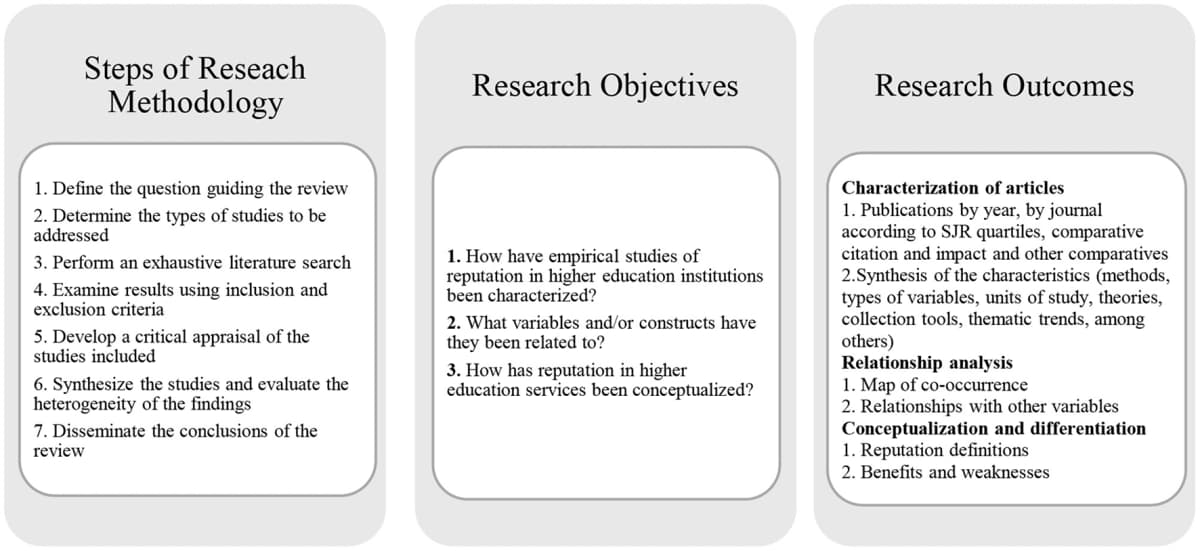
The published figure below shows how one review team placed its guiding questions beside its method steps and planned outputs. Its “objectives” are phrased as questions. That is one discipline's choice. For your project, check that each column would lead to the next.
Common objective mistakes
An objective can look neat and still leave the study hard to run. Read each line against the problem, source base, method, and limits. These are the weak spots to catch before submission.
- Repeating the aim. Break the broad purpose into tasks that add up to it.
- Claiming a gap from too few papers. Say which sources you checked and what remains to search.
- Using a vague verb. Replace “learn about” with the act you can carry out and the evidence you will use.
- Choosing a method that cannot answer the line. Interviews can describe some accounts; a frequency claim needs a suitable sample and measure.
- Adding more objectives than the project can support. Remove side questions that do not serve the main question.
- Leaving access and ethics for later. Confirm what data, people, permissions, and time are truly available.
Kantar's survey guide warns that broad or numerous goals can make a questionnaire unfocused. Trent University makes the same larger point for proposals: the rationale, objectives, and method must connect.
If your objective says “compare first-year and final-year students,” define the unit of analysis and recruit both groups. A table of library visits alone cannot tell you what each student thought.
Keep the map in Atlas
Use Atlas to check selected source material, then save your own decision. Add the background papers and a short note that states the question, campus setting, and project limits. Atlas cannot search the whole web for missing studies in Project only mode.
In chat, type @ and select the papers you want to compare. Ask: “For each source, what group and help service did it study, what did it find, and what limits did the authors state? Cite each claim.” This yields a draft map to inspect.
Open each citation. Check that it points to the right paper and that the nearby text supports the summary. If the answer merges two sources, ask for a separate row for each. The final map should use your own checked source notes.
Create a note for the proposal. Save the problem, aim, question, draft objectives, source support, and constraints. Mark what a supervisor still needs to review: search coverage, method choice, participant access, ethics, and time.
For our fictional project, a useful note would say that Pepperdine interviewed students who already used librarian help, while the live-chat paper covers another channel and group. The proposed local study asks a narrower question. That note keeps the selected-source limit in sight.
Atlas can help retrieve and compare passages with citations. It does not verify that the objective is novel, valid, feasible, or approved. Those judgments belong to the research team.
Test your draft with a supervisor
Take the question, objective map, source notes, and method sketch to your supervisor or project lead. Ask which proposed gap is supported, whether the method can answer each line, and what data access or ethics step must happen first.
Then revise the objectives as a set. A change in the group, method, or scope may change the question. Keep the old version and the reason for the change so the project has a clear trail.
Good research objectives let a reader see what the study plans to do and why those tasks belong together. The strongest draft keeps that plan within the evidence and resources you can truly use.
Atlas
Check the evidence behind your objectives
Compare selected studies, open citations, and save a scope note.
Frequently Asked Questions
They are concrete statements of what the study will do to answer its question and achieve its broader aim.